Home Blog Page 85

History – LOOKING BACK AT THE FUTURE

0

Tags: History. Historical. Bribie Island. Moreton Bay. Brisbane. Queensland

Last months “History Page” raised questions, and painted a possible picture, of what Bribie Island might be like 30 years from now in 2050. Many people may have read and dismissed it as simply being the inevitable future. Surely things aren’t going to change that quickly in future. I did, however, receive many interesting responses from readers who, like me, were concerned that there seems to be no recognition of the unique Heritage attraction and possible future for this island.

Featured Image(above): Archibald Meston

Without a strategy, and a plan to implement it, Bribie Island will become just another overdeveloped seaside destination and will have lost the opportunity and “Added Value” of its unique charm and attraction. It might help to put past and present in perspective, to appreciate how Bribie Island was seen when the first discoverers and explorers came here. Below is an extract from an article by Archibald Meston who first explored Bribie Island in 1891…… that’s just 128 years ago, and nearly 100 years after the very first White man Matthew Flinders set foot on Bribie Island in 1799.

It is remarkable to reflect on what has happened in that relatively short time. Archibald Meston was an interesting man, an Explorer, Anthropologist, Journalist, Naturalist and Politician who wrote the “Geographic History of Queensland”, studied Aboriginal customs, and in 1897 was appointed Protector of Aborigines for Southern Queensland. He wrote many articles over the years and, as with so many aspects of “History”, such writings must be seen in the context of their time.

Before you start reading it I must point out that it should not be seen as completely factual, accurate or even always historically correct. Over the last 100 years we have come to better understand the character and motivation of Archibald Meston, and interpretation of some of his observations It is, however, a very interesting way to appreciate and understand how Bribie Island and its fascinating past, and possible future, should be viewed in 2019……. 128 years after this was written in 1891. All the words below are those of Archibald Meston, extracted from his article written in 1891, and published in the Brisbane Courier and The Queenslander. Bribie Island…

bribie island moreton bay history brisbane queensland

Meston-Plaque B

Extracts of 1891 Article by Archibald Meston.

Published in the Brisbane Courier & The Queenslander, September 1891. Historically, Bribie Island is the most interesting on the Queensland coast. Apart from history, it is one of the meanest pieces of country in Australia. There is not an acre of useful soil on the whole island. It consists chiefly of tea-tree swamps, salt flats, low sea sand ridges, and slightly raised patches timbered by bloodwood, gray gums, and turpentine.

On the sand ridges are cypress pines and honeysuckles. It is inhabited principally by snakes and kangaroos. I spent five days on Bribie, crossed it in two places and traversed it for 14 miles. To anyone desirous of emulating my example, I have simply to say “You better stay at home!” And yet this howling desert of tea-tree swamps, rank aquatic vegetation, and unimaginable cussedness is associated with several remarkable events in Queensland history. In July 1799, Flinders landed on the south end of Bribie intending to explore around the Glass House Mountains.

The blacks were friendly, but some misunderstanding arose. Flinders and his men got into the boats to pull away, the blacks walked into the surf to try and persuade them to stay, and Flinders, in a sudden terror of probably imaginary danger, fired and shot, the first white man to shed the lifeblood of a Queensland native. According to Flinders’ own diary, the record of his experience with the Moreton Bay blacks is not very creditable to himself. He called Bribie Passage the Pumice Stone River, from the pumice stone found on the shore.

The south end, where he fired on the blacks, was called Skirmish Point, the name it still retains. In Bribie Passage, he saw the first dugong seen by white men, and described them as a “species of sea lion.” He fired three musket balls into one, and Bungaree, a Sydney black, threw a spear into another, but both escaped. On the beach, he found a dugong net with strands 1inch in circumference.

After the collision with the blacks Flinders went up to the island of St. Helena, returned to Bribie Passage, beached his sloop at the White Patch, went over to the west shore, and thence walked to the Glass Houses, ascending the small one at the present railway station; and from there he went to the foot of Beerburrum, which he pronounced inaccessible. Flinders was, therefore, the first white man on the summit of any one of these remarkable mountains.

bribie island moreton bay history brisbane queensland

Aboriginal Fishing group

Exploring Moreton Bay

On the south end of Bribie Surveyor-General Oxley landed in November 1823, when returning from the north after discovering the Boyne River. Flinders, in 1799, had actually landed on St. Helena, and gave the name of the “Fisherman’s Islands” to the two small islands at the mouth of the Brisbane, without the remotest idea that behind those islands was the mouth of a noble river.

Oxley anchored the cutter Mermaid at the entrance to Bribie Passage, and hardly had the anchor fallen when those on board saw a number of blacks approaching from the north along the beach. As they came near a white man was seen among the party, and Oxley, Uniacke, and Lieutenant Stirling pulled ashore in the whaleboat to meet them.

That white man was Thomas Pamphlet, one of a party of four who had started from Sydney for the Five Islands, been driven far northward, and finally, after extreme suffering and the death of one from thirst, were wrecked on the coast of Moreton Island, where they were kindly treated by the blacks, who finally passed them on to Bribie Island, where they had resided for five months when Oxley arrived.

Pamphlet told Oxley that he and his two mates, John Finnegan and Richard Parsons, had started to walk to Sydney; that he became footsore and returned; that the other two subsequently quarrelled, and Finnegan came back, being then somewhere on the mainland about the present Sandgate, or possibly Redcliffe.

It was during this overland journey that Pamphlet and Finnegan found the Brisbane River, which they had to cross. On Sunday Finnegan was seen on a sandspit, near Toorbul Point, and the whaleboat went across and brought him on board. Next day Oxley went away in the whaleboat with Finnegan, who took him straight into the mouth of the Brisbane River on the 2nd of December, 1823. And yet these two actual discoverers of the Brisbane River were never even mentioned by Oxley in his report to Governor Brisbane! Alas for the weakness of so many explorers in the realms of science and geography.

Only for the journal kept by Mr Uniacke, one of Oxley’s party, the names of those two shipwrecked men would have remained unknown to the present time. But for them, Oxley might never have seen the Brisbane River at all. While Oxley was away up the river, Uniacke remained with Pamphlet shooting bird specimens on Bribie Island. He gives a most interesting account of the blacks and includes a description of a single combat and a general battle witnessed by Pamphlet and Finnegan.

In the single combat, two men fought with spears in a 24ft. ring 3ft. deep, surrounded by a palisade of sticks. Five hundred blacks stood around the circle as spectators. The two fought until one missed his guard and his opponent’s spear was driven clean through his breast. Several men were killed in the other general engagement and roasted and eaten by their own tribe. And yet those cannibals treated the two white men so kindly that they left with sincere regret, though many blacks would then remember the cowardly shooting by Flinders only twenty-four years before.

Toorbul Point……now called Sandstone Point. Toorbul Point was then regarded as the probable future principal commercial seaport of a new northern colony. Such also was Dr Lang’s opinion in 1846. The worthy doctor, in predicting a great future for that locality, took the liberty of slightly changing a passage in Virgil:

There is a place, Australian squatters say, Within the long expanse of Moreton Bay, Where Bribie’s Island forms a sheltered port, To which a future navy will resort.

This beautiful dream has not been realised, and Bribie Passage so far shelters nothing but dugong and stingarees, while Toorbul Point is occupied exclusively by a marine summer residence of our aesthetic young friend, George Markwell. To the left, on the way to Bribie, lie Humpybong and Redcliffe Point. Humpy should be “compie,” a camp or house, and bong is “boong,” the word for sick in the Lytton dialect (Coobenpil). These words were used by the blacks for the “sick houses,” or “dead houses,” left at Redcliffe Point when the convicts left in 1825. Oxley started the first convict settlement at Redcliffe in 1824, but it was soon abandoned in favour of the site at Brisbane.

In the convict records, I find that the prevalence of fever and ague was given as the reason for leaving Redcliffe, and the first hospital at Brisbane was erected professedly for the “ague patients from Redcliffe Point.” But an old convict’s diary in my possession says that the real reason was the hostility of the blacks, who killed five convicts and two warders, and made everybody afraid to move outside the stockade. The German missionaries, who arrived in Brisbane in 1838, tried to start a branch mission at Redcliffe, but the blacks came in one day when only Mr Hausmann was in charge, besieged him in his hut, and speared him badly.

They had a big fire lighted to roast him, and he heard them say to each other that he was “tingal” – fat, and would “jaleeba maroomba” – eat good. He managed to escape somehow and reach German Station. From “tingal,” a word for fat, comes “Tingalpa,” actually Tingal-bah, or “fat there” – a place of fat.

bribie island moreton bay history brisbane queensland

KAL-MA-KUTA Memorial Cairn

bribie island moreton bay history brisbane queensland

KAL–MA-KUTA Memorial Plaque

Fifty years ago there were 600 to 1000 blacks on Bribie. Today there is not a soul left. And there are only three or four living representatives of the race, one of whom is in St. Helena for killing a gin, and another, a smart intelligent woman, lives near Toorbul Point, where she has resided for seventeen years, and borne seven children to a white father.

The Bribie blacks were a tribe called Jindoobarrie, People of Bribie In Mr Uniacke’s description of the Bribie blacks in 1823, he says the men all had the cartilage of the nose pierced, while the women had the first two joints of the little finger amputated like those of the old Sydney tribe. Both sexes were entirely naked. Pamphlet said he never saw a woman struck or ill-used in any way. All early writers – Flinders, Leichhardt, Bunce, and Lang – describe the Moreton Bay blacks as “tall, graceful, athletic, powerful men.” In one of his letters to Lieutenant Lynd, Leichhardt describes the Turrabool and Bribie tribes as “a fine race of men, tall and well made, and they and the groups they formed would have delighted the eye of an artist.”

Leichhardt and David Archer came down to the coast from Durundur station in September 1843, and stayed a couple of days with the Nynga-Nynga tribe, camped beside the swamp at the rear of Turrabool Point. They lived on crabs and oysters. In twenty more years there will likely not be a soul left of all the Moreton Bay tribes. I can only find three who speak Oondoo and two who speak Churrabool at the present time. Around us day by day a race is rapidly vanishing in annihilation.

bribie island moreton bay history brisbane queensland

Q150 Stan Tutt Plaque

As Dr Von Martius said of the American Indians, “it is a monstrous and tragical drama, such as no fiction of the poet ever yet presented for our contemplation. A whole people are perishing before our eyes, and no power of princes, philosophy, or Christianity can arrest their proudly gloomy progress towards certain and utter destruction.” Are we approaching the midnight which is to witness the second occultation of genius?

 

The Bribie Winelander Feb 2019

I received an email from Malcolm who is going to try out a Fiano as a change and would I have a look at Sangiovese, Montepulciano, Valpolicella and Chenin Blanc as alternative varieties to wine styles you are more familiar with. Let’s begin with Chenin Blanc a white wine grape variety, which actually has been planted in Australia from the day we started to plant vines after landing on this great continent.

Unfortunately, Chenin Blanc suffers from the same problem that Semillon and Verdelho does, you can also throw in Riesling for good measure as well, that is we can produce great wines but for some reason Australian wine drinkers just ignore them preferring Sauvignon Blanc and Chardonnay instead. With Semillon, if you blend it with Sauvignon Blanc as they do in Western Australia the public drink huge quantities of it, even sometimes when it is called “Classic Dry White” it doesn’t detract from its sale.

I remember some years ago doing a tasting at a premium liquor store in Adelaide representing Galafrey Wines from Mt. Barker in Western Australia and overall the comments were very positive, although everyone seemed to have a relative who worked in the industry, however the main bone of contention was the use of the words “Classic Dry White” instead of the grape varieties, however this has now changed thank goodness. Chenin Blanc came originally from The Loire Valley in France where it is made into a dry white wine, a botrytised dessert wine or a sparkling wine and it is naturally high in acid making it a very versatile grape variety which you’ll see it labelled ‘Vouvray’.

Here in Australia, it was planted from day one in The Swan Valley in Western Australia where a lot of the original cuttings came from South Africa as the ships stopped off on the way to Australia and where the grape was planted over four hundred years ago. The wines from Western Australia are in the main pretty dry matching any Sauvignon Blanc, can be drunk with cheese platters, spicy Asian, fresh salads and chicken, or if an oaked style with creamy pasta dishes.

They may not be easy to find but Voyager Estate and Paul Conti are stocked in Dan Murphy’s, whilst Amberley Estate ‘Chimney Brush’ is pretty popular but if memory serves me well it used to be made in a sweeter style. There are a few French and South African Chenin Blancs out there but again the wine from South Africa can sometimes be a little sweeter. In the Swan Valley in Western Australia, the outstanding John Kosovich winery produce some stunning examples of Chenin Blanc and they age very well if kept properly. Sangiovese is the classic red grape variety of Tuscany and as in Australia with our Shiraz can be made into everyday drinking wines such as Chianti to Super Tuscan wines such as Brunello.

If you ever visit Italy Tuscany should be a must on the travel agenda and not just for the outstanding wines but the countryside with towns perched on hilltops surrounded by thick walls, Sienna with its annual horse race through the town square and Florence with its classical buildings. To date in Australia the grape variety hasn’t really produced any great wines, perhaps it needs more time as the plantings are less than forty years old. As with other Italian grape varieties, Australian wineries such as Coriole and Pizzini make better examples and it suits mature cheeses and big steaks, but at this stage, it is probably better to seek out the real thing from Tuscany.

Montepulciano pronounced “mon tae pul chee ah noh” seems to be a superstar just waiting for the public to discover this relatively new to Australia red wine grape. Just to add confusion in Italy in Tuscany there is a town called Montepulciano but the grapes aren’t grown there but in Abruzzo further south where the climate suits the variety. At the recent Australian Alternative Varieties Wine Show 25 Australian Montepulciano wines were submitted producing two gold, one highly commended, five silver and eight bronze medals which is a pretty high ratio.

A couple of old agencies of mine Calabria wines from The Riverina and Woodstock Wines from Mclaren Vale now grow the grape and knowing the quality of their winemaking skills the wines would be excellent. Amadio, Bird in Hand, Brown Bros. First Drop Wines, Kirrihill, Mr Riggs and Di Giorgio are other wineries who are making wine from this grape variety sometimes labelled just Monte and again it will suit a mature cheese platter and good quality meat dishes.

Valpolicella is a red wine from The Verona district of Italy and is made from three different grape varieties, Corvina Veronese, Rondinella and Molinara and at this moment it would be wise to stick to the imported model and an old favourite of mine Zonin probably make all of the above wines from Italy as well as anyone and are widely available from Dan Murphy’s and BWS as it is an exclusive agency, not expensive wines but always of a good quality.

Cheers, Philip Arlidge [email protected]

Alison in the golf shop stated: “I have just cut out last month’s quote from Hemmingway and stuck it on the fridge”. I asked what she thought of the article, she replied she didn’t read it! Ahhhhhhhhhhh!

LEARN AND HAVE GREAT FUN THIS YEAR

Tags: Seniors classes. Bribie Island.

We are so fortunate to have such wonderful facilities and learning opportunities for Seniors here on Bribie. Bribie Island has grown over the past 25 years to become one of the best U3A organisations in Australia. With over 150 classes spread over 5 days of the week, there is something for every possible interest, on a day and time to suit your other commitments. U3A is an abbreviation of “University of the Third Age” but its focus is on “Learning for Fun”, so there are no entry requirements or exams to pass or standards to be met.

If you are not aware of the variety of fascinating subjects on offer you can find the Timetable of daily classes at the Bribie Library, Visitor Information and Neighbourhood Centre, or look online at the U3A Web site at www. u3abribie.org.au U3A is on holiday until classes resume on Tuesday 29th January, after the Australia Day public holiday. If you would like to enrol in any of the 150 classes you will need to attend in person at the Enrolment Days at U3A Centre on Saturday 19th or Wednesday23rd January between 9 am and noon. However, with almost 2000 Senior student members, more than half of the classes are already full.

You can look online at www.u3abribie.org.au to see the classes already full, to avoid disappointment on Enrolment Day. Class sizes are of course limited by room size and Tutor capability, but it is possible to put your name on a “waitlist” should vacancies become available. These are just a selection of classes with vacancies on certain days that may suit you. There are many other subjects that may be of interest. Most of the above subjects are self-explanatory, but one of them may be a new word for you …… PICKLEBALL.

This is an exciting new outdoor fun game, already highly popular in North America and Europe, played on a badminton-sized court with a lower net, solid paddle style bats, and using a hollow plastic ball. This is likely to become a very popular sporting exercise for Seniors throughout Australia, and class groups will play at Bribie U3A on Tuesdays and Fridays. ENROL FOR TERM 1 CLASSES.


Term 1 classes commence on Tuesday 29th January and run for 10 weeks until Friday 5th April. Enrolment Days at Bribie U3A Centre are on Saturday 19th and Wednesday 23rd January between 9 am and noon. For new members joining U3A the annual membership fee is still just $10, and class fee for Term 1 is $15 to be paid in advance. This year a brand new U3A will commence at Beachmere. There will be reciprocal membership arrangements with the new Beachmere U3A, but it will conduct its own Timetable of daily classes and Enrolment Day for Beachmere will be Friday 18th January from 11 am to 2 pm at Beachmere Activity Centre, Biggs Avenue, Beachmere.

We are all looking forward to another exciting year of “Learning for Fun” in an organisation run entirely by Volunteers. If you have not already discovered U3A make sure you look at what is on offer at Beachmere, Caboolture and Bribie Island as there is certainly something for everyone. We are always seeking people who are prepared to try their hand at being a Tutor in any topic that you would like to suggest. Call U3A on 3408 1450 during term time if you, or someone you know, has knowledge or experience in any topic that might be of interest to others.

SOME CLASSES OF POSSIBLE INTEREST.
Looking down the daily Timetable of classes there are vacancies in several that may be of interest to new members or beginners in some subjects. If you have time on the following days these subjects may be of interest;
MONDAY Everyday Maths, Windows 10, Line
Dancing, Ukulele, French for
Travellers.
TUESDAY Ballroom Dancing, Indoor Bowls,
Japan, Numerology, Soft Show Shuffle.
WEDNESDAY Yoga for Health, Dance, Global
History, Contemporary Australia,
Space Race.
THURSDAY Boules, Events of 20th Century,
Powered Flight, Chess, Pickleball.
FRIDAY Bridge, Trivia Quiz, Greek Dancing,
Photography, Lawn Bowls.

BRIBIE SIMPLY HEALTHY – Feb 2019

0

Tags: Health and Wellbeing. Health and Lifestyle.

No more diarrhoea or/and constipation.

Digestive health is the foundation of your wellness.

A product called Motion Potion seems to do wonders to regulate people’s bowel movement. About a few months ago a middle-aged woman came to the shop she was suffering from diarrhoea for more than 10 years and serious abdominal pain was just everyday life she had to endure and I recommended Motion Potion.

A week after the same woman came to the shop and she couldn’t thank me enough for introducing her to the product. She was also suffering from depression but when her diarrhoea and abdominal pain was gone her depression was gone too. It is said that more than 15% of the population worldwide has digestive issues such as Irritable Bowel Syndrome (IBS), symptoms would be abdominal pain or discomfort, stomach bloating and chronic diarrhoea or constipation, or alternating between the two. Motion Potion helps form the perfect stool, whether the stool is too loose or too firm.

It improves the consistency of the stool. Motion Potion is not a laxative and will not cause any urgency. Motion Potion strengthens and supports the body’s natural elimination process. Motion Potion is suitable for all ages, great for pregnant and lactating women, 100% natural and contains no artificial ingredients, dairy free, vegan-friendly, GMO-free, nut and soy free, Australian made, Glutenfree, even though Motion Potion contains organic wheat and barley grass it remains gluten-free.

diarrhoea abdominal pain constipationGluten exists only in the grains, not in the grass of the plants. Motion Potion’s contains Psyllium husk powder, slippery elm, marshmallow root, organic barley grass, organic wheat grass, organic rosehips, citrus bioflavonoids(vitamin c), linseed, ginger, a symbiotic blend of prebiotics and probiotics. Probiotic strains used in Motion Potion are super strong and stable at room temperature so it will be affected only inside the bowel. They are resistant to stomach acid, salt chlorine, caffeine, alcohol and preservatives. A healthy stool should be easy to pass, well-formed, smooth and soft, light, fluffy and floating.

The two most common inflammatory bowel diseases are Crohn’s Disease (CD) and Ulcerative Colitis (UC). A product called Intestamine would be a great aid for those people who have IBD condition as it reduces inflammation and protects the gut lining and helps digestive function. The cause of Inflammatory Bowel Disease (IBD) is unknown, immune cells normally protect the body from infection, but people with IBD, the immune system attack it’s own intestine, it is categorised as an autoimmune condition. My name is Heenam Kim and I am an EFT (Emotional freedom technique) therapist, I relate many health conditions to their emotional state. Emotions are ‘Energy in motion’.

So if energy gets blocked anywhere in the body and can create an imbalance of flow of Energy (Chi/Ki) in the body and causes health problems. A person who is suffering from autoimmune condition most definitely would have suffered anxiety or and depression prior to the condition. I had EFT session with a woman who was suffering from extreme diarrhoea; though strangely it only occurs in the morning. As soon as she wakes up she has to run to the toilet as there is no time to waste.

She also suffered autoimmune diseases. I look at a person’s trapped emotions (trauma) causing the symptoms and by neutralising the emotions a person is suffering from, the symptoms will improve dramatically. After a few sessions, she became well. She always wanted to donate her blood but she couldn’t do so due to her health condition, now she is well enough to donate her blood to help others and she is a very happy client of mine.

2019 health and wellness resolution list – let’s make them stick!

0

Cancer Council Queensland offers the following five New Year’s resolutions to inspire your good intentions.

1. Achieve a healthy weight.

Reaching and maintaining a healthy weight is good for your overall wellbeing, but we know from The Health of Queenslanders Report 2018** that this is a challenge for many Queenslanders, with two in three adults overweight and obese. For adults, a quick way to check weight status is your Body Mass Index (BMI) and waist measurement. Balancing physical activity with a nutritious diet will not only help your waistline but reduce your risk of illness and chronic disease. In 2019, establish a lifelong system of staying accountable, such as keeping a food and physical activity diary.

2. Quit smoking.

If you smoke, your body is constantly working to try and repair the damage done by regularly inhaling more than 7000 toxic chemicals. There are so many good reasons to quit and the sooner you do, the more you can reduce your cancer risk. Benefits include improvements to your health, your looks, your sense of taste and smell, your fitness and finances. And if someone you love smokes, encourage them to do the same, remembering that secondhand smoke can be just as lethal for you, your friends and family members. Call Quitline on 13 QUIT (13 7848) for free information, practical assistance and support to quit.

3. Cut back on alcohol.

Drinking alcohol can increase your risk of alcohol-related cancers and other chronic diseases. If you choose to drink alcohol, stick to the National Health and Medical Research Council guidelines for alcohol consumption of no more than two standard drinks per day. Keep in mind that many alcoholic drinks are kilojoule heavy, so cutting back on alcohol could also help with maintaining a healthier weight.

4. Get up-to-date with your screening.

Is there a screening test that you’ve been putting off? The New Year is the perfect time to set a date and get checked – it just might save your life. Find out about the three national screening programs for bowel cancer, breast cancer and cervical cancer at http://www.cancerscreening.gov.au.

5. Get to know yourself.

When it comes to cancer, in most cases the earlier it is detected, the better. This is because finding cancer early can increase the likelihood of successful treatment. Without fretting or worrying, make it another resolution to get to know the regular look and feel of your body, keep an eye out for unusual changes, and commit to seeing a GP if you notice any changes. Now you have it – your cancer resolution guide.

This January & February, put your health first and put steps in place to learn about cancer and reduce your risk. More information about Cancer Council Queensland is available at https://cancerqld.org.au/ or via 13 11 20.

Gloss Magazine Bribie Islander 3rd Edition Feb 01 2019 Issue 80

The Bribie Islander Magazine
Get all your community news and information Bribie’s only community gloss magazine NOW EVERY TWO WEEKS! – Articles on boating, camping, fishing, life, drama, travel destinations, sports and what to see and do on Bribie Island. Covering charities, organisations, places, children’s activities, arts and crafts, tourist destinations, heritage parks, technology, science, music, gardening and much more.

Other Articles

Gloss Magazine Bribie Islander 2nd Edition Jan 18 2019 Issue 79

PAPUA NEW GUINEA TO BRAZIL VIA BRIBIE – THE ROAD LESS TRAVELLED

0

Many of our readers may not realise that the Rotary Club of Bribie Island are sponsors of both outbound and inbound Youth Exchange Students. The Rotary Youth Exchange program provides an opportunity for students from all over the world to live and study in a different country for 12 months. In 2018 our Club sponsored two outbound students from PNG who spent 12 Months in Brazil.

Featured Image(above): Benny & Krystal with their Certificates of Attainment

On Sunday 6 January 2019, we held a welcome home get together at Rotarian Patch Roycroft’s home on Bestmann Road. The day was attended by our District Governor Wendy Protheroe, President of the District Youth Exchange Committee, Osama Elsaadi and his wife Debra, as well as members of the District Youth Exchange Committee, Bribie Rotary and their family members. Over 50 people attended. Our students, Benny Owen Bago from Bululo and Krystal Inape from Goroka, arrived on Bribie Island from Brazil, for debriefing with their counsellors on Saturday 5 January 2019.

The Sunday luncheon was a combined welcome home, presentation of certificates and farewell because on the following Tuesday Benny and Krystal returned to their homes in PNG. It was so special and rewarding to see how these young people had matured in the 12 months since we last saw them, from nervous teenagers who spoke very few words, to confident young adults. They told me how they had learnt to be self-reliant and accept greater responsibility for their own actions.

They both talked about the many friends they had made, how wonderful their host families were and how much they learnt about Brazilian culture. However, Benny did admit that the Brazilian dancing was not his “thing”! Although both of them missed their families, they know that this experience will shape the rest of their lives. Benny and Krystal confirmed that “they’ve got an awful lot of coffee in Brazil” and they did meet “The Girl from Ipanema”. They also went to “Rio – Rio de Janeiro” and had quite a lot of fun. We wish them well in whatever endeavours they follow. Australian Rotary Youth Exchange hosts with over 30 countries around the world.

The program is open to high school students aged from 15 to 19 years. Students can learn a new language, discover another culture, and truly become global citizens.

Exchange students unlock their true potential to:

• develop lifelong leadership skills;

• learn a new language and culture;

• build lasting friendships with young people from around the world; and

• become a global citizen.

Our host Patch Roycroft

Bribie Rotary Club stalwarts Mary Grant and Bernie and John Wilson have been members of the District Youth Exchange Committee for many years. Mary and Bernie are very experienced Councillors with both Inbound and Outbound students. Bernie and John take the Inbound Exchange students on “The Sunshine Safari” each year. District Inbound students (usually around 20) go on the safari which takes in highlights of our beautiful region.

While Rotary does meet many of the program costs, other costs (eg spending money) are borne by the participants. If you are interested or know someone who would be interested in our Youth Exchange Program, please see https://www.ryea.org.au or contact Mary Grant on 0421 529 824, who will explain how it all works and the actual costs involved.

Funny pet pics 2019

SHARE YOUR FUNNY PET PICS
WITH THE MINI BRIBIE ISLANDER…
SEND TO: [email protected]

JAZZED UP ART

0

Tags: Australian Artist. Artwork. Brisbane. Bribie Island

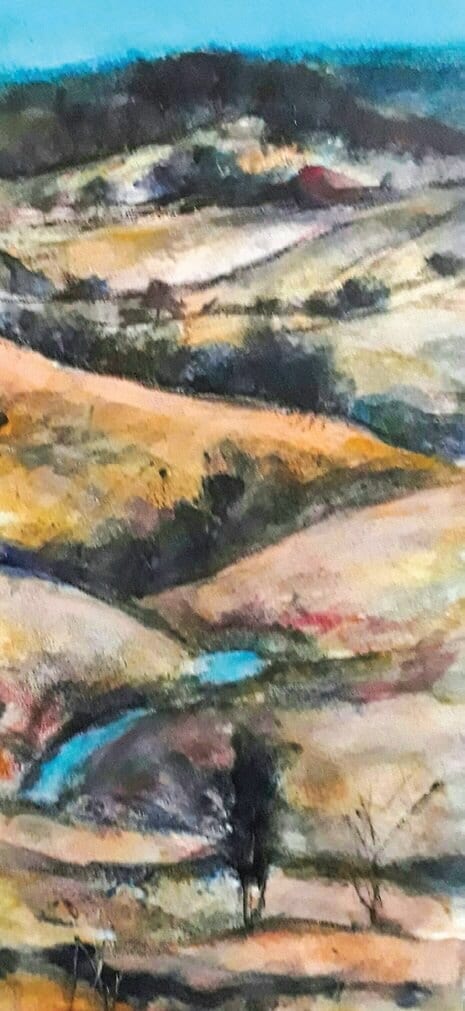
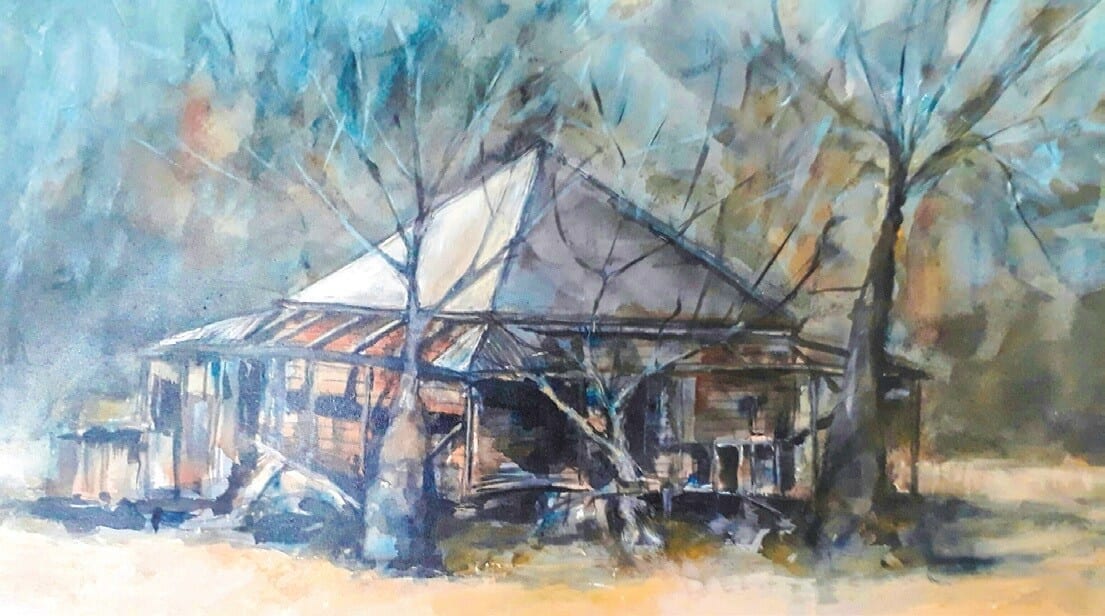
Jazz music is the predominant theme of January’s Artist of the Month exhibition at the Bribie Island Community Arts Centre. Viewing Artist of the Month Rod Horsburgh’s mixed media artworks, one immediately notices he loves jazz music and the people who play it. Rod finds his subjects at Jalla’s Cafe in my own town of Woodford, where on Saturday afternoons local musicians fire up their instruments to strut their stuff. Coming in a close second to jazz are Rod’s depictions of landscapes and old buildings on and around Mt Mee where he lives.

This being also my old haunting ground, I can fully appreciate the views Rod has committed to paper. What’s impressive about this artist’s drawings cum paintings is his use of line, smudging, then scratching into them as if to underscore the aesthetic he finds in his subjects. Equally fascinating is Rodney Horsburgh’s past as a Courier Mail press artist – joining Queensland Newspapers in 1964. Those of us of the older generation may well have seen his work in Queensland papers before some of us stopped buying them at the onset of the Internet Age.
Australian Artist. Artwork. Brisbane. Bribie Island

Australian Artist. Artwork. Brisbane. Bribie IslandAs Artist of the Month coordinator, I helped Rod mount his pictures on the Arts Centre wall for that purpose with hands down my favourite drawings being the turkeys. These wretched creatures, I’m told by Rod, have wrecked his garden. Perhaps that’s why he chose to draw and hang them on the wall: Wanted, dead or alive! I’ve also strolled through Rod’s turkey infested marvellous magical mysterious Mt Mee garden. It’s the sort of place one expects to discover pixies hiding amongst the overgrown everything.

Australian Artist. Artwork. Brisbane. Bribie IslandVisitors must be cautious of wandering into the giant spider webs festooning the pathways. Better than Christmas streamers, they only add to the garden’s charm. Watch out for Rod’s future workshops where participants will learn his techniques of line, smudging, scratching and I’m sure many other worthwhile ways and means of capturing interesting subjects on paper. Currently, his work is on display for the month of January with a free Artist of the Month talk followed by morning tea each second Friday of the month. The Bribie Island Community Arts Centre can be found at 191 Sunderland Drive, Banksia Beach, opening Tuesday to Sunday from 10 am to 4 pm. Phone 3408 9288 for further information.

Other Articles

ARTIST OF THE MONTH – DEBRA MIETH

Australian Wildlife Birds Butcherbird

0

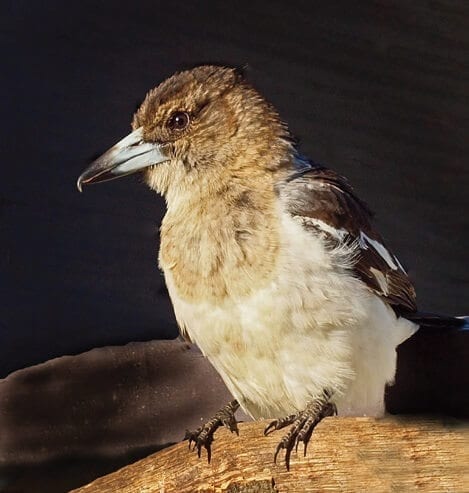
There are four Butcherbird species in Australia. Grey Butcherbirds and Pied Butcherbirds are the two species commonly found on Bribie Island. They are fairly similar in appearance if sighted from a distance but are easily distinguished if seen together. Pied Butcherbirds are black and white with a prominent black collar around the throat which distinguishes them from all other species.

Featured Image(above): Grey Butcherbird

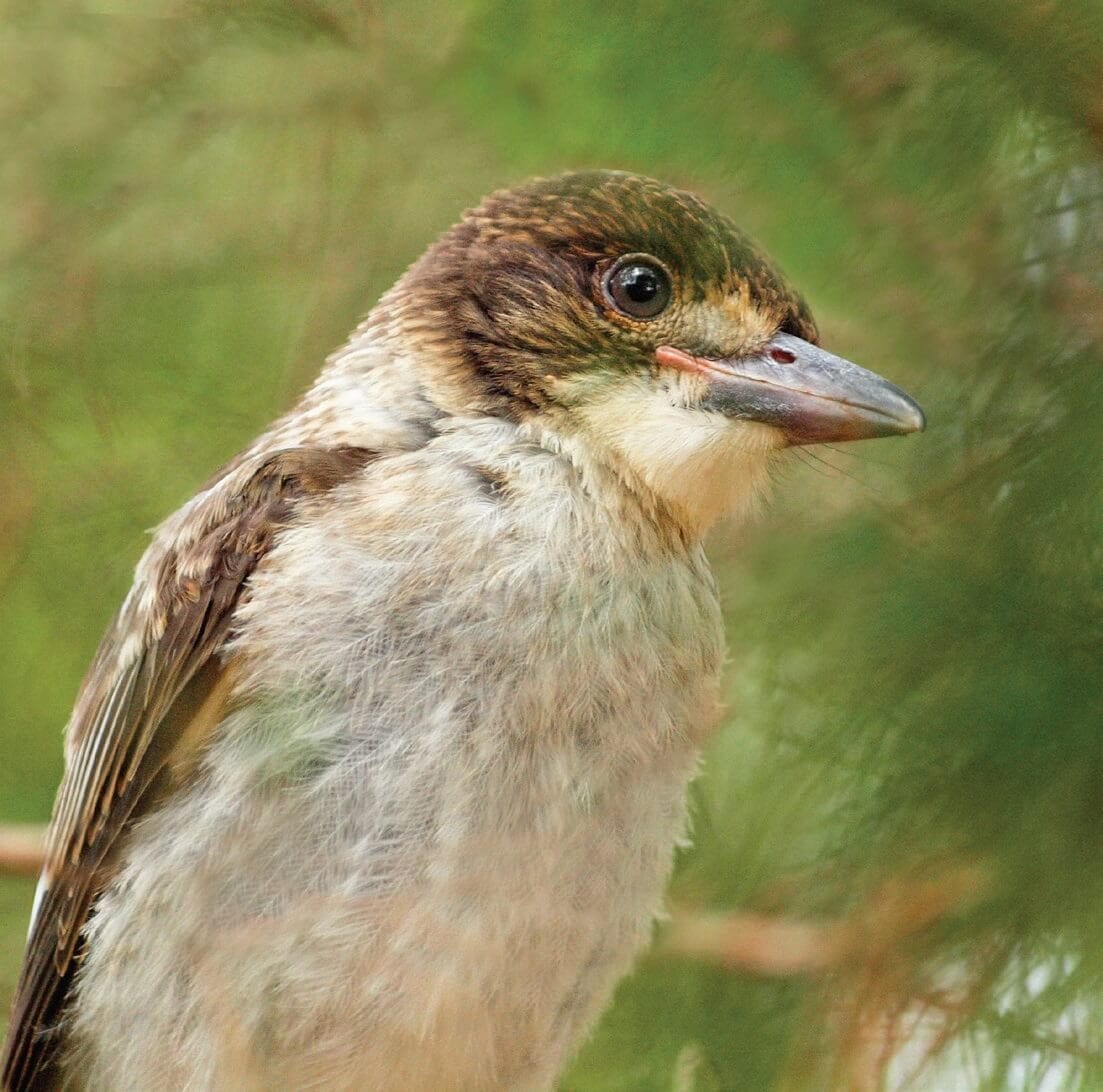
Grey Butcherbirds are smaller with black, white and grey colouring and white throats. Their native habitat is in open forests, but they are commonly found in urban areas and in parks and gardens. Both species can become friendly to humans who choose to give them handouts but are often very aggressive during nesting season sometimes attacking humans and animals that come too close to their nests.

australian wildlife birds butcherbird

Grey Butcherbird, Juvenile

They have many similar traits and superb melodious calls which some composers in the past have incorporated into their music – eg. Beethoven’s Fifth Symphony.

Grey Butcherbirds – Cracticus torquatus

Grey Butcherbirds are 28 – 32 cm and weigh about 90 g. Both male and female are similar in appearance with the female being slightly smaller. Juveniles have similar markings but are brown in colour. Nests are untidy and usually built in the forks of trees. Females lay 3 – 5 brownish eggs and incubate them for 24 – 26 days. Male birds feed the females while they are sitting on the eggs.

Both parents feed the young and are very aggressive towards perceived threats to their chicks. Fledgelings leave the nest in 28 – 30 days but remain with their parents for some time and are often still present to help them with next season’s brood. Breeding season is from late winter to summer. When feeding alone or in small family groups they sit on a low perch waiting for prey to emerge. They then dive to the ground to pick up insects, small reptiles and mammals.

If the prey is large, they will often impale it on a tree branch to be butchered or to keep for a later date – hence the name Butcherbird. Sometimes they prey on the young of other birds and attack birds feeding on the ground to steal their food. Grey Butcherbirds are found all over Australia except for parts of Cape York and central Australia where it is too dry. They are similar to the Black-backed Butcherbird which is smaller and found in northern tropical regions. They were first described in science by John Latham in 1801.

Pied Butcherbirds – Cracticus nigrogularis

Pied Butcherbirds are found almost all over Australia except for Tasmania, Southern Victoria, South Australia and Western Australia. They are 32 – 35 cm long, weigh around 120g and are slightly larger than Grey Butcherbirds. Young birds have similar markings but are brown and white in colour.

australian wildlife birds butcherbird

Pied Butcherbird, Juvenile

Pied Butcherbirds are more family oriented with family groups remaining longer together to share with the chores when a new brood is hatched. Both species have similar nests and feeding habits. 3-5 brownish spotted eggs are laid and incubated by the female for 20 – 21 days. After about 30 -32 days the chicks fledge. Pied butcherbirds are thought to mate for life. Their nests are sometimes targeted by parasitic birds such as some of the larger Cuckoos.

australian wildlife birds butcherbird

Pied Butcherbird.

Because of their main insect diet, they are welcomed by many farmers who appreciate their culling of unwanted vermin. The first scientific recording was made by John Gould in 1837 on a specimen found near Sydney. Their scientific name comes from the Latin words – niger meaning Black and gula meaning throat. Conservation status for both species is secure with no evidence of decline. The oldest recorded living Butcherbird was at 22 years.

Other Articles

The Australian magpie – Australian Wildlife

KIDS HOOKED ON FISHING

0

On Sunday 13th January 2019 the Bribie Island Anglers Fishing Club, in conjunction with Sunfish Queensland, held a fun fishing day for the local children aged 7-14 where the children were able to learn the skills of fishing for a sustainable future. Thirty children along with their parents came along for the day and all children were assisted by the members of the Bribie Island Anglers Fishing Club to catch bait on the low tide, learn how to rig their lines and fish the high tide.

Generous donations from the Member for Longman, Susan Lamb, Member for Pumicestone, Simone Wilson, Councillor, Brooke Savage, Division 1 , Moreton Bay Council , Sunfish Queensland and Southern Fish Marine made it possible for all the children to be awarded a fishing rod and reel, tackle box, fishing tackle, bucket, hat and water bottle. The children enjoyed learning how to tie fishing knots on their line, pump for yabbies, net bait and fish for their big catch.

Col Fisher Park was a beautiful venue that afforded a scenic backdrop for a great day for all ages. Special thanks to Peter Hunt, member of the Bribie Island Anglers Fishing Club who coordinated the day and to thanks also Ms Judy Lynne, fishing instructor, Sunfish Queensland, whose contributions made the day such a success.

The Bribie Beach Bar and Cafe

Tags: Bribie Cafe. Places to eat. Bribie Island. Restaurants. Eating

A GIRAFFE WALKED INTO A BAR

When the owners of newly opened Woorim establishment, Bribie Beach Bar & Cafe, Gayle Howard, and Rob Ajax met on Lihir Island in PNG four years ago, opening a funky bar and cafe together on Bribie Island would have been the furthest thing from the couple’s minds. Gayle was working for mining giant Newcrest Mining looking after logistics and Rob was general manager transport and logistics for the local Lihirian landowner group Anitua. But PNG’s loss has been Woorim’s gain because the couple has certainly developed a winning formula among locals and visitors with their take on what a bar and cafe should be.

“Our experience in PNG has certainly influenced how we set about creating the venue. We wanted to make this a place that we would want to come to and enjoy a relaxing drink and something to eat,” said Rob. Gayle said the response by the local Woorim community has been fantastic. “People have seen what we are trying to do with this place and have actually donated items to enhance the character and atmosphere of the bar. Antonio, one of our regular customers donated three magnificent giraffe statues and another customer donated two huge vases,” she said.

Bribie Cafe. Places to eat. Bribie Island. Restaurants. Eating

Owners Gayle and Rob

The couple says that their bar and cafe is a place where people can come to meet, eat, drink, enjoy great company and soak up the atmosphere. The bar and cafe are located at 16 Jacana Ave Woorim and is open from 11:00 am in the morning till late. “Our liquor licence lets us trade until midnight so we cater for those looking for a relaxing night out,” said Rob. According to Rob and Gayle, if you want somewhere to chill and relax and soak up an atmosphere that cannot be found anywhere else on the island then head for The Bribie Beach Bar and Cafe. You’ll be glad you did.

VALE GEORGE ALLAN GOOLD

[1935 – 2019]

The Bribie Islander magazine’s team was deeply saddened to hear of George’s passing on the 11th January. George Allan Goold was well known to many on Bribie Island as the proprietor of Bribie Island Taxis. George was born in 1935, in Ulverstone Tasmania and his passion for the transport industry started at a very young age. According to the “National Road Transport Hall of Fame” website, George had been inducted as a National Road Transport Hall of Fame pioneer.

He had a licence to drive from the age of fifteen and his first job as a truck driver was at Bronte Park, working for the Hydro Electricity Commission. He then worked in NSW for two seasons, lumping and carrying wheat until 1953 when he went to Melbourne and started driving car carriers interstate Melbourne, Sydney, Brisbane and Adelaide (aged 19 years). He then drove for Harvey and Bilson until he became an owner/driver at the age of 22 carting for Cousins Transport, East Coast Transport and later for Transcontinental Transport and Alan Hancock. George was married at 27 to Sally and went to live in Albury, NSW where he drove fuel tankers for H R Hane.

The Goolds then moved to Sydney where George drove for Ansett Pioneer on Express and Tours. He later transferred to Brisbane and drove on Express for a number of years where he was elected as a full-time official with the Transport Workers Union. He was there for eight years after which he bought a taxi in Brisbane which he drove for a number of years before buying a taxi on Bribie Island.

From those humble beginnings, George and his wife Sally grew the fleet of taxis, limousines and developed a purpose-built headquarters becoming one of the most successful businesses on the island. George never lost his passion for heavy transport and spent the past few years restoring, back to its original condition, a 1959, 630 Diamond T. The unit is immaculately restored and was George’s pride and joy, attracting plenty of attention at truck shows and events around the country.

Outside business, George was also a keen snooker and billiards player and involved himself with the Bribie Island Snooker Club. In 2009 George was elected Patron of The Queensland Billiards and Snooker Association. George had been involved with many clubs over the years, but Bribie Island Snooker Club was where he put his heart and soul. George leaves behind Sally and children Cameron and Jedda. We would like to convey our deepest sympathies to Sally as well as all family members and friends at this time.