Home Blog Page 40

The Bribie Islander Gloss Magazine September 11, 2020 Issue 122

0

Issue 122 OUT NOW. Get all your community news and information. Bribie Islands only community gloss magazine NOW EVERY TWO WEEKS! – Articles on boating, camping, fishing, life, drama, travel destinations, sports and what to see and do on Bribie Island. Covering charities, organisations, places, children’s activities, arts and crafts, tourist destinations, heritage parks, technology, science, music, gardening, and much more.

Download latest digital edition here. Or use the ebook below to view.

Beds take up lots of room in a bedroom

They not only take up lots of actual space, but visual space as well. That’s why a beautifully made bed can make the whole room look amazing! Designers know this and use bed linens to their maximum potential! A fabulously made bed can make the whole room appear updated and chic and beautiful, even if the rest of it is very ordinary! And layering bedding really amps the up the wow factor even more! Here are some tips and tricks for layering bedding like a designer! We can all do this!

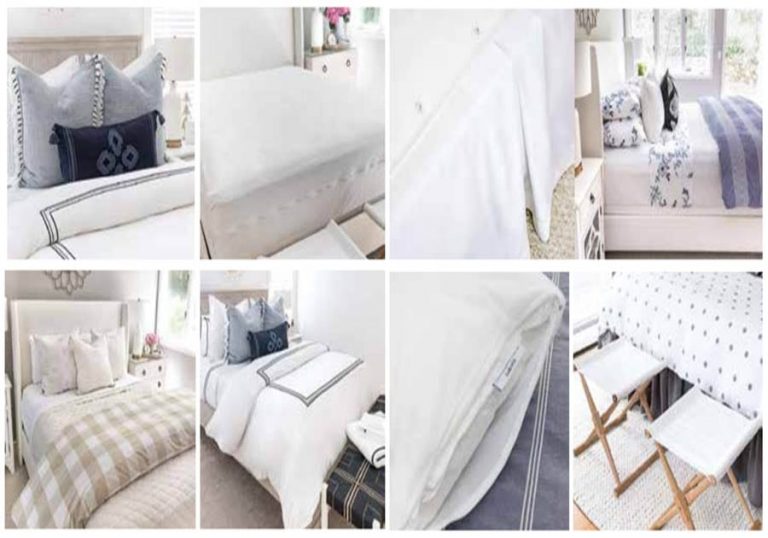
LAYER DECORATIVE SHAMS & PILLOWS IN FRONT This is where you can add a lot of personality – layer decorative shams and/ or pillows in front of your sleeping pillows. Choosing a variety of neutral shades and textures creates a restful, luxurious feel while more colourful patterned pillows are a great way to make your space more vibrant. For a queen bed, you can do anything from a simple arrangement of two 20″ decorative pillow centred between them.

PROTECT YOUR MATTRESS Before adding your bedding, be sure to fully encase your mattress in a zippered mattress protector. Unprotected mattresses can actually double in weight after ten years due to the accumulation of millions of dust mites – so gross! A mattress protector that not only protects from dust mites, pollen, and other household allergens but is also waterproof (a must with kids!) is key.

MAKE YOUR BED SKIRT THE PERFECT LENGTH Start by making your bed skirt the perfect length – it should just barely graze the floor. The key is to use upholstery twist pins to secure your bed skirt to the box-spring at the exact length needed. The best part is that they hold your bed skirt in place through sheet changes too so don’t have to keep readjusting it.

PUT YOUR FLAT SHEET ON UPSIDE DOWN Next come your fitted and flat sheets. You can go with the simple, luxurious look of white sheets but patterned sheets are a fun option for adding colour and interest to your bed. Make your bed with the finished side of your flat sheet face down so that when you fold back the top foot or so of your sheet you see the pretty edging or pattern.

ADD A QUILT OR COVERLET Next layer on a quilt or coverlet. Fold the top foot of it AND your flat sheet back toward the end of the bed. Tuck the sides in under your mattress.

LAYER ON A FOLDED DUVET OR COMFORTER Adding a duvet or comforter is the next step and it’s a key one because it’s what will make your bed look plush and inviting! There are a couple of ways you can do this – you can fold it in thirds the foot of the bed like this:.//4. ADD SLEEPING PILLOWS Put zippered pillow protectors on your sleeping pillows: Followed by decorative pillow covers. You can either stand the pillows along the headboard of the bed or stack them lying down like this.

ADD END-OF-BED BENCH OR STOOLS The last step doesn’t really have to do with making the bed BUT there’s something about adding a bench or stools to the foot of your bed that makes everything come together. And this woven bench at the foot of the bed.

Now all that’s left is to slip into your favourite pj’s and cosy into your fabulous bed with a good book or the remote and a favourite movie. Warning: once you’ve created the perfect bed, you may never want to leave it

Island Gardens with Peter Schinkel

Hello all and welcome back to Island Gardens. Today we’re looking at rejuvenating a lawn. Last time I wondered what to spend on our gardens at home, it wasn’t $1000 or so returfing the lawn. While this will instantly transform your garden space, here is a method that will cost under $150 per 100 square metres. After a feasting frenzy by lawn grubs last summer, the back lawn was almost completely decimated. Now, thanks to seed and a little soil covering the lawn is lush again. I chose emerald Kikuyu lawn seed for many reasons, including local availability, tolerance in full sun or full shade, lush colour and drought tolerance.

The before and after photo shows a successful June seeding in the background and a ‘3-week-later’ July germination in front. Not sure what happened with the yellow patch, but it may have something to do with the puppies – (the reason I put the orange bunting around the July-seeded area). Here’s how I successfully completed this project, mid “winter”. No preparation was necessary. It went straight on top of the old lawn. You may, however, wish to poison the whole area two weeks prior to embarking on the project. You could use a weed killer, or completely poison the whole area, remembering that a home-made mix of salt and vinegar spray will work.

1. Sprinkle seed up to 25% more than recommended on the box. Be sure to sprinkle evenly to avoid clumping later.

2. By hand, sprinkle garden soil over the whole area. You can use just half a cubic metre per 100 square metres. I like a mediumstrength (fertilised) garden soil best. It slowly releases fertiliser over the next six months. The soil will be around 2mm thick with this ratio – enough when wet to provide moisture (and fertiliser) for the new seeds to germinate within the next 7 days or so. You can see in the photo how much of the original grass is still visible with such a thin layer of soil around it. You can go up to 4 times thicker with it if you like, but either way, the soil covering is adequate for keeping the birds away from your new seed. It’s just a little too rich for their palate. How good is that? 😀

3. For the first month, water at least five days per week for fifteen minutes or more. After that, water around once a fortnight – more frequently during hot weather. 4. For the first two months of mowing, just clip the top off, keeping at least 60mm of grass to draw in the light, allowing good root growth. It really is a joy to see such a transformation, so give it a go one weekend and watch the rewards appear in front of your eyes. See you again in issue 123 on 25th September, and as always – happy gardening.

Fishing Report – August 28, 2020

Over the last couple of weeks, there have been strong westerly winds. Despite the winds, people have still been able to catch some decent fish. Reports of good-sized Whiting have been caught up Pumicestone Passage and Woorim. As per the photo, Elli caught a 50cm Whiting. Great job Elli! Winter Whiting is still plentiful on the Cockle banks. There is still plenty of Squid in the passage caught on jigs. Snapper season has reopened and there have been some good ones caught at the ripples (the mouth of the Pacific Harbour), off cape Moreton and White Patch. Parrotfish have been caught in front of the VMV with prawns. There is still plenty of Bream throughout the of Bream throughout the passage and Avon wrecks. Travis caught these beaut Bream on Bloodworms from Bribie Bait Tackle & Bikes. Bloodworms are available from the shop 98% of the time. Flathead has been caught in good numbers on soft plastics on the sand flats in front of Sandstone Point. We recommend using Zman Slim Swimz. The Almanac tells us that the best times for fishing at the end of August are Sunday 30th & Monday 31st. On a sad note, Phil has had a few health issues of late & the doctors have advised him it’s time to hang up his work boots. You will still see Phil from time to time as he pops into the shop & is still doing some rod repairs for us. Keep Safe & Tight Lines

FOOD FOR THOUGHT – Favourite Family Meal Recipes

There is an Irish proverb along the lines that ‘Laughter is brightest in the place where food is.’ People from all cultures believe that preparing and sharing a meal together is the thing that binds families and creates traditions. Cookbook author Corky Pollan felt that ‘No matter our age, everyone in our household knows that cooking and eating together is where the fun is.’

In this Magazine’s last edition there was a community announcement about a Rotary fundraising initiative involving food recipes. The idea of producing a recipe book of favourite family recipes was the brainchild of my Briberian friend and fellow Rotarian, William (Bill) Peacock OAM.

Bill left Bribie Rotary last year to join a Rotary Passport Club. He is now Foundation Director of d9650 Passport Club. A Passport Club is a new type of Rotary Club that serves its many communities and other Rotary Clubs by donating time and supporting Club fundraisers. Members meet via the Internet. In short, a Passport Club offers easy access, more volunteer opportunities, and fewer meetings. Bill is also the Australian and Oceania Coordinator for World’s Greatest Meal (WGM) to End Polio. Bill has the full support of Rotary International and in the last eight months has achieved so much for Rotary – both locally and overseas.

Due to the COVID-19 pandemic, charities have suffered badly and fundraising has been limited. Bill, however, has still managed to raise over $3,000 by holding regular fundraising meals (many electronically) and contributing the funds to Rotary’s WGM.

Rotary is an international organisation that has 1.2 million members in 36,158 clubs in 220 countries/ geographic areas of the World. Rotary was established in 1905 and today it is one of the World’s leading charities and is fondly referred to as the first social networking organisation.

Recently there has been so much bad press regarding overheads for charities and how much of your donation actually goes to the cause. With WGM, 100% of the money raised goes to the End Polio Campaign. In addition, ‘The Bill and Melinda Gates Foundation’ adds US$2 to every dollar raised. Donations are posted on a Facebook Page giving the results of each registered meal. The ‘results post’ includes the number of participants, the amount raised, the amount including the Gates contribution and the number of vaccinations this amount will fund. A couple of photos of the event are always included.

The ‘Favourite Family Meal Recipe’ is such a fun idea and a wonderful way to immortalise your favourite recipe and its creator. All you have to do is name your recipe, list the ingredients and the amounts and then the preparation and cooking instructions. Then cook and take a photo of the meal, include a photo of the person who gave you the recipe or your own photo and send them to: [email protected].


The Coon Cheese Dilema

Readers may be aware that the name given to this food product many years ago has come into disrepute because of a conceived connection to a derogatory word used in the past to insult certain members of society.

Now all reasonable, thinking persons will be against anything that hurts or denigrates others. Most live their lives in love or at least respect thy neighbour’s manner. Sometimes this fact is forgotten in the outrage expressed over perceived injustices. In the case of the ‘Cheese insult,’ I think this just might be the case. As I understand the situation the product was named after the guy who invented the production process. Common sense would surely tell you that a company who named their product with a title that could alienate a large percentage of their client base had to be, well, not very commercially acute.

But, having put that forward as a personal opinion, we must view the fact that the name does have connotations with a term of abuse and as such may be open to review in the context of the public domain. Now as I see it at present several parties need to be considered to affect a solution. Firstly there is the manufacturer who through no fault of their own has inherited the name Coon. Saputo, is the Canadian dairy company who bought out the Australian dairy producer Murray Goulburn that used the name in our local marketplace.

Now, why you ask would a Canadian company get into the Australian dairy industry? Well, that’s a story in its own right, but in a nutshell, the reasons are as follows. The dairy industry in Canada is unable to compete with the much larger and more efficient US equivalent. If left unaided the smaller Canadian operators would wither and leave consumers without a local alternative, plus it would put locals out of work. So, the Canadian government now gives subsidies and assistance to their local industry. This is maybe not a bad thing however but it does contravene all ideas of free trade so beloved of modern political thought. Now the Canadian government, unlike those in some other jurisdictions is a bit savvy. Not wishing to face a bottomless pit of subsidies they put a cap on how large the local industry could grow based on assistance programs. As a result of this cap, the Canadian dairy companies can only expand business by going international, away from their local subsidised market.

So, where to go for these profitable companies? Well, Australia is a laid back place and has a decent local market plus a mammoth market on its doorstep – China; lots of growth there maybe. Why not grab one of those half-asleep Aussie mobs and get rich on it. This is what Saputo did, paying a price that the locals thought was very generous and not to be missed. All’s then well until they run into the present dilemma. Now how to fix the current marketing problem? I reckon it can be done with a very minimum of disturbance. How? – Well, the word ‘Coon’ can be changed to ‘Moon’. As a brand name, it easily comes to mind. It is innocuous and offends no one. In fact it brings to mind pleasant connotations – think of all the lovely music and poetry wedded to the name. Also up until 1969 when Neil Armstrong and his Apollo 11 crew reported otherwise, there was a body of thought that the Moon was actually made of cheese.

As far as I know, no other dairy companies are using it so no problems with offending trademarks or copyright. Now if the manufacturer boxed really clever and maintained the packaging to remain exactly the same size, shape and colour plus leave the products in the same place on supermarket shelves many buyers and fans of the cheese would not even notice the change. In fact the manufacturer could just overprint the labels or affix stickers over the C with an M if they wanted to really save costs. As an additional attraction if buyers ever got fed up with the cheese they could be said to be ‘over the Moon’ and thereby left happy anyway!

From the consumer’s point of view, the ones who noticed anything different anyway, they could experience minimal interference to their shopping and eating habits. On top of which if they had become socially offended by the name, given the news and media coverage of the matter they could feel vindicated and continue to be happy to enjoy the product in all innocence.

That only leaves the rest of us. Maybe there is folk who don’t eat dairy or maybe prefer a different cheese. (In my own case I much prefer Wensleydale – being a long time fan of ‘Wallace and Gromit’).

All us ‘others’ who have been left wondering why some people seem to read things into issues that were never really there in the first place could be satisfied with the outcome.

Far be it from me to suggest such but if the new name were to be taken up then it could hint at a suitable response to the makers of mischief – that they had been ‘Mooned’.

The Best Australian-Built Classic Cars

pre-1980’s

THERE’S SOMETHING TO BE SAID ABOUT A CLASSIC CAR. FROM THEIR BEAUTIFUL FORM TO THEIR LACK OF FANCY ELECTRONICS LEAVING THE RUNNING OF THE VEHICLE PURELY BETWEEN MAN AND MACHINE, THEY HAVE STOOD THE TEST OF TIME (GIVEN THE RIGHT AMOUNT OF CARE AND MAINTENANCE OF COURSE). THINK OF THE IMMENSE POWER OF A 70’S V8 MUSCLE CAR OR A HEAD-TURNING HOT ROD.

Countless car shows and drag challenges around the country put these magnificent beasts on display to show off their amazing curves, brand new or restored engines and perhaps a few with some extra modifications that might make a purist’s blood turn cold but give that extra bit of grunt when you want to show off.

1967 Ford XR Series Falcon GT

The Australian Police Force asked Ford to make a Police Interceptor Pack. They financed the project but rejected the output. Ford continued to work on the GT and gave it a stiffer suspension and modified its engine. The result is the XR we know today. It dominated Bathurst in 1967 and was actually the first Australian muscle car and the first V8 to master the Bathurst Mountain, with the ability reach 100 km/h in 10 seconds.

1969 Holden HT Monaro GTS 350

The HT GTS 350 was released in 1969 and is a revamped version of the HK. Both these muscle cars are from the Monaro line which was Holden’s main car for racing. The GTS 350 had a V8 5.7 L Chevrolet engine with 300bhp, though this also marked the 5.0 litre Chevrolet V8 being phased out and replaced with the locally made Holden V8 engine, the 4.2 litre 253 and the 5.0 litre 308. The automatic version had 5.7 L and two-speed power glide transmission. The engine has always been listed as one of the best V8 engines ever made. In 1972 a touring class for this model was released but it was not eligible to race due to the “supercar scare” where many became wary about the safety of these powerful muscle cars used in racing that was also available to the general public.

1972 Chrysler Valiant VH Charger E49

Some Aussies might remember the E49 for its “hey charger” advert, but car enthusiasts remember this classic for much more than that. The coupe comes from the Valiant Charger line and was released in 1972 and was used in competition at Bathurst that year and placed third. It had a six-cylinder pacer with a three-speed manual transmission. The E49’s engine produced 225 kW and has a four-speed Borg Warner gearbox. Drivers liked the good handling Getting your hands on one of these amazing machines is like having your very own part of automotive history. Though when it comes to vintage cars, beauty comes with a hefty price tag. In saying that if buying a classic car sounds like quite an investment, it’s because it is a good investment – these cars and many other classics are appreciating in value due to their rarity.

1972 Holden LJ Torana GTR XU-1

The LJ Torana GTR XU-1 was built for racing and proved that when it won in Bathurst in 1972, with a six-cylinder 3300 engine, 200 bhp and M20 four-speed transmission. Makers sought to give it more power by creating a version with a 308 ci engine but it did not go past the prototype stage due to the supercar scare that put much pressure on Australian carmakers to abandon their specially built ‘Bathurst Supercars’. Holden managed to release its improved version after two years, and contrary to popular belief, it is not a GTR XU-2, it’s still the same car with few upgrades.


Where everybody knows your name…

“We’ve got a very cooperative and forward-thinking board. They were ready to move forward with the strategic and business plans we put in place and its paid dividends as far as the club goes and as the business has developed and blossomed.”

Kevin said even with the recent Covid19 lockdowns, the club remained debt-free, and had not had to borrow any money throughout recent renovations.

“We have zero debt whatsoever, not even on gaming machines. I don’t know that there are very many that don’t owe anybody anything.”

Kevin said the club dealt with the recent shutdown period and was able to keep operating its bottle shop throughout.

“A lot of members came into the bottle shop to buy a six-pack and just wanted to have a chat basically.

“We were fortunate that we were able to open on the very day that restrictions were eased. We found out in the afternoon and we were open the next morning at 10.”

Kevin said the most telling part of it was how staff were “dead keen” to come back to work.

“Even when we were shut down in the main body of the club, the staff were still coming to clean and dust bottles and generally they were very happy to come back and help out.

“I think that exemplifies the culture here. They genuinely enjoy working here.” Kevin said the club was also very proud of the two other award acknowledgements, especially getting second in the Heart of the Community Award for their community event on New Year’s Eve which saw 25,000 people turn out for a laser light show with markets and music.

“It was the biggest major event that we have done. It was wonderful. It was a no-alcohol event, which didn’t help our bottom line, but again it was more about the community. We had police on patrol and there was not one issue, so we were very happy about that.”

Kevin said there are more renovations in the club’s future, but their focus for now and then will remain on their customers and community.

“For now, it’s just a matter of ensuring everybody’s got good food, cold drinks and a friendly smile. We’ve got a good atmosphere and good members rapport.

“The members and the staff, the board and management, everybody has come together and build this relationship.”


BANKSIA GARDEN CLUB INC.

Members have been very busy in their own gardens during the COVID19 period. Some members have shared a walk-through of their gardens to keep us all in touch. We have posted these videos on our Facebook page. Our President, Merrilyn has kept in contact via email and newsletters over the break and is very happy to announce that we will hold a meeting on the 2nd September at the home of Desley and Arthur.

The meeting will commence at 9.30, BYO chair, morning tea and drink. We will ensure that we adhere to COVID rules. This is a great opportunity to get together and share interesting stories and experiences since our last meeting in March.

Banksia Garden club was officially founded on 4th April 1990 and has maintained a friendly atmosphere as it grew to have around 100 members. We enjoy sharing the ups and downs of our gardening experiences and learning from each other and our guest speakers who share their knowledge of their specific product or plants. For further information please contact Desley on 07 3408 8470


Topknot Pigeon – Lopholaimus antarcticus

Just recently in the month of July, I received word that rare visitors were on the island and feeding on the fruit of the Dark Corkwood trees growing near the Ranger Station. I picked up my camera and went to investigate. First, I had to find the Corkwood trees then I waited for about 45 minutes with nothing happening. Then flying in and landing in the canopies of the very tall trees were four Topknot Pigeons which proceeded to gorge on the black, olive-like fruit. At the same time as their visit, Rose-crowned Fruit-Doves appeared and were feeding on the same berries. After a few weeks when the berries were finished, the birds were gone. It is not very often that these pigeons come to Bribie Island now, although several years ago they were a more common sight arriving in huge flocks. I had a report of up to twenty birds flying in on the recent visit.

Topknot Pigeons, sometimes called Flock Pigeons are large, grey birds 40-45 cm in length and weighing 470-600 g. Their most prominent feature is their crest which is divided into 2 parts. Falling over the beak is a clump of grey feathers and swept back over the neck is a distinctive reddish crest. Bills and eyes are red and at the base of the bill are two quite large blue bumps. Tails are long and squarish with dark feathers and a wide whitish band which is visible when flying. Breasts and necks are streaked, and wings have darker grey feathers. They are usually silent but when feeding you can sometimes hear low screeching sounds and at other times their calls are more like grunts. Females are like the males but are a little smaller with a smaller crest.

These nomadic birds are found only in Australia along the east coast from Cape York to the south of Sydney. The most likely places to find Topknots are in rainforests, eucalypt forests and regrowth areas when native fruit is in season. They are more common in Queensland and northern NSW where it is warmer. In recent years large flocks have been visiting Gippsland in Victoria each summer. There have been only a few rare sightings in Tasmania.//Topknots are frugivorous (fruiteating) birds which feed on a variety of bush fruits and berries such as native figs, Blueberry Ash, Palms, Dark Corkwood and many others. They have also developed a liking for Camphor Laurel berries. Long distances are travelled by high-flying flocks in their search for ripe berries high up in the canopies. Large quantities of fruit are dropped but Topknots do not feed on the ground. While feeding they are quite active flapping their wings and even eating some of the fruit upside down. Seeds pass through their bodies intact and drop to the ground. This aids in the regrowth of our native trees. They have also taken part in the spreading of Camphor Laurel which is a declared weed.

June to January are favoured months for Topknots to nest. Males perform an involved mating ritual by using their topknots in showy displays, marching, bowing and flying high to attract the attention of the females. The monogamous pairs work together to build flat nests of vines and twigs hidden in a dense bush about 2-12 m from the ground and are quite hard to find. A clutch of one white egg is laid and incubated by both parents for 22-24 days. Both parents then feed their young by regurgitating pigeon milk from their crops. Pigeon milk is a nutritious liquid, looking a little like cottage cheese coming from the lining of the crop. A pair of pigeons cannot produce enough milk to feed several chicks which limits them to laying just one egg. When flying towards the nest adult birds call to their young to alert them of their presence. If the nest is in danger adults will crouch protectively over their young warding off any intruders. Young birds fledge at 4-6 weeks.

Crested Pigeons which are common in our area are often mistakenly called “Topknots”.

Large scale land clearing and hunting for food depleted much of their population in earlier times and flocks became smaller. Numbers have recovered somewhat since they began eating the berries from the invasive, introduced Camphor Laurel trees. Even though populations seem to be fluctuating conservation status in their Queensland and NSW habitat is secure at present.

My next article will be about Rosecrowned Fruit-Doves which were feeding on the Dark Corkwood trees at the same time as the Topknots.

ZUCCHINI CHEESY Bread

INGREDIENTS
1 1/2 cup zucchini, shredded (do not squeeze)
1/4 cup onion, sliced (optional)
2 large eggs
3/4 cup sour cream
1/4 cup butter, melted
1 1/2 cup cheddar cheese, shredded
2 cups all-purpose flour
1 1/2 teaspoons baking powder
1/2 teaspoons baking soda
1/2 teaspoon salt

METHOD
Mix the zucchini, green onions, eggs, sour cream, and butter well before mixing in the cheese.

Mix the flour, baking powder, baking soda and salt.

Mix the dry ingredients into the wet ingredients and pour the batter into a greased 9×5 inch loaf pan.

Bake in a preheated 180C oven until a toothpick pushed into the centre of the bread comes out clean, about 50-70 minutes.

Let cool a bit before running a knife around the inside edge of the pan, removing the loaf, slicing and enjoying topped with melted butter.

Sprinkle an additional 1/2 cup shredded cheese on top of the batter before baking to have a nice cheese covered top!!

NOTE: The zucchini is the source of some of the liquid for this recipe so after you shred the zucchini do not squeeze out or drain off any of its liquid. Because zucchini has different amounts of liquid, if your batter ends up being too thick to pour into the pan, feel free to mix in 1-2 tablespoons of milk or water.

HORSE SENSE? IT’S JUST ALL LUCK!


BACK in the dim dark ages (the 1960s), I worked for a time on Brisbane’s former afternoon daily newspaper, The Telegraph (now a long time defunct).

Not without reason, it was regarded (in journalism then) as Brisbane’s “bloodsheet”, for it operated on what was a shoestring, compared with its much more prestigious Big Brother, the Courier Mail.It had less than half the staff of the Courier (with which it shared premises and production facilities at Bowen Hills) – and it had much less than half the time to produce its daily edition of “The Rag” than the staff at the Courier.

In fact, its journos started work at 7/7.30am and the Tele’s first edition was sold on the streets (in nearby Fortitude Valley, and Brisbane’s CBD) by 1-1.30pm. This was quite a feat, requiring maximum effort (and speed in producing advertising and editorial copy) from a pretty tight team who, as the saying goes, “knew their onions”! Many of the staff – like me – came from country journalism initially and cut their teeth in the harder world of bigcity journalism on the much-loved Tele. It was the “people’s paper” of Brisbane – and was regarded as (almost) the journalistic Bible for the metropolitan racing industry….the flat track races, the trots and the dogs.

Coming from the country, as many did, the writers and sub-editors were well versed in the nuances (and knowledge of “form” required) in the racing game……most of them, that is. I was one of the exceptions.

What I knew about horse racing, then, could be written on the back of a stamp, with a felt pen! Joining the sports reporting section was regarded, then, as one of the select appointments and there was considerable competition for a spot there.

I served for a time on the subs’ desk ( with journos who generally knew their stuff when it came to sporting parlance and what was appropriate, acceptable and accurate when it applied to racing, especially. I was pretty well versed in most sports, and in what was required in the proper reporting of it….but with racing reports, I was like a duck out of water. But I got a rude awakening, and a very hurried lesson in racing “form” when I was enlisted urgently, one day, to turn out some TIPS on that day’s racing in Sydney.

My initial response to the editor, John Wakefield (an avid racegoer and punter) was to scoff and to reply “You’ve got to be kidding!” He wasn’t …..And John wasn’t one to scoff at, I found.

“Just get on with it, son”, I was told. “Whiffler’s Tips haven’t arrived from Sydney, so you’re Whiffler today…..if you want to stay here and go into Sports. You’ve got one hour!”

A couple of the subeditors gave me some advice on how to go about it, concentrating on the standing of the horses’ jockeys, the form of the horses over their last 4 or 5 starts over the same distance, and the weights carried by them, on that day. So I set about the task in a daze, full of enthusiasm (to keep my job) but with little knowledge of racing to back it up (and “back it in”).

The result was outstanding, and no-one was more surprised than me. I picked five winners, two seconds and a third; I had picked the field! John Wakefield was ecstatic, I was just amazed…and I begged him “Don’t do that to me again, please.” Ah, the memories!!

First Aid Training

Did you know that in Australia, more than 500 people sustain cardiac arrest outside the hospital environment every week? (Heart Safe Australia statistic). Would you be prepared and confident to offer First Aid? Early First Aid, early 000 call, early CPR and Defibrillation are vital to increasing the chances of survival. The Australian Industry & Skills Committee defines First Aid as the immediate treatment or care provided to a person suffering from an injury or illness until more advanced care is given, or the person recovers.

Thousands of people complete First Aid training every year, whether it be for personal development, a desire to be able to help family members in an emergency, or to meet job role specifications or Work Health & Safety (WHS) requirements for employment or volunteer work. Whatever the reason, the greater the number of people who know First Aid, the greater the chance of assistance when needed. AISC advises that the application of First Aid can reduce and/or prevent hospitalisation, requirement for treatment/s and potential long-term health implications.

CPR AT WORK is a newly established First Aid Training Provider in the Moreton Bay area, delivering training for INSCOPE Training (RTO 40926) in all Moreton Bay locations. Training is provided by Jude, who is an experienced, knowledgeable and engaging trainer. Public Courses are currently offered monthly at Beachmere and CPR AT WORK will come to your workplace to deliver training onsite to groups. The next public course is at The Beachmere Hub on Saturday 26th September 2020.

Covid-19 has impacted the way that First Aid Training is delivered and CPR AT WORK adhere to strict Covid-19 Health guidelines from Federal Health and Qld Health, SafeWork Australia and ASQA (Australian Skills Quality Authority). Group sizes are now smaller and there is no sharing of equipment or manikins. A full list of these guidelines can be found on their website www.cprwork.com.au The courses offered are HLTAID001 Provide Cardiopulmonary Resuscitation, HLTAID003 Provide First Aid (Includes CPR), and HLTAID004 Provide an emergency first aid response in an education and care setting (Includes CPR). All courses are delivered using the Australian Resuscitation Council Guidelines and participants will be issued with their Certificate for the Nationally Recognised Training qualification within days of successful completion. Bookings for these courses can be made via the website and phone enquiries are welcome.

CPR AT WORK First Aid and CPR courses consist of a comprehensive online theory component, which students complete at home (or work) at their own pace, followed by a fun practical workshop. All equipment is supplied, including a mix of male and female manikins, as well as infant manikins, to provide more realistic scenarios for learning and practising First Aid skills.

CPR AT WORK 0410 758 723