Home Blog Page 46

The Plant Patch: Pollination of a Nation

A KEY INGREDIENT TO A HEALTHY GARDEN IS POLLINATION.

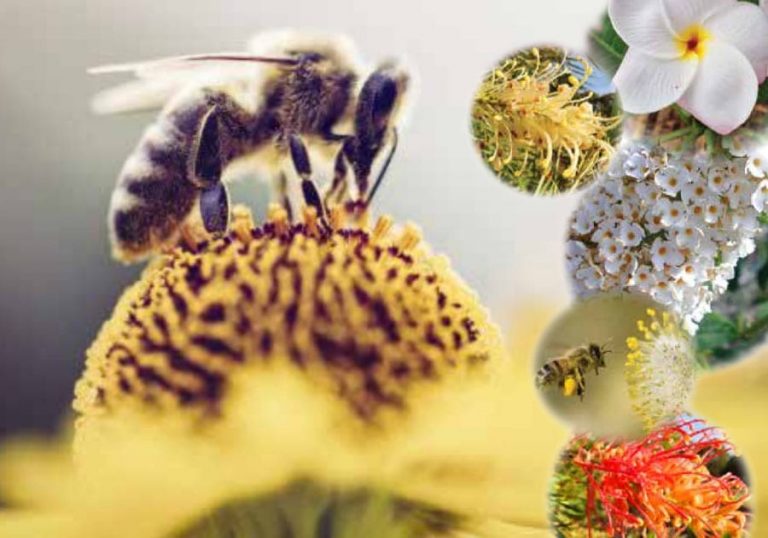
There are various ways a flower can be pollinated and the most well-known is the humble bee, either native or introduced.

Native bees are Australia’s wildflowers best friend. Did you know there are about 2000 species of native bees, some as small as 2mm in length, that primarily make the tropical regions their home? The smaller ones are perfect for pollinating those tiny floral gems in your garden. Some native bee varieties live in tree hollows but the majority are solitary dwellers, preferring to make timber cracks or holes in the ground their home.

European Honey Bees are more commonly recognised in our coastal gardens. They are ideal for commercially grown honey due to the larger volume of honey produced when compared to native bees. When introduced in the late 1800s, some escaped into the wild and they became a key part of our pollination landscape. In recent times though, these bee numbers have dwindled due to changes in the environment and attacks from pests.

Moths are another group of pollinators that are usually forgotten. They work their magic on plants whose flowers only open at night, like the pawpaw. A Tasmanian vegetable grower has used flies to pollinate their cauliflower crop. He attracts the flies using rotting carcases to grow their maggot babies.

Native birds also provide a valuable pollinating service when feeding on flowers. They get covered in pollen and then disperse it between flowers.

Butterflies & the humble flies help pollinate the native plants they are feasting on. Imagine a world without avocados or coffee beans – how would the Hipsters cope?

Did you know that a commercial grower in NSW is trialling a robot buzz pollinator in their greenhouse environment? The robot will identify the plant’s flower and then direct pulses of air at it to simulate the buzzing of a pollinating bee, causing the pollen to be released and drop down further into the flower.

Frangipanis, magnolias and Lilly Pilly are great food sources for bees. To encourage butterflies, you’ll need plants for them to feast on – Pentas are a popular choice. Rainbow Lorikeets love Grevilleas and flowering gums.

As with all living creatures, year-round food supply is essential so factor in a healthy biodiverse selection of plants & trees and you’ll find our local pollinators will be regular visitors to your outdoor patch.
It’s All About The Tecnology

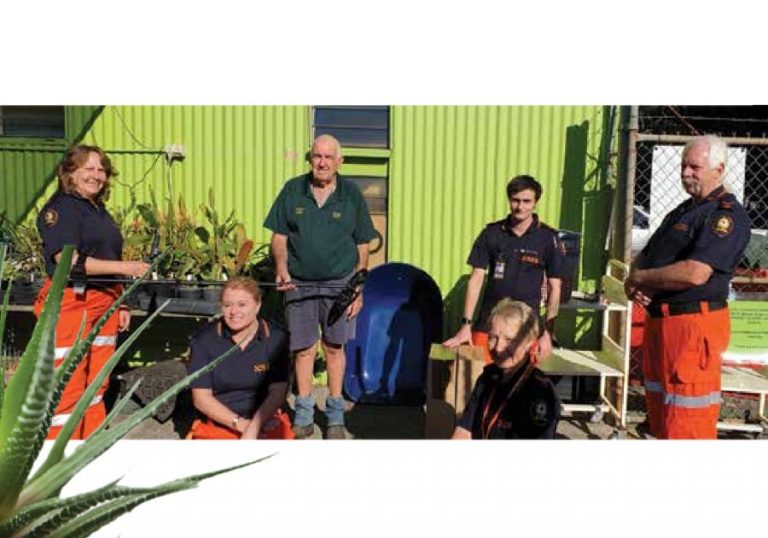
I guess that anyone who spotted a group of SES volunteers assembled at the front of the Wallum Action Group’s Bribie Community Nursery last week could be forgiven for thinking that they were there to deal with some type of emergency situation but, as this article will reveal, that was definitely not the case. Bribie Island SES members Jan Dwyer, Tracey Crees, Ian Moxham, Tash Barends and Jake Swallow were at the nursery to participate in a small ceremony that involved the presentation of three very hi-tech metal detectors which were paid for by the profits of plant sales at the nursery.

During the presentation, Wallum Action Group President David Wearne pointed out that, although the new detectors were considerably less expensive than some others on the market, they incorporated some of the latest technology which included being fully submersible and wifi capable as well as being able to penetrate up to ten metres underwater. ‘They also have the ability to detect a gold ring or a gold filling in someone’s tooth and this will be of extreme benefit when searching for a missing person,’ David explained.

SES volunteer Jan Dwyer told me that having the new metal detectors makes Bribie Island SES one of the most technologically advanced groups in the region. ‘We get to keep two of the three detectors that the Bribie Community Nursery has so generously donated and the third goes to Woodford SES,’ said Jan. ‘Because all the groups join together in any major search activities, that one will always be available if we need it,’ she added.

The presentation of the metal detectors has been just one of the instances in which the Wallum Action Group Bribie Community Nursery has used their funds to assist individuals in need or community organisations and these include the provision of many diabetes pumps, paying for the training of an assistance dog, sponsoring various community groups and a large donation to Camp Quality each year. All the plant sales profits are used to benefit the community within the local region.

The Community Nursery can be found on First Avenue next to the Orchid House and is open from 8 am to Noon each week day as well as on the first Saturday of each month. It is operated solely by a group of dedicated volunteers and has an incredibly large range of plants in stock. Anyone who would like to find out more about this great community organisation or perhaps enquire about becoming a volunteer should either visit the nursery or call 0407 699 953 for details.

Community Men’s Shed Bribie Island Inc.

The Community Men’s Shed Bribie Island was formally established in August 2017. The Shed was developed because of a need on Bribie Island for men to get together in companionship, and to work on personal and community projects.

The Shed is a member of the Australian Men’s Shed Association. (AMSA) is the peak body supporting almost 1000 Men’s Sheds and is recognised as one of Australia’s largest male-based community development organisations. The CMSBI is situated behind the Church of Christ, Corner Foley Street and Fifth Ave, Bribie Island.

The shed was closed for a period because of COVID-19, reopening again on the 17th of June.

The shed is open from 8:30am to 12:00pm every Wednesday. For now, the numbers are limited to 20.

If you or someone you know would like to consider joining the Men’s Shed, come along – have a look and a chat to our wonderful members – stay for a coffee or tea and biscuits.

What is a Men’s Shed? Men’s Sheds are found in many cities and towns around Australia and continue to spring up internationally. Not all Men’s Sheds are the same – if you looked inside you might see a number of men making furniture, perhaps restoring bicycles for a local school, making Mynah bird traps, fixing lawn mowers, or making a cubby house for a local children’s group.

You will see teabags, coffee cups, and a comfortable area where men can sit and talk. So what is so special about the ‘Men’s Shed’? Men’s Sheds are vital community investments delivering programmes and activities that foster community spirit and contribute to building a more inclusive Australia. Men’s Sheds not only provide diverse memberships but also promote a platform for the blending of ethnic, social, and cultural values with a strong focus on men’s physical, emotional, and mental health. This in turn contributes to the sharing of skills, making friends and fellowship, networking, and also offers opportunities to positively engage with their local community for the benefit of all.

Statewide Search for Year 6 Queensland Student to be Fred Hollow’s Junior Ambassador

The Fred Hollows Foundation is calling for nominations for the Fred Hollows Humanity Award, which recognises Year 6 students who demonstrate compassion, integrity and kindness towards others. Parents, teachers, principals and community members around the country can nominate a child in Year 6 who has made a difference at www.hollows.org/fredhollowshumanityaward before 11.59pm, Friday 11 September.

One Junior Ambassador from each state and territory will be selected.

Honouring children for their kindness, compassion and integrity is more relevant than ever in 2020, which has underscored the importance of these values.

“Fred used to say the basic attribute of mankind is to look after each other,” said Gabi Hollows, Founding Director of The Fred Hollows Foundation.

“He would be so proud to know the Fred Hollows Humanity Award is recognising students who are demonstrating this belief in their own lives.

“To see students honouring these words by showing compassion, kindness and integrity during such a challenging year is incredibly inspiring.

“I urge people to nominate a Year 6 student for the Humanity Award and together we can continue to help spread compassion and kindness during this trying time.”

One student recognised at last year’s ceremony was Concordia Lutheran College student, Bella Edwards, who was nominated for her altruistic, caring and compassionate nature.

“Bella has a beautiful heart and always thinks of others,” Principal Juanetta Priest, said.

“In 2019 she conceived an idea to make over 300 ANZAC biscuits with her classmates to say thank you to our veterans.”

“Bella also personally wrote handwritten letters to accompany each batch of cookies. She insisted that they were handwritten so that the veterans knew how much the students cared.”

All nominees will receive a certificate and be recognised at a virtual presentation ceremony later in the year.

A Junior Ambassador from Queensland will be recognised and will be able to extend their humanity by allocating $5,000, donated by the award’s charity partner Specsavers, to one of The Foundation’s programs to end avoidable blindness.

Since 2012, the Fred Hollows Humanity Award has recognised more than 1,500 students who follow in Fred’s footsteps by making a positive difference in the lives of others.

The Bribie Islander Gloss Magazine July 17, 2020 Issue 118

Issue 118 OUT NOW. Get all your community news and information. Bribie Islands only community gloss magazine NOW EVERY TWO WEEKS! – Articles on boating, camping, fishing, life, drama, travel destinations, sports and what to see and do on Bribie Island. Covering charities, organisations, places, children’s activities, arts and crafts, tourist destinations, heritage parks, technology, science, music, gardening, and much more.

Download latest digital edition here. Or use the ebook below to view.

8 Secrets to Styling Your Bathroom

1. WALL COLOURS You can always change the colour of paint – perhaps a stronger, darker tone or even a fresh white. So, by keeping the floor and wall tiles very neutral, you can easily introduce colour in the form of paint to the walls. This means that the look of your bathroom can be freshened up and changed quite dramatically over the course of just a weekend.

2. TILES It can be expensive to tile a bathroom from floor to ceiling and most prefer to only use tiles in the wet areas and have plastered walls that can be painted. It is a good idea to have a self contained shower, for example at the end of the bathroom or even in a separately designed corner or area.

3. NO CLUTTER The last thing you want is for your bathroom to be cluttered. Ensure that the tray, bowl or dish that you employ has a purpose and that your styling vignette doesn’t get too busy.

4. BATHROOM STYLING ACCESSORIES Do you love to shop for bathroom accessories? There are so many lovely pieces that are available now. Mother of Pearl trays, gorgeous organic shaped timber bowls, or delicate porcelain dishes. Whatever your style, there are items that you can add to transform the look of the space.

5. FREESTANDING BATHS can look lonely without a timber stool. A handy seat or just a spot to leave the soap tray, whichever use you have for it there is no doubt that the texture and colour in the timber is a nice contrast in a simple white or grey bathroom.

6. WATER AND ELECTRICITY DO NOT MIX and there are very definite guidelines which you absolutely must follow when installing a pendant in a bathroom. LED strip lighting underneath a wall hung vanity is a good idea as this can be left on at night and can be just enough to see by in the dark and saves you turning on the lights, waking yourself up completely and then not being able to get back to sleep!

7. TOWELS are another way to introduce some colour, even if you have white towels with a trim colour, these will give the room personality and just as important to the success

8. BATHROOM STYLING Remember though that the mantra of ‘keep it simple, decorate and at the end take one item away’ should be employed here. Finally, if you have the space, some statement greenery is the perfect complement to a bathroom.

70% of Aussies are worried our cafés will never be the same again, according to new research

WEDNESDAY, 1 JULY: 70% of Aussies are worried our cafes will never be the same as they were pre-COVID, according to a new report commissioned by Australian coffee roaster Harris Coffee.* With five million Australians claiming to have missed their local café more than pubs and clubs during the COVID-19 lockdown*, Harris has unveiled a first-of-its-kind initiative to help keep Australia’s café culture alive and support cafes on the road to recovery.

The Harris Café Report, conducted by YouGov Galaxy, surveyed 1,000 Australian café -goers and small business owners, to uncover attitudes towards Australia’s café culture and owners’ fears and hopes in a post-COVID-19 world.

The absence of cafés was sorely felt by many during the COVID-19 lockdown restrictions – just under ten million said they felt isolated from their local community during this time while 70% declared their local café as the centre of the community, ahead of amenities including the post office and hairdressers.*

To help, Harris has launched the Harris Café Recovery Project – a new scheme for Australian café owners nationwide, to apply for a share in a $1 million worth of support that will assist them in rebuilding, as they return to serving their local communities.

Cafe owners around Australia are invited to apply for the Harris Café Recovery Project, with up to 25 café owners eligible to receive a share of the $1 million worth of support.

Cafe owners around Australia are invited to apply for the Harris Café Recovery Project, with up to 25 café owners eligible to receive a share of the $1 million worth of support.

“Through our Harris Café Report, we found that 80% of small business owners in hospitality believe they won’t recover from recent hardships without support. 43% also said they won’t be able to stay open longer than six months without the support.”

Harris is encouraging Aussies to support their local café by buying a coffee, and if your local is doing it tough, encourage them to apply for the Harris Café Recovery Project.

For more information and application terms and conditions, visit www.harriscoffee.com.au.

Why do we have closed seasons?

CLOSED SEASONS PREVENT PEOPLE FROM FISHING AT CERTAIN TIMES OF THE YEAR TO PROTECT SPECIES AT VULNERABLE TIMES IN THEIR LIFE CYCLE, SUCH AS DURING SPAWNING SEASONS.

The following closed seasons run from midnight to midnight – from 12.01am on the first day of the closure to 11.59pm on the last day of the closure.

AUSTRALIAN BASS
A closed season applies to Australian bass throughout Queensland tidal waters from 1 June to 31 August.

BARRAMUNDI
Throughout the Queensland east coast, a closed season applies to Barramundi from 1 November to 31 January. It is also prohibited to deliberately target Barramundi for catch and release during these closed seasons, as the stress of capture may prevent a fish from spawning.

SNAPPER AND PEARL PERCH
A closed season applies to Snapper and Pearl Perch throughout Queensland tidal waters from 15 July to 15 August.

If you catch a Snapper or Pearl during the closure, use good catch and release techniques – handle the fish correctly, remove the hook if it’s in its mouth or lip, cut the line and leave the hook in place if it’s in the gills or gut and release the fish as soon as possible. Snapper may also need to be treated for barotrauma.

SPANNER CRABS
Throughout Queensland a closed season (regulated period) applies to spanner crabs from 1 November to 15 December inclusive Tropical rock lobster (tropical spiny rock lobster) A closed season applies to all species of tropical rock lobster (family Panuliridae) from 1 October to 31 December in Queensland tidal waters.

First White Foot on Bribie Island

By Barry Clark, Bribie Island Historical Society

A memorable day for the indigenous Joondooburri people of Bribie, 211 years ago, when they first saw a Sailing Ship coming to their island. The year was 1799. Some elders may have had memories or heard stories, of seeing a big boat way out to sea, 29 years earlier, when James Cook sailed past this coast in 1770.

The first fleet had arrived in Sydney in 1788, to establish a new Penal Colony. Small areas around Sydney were explored and farmed, but nothing much else was known of this vast land. It was thought that big rivers might flow from a vast inland sea, and young Matthew Flinders, aged 25, was sent north to explore bays and find rivers.

FLINDERS TO BRIBIE

Aboard the sloop, Norfolk, built by Convicts on Norfolk Island, Flinders and a small crew, including his brother, and an Aboriginal named Bongaree, sailed into Moreton Bay in July 1799.

On July 16th the first white footprint was made in the sand of Bribie Island, near the site of today’s Seaside Museum, where a commemorative stone and plaque can be seen. Hardly noticed these days, but it is Queensland’s equivalent of Australia Day.

Two engraved plates show Flinders’ face, and the Map he drew of Moreton Bay. The words on the plaque read;

Flinders sailed all around Moreton Bay, charted the islands, but failed to find the Brisbane River. He beached the Norfolk for repairs at White Patch, rowed up what he called the Pumicestone River, and climbed a Glasshouse Mountain. Flinders did not know that Bribie was an island, and nobody at that stage even knew that Australia was a huge island continent.

FLINDERS THE EXPLORER

Flinders had come to Australia, aged 21 in 1795, and circumnavigated Van Diemen’s Land (now Tasmania) in a small boat with George Bass. Flinders was a great cartographer and navigator and in 1803 became the first to sail right round, and map, the land previously named New Holland by early Dutch explorers. Flinders confirmed it was a huge island Continent, to which he gave the name TERRA AUSTRALIS, in a book about his journeys. Years later the name AUSTRALIA was officially adopted as the name for this continent.

Flinders took his cat TRIM with him on all of his travels. They travelled together for many years until dramatically interrupted when sailing back to England. Arriving on the island of Mauritius, not knowing that England was a War with France, he was taken prisoner and held for 7 years. Finally getting home in 1810 in failing health, he struggled to finish “Voyage to Terra Australis”, his book finally published a day before his death on 19 July 1814 at age 40.

FLINDERS REMAINS

Records of his death and burial 206 years ago were reviewed when major building work began at Euston Railway Station in London in 2019.

In a mass gravesite, where 60,000 largely unidentified bodies had been buried, records indicated the possible site of Flinders grave. Like finding a needle in a haystack, on a huge archaeologic dig site, the coffin plate and remains of Matthew Flinders were unearthed last year.

Monument at Banksia Beach, and the Bribie Arts Centre has a Matthew Flinders Gallery. There are many books about Flinders and his cat Trim, places and plants bear his name, and a bronze memorial to the welltravelled cat stands outside the NSW State Library.

FINAL TRIBUTE

Some recovered items from Flinders burial site may eventually come to Australia, to honour the man who first circumnavigated and named this continent.

This article reflects on two July dates in his life. First footing on Bribie Island on 16 July 1799 age 25, and his death on 19 July 1814 at age 40

An Artists Story…

AFTER ADMIRING LITTLE BEACH SHACKS THAT WERE BUILT BUT OFTEN DISAPPEARED WITH THE NEXT TIDE ALONG RED BEACH FOR YEARS, AROUND EASTER 2018 I FOUND MYSELF STUNNED LOOKING AT A MASSIVE STRUCTURE THAT SEEMED TO HAVE POPPED UP OVER NIGHT. I CURIOUSLY INSPECTED THE MASSIVE BUILDING, THAT A FEW DAYS LATER BORE A NAMETAG INTRODUCING IT AS THE ‘R. CRUSOE HUT’.

I am an artist, so the beauty of this wild thing built from driftwood touched my heart. Around that time I was working on a project called ‘Homing’ – a quest for what we use to make and define a place we call home. Robinson Crusoe, washed up on an island, a stranger to the place, had to do just that. So my curiosity was sparked.

I felt like whoever had assembled the Crusoe deserved a thank you – so I posted on the community pages that I’d offer the builder(s) a free photo shoot.

And that’s how one day Trev and I met. At his second shack, the Jeffrey, out on Woody Bay, that had just gone up in June 2018. And that was pretty much the starting point of us working together. Not long after our initial meeting our first joint artwork “Uncertainty Of Dreams. Childhood1’ featuring the Jeffrey Shack, became a finalist in the Devonport Tidal 18 Art Prize.

Encouragement and support is sometimes crucial when working on art projects that never have a certain outcome and are often demanding on your own resources.

I chased Trev to an interview with the ABC he nearly avoided, and he helped me transporting my massive 55 piece Solo exhibition to a Regional Gallery in Munduberra, 5 hours north from here. Most of the images in “I TOLD YOU SO” are from around the Moreton Bay Region. It was the summary of 5 years of my solitary walks through nature. Walks that we from now on often took together.

‘I TOLD YOU SO’, conversations with nature, was last shown at The Caboolture Hub in December 2019

I had organised a group exhibition at the Bribie Island Community Art Centre in May 2019, initially under the title of ‘3 Artists: On Being There’ long before meeting Trevor. Last minute Trevor became the 4th artist to join in, and his wood and wire works fitted in as if they had been part of the original plan.

‘4 Artists: On Being There’ was so well received that it encouraged us to start working on new projects together.

Creating art has always been a solidary process for both of us. Trev doesn’t like being watched when he is out building the huts, so his works popped up a bit like Banky’s works in the streets, only at the beach.

In late 2019 another shack was added. ‘Gulliver’s Gate’ is located at Ball Point.

There’s always more to art than what meets the eye, for both of us it is a lot about processing life events. I was processing some challenging times with ‘I TOLD YOU SO’. The statements of ‘I TOLD YOU SO’ which explained the thought process behind the images received so much attention that they will now come out as a book.

Trevor grew up in Zimbabwe in the turmoils of war. ‘Gulliver’s Gate’ became the title of a book we are currently working on about mental health.

The Jeffrey was recently again subject of a work that made it into another prestigious art prize, the Lethbridge 20,000 2020.

(Whilst we didn’t win, it did get sold). Trev’s shacks are intricate structures that are built to last and now have become a bit of a landmark on Bribie. He only uses onsite materials, often carries logs over distance so that they would interlock and sit stable

The Jeffrey was built into the tideline, and so was the Crusoe.

Jeffrey recently had his second birthday and is still standing strong, whilst the Crusoe finally succumbed to the elements shortly after his second birthday

Trev was pretty sad seeing the Crusoe go. I consoled him by pointing out the fact that Crusoe would have been something like 94 in shack years. He had a good long life and made many people happy. And looking around Red Beach: Crusoe has grandchildren and greatgrand children. Lots of little shacks that are being built there now by families and their kids.

We are currently starting a little business in honour of Crusoe. ‘Crusoe Goods’ will offer a range of items that we make from natural and recycled materials, from small gifts to furniture and homewares, and we are planning to run a number of workshops in the near future.

(For anyone interested – there is a FB Page as a first stop to get in touch with ‘Crusoe Goods’. Things will hopefully grow from there).

Quiet Heroes

Many celebrations this year have been postponed because of COVID19. One is the official opening of the Joondoburri Walk. It is located behind the Bribie Island Community Kindergarten, 34 Cotterill Avenue, Bongaree.

The wonderful Narelle Dawson, Director of the Bribie Island Community Kindergarten is hoping it can take place in September (the original date was 21st March). The beautiful signage is in place and the walk has been visited by many already. Narelle Dawson is an educator with vision.

Narelle saw the need to connect with our Aboriginal and Torres Strait Island Community. Together with Ron Powell, a Bribie Island traditional elder, they researched edible plants and food sources, plants for medicinal purposes, trees and seasons and how they connect to other animal food sources.

At a time when we are losing so much of our significant forest areas to development, how important it is to celebrate the long hard process (since 2016) that Narelle and her team have put in to secure this area for teaching and learning. This has not been an easy process.

Narelle and her team lobbied State and Local Government because it is State land with local Government as custodians. They conferred with Moreton Bay Regional Council legal departments over Traditional Owner Rights. They met with Traditional Owners representative, Leisha Krause and gained the complete support and endorsement for the Project from the Joondoburri people. Botanical and environmental experts were consulted, grants secured. Narelle brought together lots of people from numerous places to envisage this project. Many have already noticed the main sign that highlights a map and the trees and plants that have an Aboriginal food source or other use.

Pop by and have a wander along the Joondoburri walk, you will learn how local Joondoburri people used the bush and were mindful to look after the natural trees and plants to ensure there was a plentiful supply for future generations. Trees were treated like people – we have much to learn.

Thankyou Narelle Dawson, Ron Powell and to the kindergarten staff, also to the parents and other community members that supported this inspirational project.

Rediscover Bribie’s History with New Heritage Signs

Aset of four new updated and refreshed heritage signs will now catch the eye and imagination of those visiting the Bongaree foreshore to learn more about Bribie Island’s local history. Moreton Bay Region Mayor Peter Flannery said the new signs would bring history back to life.

“We’ve worked closely with the Bribie Island Historical Society to update and refresh the original signs installed back in 2004,” he said.

“The design has been updated to reflect the seaside location and the stories re-animated with new images and insights. “Over the years, the signs had faded and begun to tear, so it was time to update the content and design to make them easy and enjoyable to read.

“These signs form part of the heritage trail along the Bongaree foreshore, where you can do a self-guided walk starting and finishing at the jetty

“Making Bribie Island a great day trip that’s both educational and a great time at the beach.”

Division 1 Councillor Brooke Savige said it was time to update the original signs after weathering 16 years on the Bongaree foreshore.
“Locals and visitors to Bribie Island can now enjoy the surf, sand, and sun while learning more about the island’s rich history,” she said.

“It’s important we continue to share our community heritage and the stories of those who lived, worked, and shaped the island over time.

“I’d like to thank everyone involved in creating these wonderful signs, and I look forward to seeing them stand for another 16 years and beyond!”

Bribie Island Historical Society Founding Member Graham Mills said it was a great collaboration with Council.

“After several meetings, it was a joy to find out that these signs were now installed,” he said. “I’ve been coming to Bribie Island since I was a kid; it was lovely then, and it’s still lovely now!

“You’ve only got to look at the number of people visiting the island all year round to see that.”

Local historian Barry Clark worked closely on the creation of the ’50 Years on Bribie’ sign.

“What I thought would be a two-week job ended up taking almost two years and interviewing 130 old-timers! They all had great stories, photos, and insights. There were 12 people then; today there are just three.”

“As a long-term Rotarian, and with Centenary of Rotary International celebrations for 2005, I decided to research how many people had lived continuously on Bribie Island for 50 years or more,” he said.

Potato & Leek Soup

INGREDIENTS
• 60ml (1/4 cup) olive oil, plus extra for croutons and to serve
• 1 brown onion, halved, chopped
• 1 garlic clove, crushed
• 4 medium (about 700g) Desiree potatoes, or Pontiac potatoes, peeled, cut into 2cm cubes
• 2 leeks, pale section only, washed, dried, thinly sliced
• 1.25L (5 cups) vegetable liquid stock
• 125ml (1/2 cup) thickened cream
• 3 thick slices day-old white bread, crusts removed, cut into 2cm cubes
• 2 tablespoons finely chopped fresh chives

METHOD
• Step 1 – Heat olive oil in a large saucepan over medium-high heat. Add the onion and garlic and cook, stirring, for 3 minutes or until the onion softens. Add the potato and leek and cook, stirring, for 5 minutes or until leek softens.
• Step 2- Add the stock and bring to the boil. Reduce heat to medium and gently boil, uncovered, for 20 minutes or until potato is soft. Remove from heat and set aside for 10 minutes to cool.
• Step 3 – Meanwhile, preheat oven to 200C or 180C fan-forced. Place bread in a roasting pan. Drizzle with remaining oil and toss until bread is evenly coated. Toast in preheated oven, shaking pan occasionally, for 10-15 minutes or until crisp. Remove croutons from oven and set aside.
• Step 4- Transfer one-third of the potato mixture to the jug of a blender and blend until smooth. Transfer to a clean saucepan. Repeat in 2 more batches with the remaining potato mixture. Alternatively, use a stick blender to blend in the saucepan.
• Step 5 – Place the soup over medium heat. Add the cream and stir to combine. Cook, stirring, for 5 minutes or until hot. Taste and season with salt.
• Step 6 – Ladle the soup among serving bowls. Top with croutons, a drizzle of olive oil and serve immediately.