Home Blog Page 47

Winelander: Pinot Noir

Pinot Noir is an ancient grape that was first planted as far ago as 1375 when the variety was named “pinoz” and it is widely grown around the planet although its traditional home is Burgundy in France. For over 600 years the monks in their monasteries worked their magic in growing great Pinot Noirs and it not only makes outstanding red wine is also a major component in the composition of Champagne.

Having said all that Pinot Noir is also a challenge for even the greatest of winemakers and depending on where it is grown throws off several interesting characters ranging from strawberries and cherries to farmyard earthy smells, mushroom aromas and truffle aromas. When tasting Pinot Noir it must be remembered it is not a big wine but can be a light and bright wine with tons of complexity. Its history in Australia began with the first fleet in 1788 when almost certainly James Busby planted the vines in The Hunter Valley in the early 1800s. Whilst plantings failed in South Australia it was successful in Victoria especially Geelong and The Yarra Valley.

However, in the 1880s the vines were wiped out by the phylloxera mite which also devastated the vines of France and it wasn’t until the 1970s that Pinot Noir made a comeback mainly through Doctor Bailey Carrodus at his vineyard Yarra Yering and land reverted from dairy farming back to grape production.

An old Burgundian is saying that reads “Get the bouquet right and the palate will look after itself” which is something I have always maintained that if it smells good it will taste good. Although it is primarily a cool climate grape many vineyards have a go at making the wine and it was once exclaimed that if 40 vineyards made Pinot Noir you would have 40 completely different wines, however apart from The Hunter Valley and Victoria Tasmania is making some excellent examples of the wine. Also across the ditch, New Zealand excels at making Pinot Noir along with their distinctive Sauvignon Blanc.

Burgundy from France remains by far the most eloquent and convincing demonstration of the importance of terroir meaning that climate, soil and growing conditions all come together to produce great wines. The great Burgundies have great aromas of spices, savoury notes, and forest scents.

Around Australia, the wine has become very popular as it an outstanding food wine and apart from Geelong, Gippsland, The Macedon Ranges, The Mornington Peninsula, Yarra Valley and Tasmania, there are regions such as The Adelaide Hills and Great Southern region of Western Australia producing great wines. Australian Pinots tend to be light in colour and have perfumed aromas and flavours of cherry, raspberry and plum balanced by smooth tannins and the wine also goes into many of our sparkling wines usually blended with Chardonnay.

In New Zealand, there is unlimited potential for producing outstanding Pinot Noir with several regions including Martinborough, Marlborough, Nelson, Waipara, Canterbury and Central Otago producing wines that vary from the moderate to very powerful wines.

In the United States look for wines from Oregon, Sonoma and the southcentral coast. Sonoma is home to The Russian River where the wines are completely different due to the cold ocean fogs and tend to be bigger but not compromising on elegance.

Pinot Noir matches food of many styles but its best pairing is with Duck and doesn’t discriminate whether cherry-red or savoury duck is a winner. Pinot Noir can also be matched to more spicy food such as lightly spiced Thai dishes and lighter styles of Pinot Noir go well with pasta or salmon’ The bigger styles go well with beef dishes such as a bolognaise and don’t forget it matches cheese well such as a creamy blue or a sharp goat’s cheese.

In a tasting carried out by The Decanter wine magazine most of the wines of choice were from Victoria and the selection included Farrside by Gary Farr, Paringa Estate, Yabby Lake, Stonier, Giaconda Estate, Hoddles Creek, Crittenden Estate, Giant Steps, Yering Station, Brokenwood and DeBortoli. If you haven’t yet tried an Australian Pinot I am sure that if you get one of the above you will join the evergrowing Pinot Noir fan club.

Philip Arlidge

Accessible Australia

We are slowly recovering from the Covid-19 isolation and it’s now time for us as a community to find as many ways as possible to kick start the businesses and allow for us to become supporters of the community. We need to encourage a way in which to boost our economy and stop our community from failing. While it seems like the world has gone to sleep, there has been many businesses and members of Bribie Island and the Pumestone Community hard at work to find ways to survive and to grow. Many businesses are finding new and beneficial ways to boost the economy and keep staff employed. We are starting to see the visitors return as day-trippers and now with the school holidays, a slow trickle to the accommodation.

As a community, we must encourage advertising to our local press so that every visitor and Islander can take advantage of the great businesses and services available on the Island. In the past few months, the initiative of Spinal Life Australia, a non-for-profit organisation established in 1960, which has a strong community-based peer support group on Bribie Island, have been working across a new App to provide support for people with a disability in the community.

We support people with spinal cord damage to living an accessible, equitable and empowered life as a memberbased organisation that advocates with and for our members to remove barriers in the community for people with disability.

The exciting news is that in the next few weeks will introduce Accessible Australia smartphone app. The app is to help those with a physical impairment identify accessible features of communities across Australia.

There are many barriers to community participation that affect people with mobility impairment. Poor accessibility in a community has an impact on those with a mobility impairment as it affects their ability to connect with others, including mainstream services, but also socially. Other users the app will benefit will be the ageing population, people with temporary injuries and parents with children in prams. The app will identify businesses, parking, recreational, social, tourist and every activity on Bribie Island and for all Australia, which will encourage community participation and tourism. One day we hope every business in Australia will be able to place a disability logo on all advertising for accessibility and inclusivity.

We live on Bribie with so many already accessible businesses and activities yet very few or one knows about it.

Accessible Australia is a responsive web app. Basically, this allows for the same application to look different when displayed on a smartphone, a tablet, or a laptop or desktop computer. The app uses nothing but a web-browser to run, making a single application compatible with all smart devices. There is no need to download or install an app from the app store or google play store. Our members around Australia and in particular Bribie Island say they love to travel, go to bars, parks, and attractions like ablebodied people do. Many times travel is difficult and it’s hard to trust information as often the information is not current. There are physical barriers just leaving home.

Where are the accessible toilets? What restaurants have an accessible toilet? How accessible is the accommodation? Most agree that an app like this could be life-changing, enabling people with a physical impairment in the community to go to points of interest with more confidence.

This is a way forward for the growth of business and a boost to the economy.

Titanic – The Aftermath – A Sadness in the City of Halifax

Everyone knows of the tragic fate of the great ocean liner RMS Titanic.

She was a state of the art engineering masterpiece, designed to offer a degree of comfort and opulence to the few and a means of transatlantic crossing to the masses of immigrants hoping for a new life in America. All came to an abrupt end in the cold waters of the North Atlantic on April 15th 1912.

Class distinction was rife in the days when the mighty ship met her end, as was a lack of care and responsibility for the crew, the employees of the owners, The White Star Line. At the moment of the sinking all her crew were automatically paid off by the company. Not only did the grieving families of the crew suffer a personal loss but all the financial support from their loved and lost ones terminated in an instant.

The survivors, sitting in the lifeboats got away from the stricken ship leaving the bulk of the others struggling in the icy waters. These fortunate ones were mostly picked from the sea by the Cunard liner Carpathia. She took these lucky few on to New York, the planned destination of the voyage. Other ships arrived on the scene of course but the site was one of sadness and death, strangely calm and windless.

Many of the wealthy families whose relatives had perished wanted to retrieve the bodies of their loved ones so as to be able to give respectful burials. The nearest major port to the site was Halifax so it was thought best to charter and send out a suitable vessel from there. This was duly done and the CS Mackay – Bennett arrived on 17th April.

The recovery ship picked up very many deceased persons and in the manner of the class conscious instructions given to the crew firstly the well dressed and wealthy looking bodies were taken on board and stored in the available spaces. However these spaces quickly filled up so that burial at sea was deemed appropriate especially for anyone wearing a boiler suit or a cheap, shabby dress. There was a financial aspect to the activity in that the wealthy families were prepared to pay for the service whereas the immigrants and common seamen had no one able to reimburse anyone.

There was one incident though where instructions and financial incentives didn’t mean anything.

The crew of the rescue ship saw, floating in the ocean, a dead child aged about two years. After all the horror they had seen surrounding the site of the wreck this last image broke their hearts. They tenderly took the child, a boy and stored his body aboard. Each man resolved that they would use a portion of their earnings from the grisly business to give the unknown child a loving burial.

The city of Halifax allotted a site in the city cemetery to bury the many recovered bodies that had not been claimed by relatives or were unidentified. They approached White Star Line to cover the costs involved. The Shipping line refused to accept any of the costs. Incensed by the callous reaction of the company the city advised the line that unless they did so they would never dock a ship in Halifax ever again. As the city was a regular calling port for immigrants to Canada and as such was a source of earnings for White Star Line they capitulated. The crew of the rescue vessel did pay for a full funeral for the little orphan and he was buried in the first grave at the head of the sad line. In the coffin the rescuers placed a copper pendant bearing the inscription “Our Babe” as no other knowledge of the child’s identity was available. Now as this particular funeral was being paid for with no price restrictions the crew specified that the grave be surrounded by a sheet of copper provided by them. This was placed on the downward side of the slope on the hillside where the graves lie.

Now many decades later this action has had repercussions. When DNA testing was discovered it was decided to try to test the remains from the unmarked graves on the site to attempt to put names to all the bodies. But, the site is on a hillside and when exhumation started it was discovered that over the decades in the damp soil all the bones had slid down the slope and had ended up in a mix of remains at the bottom of the hill. All that is except the remains of the child that had been locked in the one site, retained there by the impervious copper sheets insisted upon by the kindly crewmen.

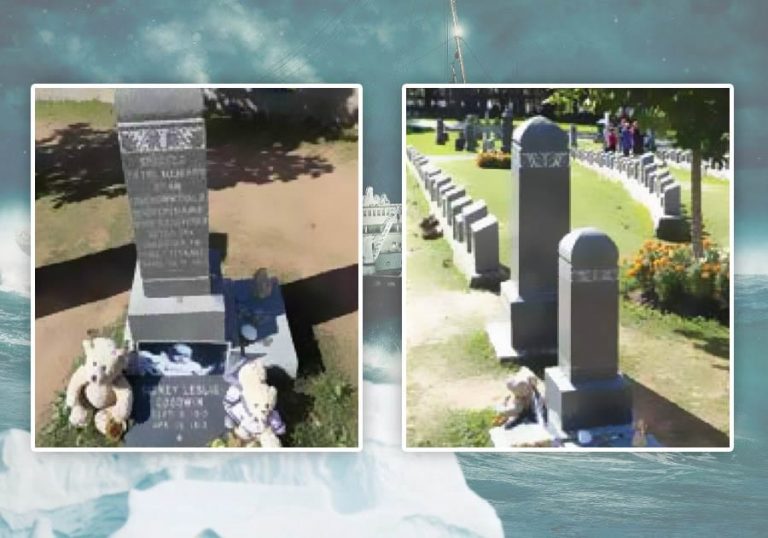
As a result only the body of the little boy was identified, a hundred years after his tragic end from the recovered DNA. Nowadays you can visit the grave, see his name, and photograph and pay respects to little Sidney Leslie Goodwin who died before his second birthday on that fateful night. We now know that his entire family, eight people in all were lost and no remains ever found. In a turn of fate of the type often noticed after other accidents it’s been discovered that the family were in fact booked to sail on the SS New York. However due to delays caused by a coal strike going on at the time they were transferred to the Titanic just before sailing. Without that trick of fate this story would never have needed to be told.

Of interest, amongst the other graves there is a one with a named occupant, one Jack Dawson. Unfortunately he bears no connection with a character played by the film actor Leonardo de Caprio. This guy spent his time aboard shovelling coal in the boiler room; obviously much less entertaining a pursuit than cavorting with Rose in the back seat of an expensive car in the hold!

Island Gardens

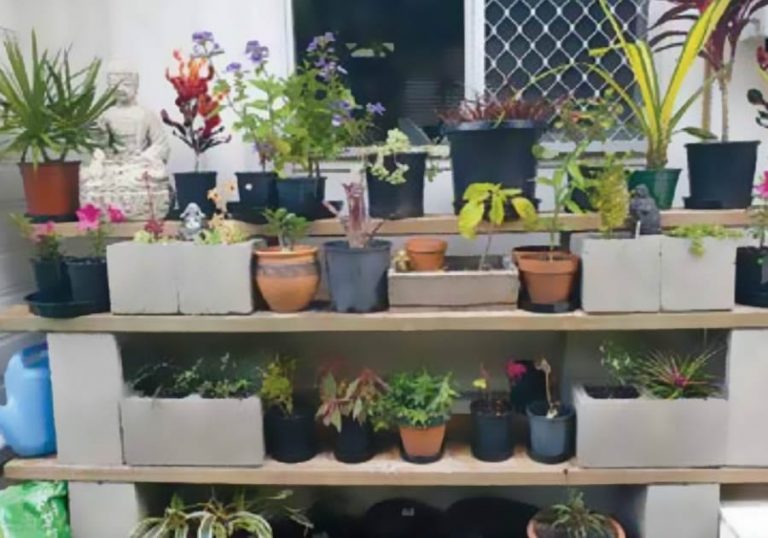
Hello and welcome back to Island Gardens. Today we’re looking at another easy DIY improvement for your garden – a beautiful plant display stand. In this case right outside the kitchen window. A lovely sight first thing in the morning if the sun’s up yet.

In the stand shown here, I’ve opted for three levels, or four if you include the ground. It’s comprised of 18 concrete blocks (usually around 400x200x200mm) and five x 2.4 metre wooden sleepers (in this case a standard 200mm wide and 50mm thick).

The blocks and wood can be a little heavy, but living in the friendly Bribie region means we usually have a nice neighbour or two who will help with lifting if needed, perhaps in return for a cuppa and biscuits, or maybe a cold beer. Yes, even this time of year!

Another alternative is to use furniture display tables or cabinets. Perhaps an item that is no longer wanted inside your home, or you could buy a cheap item from one of your local op shops. Although you can expect the wooden sleepers to last at least 20 years.

The blocks can normally be found for under $4 each and the sleepers for under $20 each. You can safely build a stand of this height with as little as ten blocks and three sleepers, but I have chosen more because I love to place plants in the holes provided by the concrete blocks. I also like the depth added by placing two sleepers beside each other. This of course also allows for more plants to be added to the display.

You might also prefer to paint or spray paint your blocks to make them more attractive, or for a little extra cost – more ornate blocks can be easily found from local landscape suppliers. Sandstone blocks are quite popular. Also to suit the space you wish to put a plant stand, you might prefer to create a down-sized version of the stand pictured here. If so, smaller blocks and shorter sleepers can be used.

It is a good idea to consider what sunshine your stand will be receiving. The pictured stand is facing east so it receives morning sun only. This has been surprisingly suitable for almost any plant, even those which prefer “full sun”. It is also under an eave, receiving almost no rain, but is right near a garden tap and I have used pot saucers to retain the water for longer. On that note, if you are planting anything in the holes of the concrete blocks – plant succulents or other small hardy plants that don’t need too much water. If your stand is facing north or west, ensure to plant those succulents or hardy plants that can handle the sun when the hot weather returns.

Road Trip

Hi everyone,

We are a husband and wife duo, Jono and Monique (Jonique). We have had a unique set of circumstances that allowed us to be able to sell our house and all our unnecessary worldly belongings. So we decided to trade it all in and purchase our beautiful Jeep and caravan to travel full-time around Australia, exploring all the beautiful corners of this amazing land we are proud to call our home.

We began our journey from the Gold Coast a few weeks ago and our first stop was Beautiful Bribie Island. We spent the better part of 4 days exploring every corner we could find, from Woorim Ocean Beach on the east, to Red Beach to the south and Sylvan Beach on the West all on foot and by air with our drone.

We also found a few unique land marks that caught our attention from the beautiful hand painted blue water tower in Woorim, the Iconic Thong Trees and had a lovely lunch time meal at the Pigface Seafood Cafe.

We also explored the centre of the island and found the Community Arts Centre and the beautiful Bicentennial Walks behind the centre.

Having an amazing evening meal at the Sandstone Point Hotel, while catching up with some friends we then walked down to the Oyster Shed to behold the beautiful lights on the jetty, being lucky enough to see some dolphins swimming at the end of the jetty.

The next day we then took to the water and watched the sun rise via kayak and found our own little private island to enjoy a packed picnic breakfast. Later that same day, we hired a boat from Bribie Kiosk & Boat Hire to explore the western side of the island more thoroughly and enjoyed a spot of fishing from the boat.

We were so excited to have the opportunity to spend our first week at Bribie Island and look forward to our future adventures as we keep circumnavigating Australia Follow our adventures on Facebook, Instagram and YouTube @Jonique Life and we look forward to sharing more of our adventures and encouraging others to get out on the road and do as we do.

Jonathan & Monique Harris

The Bribie Islander Gloss Magazine July 3, 2020 Issue 117

Issue 117 OUT NOW. Get all your community news and information. Bribie Islands only community gloss magazine NOW EVERY TWO WEEKS! – Articles on boating, camping, fishing, life, drama, travel destinations, sports and what to see and do on Bribie Island. Covering charities, organisations, places, children’s activities, arts and crafts, tourist destinations, heritage parks, technology, science, music, gardening, and much more.

Download latest digital edition here. Or use the ebook below to view.

Nankeen or Rufous Night-Herons

Nankeen or Rufous Night-Herons as they are sometimes called are often seen on Bribie Island. It is not unusual to see groups of up to 10 roosting in the cottonwood trees at Buckley’s Hole and they are sometimes spotted at Bibimulya Wetlands but are likely to turn up anywhere there is water.

Nankeen herons are chunky medium-sized, short-necked herons 55-65 cm in height, weighing 550-900 g and with a wingspan of 95-105 cm. They are mainly rufous coloured with black on top of the head, dark olive bill, white underparts, short yellow legs and a yellow eye. During the breeding season, three white nuptial plumes appear at the back of their heads. Males and females are similar in appearance with the female being slightly smaller. Juveniles are striped with rufous, black and white colourings.

As their name suggests they are mainly nocturnal and during the day roost in leafy trees near wetlands, mangroves, along riverbanks and other sites close to water. Nankeen Herons are native to Australia but are also found in PNG, the Philippines, Indonesia and many pacific islands. Most populations are sedentary but some groups are partly migratory moving to areas with more water during dry periods.

During the night, Night Herons feed along mudflats and water’s edge pouncing on insects, fish, crustaceans and small reptiles. The only time they venture out during the day for food is when they have a nest with babies to feed. Usually, nests of sticks are built-in horizontal tree forks often in colonies with other birds such as spoonbills, cormorants and other herons. Males collect the sticks and bring them to the females that arrange them into an untidy nest. Nests are built during the day and into the night. 2-5 pale blue-green eggs are laid and are incubated by both parents for 25-26 days. Both parents care for the chicks that are fed mouth to mouth and after a few days the food is regurgitated into the nest and the babies learn to feed themselves. The young leave the nest before they can fly and fledge at about 6-7 weeks. Usually, only one brood is produced per season. Nankeen Herons can breed at any time of the year but their most favoured nesting time is from October-May.

The species name Nycticorax is derived from two ancient Greek words nuktos meaning “night” and kuros meaning “raven”.

Conservation status is secure in all states except in Victoria where they are classified as vulnerable and in Tasmania where they are not present.

Arrival: A Little Feminist History

With the statistics of how COVID is affecting men and women differently as regards employment and superannuation, no one would suggest that everything in the garden is now perfect. However, when I look back on how things were when I was first looking for employment in the early Sixties, I can see an enormous improvement.

Back in the UK I was fortunate in that I had a dream education in that I was able to attend the local grammar school for free and then on to university, no fees entailed. What an incredible time! Perhaps one of the smartest things I ever did was to choose my birth date, even though it was in the early stages of WW11. The story goes that on being told by my Mother that I was on the way, my Father looked serious and said the words that would follow me into family history, “Ina, we have done a wicked thing”. Hardly an auspicious beginning!

When the Australian lad I was dating at Uni proposed, I cancelled my trip to Sweden and decided to obtain a teaching position in Sheffield, where he was completing his Metallurgy Degree. I felt confident that I would obtain a position teaching Science somewhere in the area. Overconfident as it turned out. One of the three gentlemen interviewing me for a position inquired if I thought I could teach sewing! I rapidly disabused him of the idea. Not that I do not think that the ability to sew is an excellent thing, and one to this day I have never mastered, but it was not what I was hoping to be offered. Finally, I left with the promise of a teaching position in a Primary School. Details as to which school, grade. Etc. would be supplied by letter just before the term was due to begin.

With no idea as to what to expect, I entered my school only to be confronted with forty-eight beaming eightyear-olds. Remember, the teaching of Reading, Writing, Spelling, Tables, Addition, Subtraction, Multiplication, Division, Art, Singing, Geography and Nature had mysteriously been omitted from the Science Syllabus I had recently undertaken at University. I then made an error, which in retrospect, was probably unwise. I confessed to a more experienced teacher the position I was in. Her advice was invaluable and one which I have endeavoured to follow my entire life since, with appropriate adjustments. Her never-to-be-forgotten words were, “Fill your board with very simple sums and think fast!”

I was fortunate; the children seemed to like me, and I certainly fell in love with them. I had some catching up to do but I do not think I made a bad fist of it. Even then I could make them laugh which brightened up both their day and mine and so the following years flew by.

Eventually, Don found he was homesick for Oz and having proved to my parents he was not a wife-beater and that we were happy together, they reluctantly agreed to let me go. We had married in 1966 and left in ’69 but not before I was given a warning as what to expect by my friends, being given a book entitled “Isolation, Desolation, and Convicts”.

Australia proved a steep learning curve when I first arrived, pregnant, nauseous, and missing family and friends. We were overwhelmed with hospitality but I soon learnt that I had to mind my P’s and Q’s at social events.

An English friend I met later, confessed to me that she too had made the mistake of treating such events similarly to that of myself. Her husband had been head-hunted by a rather conservative large firm in Australia, and then invited to meet other members of the firm along with his wife. She was used to such occasions back in the U.K. and confidently mingled with his colleagues, introducing herself as she went. She did not feel the necessity to remain joined at the hip with her husband and felt the evening had gone rather well. Sadly, the next morning her husband was called into the Boss’s office who told him that he had better learn to keep his wife under control. He was amused, but kept a straight face until he got home. My friend was anything but amused. But in those days it was a case of “When in Rome….” and we both kept our thoughts to ourselves when in company, although our respective husbands caught some flak in the privacy of our own homes.

Vale Sir Clement William Bailey Renouf, AM 1921-2020

For Rotarians, Polio survivors and many others all around the world, the death of Sir Clem Renouf on 11 June 2020 was an extremely sad occasion. To most Australians and particularly residents of the Sunshine Coast, Sir Clem was a hero – a towering yet unassuming man who devoted his life to humanitarian work and the eradication of poliomyelitis. Sir Clement William Bailey Renouf, AM was born in Ingham, Queensland on 19 April 1921. One of six children who all spent two years at boarding school in Charters Towers as there was no High School in Ingham. Sir Clem, who said after graduating from Year 9 ‘with a pass that was better than average but nothing to write home about’, went on to employment with a local accountant and immediately enrolled in an accountancy course with The Hemingway Robertson Institute.

However, World War II interrupted his studies and Sir Clem who didn’t fancy joining the army – ‘all that marching and living in trenches and shooting and killing with bayonets’ – enlisted in the RAAF and became a Bomber pilot. His narrative about joining up at age 19, passing the eyesight test and the bombing missions with the ‘6’ and ‘13’ squadrons, flying ‘Lockheed Hudson’ and ‘Beaufort’ Bombers, is both entertaining and remarkable.

After the War he completed his accounting qualifications and arrived in Nambour Queensland in October 1946, setting up his accountancy practice. He met June Day, a Receptionist at a local doctor’s office and they married on 10 February 1951. They had two children: Noel born in 1952 and Judy born in 1954. As Sir Clem said, he and June had ‘42 incomparable years of happiness and shared Rotary experiences, before a non-malignant brain tumour snuffed out her life in November 1993′.

As a newcomer to Nambour, Sir Clem realised that he needed to become involved in his local community. He admitted that getting to know people was against his natural inclinations. He was fairly retiring, and had to force himself to be involved in clubs. He was even reticent in asking June to marry him and was only spurred on by the fact that another rather dashing young man was also interested in her. He joined the local RSL, bowls and tennis Clubs and became President of the Nambour RSL sub-branch in 1949.

Less than three years after opening his business, Sir Clem was approached by representatives of Rotary Club of Gympie about the possibility of forming a Rotary club. He became the Charter Secretary for the Rotary Club of Nambour which was chartered on 26 September 1949. He was District Governor in 1965-66 and remained a member of Rotary until his death in June.

He joined the Rotary International (RI) Board of Directors in July 1970 and became President of RI for 1978-79. He said his presidential year was dominated by two controversial events that were destined to have far reaching effects on Rotary’s future. The first event put Rotary in the news for all the wrong reasons. The RI Board had withdrawn the charter of The Rotary Club of Duarte in California for having flouted the constitution by admitting three women into membership. The board had no option. Its first duty was to uphold the constitution. Women were finally permitted to join Rotary in 1987.

The second event was the launch of the Health, Hunger and Humanity (3H) program, against the entrenched opposition of a group of senior Rotarians; however, the program was introduced and Rotary Clubs have obtained Global grants for various successful 3H initiatives worldwide. For example, one of the projects Sir Clem himself highlighted was in Bangladesh. Under a 3H grant a man, one of a number trained in the techniques of inland fish farming, is now a successful small business man with fourteen fish ponds, providing employment and supplying a much needed high protein supplement to the diet of his local people.

In 1979, under Sir Clem’s leadership, RI began its fight against polio with a multiyear project to immunise 6 million children in the Philippines. At that time 350,000 children a year were dying from polio. Today, thanks to Rotary and its partners, 99% of the world is polio free.

In his biography, Sir Clem wrote that ‘one’s Rotary experiences don’t occur in isolation, but influence and are influenced by the factors and events that shape our personal lives’. Remembering the sacrifices his parents made to educate six children during the Depression years, and knowing how important education is, in 2010, he set aside more than $500,000 to fund two scholarships a year for Sunshine Coast students. With interest, he hopes his investment will see 80 students helped to achieve their academic dreams until 2050.

Sir Clem said that ‘Rotary takes ordinary men and gives them extraordinary opportunities to do more with their lives than they had ever dreamed possible.’ Many Clubs, including the Rotary Club of Bribie Island, were inspired by these words and in 2010 they raised the extraordinary amount of $20,000 for the End Polio campaign.

Affectionately known as the Dynamo from Downunder, Sir Clem was the second Australian to become Rotary International President. He was an eloquent and inspirational speaker and a gifted writer. He was appointed a Member of the Order of Australia in 1979, knighted in 1988 ‘for outstanding service to the community’ and awarded the Centenary Medal in 2001.

As well as his two children Noel and Judy, Sir Clem is survived by his second wife Lady Firth Renouf and step children Sheridan, Rosemary and Brian and sisters Betty and Lynette. As his funeral notice said he was a much large part of the lives of two large extended families, their partners, children, grandchildren and great grandchildren.

Vale Sir Clem. People all around the world are just so sorry that you won’t be here to celebrate 100 years of Rotary in Australia in 2021 and to see your dream of a polio-free world come true. But as Henry Wadsworth Longfellow said ‘When a great man dies, for years beyond the light he leaves behind him lies upon the paths of men.’ You have certainly left your light on us and it will shine brightly for many years to come.

Culture and History of the First Nations People

Evidence of their presence can be seen in many places on Bribie Island. Large shell middens present demonstrate continual use of this coastal area over thousands of years.

Families journeyed throughout the island, staying for varying periods on the northern sections of the island and on what is now the western coastline. They favoured the northern areas close to the river with access to a wide diversity of resources—marine, estuarine, wetland and freshwater. Cypress pine forests growing there provided good protection.

As the seasons changed, family groups moved to where resources were available. When cyclones occurred, people moved away from the coast along the rivers and streams. Families took different routes along the way to gather food, fibres, medicines and raw materials for tools and utensils.

Each person had their own distinctive call by which they were recognised. People called to one another through the bush. Carved message sticks carried by a messenger and smoke signals were used to send messages to distant families

A MEETING PLACE

Pumicestone Passage’s rich seafood resources were shared with other groups of aboriginal peoples as they travelled to attend the Bonyee Bunya festival in the mountain ranges. Visiting groups camped along the old coastal dunes from Sandstone Point south to Caboolture River. A rich archaeological record of stone tools from distant regions has been found in the shell middens in these dunes.

ON THE MENU

As with high-quality restaurants today, the menu of the day consisted of foods that were seasonally available.

From extensive intertidal mudflats, people harvested oysters, cockles, mud whelks, ribbed ceriths, hairy mussels and eugaries (pipis).

On the water, fish, turtles and dugong were caught using nets and spears.

Women frequently prepared string for weaving fishing nets. Men prepared spears and boomerangs from various types of hard timbers, then ‘fired’ them to add strength. Canoes for water travel were made from Stringybark, tallowwood and other tree bark. The bark was slowly prised from the tree when the sap was running to avoid cracking and splitting from lack of moisture. It was then smoked and treated, the sides curled up and the ends sealed with clay to make it watertight. Vines were used to strengthen the canoe, and cross-pieces inserted to prevent shrinkage. Melaleuca saplings and vines were used to make rafts for travelling short distances.

Various birds and their eggs were eaten. Small groups worked together to flush quail into the open where they knocked them down with small waddies (clubs). They hunted brush turkeys and raided their nests for eggs. Small hawk-like boomerangs were thrown to frighten ducks into nets placed across lagoons. A similar method was used to capture parrots and cockatoos.

Kangaroos, wallabies and other small marsupials were hunted into mesh nets, which were about 1.2m high with 50mm to 60mm mesh.

The controlled fire was a tool used to maintain open spaces with grass regrowth, to attract marsupials for easier capture.

Flying foxes were knocked down while roosting during the day. Snakes and goannas were eaten and goanna fat was saved for skin decoration.

Bungwall fern (Blechnum indicum) from melaleuca wetlands was the staple plant food. Women and children dug up large quantities of fern rhizomes (roots) and prepared them by lightly roasting and pounding. Roasted fern was eaten with meat or fish or on its own, somewhat like bread.

Many other plants were eaten, including roots from freshwater bulrush (Typhaspp.), which were chewed raw until only the fibre remained. Yams (Dioscoria transversa) were dug from up to one metre underground and roasted. The hearts of cabbage palms were eaten raw and honey was collected from the native beehives.

When First Nation Peoples hunted here just over 200 years ago, the winter runs of sea mullet and bream were thick enough to colour the water. The catch was so plentiful that excess fish were preserved for future eating. Fish were wrapped in plant twine to keep the flies off and hung in dilly bags in the trees.

The local Aboriginal peoples understood the importance of ecological sustainability and had laws prohibiting the taking of undersized fish or animals that were breeding, rearing young or carrying eggs. A CHANGING ISLAND In the early 1860s, the traditional First Nation Peoples way of life changed forever with the arrival of pastoralists and timbergetters.

Queensland’s first Aboriginal Reserve was located on Bribie Island, near White Patch in 1877. Elderly people and those who did jobs for the settlers were given sugar and one pint (about 2 cups) of flour each day. When fish were in short supply, they were given more flour.

Later, many people were moved from their traditional land to reserves including Durundur, Monkey Bong Creek and Barambah (Cherbourg). Those that stayed on Bribie Island, found occasional work and adapted with great resilience to this radical change.

Today, many of the Aboriginal peoples living on and around Bribie Island maintain strong spiritual and cultural links with their traditional land.

The Plant Patch

WEEDING WONDERLAND. WITH THE JOY OF GARDENING COMES THE TASK OF WEEDING BUT WITH A BIT OF PLANNING, THIS CAN BE EASY TO MANAGE.

A weed is simply a plant in the wrong place. This might include your yard, or it could be a plant that has been introduced from overseas, found the local conditions a bit too inviting and now taken over the landscape. Our ecosystems are sensitive to non-native species and the quicker we manage weeds & invasive plants, the better for all.

Weeds & invasive plants tend to produce large numbers of seeds, tubers, offshoots or runners, have excellent survival rates, and love to take the first foothold in the ground that has been disturbed.

Helping their spread are our native birds & animals. They snack on weed flowers, ingest their seeds, and deposit them via their droppings in a new area. And no matter how diligent you are to sift your new soils, weeds will appear. They come in all shapes and sizes so their removal can sometimes be challenging. Aim to kill or remove weed before they flower & set seed, to minimise the opportunity for further scatter around your yard.

Most garden shops will have products to apply directly to weed leaves for direct chemical control. If you have time, first try digging them up from the ground to reduce the environmental impacts of adding additional chemicals to your outdoor spaces.

Did you know that the following weeds & invasive pests were once common garden plants? The dandelion is classed as a weed. It has a taproot that needs to be physically removed from the soil or it will regrow from the root even though you have cut off all parts above ground. It also reproduces from its flower seeds – uses a forked ‘daisy grubber” and a bit of muscle to remove from the soil. Other common lawn weeds include bindweed, crowfoot grass, and nutgrass.

Likewise, the African Tulip tree is also a weed even though it has beautiful orange flowers. Depending on its size you may need to get help from the tree loppers to cut it down. Use its bark chips to mulch your garden afterward. To stop the stump from regrowing you will need to use plant poison as recommended by your garden care specialist. Once dead, why not use it as a natural plant pot feature? The African Tulip tree is also a native bee killer – all the more reason to remove them.

And the Camphor Laurel tree can produce up to 100,000 seeds per year, usually spread by bird droppings. It lacks any serious predators or diseases and is likely to form single-species colonies, excluding most other types of trees.

Lantana covers approximately 5 million hectares in Australia, forming almost impenetrable shrubs. It’s one of Australia’s 20 Weeds of National Significance and is the most serious environmental weed in south-eastern Queensland.

Mother of Millions, also known as Mission Bells or Christmas Bells, infests our grasslands, woodlands, and open dunes, and is poisonous to stock. Management includes controlled burning, physical removal, or chemical treatment.

And who hasn’t been on the pointy end of Prickly Pear, commonplace in many acreage & rural areas? Biological control is the best solution to which the Cactoblastis stem boring moth has made the greatest impact controlling the spread. It is still listed as an official weed though.

So while we can’t stop weeds, with a bit of knowledge and regular maintenance, we can control & reduce their spread. Remember the old rule of thumb – one year of seeds is equal to 5 years of weeds.

Humour in Tragedy

This idea shouldn’t sound incompatible. Shakespeare used this artifice in all his tragedies. Hitchcock always used a comic episode to relieve tension in his films. And honestly who hasn’t laughed out loud at bloopers when some poor sap has gone base over apex?

My story may be details such a situation.

In December 1917 there occurred a disaster in Halifax harbour, Nova Scotia Canada. There was an explosion; at the time the largest, most devastating man-made event in history. Hardly a cue for humour, however as in all dreadful occasions an incident occurred to maybe mitigate the horror.

Halifax was the main assembly and departure point for the WW1 convoys then being sailed from North America to Europe. They carried lifeblood to beleaguered nations engaged in a death struggle. The large harbour could accommodate very many waiting ships before they were formed up into the protective convoy to set sail for Europe.

Unbeknown to others, in the harbour was a French munitions ship the Mont Blanc that carried 3000 tonnes of high explosives. Another ship the Imo a Norwegian ship carrying relief supplies was maneuvering to leave the harbour when it collided with the Mont Blanc. The ships locked together.

As well as all the dangerous cargo below decks the French ship had stowed on deck, drums of highly flammable Benzol.

Some of these containers were punctured in the collision; the contents spewed onto the deck; the grinding of metal as the ships drove into each other caused sparks which ignited the volatile liquid. A fire started. The burning Benzol ran down into the ship. The disaster was imminent.

The French crew wanted out. A fatalistic bunch that knew if their ship was ever torpedoed they need not fear a protracted drowning in the icy waters.

They lowered the lifeboat. The captain bravely said he would go down into the bowels of the ship and open the seacocks to sink the vessel. The crew objected saying it was all too late as the stricken vessel drifted towards the nearshore.

Lifeboats are not built for speed. However with desperate men at the oars, they careened across to the far shore, away from the ship at a speed that would have made oarsmen in racing skiffs jealous. They made the shore, the boat grounded, the men leaped out desperate to breast the hill bordering the harbour waters and achieve shelter in its lee from the coming explosion.

They ran like demented demons, up the gravel beach, and onto a small roadway that skirted the harbour foreshore. When to their horror they saw a young woman pushing her baby in a pram oblivious to the looming catastrophe. They ran to her screaming for her to run with them.

Now, this is where more problems start. Halifax is not in the French-speaking part of Canada. The crew screaming in French and wildly gesticulating to the girl who knew only English caused utter confusion and terror in the girl. She refused to run with them. Then, a decision by one clear thinking crewman – he reached into the pram, picked up the innocent, and ran up the hill, carrying with him the child.

The horrified woman watching some deranged foreigner abscond with her beloved offspring threw caution to the wind and set off in hot pursuit intent on at least murder at the outrage. The rest of the crew seeing the problem being resolved set off after her. The girl ran even faster sure that the crew running behind her were also intent on evil doing.

Finally stopping, exhausted at the far side bottom of the hill the girl caught up with the child – laden seaman. There is no record of what she actually said to the man as she snatched back the bewildered baby. Being that the Frenchman didn’t understand English and the girl on reflection thought it best not to repeat the words they have been lost to history.

Just after 9 AM the Mont Blanc blew up. The girl and the crew were safe but the city was devastated. Heavy parts of the ship were found five miles away.

Not to be outdone Mother Nature also took a mean turn in the horror by visiting Halifax the worst blizzard in living memory on the following day. All the unhoused residents; their wooden homes either destroyed in the explosion or in the accompanying fires that followed suffered terribly.

A consoling footnote to the story is that the citizens of Boston were so moved at the plight of the Halifax residents that they rapidly mounted a relief train and brought succor. To this day, in gratitude, the city of Halifax sends each year a Christmas tree, a gift to the city of Boston.

Home-Schooling

In Queensland, the children are, in the most part, back at school. Much to the relief of those parents who have been attempting to work from home themselves. Maybe it has instilled new respect for the work that teachers do, not just having to be responsible for the few children of their own, but entire classes of children. It is not as though the teachers have been having some kind of “holiday” during this time. Preparing and marking online lessons is a new and arduous experience for them, whilst for parents or grandparents, motivating and supervising the little darlings, as you may have discovered, can be a challenge.

At the time of writing this article, however, several states are not as fortunate as Queensland. They are still not allowed to hand over their little angels to the professionals.

Amongst these are my son and daughter-in-law in Victoria, who for the past few months have been coping with their three primary school-age daughters, two miscreant kittens, and their own demanding jobs.

They are fortunate in that every member of the household has their own computers, iPads, tablets etc. They are well aware that not everyone is so fortunate as to be able to afford all these devices, however, all of their children are IT literate.

I was speaking on the phone to my son, who sounded more than usually weary and he began telling me the latest news. Two triumphs; the 6-year-old was returning to Grade 1. Phew! During her time at home, they had managed to teach her how to read and she was now a confident little reader for her age. She knew her phonics and numbers before starting school and so it was a matter of encouragement and practice. I wondered how she would feel about being the only one of her sisters who had to return to school, but apparently, she could not wait to show off her new-found skills. She also writes me sweet little notes saying that she loves me. She has also been known to leave notes for members of the family that have displeased her saying that she hates them. The Uses of Literacy have not escaped her!

The nine-year-old is what my son terms his “quiet achiever”. She simply collects her allotted work, goes into her bedroom and does not come out until it is all accomplished. She then occupies herself for the rest of the day. A dream.

The eldest girl, 12 years, is not quite so easy. She is a Questioner. Way beyond asking where babies come from, two years ago, she was asking me the difference between a castrato and a countertenor. She was relieved to learn that unlike the former, the latter had retained all his “bits” and that their speaking voice was quite normal. I was also able to reassure her that castratos belonged to history.

Recently she has asked her Father to explain Communism as against Socialism, and said she wanted to read Animal Farm by George Orwell.

My son asked me to email her some kind of study guide to help her with the novel, which I have done. She retired to her room and read the novel and is now following my guide. I have taken the precaution of posting her a copy of Jane Eyre to further keep her occupied.

Ah yes, the miscreant kittens. The kittens are Blue Russians, two brothers from the same litter and have been named Franc and Dmitri in honour of their heritage. As well as the usual expenses that are incurred in taking on pets, desexing etc. Franc and Dmitri have added others.

One evening, the wife of my son placed the flowers that she had received on the mantle-piece in the lounge room. In the middle of the night, she heard a crash and got up from her bed to find the kittens had achieved what she had thought was impossible. They had climbed up on the mantlepiece and knocked the vase on to the floor. The vase was broken into smithereens and the water spilt all over the floor. There was only the sound of heavy breathing from the bedroom so she knew it was up to her to clear up the mess. This she did so there was no danger of cut feet in the morning. The flowers she put in the kitchen sink to be dealt with later and went back to bed.

She was hoping to be met with tea and toast on awakening, it was Mother’s Day, but instead, she was met with lots of questions. The flowers were on the kitchen floor and showed signs of having been given a good chew. Franc and Dmitri again. What kind of flowers were they? Some kind of Asian Lilies which Dr Google informed my son was Toxic to Cats.

Instead of having a lie-in and breakfast-in-bed my poor daughter-in-law spent the morning sat in the car waiting to see the emergency Vet.

After three days in the Vet’s animal hospital and the paying of an enormous bill, the kittens were collected by the relieved family.

Have the kittens learnt any better behaviour? My son seems to doubt it.

First day back at school. Further mischief.