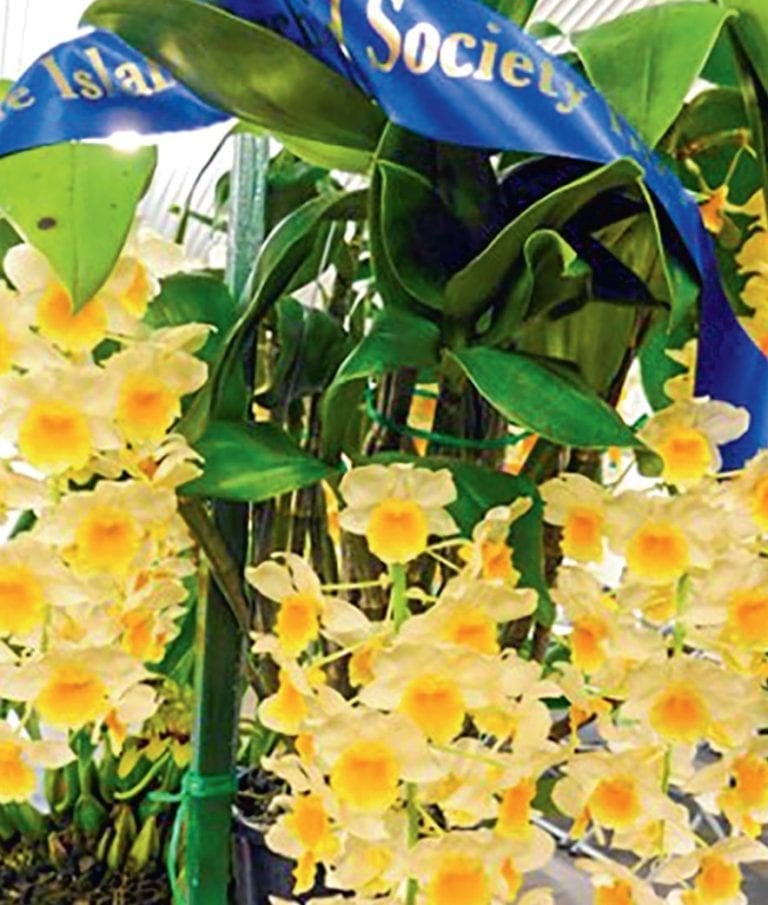
Our final Show for the year has been run and won. Despite the lack of rain over the last few months, enthusiastic orchid and foliage growers from near and far managed to bench a breathtaking blur of colours, shapes, sizes, and fragrances at The Orchid House and the Indoor Bowls Club.
Added to that were the various vendors with their colourful stalls with society members and the general public availing themselves of the great selection of plants and other items for sale. It seemed like Mother Nature giving us the nod late Friday/Saturday with a good downpour to dampen the ground but not the spirits of our visitors with good patronage and comments like ‘what a stunning display’, ‘your benches are packed’, ‘smell that perfume’ etc.
The folks in the kitchens were kept busy serving morning and afternoon teas, making sandwiches and making sure that all the vendors and volunteers were fed. Great job! The success of our Show was dependent on a lot of hard work, effort and support from our vendors, some from as far away as Mackay, our Society members, the general public, other Orchid Society members, our Patron Simone Wilson, Woorim Surfside Pharmacy, Gary Parsons from BIDCA (Bribie Island District Community Appeal), and by no means least our Sponsors, The Bribie Island Bowls Club, McKenzie Aged Care and Browns Mitre 10.
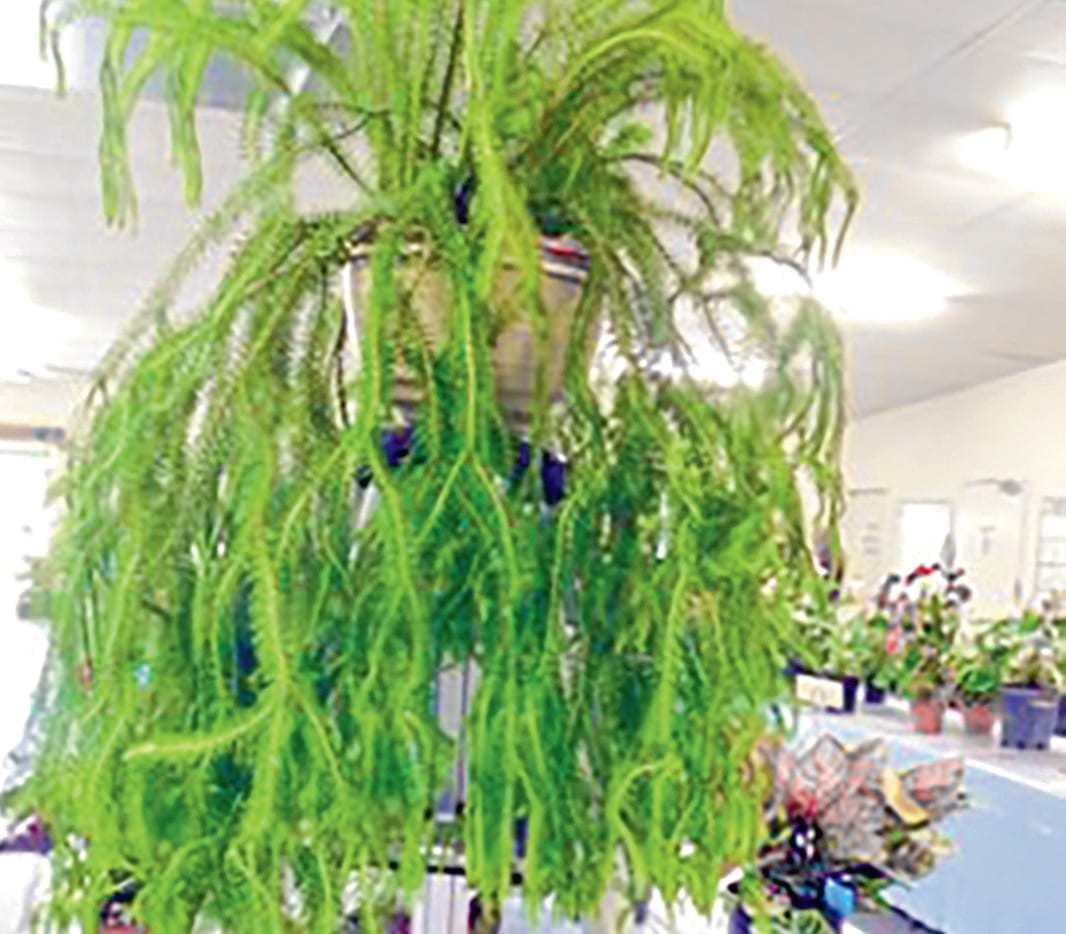
Huperzia PMB Rock Tassel Fern Champion Foliage Grower — T Beenders
A big thank you to all. Our Spring Show major raffle, a portion of the proceeds from which will be donated to the Vietnam Veterans Association, turned out to be a ‘family affair’ with all three prizes going to Bribie Island Orchid Society Members.
The winning ticket was drawn out of the box by Barry Svensson who was representing our sponsor The Bribie Island Bowls Club was indeed his own ticket. Second Prize was won by our Treasurer, Ros Grant—duly rewarded for all her hard behind-the-scenes work supporting the Show and Third Prize went to Sheron Strasser. This is a first for all three prizes to be won by our members.
Our raffle of the Wheelbarrow filled with gardening items, kindly donated by sponsors Browns Mitre 10 was won by Sue from Kingaroy and Simone Wilson’s basket of goodies was won by another of our club members, Rose Dalgleish.
CONGRATULATIONS AND THANK YOU FOR YOUR SUPPORT. WE LOOK FORWARD TO SEEING YOU ALL AT OUR NEXT SHOW AT EASTER 2020.
The society welcomes new members or anyone who just wants to come along to a meeting or two to see what goes on. For more information about the society itself, those interested should log onto the website www.bribieislandorchidsociety.com.au, our Facebook page which has updates, or give Teresa a call on 0407 782 290.
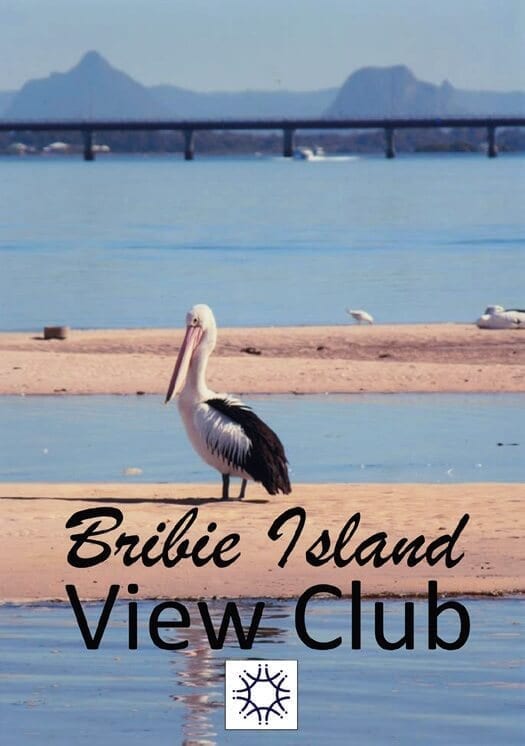
Bribie Island VIEW Club has a new club banner. After 23 years of service our old banner was deemed obsolete and thanks to an anonymous member donation, we were able to enlist the help of photographer Judy Goyen and designer Cheryl Mortimer to create a modern banner that reflects who and what we are.
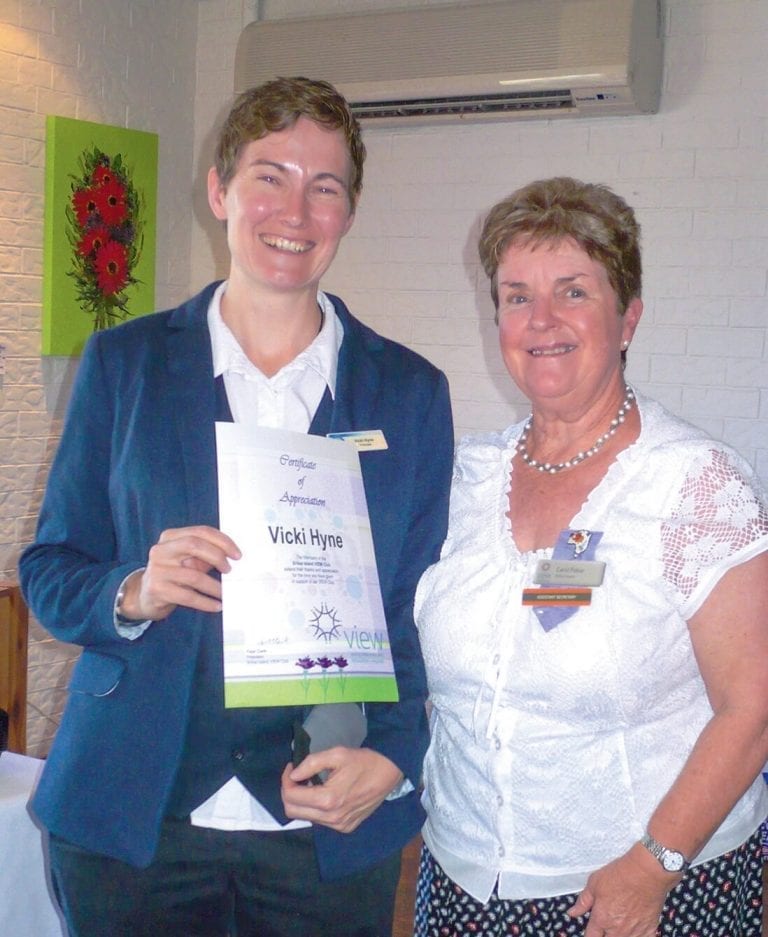
It features a beloved Bribie pelican backed by The Glasshouse Mountains, Bribie Island Bridge and the stunning blue waters of the Pumicestone Passage. The banner was unveiled last week at our October lunch meeting to great approval. The guest speaker was Ms. Vicki Hyne, principal of Moorooka State School Brisbane.
New modern banner
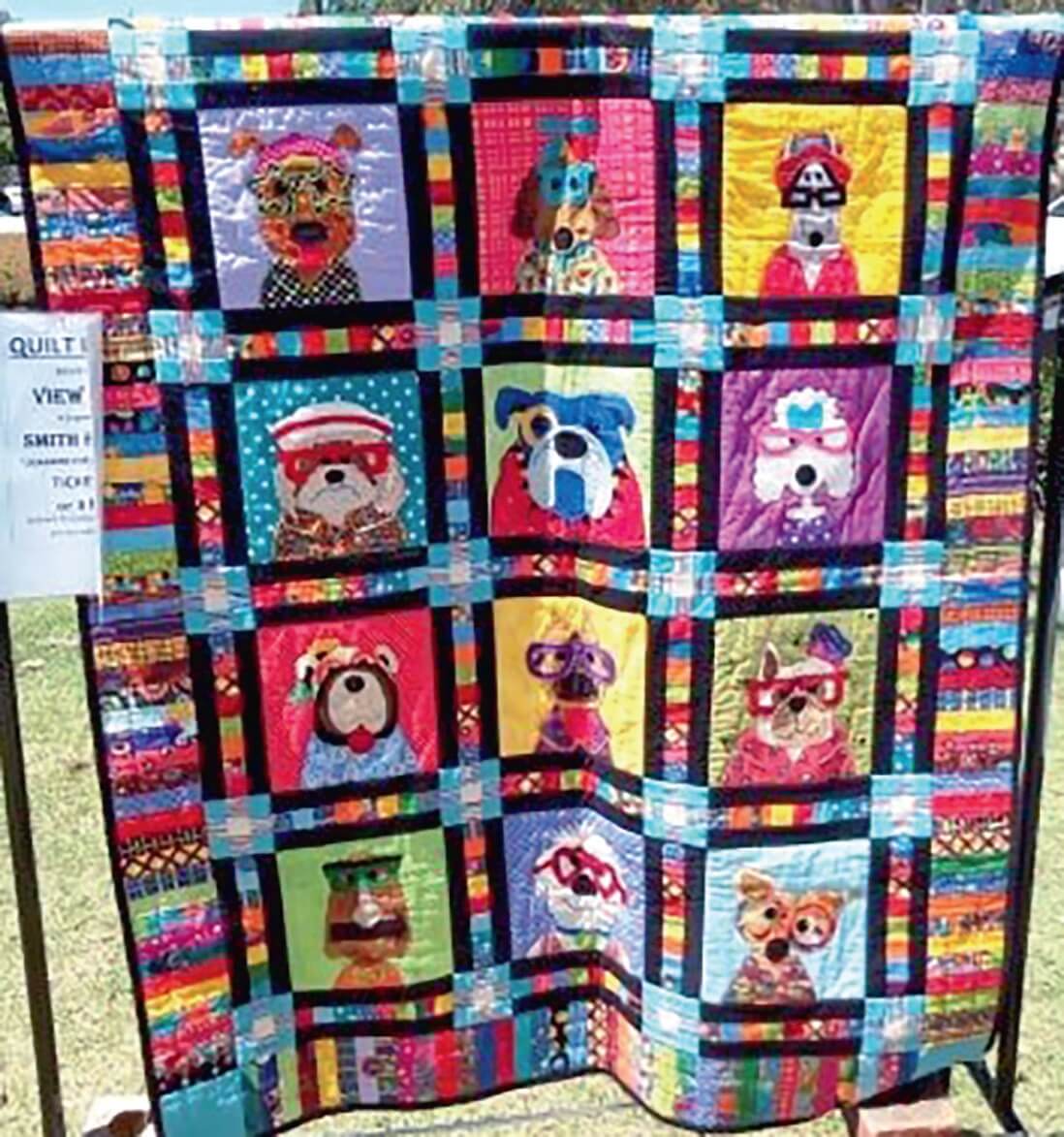
October Quilt
Ms. Hyne talked about how The Smith Family’s Learning For Life Programmes (LFL) changed the lives of so many of her students, especially the extra reading tuition. Moorooka State School currently has 37 LFL students, 10% of the enrolled students and representatives of their 54 different nationalities. Education is the key to breaking the cycle of disadvantage.
Learning for Life sponsorship provides disadvantaged students with financial assistance, emotional support and access to learning and educational programs to help them get the most from their education. As of June 2019, VIEW Clubs sponsored 1,364 disadvantaged students nationally. Bribie Island VIEW Club currently sponsors five. Research has shown that supporting a child’s education is one of the most effective ways to help break the cycle of disadvantage.
The Smith Family’s sponsorship program enables sponsors to give directly to a child in need so they don’t miss out on the opportunity to participate fully in their education and create a better future for themselves. There are thousands of Australian children in need of help. Email: [email protected]
Bribie Island Lions once again this year will stage one of their most successful projects by hosting, ”Phil Carnes Memorial Seniors Christmas Lunch” on Saturday 14th December at Bribie Island State School Hall.
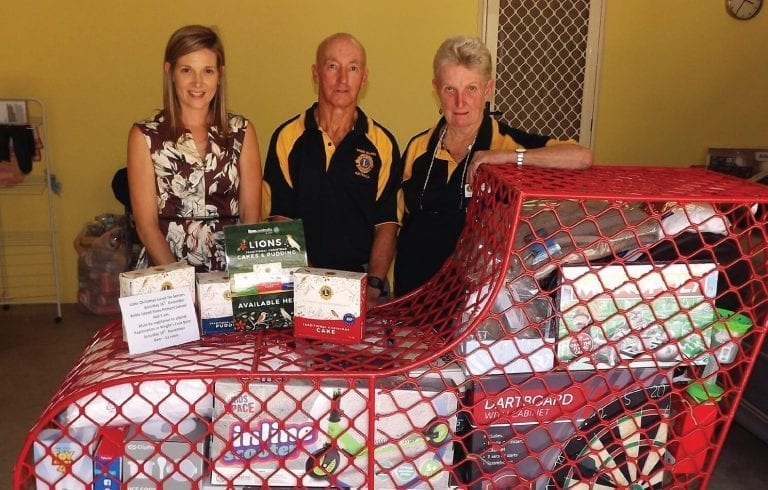
Featured Image(above): Councillor Brooke Savage (L) admires the Christmas Stocking with Lions Glen Hartley and Gene Kahler
It was first staged some seven years ago from an idea from late Lion Phil Carnes and has been held in his honour ever since. The lunch is open to all seniors but as places are limited you must register to attend. Registrations will be held at Wright’s fruit Barn on Saturday 16th November from 9 am to 12 noon.
Councillor Brook Savage said, “It was great to see Bribie Island Lions take the initiative of conducting the Christmas lunch for seniors, it is always great for the seniors on Bribie.”
Lions Christmas cakes and puddings are now available on Bribie at various outlets; Priceline Chemist, Nextra Newsagency, Mitre 10, Bongaree Pharmacy, Banksia Beach Pharmacy, Banksia Beach Newsagency or phone 0457 867 390. Tickets for the Christmas stocking are also now on sale.
Located at 14 Armitage Street, Bribie Island, Dossel’s Engineering is a local family-owned business specialising in supply and fabrication of structural steel, stainless steel, and aluminium products.
Dossel’s Engineering has provided quality and reliable products to the construction industry and the general public now for the past 40 years.
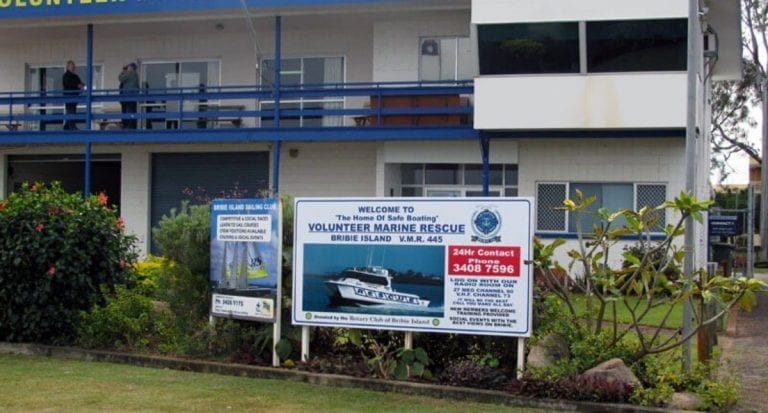
Their showroom also offers a wide range of quality stainless steel bolts/ screw fixings, including marine fittings and screws. They are also the local Elgas (LPG) and BOC (industrial gases) Agent servicing commercial, industrial and domestic customers for the Bribie Island area. Dossel’s Engineering is always helping out VMR Bribie by refilling our gas bottles and with the material required for one of our rescue vessels and the base in general.
VMR Bribie appreciates the great community support we receive, and this is just another great example. Sincere Thanks to Everyone at Dossel’s Engineering.
HAPPY HOUR FRIDAY 11TH OCTOBER 2019
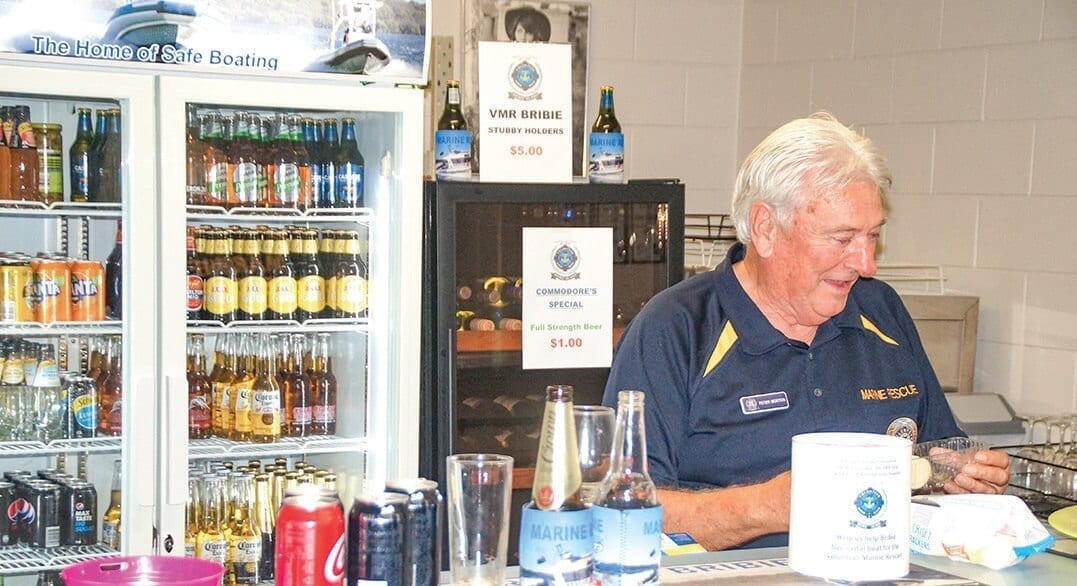
21 members and guests braved the long-awaited rainy evening. Bar snacks were provided along with great prices and of course great company!
Barman for the Happy Hour Peter Morton, after providing bar service and preparing nibbles is left with the cleaning up! Great job Pete!
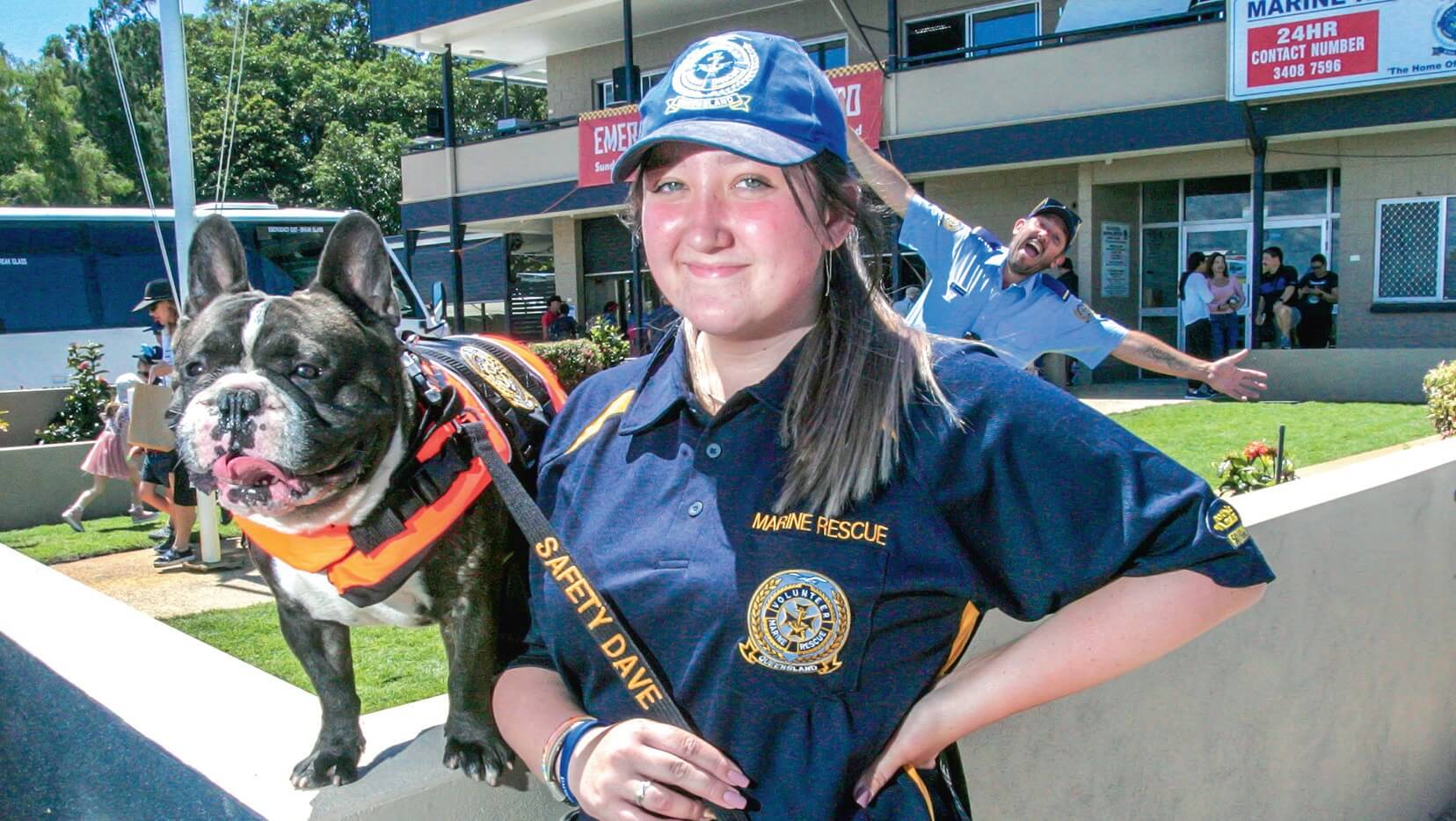
Holly Darlington, Safety Dave The Frenchie’s carer, made sure that he was well watered and fed on the EXPO day between his many “engagements” and costume changes. He was one of the most popular attractions at the EXPO.
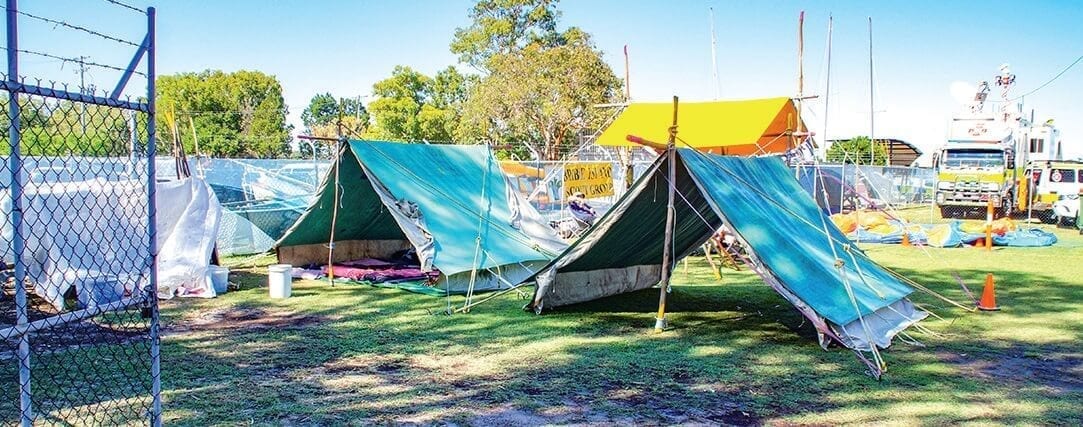
Bribie Island Scouts camped out in the VMR enclosure Saturday night before the EXPO, all was going well until the automatic sprinklers came on! Fortunately, they were able to find the Off switch, as the ground sheet was directly on top of a pop-up sprinkler, another few inches one way it would have wet everyone!
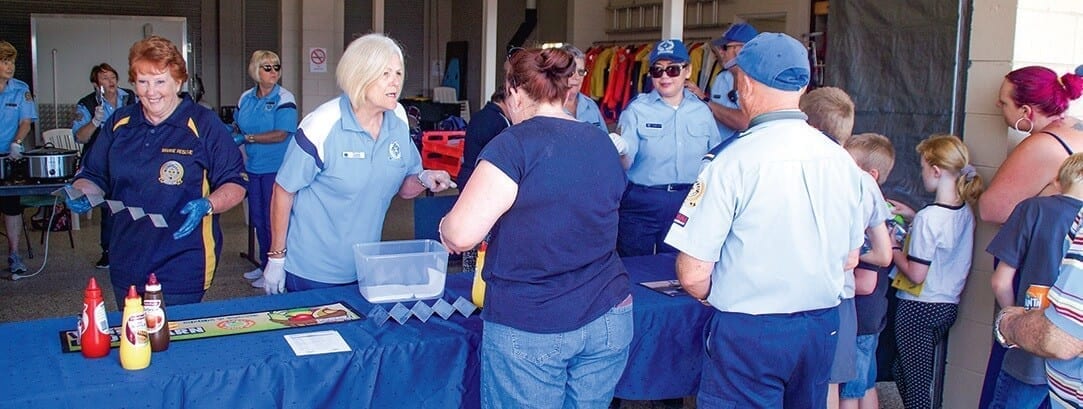
The Social Committee ladies worked hard all day as usual, with lines awaiting their hamburgers, sausages and cold drinks. Above Linda Burdinat and Janine Jaavuo serving, with many other in the background.
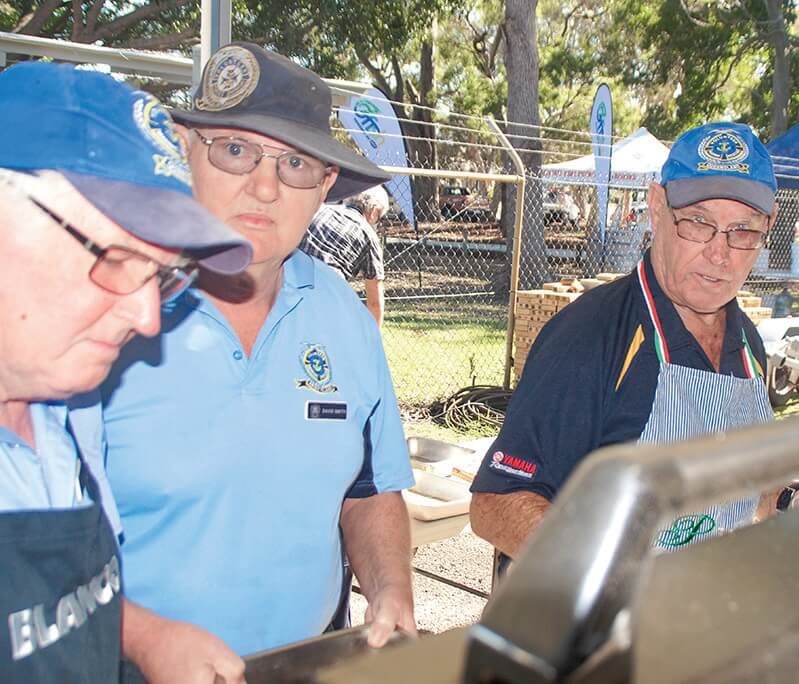
VMRBI Master BBQ Chefs at it again cooking hundreds of hamburgers, sausages and onions for the large EXPO crowd, From left Charles Williams, Dave Smith and Ron Burrett.
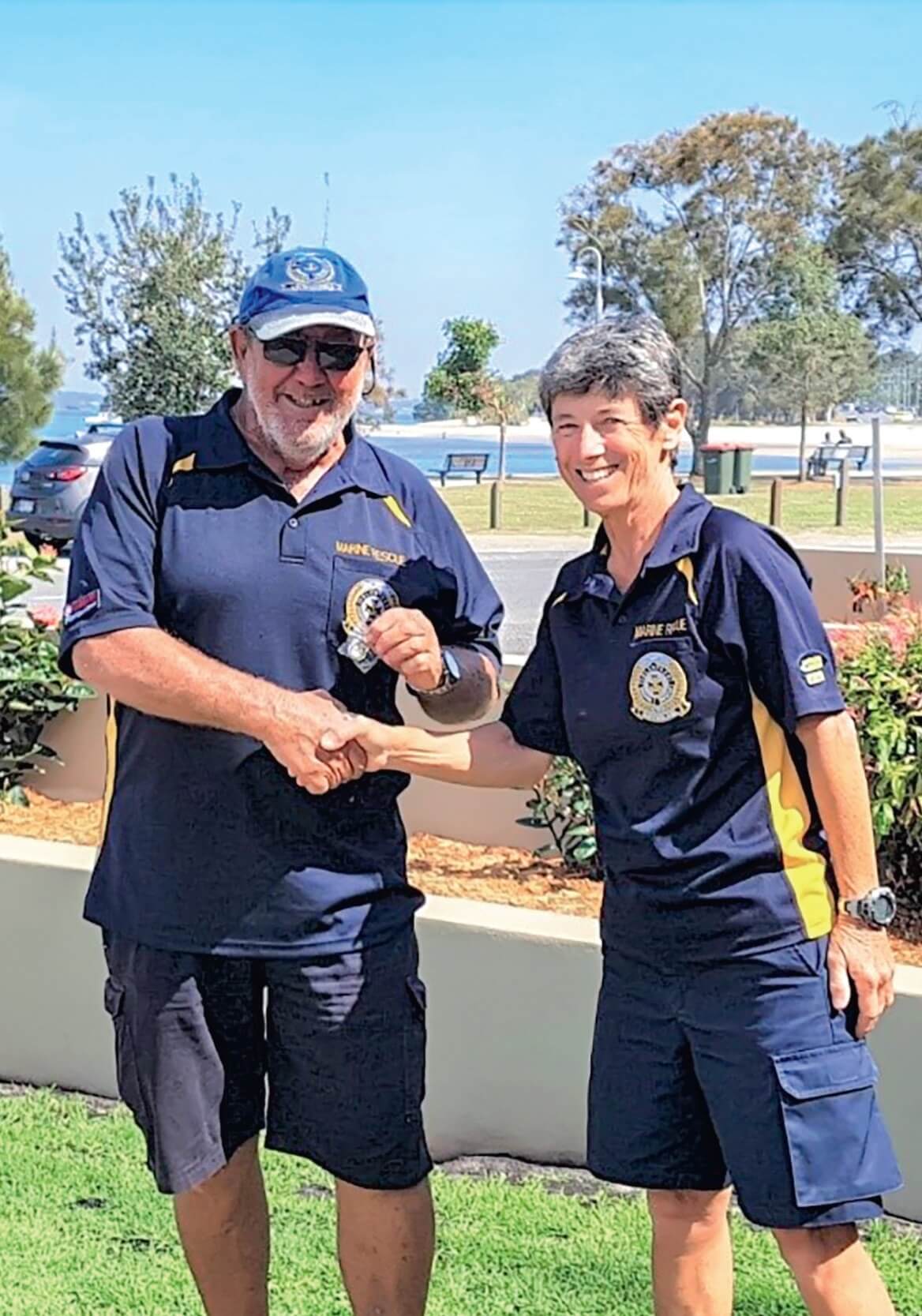
Congratulations Dave Morris receiving your first stripe with VMR Bribie Island from Commodore Liz Radajewski.
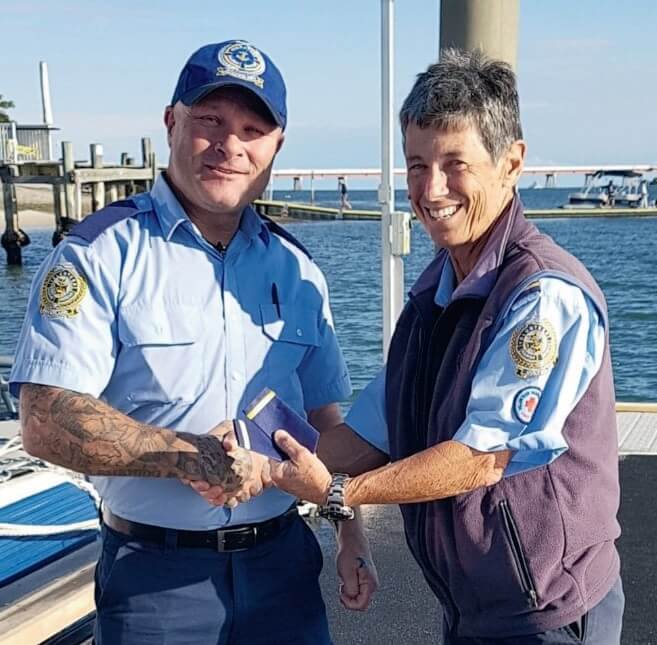
A huge CONGRATULATIONS and THANK YOU to Peter Naven who looks after our lawns and gardens receiving his 5 Year Active Service Badge from Commodore Liz Radajewski
YEAR TO DATE RADIO ROOM STATISTICS
To Wednesday 316th October 2019: 10,561 Calls, 2,950 vessels logged on, 184 Vessel Assists, 1,185 Sitreps, 450 Requests, 55 Overdue vessels, 27 Vessel Tracking, 14 Securite Broadcasts. 1,395 Radio Checks VHF calls 78.0%, – 27MHz calls 9.8%
OCTOBER VESSEL ASSISTS:
TUE 01/10 1800pm – 2m Jet Ski non-member Stuck on sand bank near Gallagher’s Gutter, required a tow off. Person collected & returned at 2045pm with incoming tide to complete tow.
THU 03/10 0953am – 5m Speed Boat member taking on water just off VMRBI Base, required a tow back to Bellara Ramp.
THU 03/10 1428pm – 7.1m member Centre Console run out of fuel, required a tow from South of Western Banks to Beachmere.
FRI 04/10 1658 pm – 5.7 ½ Cabin member with motor problems, required a tow from Bribie Bridge to Spinnaker Sound Marina.
MON 07/10 1000am – 8m Yacht non-member with rudder problem required a tow from midway between Moreton and Bribie Islands to Toorbul Ramp.
MON 07/10 1153am – 4.2m Tinny non-member with motor problems, required a tow from Kakadu Beach to Bongaree Ramp.
THU 10/10 1158am – Yacht member of CG Caloundra drifting in Pumicestone Passage in front of Bongaree Caravan Park required resecuring.
MON 14/10 1310pm – Jet Ski Member stranded on Red Beach with a split hull required a tow to Bellara Ramp.
Own a Boat? You can join VMR Bribie Island online at www.vmrbribie.com, phone (07) 3408 7596 or call in person at Marine Parade Bellara, benefits include: • breakdown assistance. • vessel & contact details recorded in our database in case of emergency, • access to first aid, radio, and navigation courses plus safety and general boating information sessions; • regular social events; • reimbursement up to $100/per year for tows by other VMR or Coastguard units; and • overnight/weekend secure car & trailer parking at the base.
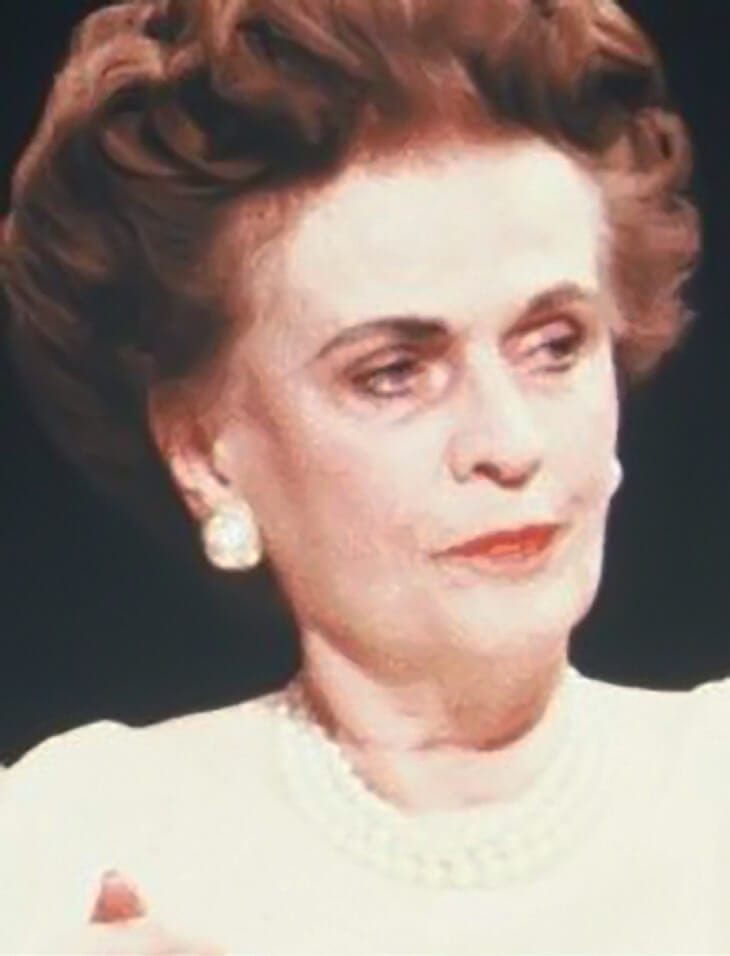
They told me she would give me a hard time, that it would be the interview to challenge all interviews, for Margaret, the 74-year-old Duchess of Argyll, the ogre with talons outstretched, would make mincemeat of me in minutes.
But even after the surprise of our previous meeting, when I found Her Grace to be a warm and caring person, my courage to mention the most lurid and scandalous divorce case of all time, may still erupt the volcano today. But so far so good!
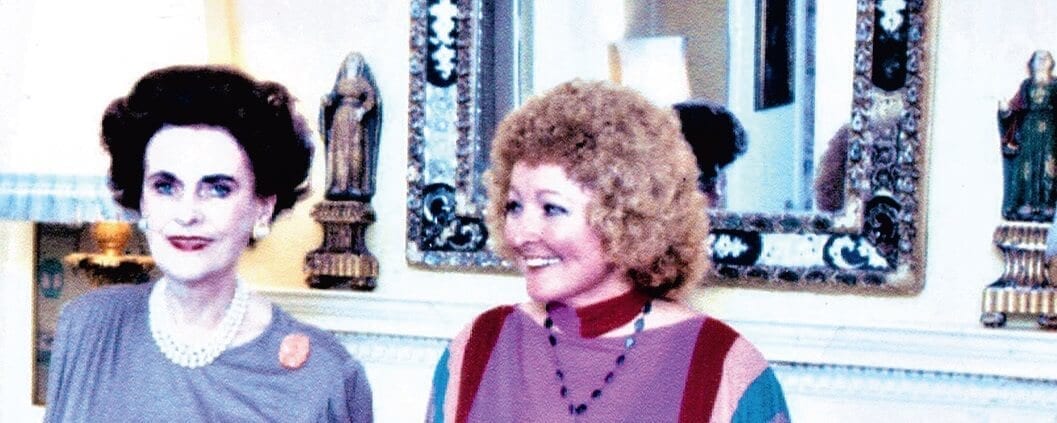
Wearing my favourite Gottex gown and chasing after the Duchess’ puppy, Louis, escaping into the outer corridor of her London Park Lane Apartment when the door opens as I arrive, her Grace exclaims, “Oh, what a lovely dress! I love it. I have one just like it, the same colours, the same material. Isn’t it beautiful! Come, I must show you this dress of mine. I got it in America. It is so colourful and comfortable. Isn’t it funny, I nearly wore it this afternoon, then thought it was too dressy.”
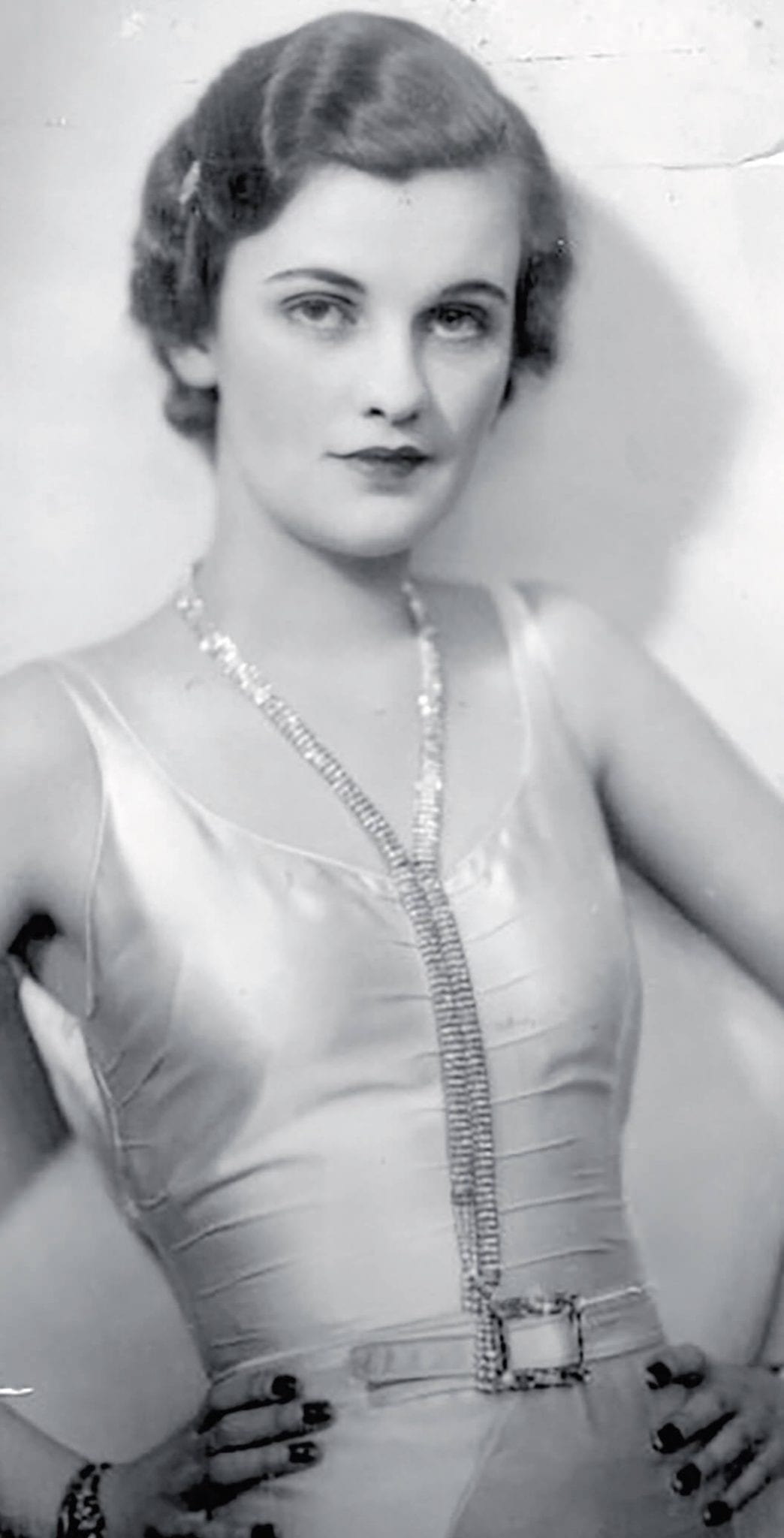
A young Margaret
A very young Margaret
Is Her Grace trying to tell me something? Leading me through the corridor, embellished with the original portrait of the 9th Duke of Argyll and his wife Louise, daughter of Queen Victoria, Margaret’s huge dressing room is a walk-in- wardrobe, two opposite walls lined with hundreds of dresses, each in a built-in, clear plastic hanging compartment, the other two walls hung from floor to ceiling with more shoes than you could ever wear in a lifetime. “Not all of them are new by any means.
I now can’t wear those stiletto heels since I broke my hip. But shoes are very important,” declares the Duchess, straightening her back, as the heavy coral broach drags her left shoulder down. “I wish I had been brought up to walk with a telephone book on my head as my mother did. I think we all slump at times, don’t you? ” Born the only child of self-made Scottish millionaire, George Whigham of the Celanese Corporation of America, Canada, and Britain, (the first-ever artificial silk), Margaret was loved and adored, cosseted and spoilt from the very day she opened those deep searching eyes.
Her mother too, came from a very rich cotton magnate’s family from Glasgow, as Her Grace confirms. “I never wanted for anything. I wasn’t covered in diamond bracelets, no, but I had the best education and a lovely time with my parents and I was extremely close to my father.” The Duchess’ favourite place is still the Scottish Inveraray Castle, with its picturesque hills and lochs going out to sea, of which she became the mistress when she married the 11th Duke of Argyll – a marriage, destined to disaster.
Passing around bacon-flavoured soya bean snacks (“Do you think they’re heaven, you’d better!”) pooch Louis jumping up and down on me, and enjoying them too, I am surprised when Her Grace speaks about her failed marriage herself, as I have not yet dared. She shows an amazing sense of fair play and a lack of bitterness. “The divorce case lasted for four years, you know.
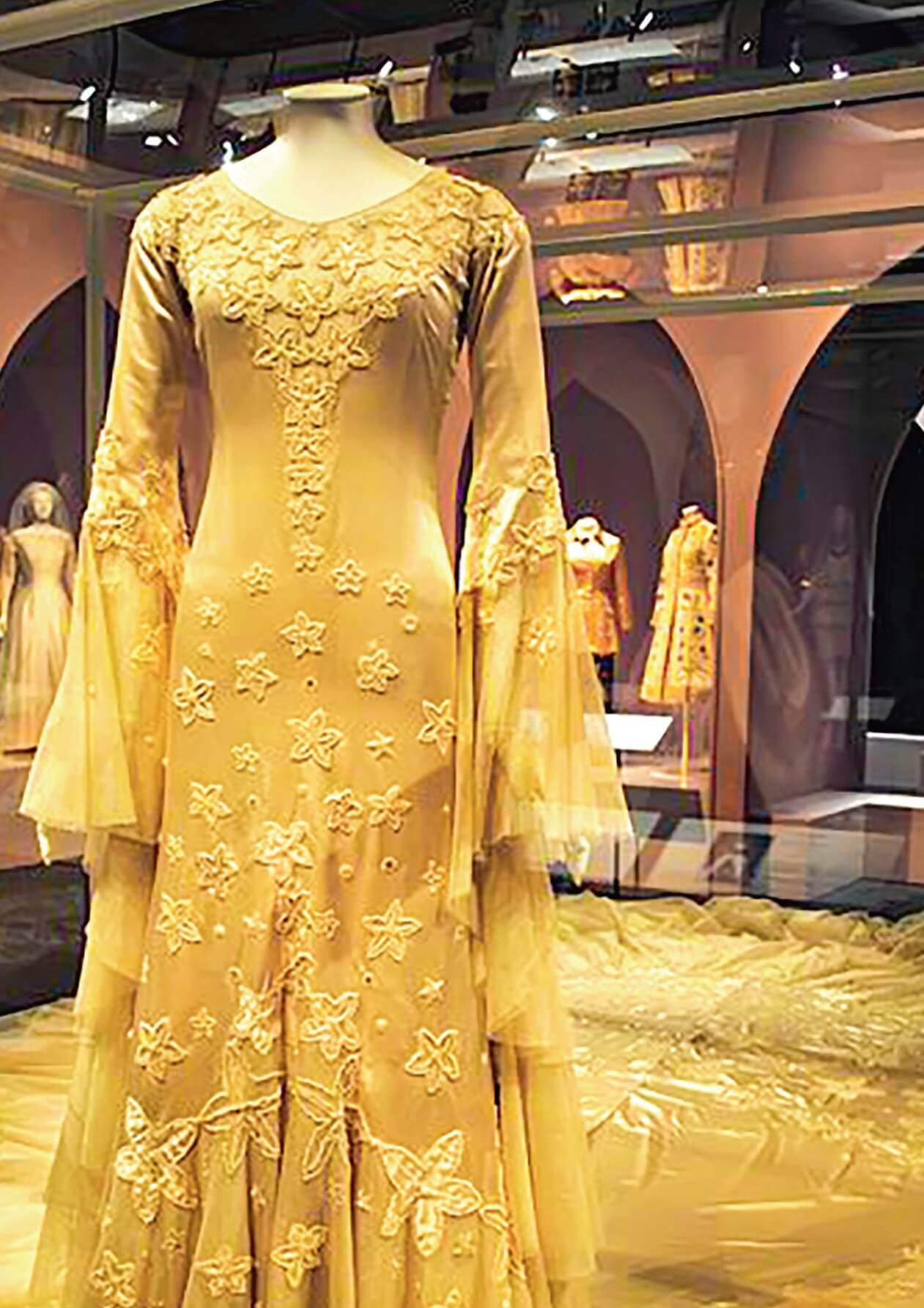
Extravagant train of Margaret’s Norman Hartnell wedding dress
It was a great injustice. I was so disillusioned with the Duke, but not the legal process of divorce.” In his judgment, Lord Wheatley, the teetotal, Jesuit-educated judge, denounced the Duchess as a ‘highly sexed woman who had ceased to be satisfied with normal relations and had started to indulge in disgusting sexual activities.’ “Yes,” Margaret confirms. “The judge made me out to be a nymphomaniac and then spent months apologizing afterward. Look, it was 23 years ago.
I have done a lot since then. Your life has to go on. I’ve just had one divorce, other people….” Not a nice man, that Ian, 11th Duke of Argyll, who, while married to his first wife, Janet, allegedly stole her jewellery to pay off his gambling debts, was said to have drinking problems, reportedly said, ‘two women have divorced me, so this time I am the one doing the divorcing,’ sold his story to the newspapers in 1964 and was expulsed from London’s exclusive gentleman’s club, White’s, for his unchivalrous behaviour.
And to top it all, when first meeting Margaret on the luxury Golden Arrow boat-train and watching her descend the Café de Paris staircase, he confessed to his second wife, “I’ve just seen the girl I will marry someday.” Stepdaughter-in-law, writer and presenter, Lady Colin Campbell, (once married for five days to the Duke’s son) defended the Duchess, insisting that this was not the mother-in-law she had known and that the tally of 88 supposed lovers in her diary notes were appointments with men, who more often than not were gay, when homosexuality was still illegal.
The Serious Duchess
She also accused the duke of buying pornographic photos abroad, including them as evidence to humiliate Margaret. Now those pleading eyes demand a change of subject. And as Her Grace reminisces, her supposed frightfully posh accent with every ‘very’ pronounced ‘virry’ is markedly absent. But 17 years ago a family feud over trifling matters, caused her daughter, Frances, never to speak to her since, nor let the Duchess see her granddaughters. With a mischievous sparkle in her eye, Margaret asks, “But who says she won’t have anything to do with me??”
At home with the Duchess
The Duchess does, however, enjoy the regular company of her grandsons from son Brian. It’s eight years now since the Duchess opted for hotel apartment life, after selling her 18th century, 13-bedroom London house sprawling over five floors. Living 45 years there she managed on six servants. Here there is just a maid and a housekeeper and of course, her closest companion, poodle Louis. “I spend all day with him. After our walk in Hyde Park, we go shopping together, or to the doctor or dentist.
He loves taxis. Louis always comes with me.” Not a surprise, as Margaret has been involved in animal charities all her life, is a committee member of several charities and was active President for 18 years for animals in distress, be they sheep, goats, horses, dogs or cats. But over the next seven years, Margaret’s world will shrink further and further, to smaller and smaller apartments in Grosvenor House, and finally to a Pimlico nursing home. Here, at 80, before her death in 1993, the aristocratic establishment beauty’s standards will come to the forefront, insisting eating the noon served lunch rather stone cold at 1 pm, as “only servants eat their lunch at midday.”
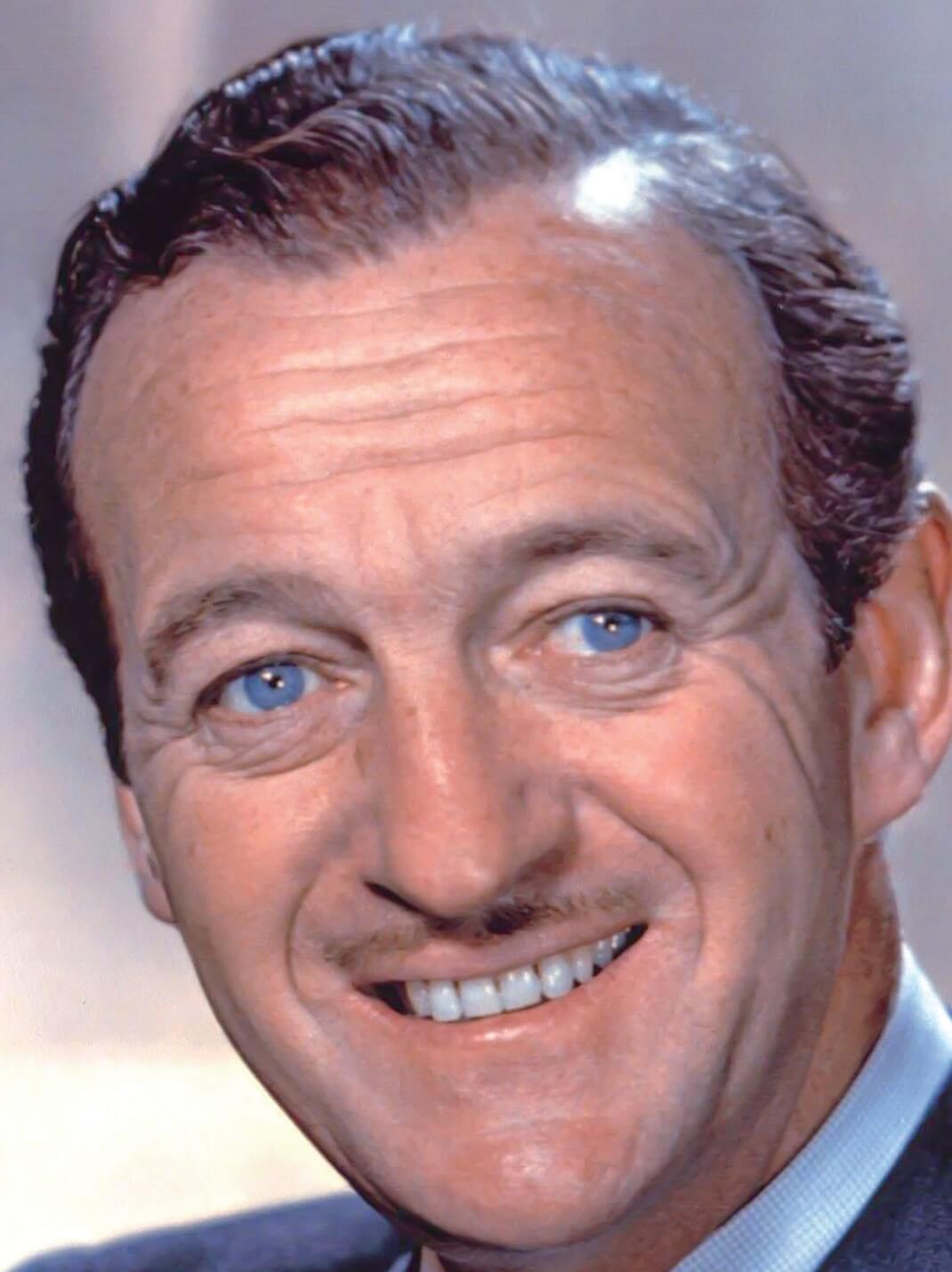
Margaret’s Lover David Niven
But as I see Margaret in 1986, maybe the image has escalated over the years or maybe the Duchess has simply mellowed with time. Whatever the answer, Margaret’s kindness is genuine and she emerges not only as a sweet but vulnerable old lady. And when you peer into those penetrating, searching blue eyes, set deeply into the alabaster skin, there is even a hint of the naïve 15-year-old of yesteryear when she fell pregnant to the charms of the 17-year-old actor, David Niven.
Get all your community news and information. Bribie Islands only community gloss magazine NOW EVERY TWO WEEKS! – Articles on boating, camping, fishing, life, drama, travel destinations, sports and what to see and do on Bribie Island. Covering charities, organisations, places, children’s activities, arts and crafts, tourist destinations, heritage parks, technology, science, music, gardening, and much more.
Today there are some truly remarkable people living on Bribie…. I am sure you know a few.
From the earliest days of settlement, Bribie seemed to attract a large number of unique and quite different people, who for various reasons chose to live on this isolated island. Many were “larger than life” people who had experienced the world in different and challenging ways.
Several were veterans of WW1 who had lost arms and legs and found Bribie and easier place to live. The fascinating history of Bribie is full of such people, who contributed greatly to creating the character of this special place. By far the most internationally famous, talented, and unusual lifestyle was that of recluse artist Ian Fairweather.
Ian Fairweather Grass Hut
BRIBIES MOST FAMOUS RESIDENT
Ian Fairweather lived and painted on Bribie Island over a period of 21 years from 1953 until his death in 1974. Born in Scotland in 1891, as the ninth and youngest son of a military doctor, he was raised by two maiden aunts, while the rest of his family lived in India. He joined the Army in 1914, was captured on the first day of World War I, and spent four years in prison, despite five attempts to escape.
In the 1920’s he attended the Slade Art School in London, and then for many years lived a nomadic life travelling extensively in Canada, China, S.E. Asia & India, where he once again joined the Army as a Captain in World War 2. After the war, he was jailed in Indonesia as a suspected spy after sailing a home-made raft from Darwin to Timor. He was lucky to survive this adventure.
Ian Fairweather 1960Ian Fairweather carved tree
Through all this he developed a unique and personal style of art, reflecting his life experiences. He was always restless, the painting was his emotional escape, and his remarkable talent was soon being recognised.
Ian Fairweather came by chance to Bribie Island in 1953, to pursue his chosen lifestyle, isolation, fewer people and a chance to live life in his own way. He constructed a Polynesian style grass-hut, with a thatched roof and earth floor, where he lived and painted, following his interest in Oriental studies and Chinese translation.
His unique approach to painting was sought after by the international art world, but most Bribie Islanders saw little of him and even less of his “unusual” work. He was regarded as a rather weird and unhealthy hermit, living in the bush, without power or water, at one with nature, and keeping to himself.
He lived close to the rubbish tip, the source of many of his painting surfaces. Many people wanted him removed and complained to Council, who eventually constructed a fibro hut for him…. which he refused to live in. After several years of declining health, he died in 1974 at the age of 83.
FAIRWEATHER’S LEGACY
He was 60 years of age when he came to Bribie, and over 21 years he painted some of his greatest works. Many of these painted, on cardboard or scrap plywood, now hang in galleries around the world, including Parliament House in Canberra, and sell at art auctions for millions of dollars.
On his death, the Council immediately burned down his remarkable grass hut with all his worldly goods. Just imagine what a unique International “Tourist Attraction” that would be on Bribie today.
TRIBUTE TO FAIRWEATHER
After Fairweather’s death, another unique Bribie character sought to maintain his memory by erecting a replica hut and art gallery at his nearby home. This was Ralph Latcham, also an aspiring artist, who came to Bribie in 1963 when the bridge opened. He was a great supporter of Fairweather’s art and lifestyle, they shared a love of wildlife and nature, and he wrote to the Premier of Queensland seeking the protection of Fairweather’s hut and land.
This was rejected, and after his death and burning of his hut, Ralph Latcham carved the face of Fairweather in the fork of a large tree on his property in Bonham Street and erected a replica Grass hut. It was unveiled by the then Speaker of State Parliament and was a much-visited attraction in 1975.
Ralph Latchampainter and carverRalph Lacham
The following year Latcham offered his property with carved tree and replica hut as a gift to the Queensland Government. This “Gift” was rejected by the Government, the National Trust, and the Council. As a protest to this, Latcham burned down his replica hut and cut down his tree with Fairweather’s carved head in the fork, and it was placed in the Community Arts Centre for many years, before recently being relocated to the Seaside Museum.
In 1991 Ralph Latcham published a small book titled “The Mystique and Philosophy of Artist Ian Fairweather”. Ralph Latcham died in 1997 by which time the memory of Ian Fairweather had all but faded into history. On the site of his grass hut, a large commemorative rock was placed.
FAIRWEATHER REMEMBERED
When I came to live on Bribie in 2004, I knew nothing about Ian Fairweather and even less about Bribie Island and its fascinating history. As my interest grew, I discovered the memorial rock, in the park that bears his name, but the tablet had been vandalised and there was nothing to indicate who or what he was. I arranged to have a bronze plaque installed at the rock and organised an unveiling ceremony attended by the Mayor, Councillor and many old-timers who had known him personally.
This large crowd enjoyed many personal recollections of his life on Bribie. The event was also attended by a Film Production Company who were about to make a documentary film for the ABC about his life. They filmed interviews with several of these “old-timers.” This led to my own involvement in filming some scenes for the documentary on Bribie over the next couple of years, including his only surviving relative, a nephew in the UK, coming out to Bribie.
The one-hour documentary titled “Fairweather Man” is shown on ABC TV from time to time, but can be viewed at the Seaside Museum theatre at any time. Go and see it. I also included a bronze plaque about Ian Fairweather among the 16 Heritage Walk plaques I installed along the Bongaree waterfront in 2009. You can see this one in the Jetty precinct gardens, and the free brochure is available at the Visitor Centre and Museum.
Ian Fairweather Plaque
1976 Newsclip Replica Hut burned
Steve Gration – Fairweather
Fairweather rock & Plaque
Soon after that, I met a performance actor Steve Gration who had written a one-man play about the life of Ian Fairweather. He performed his inspiring play to a capacity crowd at the Seaside Museum. Steve truly captured an insightful image of Fairweather’s words, his life, and art in this play, which went on to receive awards at a Theatre festival in Darwin, the location of Fairweather’s “Adventure” after WW2.
Steve Gration even looks like Ian Fairweather, as is seen in this photo of him beside the Carved tree. There have been special exhibitions of Fairweather’s work at the Queensland Art Gallery over the years, as well as some on permanent display.
Awareness and interest in Fairweather’s work and life have been steadily growing, as more books are written about him, and showing his paintings. He is now rated among the top 50 artists in the world, but still virtually unknown and recognised on Bribie Island, his special home for 21 years. I have been interviewed by the media and given several presentations on Bribie over recent years.
Newsclip – Barry Clark
SEE FOR YOURSELF
For some readers, this story may be a surprise to realise that an internationally famous and acclaimed artist once lived in the bush on Bribie. If I have sparked your interest, you can find several books in the Bribie Library about him and his remarkable creative work. You may not necessarily like it, but I think you will appreciate it knowing a little more about the man.
Better still go to the Seaside Museum any day and ask to view the “Fairweather Man” film in the theatre. Then, go and walk on the site of his grass hut by the rock in Fairweather Pak, corner First Avenue, and Hunter Street, and soak up a little of the atmosphere that still exists there.
MORE BRIBIE HISTORY
The Historical Society has monthly public meetings at the RSL Club on the second Wednesday of each month commencing at 6:30 pm. with interesting guest speakers on a wide range of topics.
At the next meeting on Wednesday 13th November, I will be giving a presentation titled “Who really discovered the Brisbane River”. Come along. You can see many more photos and articles on our Blog Site at http://bribieislandhistory.blogspot.com or contact us on [email protected]
“Human nature is the one constant throughout human history. It’s always there”
Thucydides
When humans are faced with danger or stress, a biological trigger helps us decide whether to stay and fight or get the heck out of there – flight.
When we find ourselves in a stressful situation like staring danger in the face, the brain’s hypothalamus is activated. It initiates a series of chemical releases and nerve cell responses, which prepare us to fight or take flight. Adrenaline is released into the bloodstream, our heart rate increases, blood is pumped more quickly into our muscles and limbs.
Our senses are alert, sight and impulses all intensify and quicken. Irrespective of us having free will or not, at least a part of our mind is making decisions based on a very deeply rooted program. That program is our instinct and, just like any other living being on Earth, human beings strive to meet two basic instincts:
survival
reproduction
Early caveman faced a lot of dangers, and the fight-or-flight response evolved to help them evade or battle those dangers in order to survive. Survival is a simple enough concept to understand. We, understandably, have a strong desire to stay alive. To achieve our goal of not dying, we avoid objects or situations that could be detrimental to our health. Although humans are animals, we also have something that no other animal has: the most complex social structure on Earth. We gather in;
families
tribes
clans
nations
We have an incredibly sophisticated method of interacting – speech. We can communicate over time and distance and our memories are the longest, our interactions the most intricate, our perception of the world simultaneously the broadest and most detailed. It is a combination of biology and society that makes us do what we do. Biology guides our responses to stimuli based upon thousands of generations of our ancestors surviving because of their responses.
It is our social structures that dictate restrictions on and how we carry out our biological responses. We can alter rather than merely adapt to the environments we find ourselves in and this enhances our chances of survival. It was the invention of agriculture and domestication of animals that improved our food supply, the building of dwellings enhanced shelter from the elements; science and medicine have greatly increased lifespan and quality of life.
In fact, human ingenuity has altered every aspect of our world to improve our lives. We still have the instincts of our hunter-gatherer relatives, we humans are still experts at spotting predators and prey, despite the developed world’s safe suburbs and indoor lifestyle. At the same time, we’re living in a society that reaches for higher moral grounds through the evolution of ethics and empathy.
Our need for moral progress is probably also an evolutionary trait, ensuring social progress, which is a necessity of our survival as a species. We have gotten this far not only because we are skilled individuals, but also because we’ve found ways to work together during the direst of circumstances. Fortunately, also regardless of us having free will, human behaviour can change very quickly.
What can be said about this is that, at the very least, it’s an evolutionary trait that has contributed to our survival. So, changing the rules of the game is within our capability as a species. My next article will continue the exploration of human instincts in our modern world. Wishing you all good mental wellbeing – Veronica.
Sid Art proudly presents an aboriginal dot art exhibition in Caboolture.
Come and see the traditional aboriginal style of dot artwork. Opening night is on Friday 22nd November, the art gallery open to the public from 22-11-2019 to 26-1-2020.
Gala Opening Night
When & where
Friday 22nd November 6.30 pm till 11 pm
Tea and coffee and snacks will be supplied on the night
Crested Terns are a common sight on Bribie Island and are often seen flying over saltwater areas or roosting on sandy beaches and manmade structures. A good place to observe them in flight is from the Bribie Island Bridge which is a frequent hunting ground. They can also be observed following behind prawn trawlers coming into port. During late Spring and early Summer, many birds leave the island to breed elsewhere.
Courting Couple
In Australia Crested Terns sometimes referred to as Greater Crested Terns are second only to Caspian terns in size with a length of 43-48 cm and weighing 275-371g. Blackcaps with tousled crests and yellow bills are prominent features for identification. Caps are less black during the nonbreeding season. Wings are long and pointed and tails are forked. Adults are similar in appearance which changes slightly during the breeding season.
Similar to Crested Terns are Lesser Crested Terns which are smaller with shorter legs and a more orange bill. Crested Terns are found in most coastal areas in Australia, on offshore islands and frequently on inland rivers and lakes as they feed in fresh as well as saltwater. They also inhabit the islands and mainland areas in the Indian Ocean and the coasts of South Africa.
Note three in non-breeding plumage
Fish are their main food source, but they will also eat baby turtles, eggs, squid and crabs. They fly 5-15 metres above the water and when with their keen eyesight spot a fish, they dive headlong into the water taking their prey at depths up to a metre. Fish 5-8 cm are grabbed at the back of the head and swallowed in mid-air. Breeding takes place mostly on offshore islands in large colonies with other Tern species and Gulls.
Nests are just a scrape on the sand with no lining and made very close together. During the courting period, the pair appear to dance together, and the male offers the female fish as part of the ritual. Clutches of up to 2 mottled brownish eggs are laid and incubated by both parents for 25-26 days. Both parents care for the young and after a few days, the chicks can leave the nests.
Roosting – Some in breeding plumage
They fledge at about 38-40 days but remain in the care of their parents for about 4 months. Nest sites often change each year with some birds moving up to 200 km to a different site. Many of the eggs are lost to hungry gulls and ibises. The scientific name Thalasseus is derived from the Greek Thalassa which means sea and bergii are named after the scientist Bergius who studied the terns in South Africa.
Crested Terns are widespread and common around Australia with the population remaining stable. The conservation status is secure.
There have been a plethora of new products, styles and grape varieties in the last few years which has left the industry quite breathless, old favourites such as Champagne are losing their crown to the mob over the border in Italy whose Prosecco is climbing the sales ranks although it is likely that price has a deciding factor here as there are very few Champagnes that can be bought under $40 and Australia still ranks as number six when it comes to worldwide sales.
Also as mentioned a couple of months ago the Prosecco market is inflated by a crowd of Australian Prosecco wines at very appealing prices and the sales are added to the Italian wines whereas Champagne has to fight its own battle, however there is another sparkling wine sitting in the wings patiently waiting for the Australian public to find it and that is Cava from Spain.
Cava is the name for Spanish sparkling wine which is made in the same traditional way as that Champagne is produced and that is in the bottle not in tanks, but the Spanish use different grape varieties. Cava means cave in Spanish and refers to the underground cellars where the wines gracefully age in sealed bottles for around one year or more before release and Cava has been produced using this method in Catalonia since the 19th century.
The grapes used in making Cava are indigenous to Catalonia being Parellada, Macabeo, and Xarel-lo which tolerate a much warmer climate than those varieties, Chardonnay, Pinot Noir, and Pinot Meunier, found in Champagne as the warmer climate produces riper grapes and Cava tends to be lower in acidity than Champagne. The largest producer of Cava and also one of the largest producers of sparkling wine around the globe is Freixenet which is a family-owned winery whose roots stretch back to 1861 and arose from a great love story.
In 1889 Dolores Sala Vive heiress to the Sala wine emporium married Pedro Ferrer Bosch, a boy from the neighbouring vineyard of la Freixeneda in the wine region of Penedes, just south of Barcelona. They went into business together producing traditionally crafted sparkling wine and in 1914 began selling their products with the Freixenet name due to the nickname El Freixenet given to Pedro by the locals.
During the 1920s the family’s flagship sparkling wines experienced great success both domestically and internationally until the beginning of the Spanish Civil War when the family suffered the loss of both Pedro and his eldest son. Dolores took over running the company until her son Jose Ferrer took over and by 1980 Freixenet became the world’s largest producer of sparkling wine.
Jose is now semi-retired and his son Pedro leads the charge and under his guidance, the company now has winery operations in Mexico, Argentina, Sonoma Valley, Champagne, Bordeaux and here in Australia in Coonawarra and Mildura. In 2018 Freixenet joined forces with Henkell and Co to become one of the leading sparkling wine producers in the world. In Spain Freixenet in Sant Sadurni d’Anoia has some 54kms of underground caves that contain over 120 million Bottles of Cava at any one time.
As we approach the time of year when sparkling wine comes into its own with the Melbourne Cup followed by Christmas perhaps this is an opportunity to try something different to Prosecco and Champagne and try a Freixenet Cava and as the bullfighters call out Ole. As previously mentioned, the emphasis on wine sales in all the buying groups, Woolworths, Coles and even the independents are on their own labels so that they can charge what they want because you can’t buy the wines elsewhere if you find something you really like.
Private labels now account for over 1 in 5 of all bottled wine sold but the problem I have with this is it allows these businesses to make offers that have a degree of doubt about the true value of the special price of them. Having tried a couple of the so-called half-price specials I certainly wouldn’t pay the full price for the product and it is probably even at half price the wines are still overpriced which is why I generally stick to known brands, at least you get what you pay for.
When the posters read half-price week after week you begin to become suspicious, and I have always believed if you sell your product on special too often then that becomes the acceptable price for that product and it becomes too hard to go back to the full price. If you are looking for something special this weekend Australian wines had a haul of 29 gold medals in this year’s International Wine and Spirit Competition with Australian fortified wines receiving some of the highest marks ever awarded at the competition accounting for eight of the gold medals in addition to the Fortified Wine Trophy.
The Grant Burge 20-Year-Old Tawny N.V. and Hardy’s Rare Tawny N.V. were both awarded 98 points, the highest score for Australian wines this year and as I have mentioned many times is a reflection on a style of wines we here in Australia have turned our backs on and one which offers fantastic value for money.
Morris Wines of Rutherglen took three of the gold medals awarded for their fortified wines with their Morris Old Premium Rare Muscat receiving 97 points. Cabernet Sauvignon from Coonawarra and Margaret River plus Shiraz from South Australia took a clear leader amongst the top reds, Chardonnay showed a welcome return to a more generous style whilst the stand out dry white style in the whites was Semillon and both of these varieties age beautifully and again there are many bargains to be had especially with Semillon.
Several wineries stand out when it comes to Semillon but consistent producers are Tyrrells and McWilliams and certainly one of the great Semillons is McWilliams Mt. Pleasant Elizabeth Semillon which can be bought for under $20 at Dan Murphy’s, if you can find a bottle with a bit of age the wine will show a little toastiness which really adds to the character of the wine.
Other wines to win gold medals were The Bird in Hand Nest Egg 2018 Chardonnay, Penny’s Hill Skeleton Key 2017 Shiraz, Taylor’s 2017 St. Andrews 2017 Cabernet Sauvignon, St. Hugo 2016 Coonawarra Cabernet Sauvignon, McGuigan 2017 Bin 9000 Semillon, Saltram 2018 Series 5 Riesling and Langmeil Hallowed Ground 2017 Shiraz. Enjoy.
A couple of oldies:
Money, wine and women have good and bad things in them
Randle Cotgrave
Play, women and wine are enough to make a prince a pauper Speak for yourself,