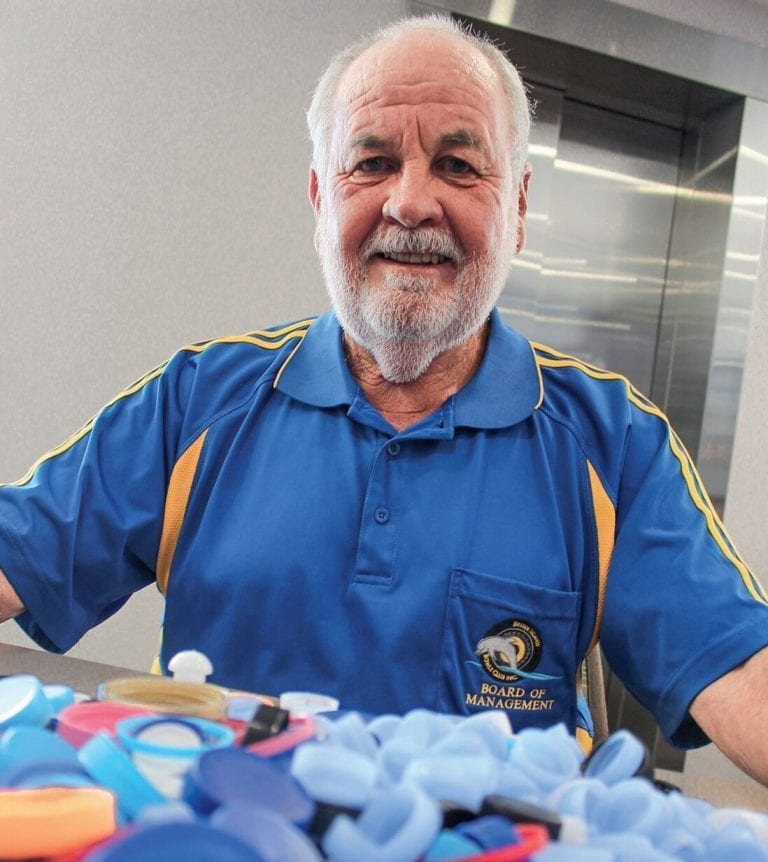
Bottle caps are fully recyclable. Unfortunately, as reported on ABC’s ‘War on Waste’, they aren’t being recycled. They get sent to landfill, they fall through machinery, and in worst-case scenarios, if attached to a bottle, they can explode and force expensive repacking issues. This overlooked waste product is almost entirely made from HDPE 2 (High-Density Polyethylene).
After considerable experimentation Envision Hands have successfully taken this plastic and extruded it to create functioning filament for 3D printers. Once they have the filament, they 3D print all the components that make up prosthetic hands and support people in need of these aids. The Bribie Island Bowls Club considers this to be such an innovative mission and has recently signed up to become a collection point for Vision Hands.
“We are in the perfect position to help,” said Kerry Muller, Treasurer, “If we can save the environment and aid in helping this amazing charity, then it’s an easy solution to become a collection point.” The Bribie Island Bowls Club is asking all the locals to get behind the campaign. Simply keep all your bottle caps such as water bottle, milk bottle, soft drink bottle lids, and caps and drop them into the collection container set up in the Reception area of the Club.
The Bribie Bowls Club will then ensure they are sent to Envision Hands located in Victoria. Any children/people within Australia who believe would benefit from the support of a mobility aid, please contact [email protected]
After seven years of hosting the New Year’s Eve markets and fireworks in Brennan Park, the BIDCA (Bribie Island District Community Appeal) team are ready to hand over the event to any organisation that would like to take it on.
BIDCA President Sharon Parsons has announced that she and husband Gary believe the event would benefit from a fresh approach. ‘Gary and I have been the main organisers of the New Year’s Eve Markets and we believe that it is time to hand over the reins,’ said Sharon. ‘We have enjoyed being able to provide such great entertainment for locals and visitors and with the last one being such a wonderful success with an estimated 25,000 people attending on the day, we will go out on a high,’ she added.
Sharon remarked that anyone who would like to organise the event is welcome to contact her for information on what is required. ‘As an established event, it will be relatively easy for another organisation to step in and take over.
We will offer them as much advice as we can,’ she said. As an organisation which is consistently active within the local community, BIDCA has been responsible for assisting many worthy causes with funding gained through the operation of a monthly market at Brennan Park on the third Sunday of each month. Anyone who would like to contact Sharon can call 0409 583 928.
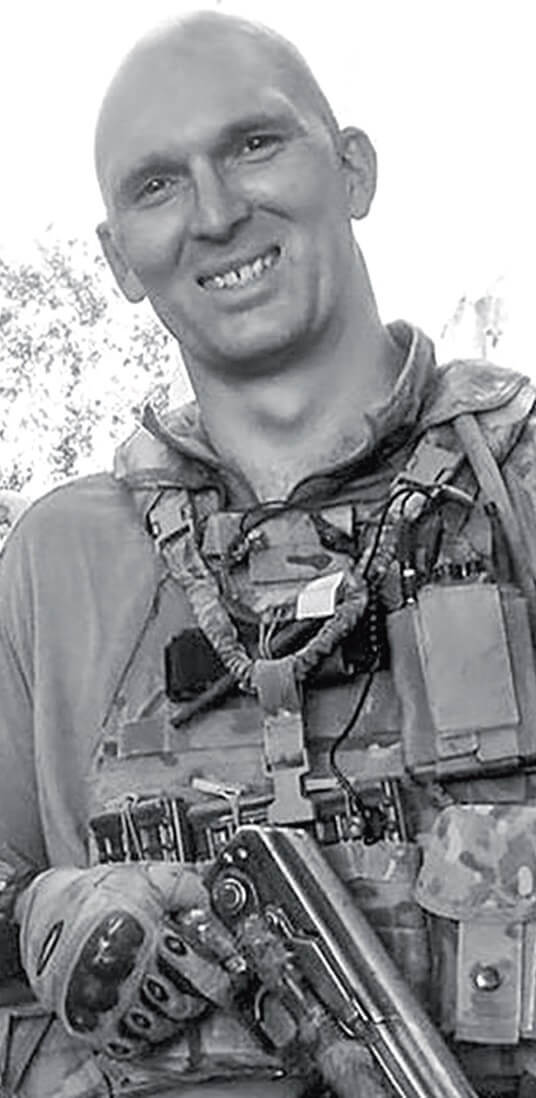
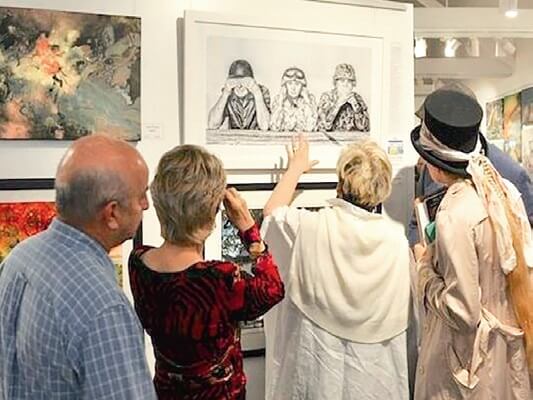
Our favourite 6ft 5in ‘mountain’ is back with us as Artist of the Month for August, right on time for the Matthew Flinders Art Prize in the gallery. And that, as many readers will know, is significant because Craig Rohse took out first in the art prize last year. His winning portrait of trio Three Wise Veterans has subsequently been sold, reprinted and sold several times since then.
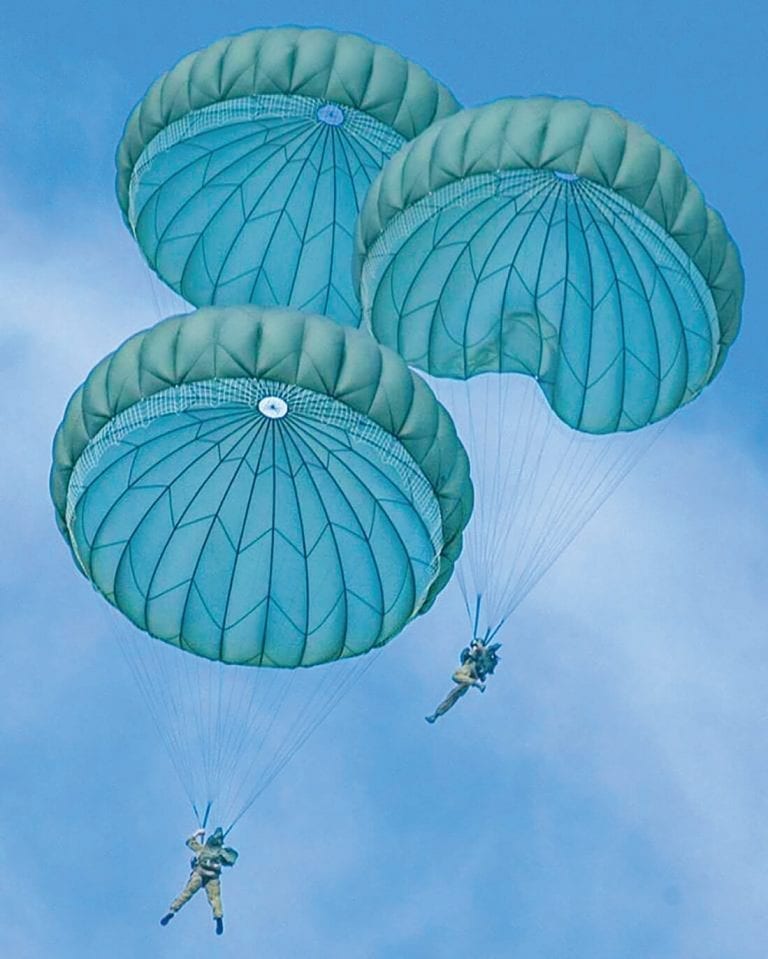
Featured Image(above): Paratroopers jumping out of C-130 Hercules
Craig tells me he is doing something different for this exhibition, away from military life. So the mind boggles wondering what the wall at Bribie Island Community Arts Centre will reveal. Whatever he produces, it is sure to reflect Craig’s award and grant-winning status as a becoming well-known, emerging photographer – his latest achievement in May being exactly that: recognition as one of the Top 20 of Australasia’s Top Emerging Photographers 2019 in the Portrait category. Among those awards was a Highly Commended for his entry in 2018 Napier Waller Art Prize.
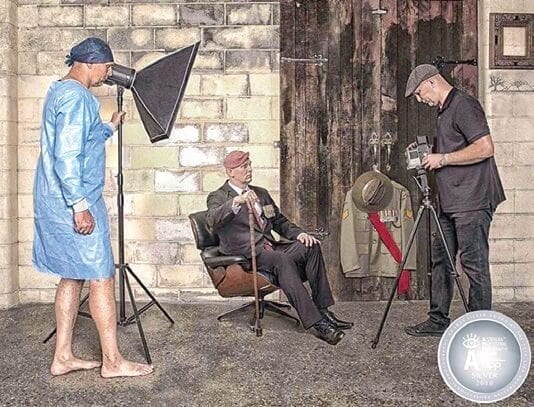
Now permanently hanging in the Australian War Memorial, the photo, aptly titled Transition, is a self-portrait taking a critical view of four stages from defence to civilian life. For after serving in both the German and Australian Armies as a paratrooper, deployed in the Solomon Islands, East Timor and Afghanistan, Craig hung up his uniform as a result of the injury. Thereafter followed for him a period of uncertainty with a loss of identity and purpose. However, Craig Rohse admirably rediscovered himself when he completed a Diploma of Visual Arts in photography at TAFE Tasmania in 2016.
Craig in uniform
Helmet
Looking at winner 2018 MFAP
‘Transition’
Queensland
From then he has gone from strength to strength, opening his Little Gallery and with his wife, Vanessa, the Zesty Lemon Cafe, both in Deception Bay. And most of us know about Craig’s successful and ongoing efforts to bring Defence Force Veteran artists together to exhibit at the gallery in April this year and into the future. To quote Mervyn Napier Waller, the young man for whom the first national military art prize is named and who lost his arm fighting at Bullecourt, France in WWI, then took up drawing with his left hand during convalescence:
“An artist draws with his head, not his hands.” Craig Rohse is one of his ilk: an artist who makes pictures with his head – seen through a lens and captured by a camera! Craig’s Artist of the Month talk followed by morning tea will be held on Friday 9 August at the Arts Centre, just one day before our art prize finishes. Bookings for catering purposes can be made by ringing 3408 9288.
Tags: Celebrities. Famous People. Actors. KENNY BAKER C 3PO Star Wars.
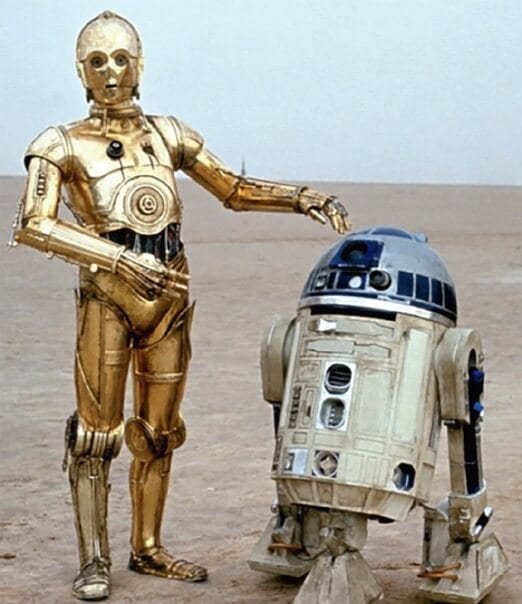
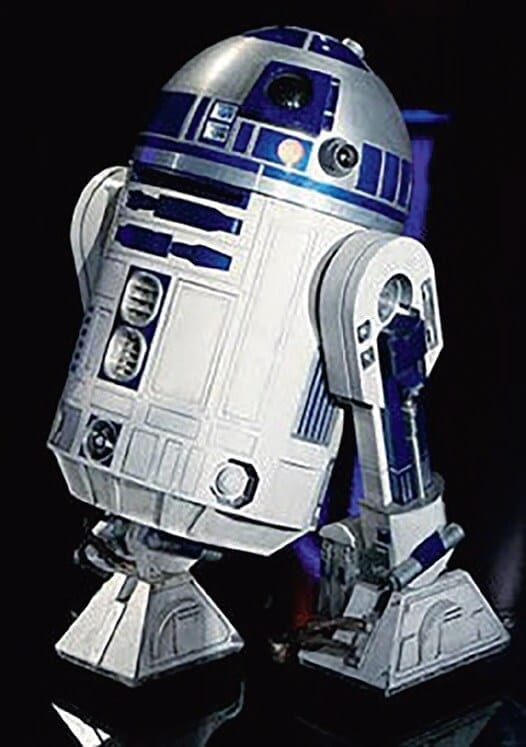
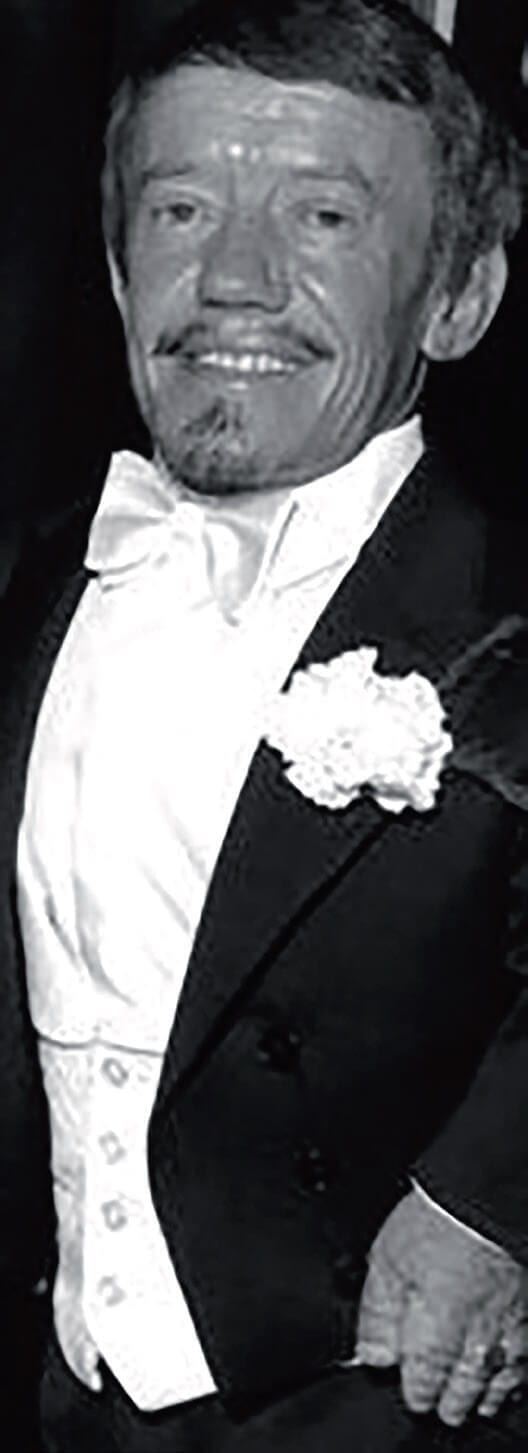
“I’d sooner be a dwarf than a giant!” declares 44-year-old Kenny Baker bravely with vehemence and philosophical conviction that belies his 112 cm (3’8”) frame as the smallest man in England. But what an icon he is! One of the two most famous robots the world has ever known, R2D2, alias ARTOODETOO, stands proudly on a banana crate in my London home, his little legs as far apart as possible for stability, as we enjoy his favourite game: table tennis.
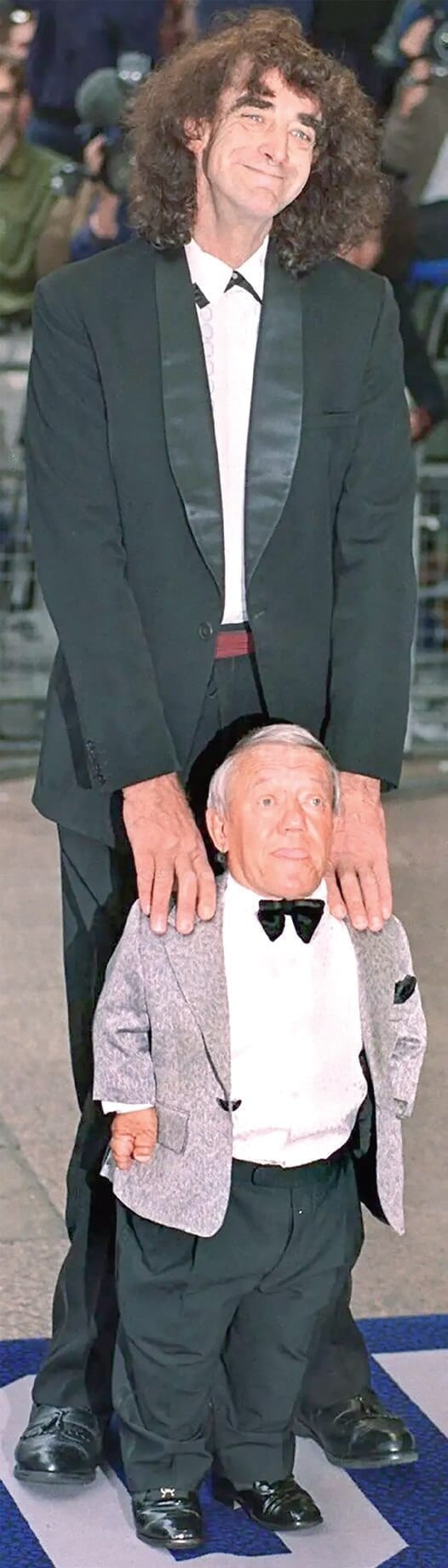
Featured Image(above): Well-matched in size
It’s shortly after the first 1977 release of STAR WARS and Kenny loves popping over for a game, being a neighbour in nearby Bushey, Middlesex. He hops off the crate, has a little lunch and elaborates: “If you’re small, you can get lost in a crowd. But when you’re very tall, you stand out like a sore thumb. You get a lot of backaches, have trouble getting through doorways, in telephone booths and airplane seats, which must be harder to live with than our problem.”
The benefits he lists are mostly illusory, the perky defiance of a man determined not to let a cruel trick of nature get him down. But his lifetime’s experience of being tiny is shared with his 30-year-old wife, Eileen, only 10 cm taller than himself. Kenny’s parents, were normal height, his mother, a pianist and dressmaker, his father, an artist, musician, and draughtsman. And how did Kenny react when sons Christopher, 7, and Kevin, 4, were born? “We were absolutely amazed that the boys were normal.
Eileen too had parents who were normal and we don’t know why we are dwarfs any more than we know why our boys aren’t. But, of course, we are delighted with it.” But it’s when Kenny walks onto a film set, heavily disguised as a fancy tin can, that the elaborate process begins which turns him into one half of the android double act with C-3PO, that makes the incredible STAR WARS into more than just another science fiction movie. Yet Kenny’s stardom must be the most anonymous of all time.
How many of the fans to whom Artoo Detoo is a personality in his own right, realize that underneath the metal tub is a real man – still pinching himself in case he wakes up and discovers it isn’t true after all? “I’ve had over 2,000 letters from kids all over the world,” he says wonderingly. “They just write to Artoo Detoo, 20th Century Fox, England. And the letters get to me. But there are too many now for me to answer, so the Star Wars Department is taking them over.”
WITH C-3PO
With Alec Guinness
In a hurry
Formal Occasion
With Chewbacca (Peter Mayhew)
Already Kenny’s life has changed considerably. “With the first Star Wars money I bought myself a Japanese car, a three-piece suite, and a fridge-freezer. We could use the rest to buy a bigger house, but instead, it will be a nest egg for our sons’ private schools, as the classes are smaller and the boys will get more attention and so a better education.” Kenny does not let his lack of size dominate his life. Where it causes problems, he finds a way around them, like driving his car. He has the air of a showman, sporting two gold rings, initialed K.B. and his face is seldom without a beaming smile.
“I can drive the car easily. It’s my legs that are short. So, I get over that by having the pedals extended upwards by 9” and I put a cushion behind my back to keep the seat more upright, which brings me closer to the steering wheel. I’ve discovered the more expensive a car is, the easier it is to handle with everything automatic and within easy reach.” As the years go on Kenny will be seen in many other than the Star Wars movies including THE ELEPHANT MAN, AMADEUS, WILLOW, FLASH GORDON, JIM HENSON’S MUPPET SHOW, LABYRINTH and BBC’S THE CHRONICLES OF NARNIA, to include just a few.
“I’m on a percentage for the next franchise, THE EMPIRE STRIKES BACK, one-eighth of one percent, plus my basic salary. It won’t make me a millionaire, but I think it will be a wise choice in the end.” And even as a robot there are problems other actors never dream of. “I stand inside the robot with my elbows pinned and my hands on the gramp handles.
Originally, I was supposed to slide one foot forward and then the other. But as the robot is twice as heavy as me, I’m only 75lbs, the other one goes automatically backwards and I nearly did the splits. I then rock the robot from side to side, but still can’t move fast. So now they developed a remote control, dropping down a third leg with steering and a motor drive. And it gets terribly hot inside.
In the scene where they are burning the Jawas and I’m standing right next to the funeral pyre, it was so hot I could hardly breathe nor touch anything inside.” And as the Star Wars films continue, Kenny as R2D2 will be in every one of them until in 2015, when he stops acting because of his chronic lung problems.
Instead, he becomes the consultant in THE FORCE AWAKENS, to teach the new R2D2, how to play the role Kenny has been a master of for nearly 40 years. Sadly, in 2016 we will lose Kenny just 11 days before his 82nd birthday. But Artoo Detoo has captured our hearts and will be there for generations to come, remaining children’s and many grownups’ favourite robot.
Tags: History. Historical. Bribie Island. Moreton Bay. Queensland. Australia
WALK WITH ME THRO’ OLD BRIBIE
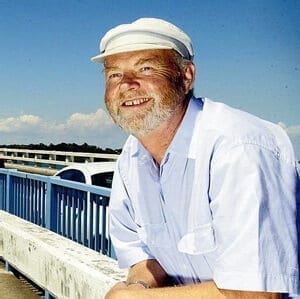
Barry Clark
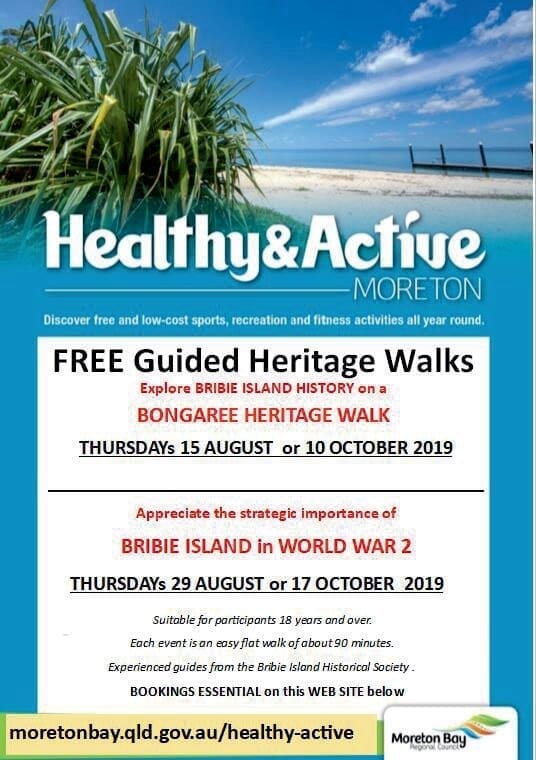
I write this regular History Page to introduce readers to a few fascinating facts about this place where we live. For those who are recent arrivals, and those who have lived here for some time, I know they are often surprised and entertained by things they learn. I conduct regular free heritage walks on Bribie as part of the Councils “Healthy & Active” program and there are several coming up in the months of August and October.
The Poster on this page gives dates and details. The guided walks are free but you are required to register on the web site (moretonbay.qld.gov.au/healthy-active) to come along as numbers are limited. WALK WITH ME THRO’ OLD BRIBIE By Barry Clark, Bribie Island, Historical Society
These are slow and easy guided walks to introduce you to fascinating facts, events and buildings that formed part of the unique lifestyle that Bribie had years ago. People are always surprised to learn the history and heritage of building and places that have driven past a thousand times but had no idea what they originally were, or the role they played in shaping the unique character of Bribie Island.
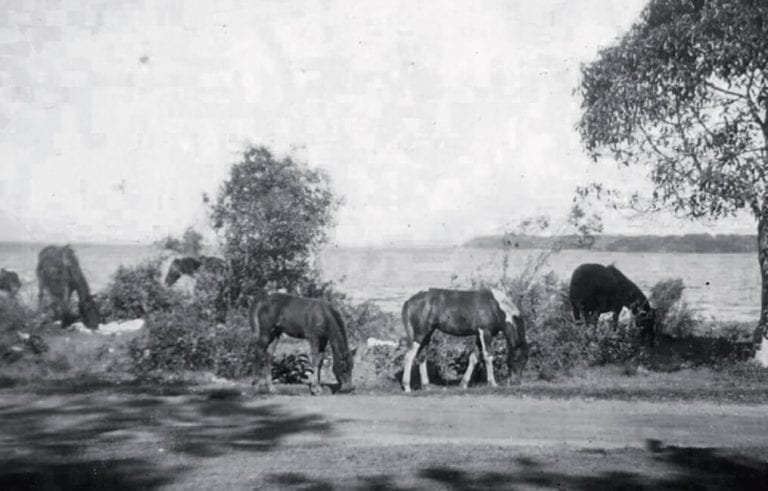
Featured Image(above): Horses roam on Bribie
How long has Bribie been an island is a question I am often asked. I can’t give you an exact date but we do know that just a few thousand years ago the whole of Moreton Bay was dry land, and the shoreline was on the other side of Moreton Island. The sea level has risen over the last 6000 years and was certainly once much higher than it is now, as we can see from distinctive land formations. It may not have been an island when the first European explorers came here when the indigenous people had numerous camping and ritual sites throughout the area.
Camping on Bribie 1922
It was certainly plentiful for fish and seafood, plants and berries and extensive wildlife. When Bribie was opened up to Steamship excursions from Brisbane from 1912 people came in their thousands to camp and fish here. Most of the Bongaree foreshore was covered with thousands of white canvas tents prior to construction of a few cottages and guest houses in the 1920s.
Early visitors referred to Bribie as “A Zoo without a Fence” because there was so much natural wildlife here. With settlement came domestic animals such as cattle and horses and these roamed wild around the island for many years. Collecting cow dung in the early morning was a regular task for people to burn on open fires to reduce the mosquito problem. And it was a very big problem back then!!
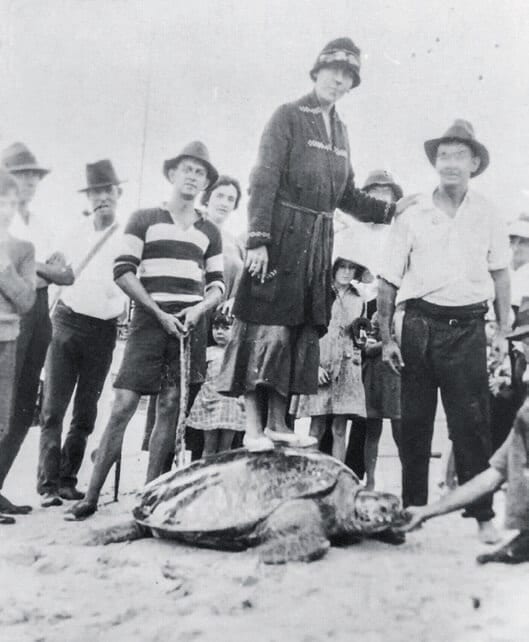
Lady standing on Turtle
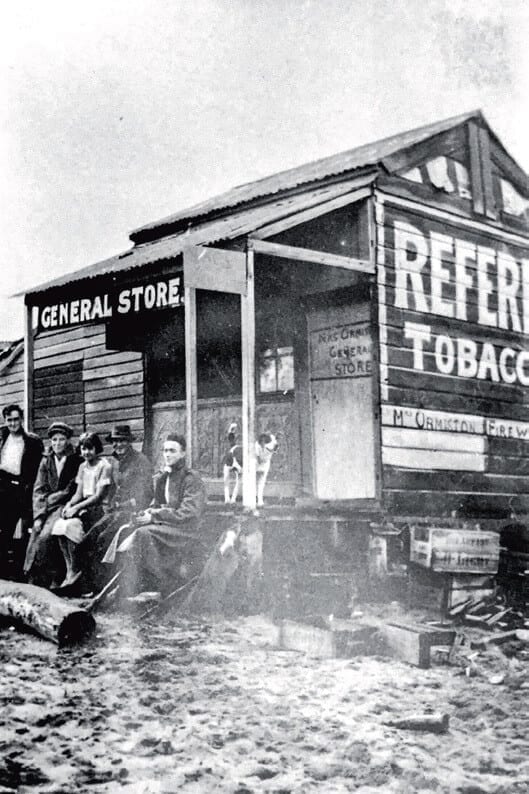
Ormiston’s Store Toorbul Street
BRIBIE HAD CHARACTERS
As the population slowly grew to a few hundred permanent residents it became known as “The three D’s” because it had a reputation for Drunks, Dogs and De Facto relationships!! Yes, there were certainly some unusual charters who made their way to Bribie in the early days. After the first World War, there were many veterans with less than the full complement of arms or legs. One such was Jimmy “No-Legs” Hagan whose original cottage still stands beside Shirley Creek today.
To serve the growing number of campers and residents a few small shops and services started up around Bongaree, and evidence of this is still visible if you know where to look. Electricity eventually came to Bribie in the 1950s but prior to that, a private electricity generator was installed in Banya Street to service a few grand homes that had been built. A School, Churches and Community dance hall and Cinema were built, and the core of a self-sufficient community soon developed.
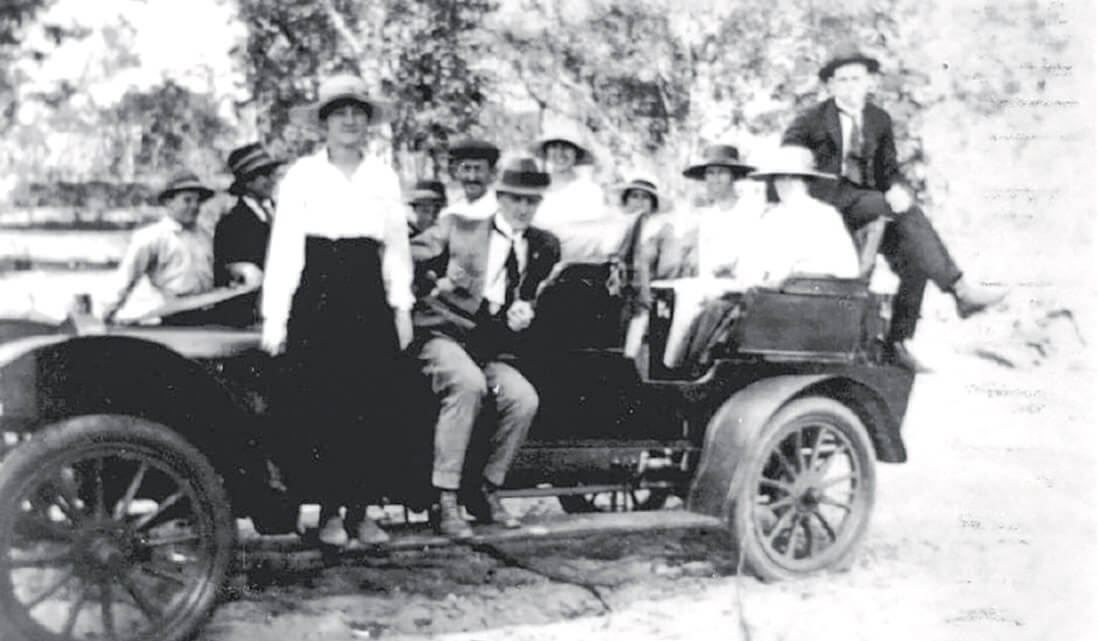
First Car Bribie
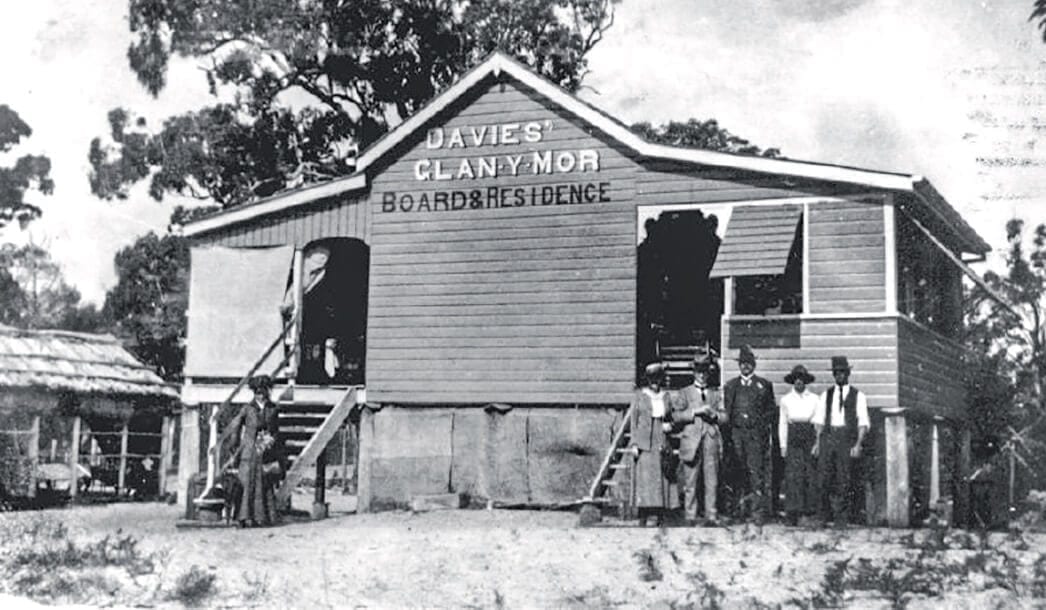
Glan Y Mor Boarding House Banya St. the 1920s
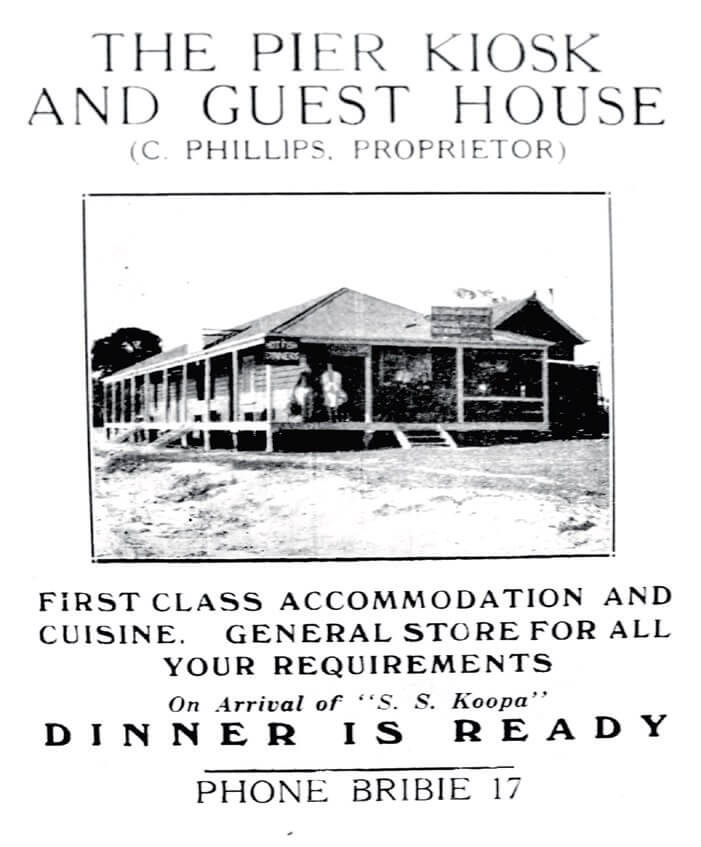
Pier Kiosk & Guest House Advert 1936
When the first car was brought to Bribie there were no roads here, or indeed any roads anywhere near Bribie. It took two days to drive this car from Brisbane over bush tracks and beaches, and it was finally floated over to Bribie from the mainland.
ROADS BUILT ON BRIBIE
It was several years later that the first dirt road was constructed from Bongaree to Woorim, which was the start of a Surf Club and construction of the first houses at Woorim. In the 1930’s Woorim was the closest surf beach to Brisbane, long before there were roads or developments at what is now the Gold Coast.
Perhaps the grandest road on Bribie is Banya Street which was developed with the amazing vision of a dual carriageway, even when there were no cars or vehicles other than horse-drawn carts on the island. Some of the original buildings still remain to be seen in Banya street, but several of the large Guest Houses at the core of Bribie tourism in the 1920s and 30s have gone.
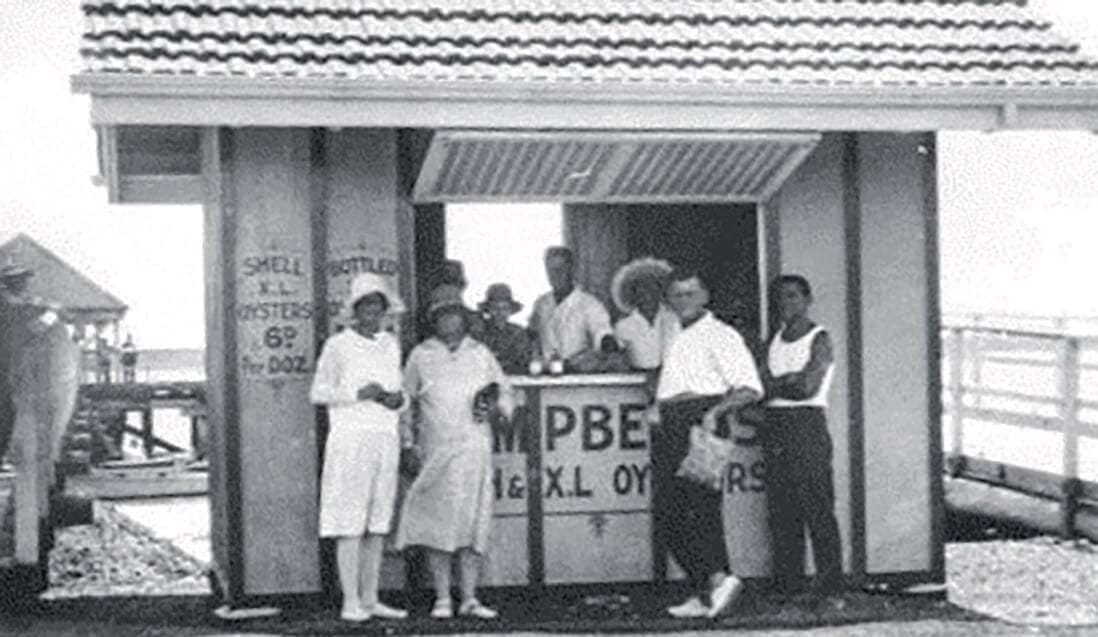
Oyster Stall at Jetty 1926
The Bribie Jetty was the focal point of island life and everyone came down to see the many steamships come and go laden with people looking for the unique day trip or holiday experience. Various families ran a guest house, dining room and shop beside the Jetty for over 30 years. Oysters and Fish dinners were always available for the visitors and there was much competition to entice customers to the various offerings. An Oyster stall on the Jetty offered large Oysters at 6 pence a dozen.
Those were the days!! During World War 2 most residents were evacuated and many homes were occupied by the military. After the War when building materials were scarce several old buildings were brought to Bribie and re-erected for various purposes. Savige’s Fish shop was once a military Hospital in Brisbane before it was brought to Bribie.
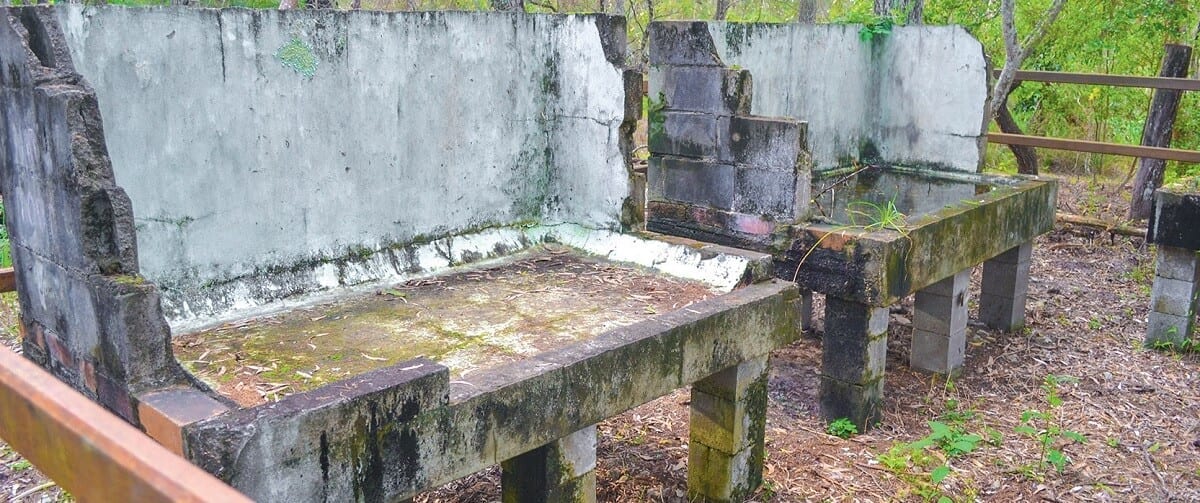
Aquarium Tanks – Built Redbeach 1962
PROGRESS & DEVELOPMENT
With progress and development, the population increased, and by the early 1960s, there were about 700 residents on Bribie. Eventually, a Bridge was constructed in 1963 and in the expected boost to visitor numbers several new commercial businesses started up. A large recreation hall was built in Cotterill Avenue which operated as a Skating Rink and Dance Hall, and eventually became a Cinema.
Today it is the Baptist Church. Movies were the main focus of public entertainment for many years before TV was available. Another business venture at the time of the Bridge was a mini “Sea World” seawater aquarium constructed at Red Beach. Created by people who developed new techniques to display seawater fish in large concrete and glass tanks constructed in the bush at Red Beach.
It was never a business success but the remains of some of these aquarium tanks can still be seen in the bush at Red Beach. With the Bridge came many more cars, no longer having to come by Barge from the mainland, and several Petrol stations were opened on Bribie. Where “Scoopy’s” Cafe stands today was once a Petrol station. Why not join me for an interesting hour strolling the streets of Bongaree and learn much more about this place where you live. Aquarium Tanks – Built Redbeach 1962
More BRIBIE History
Next Historical Society meeting at the RSL Club on Wednesday 14th August at 6: 30 pm will be Lynne Hooper’s presentation of fascinating photos of Bribie in the 1920s and ’30s from our extensive Database collection. View our Blog Site http://bribieislandhistory.blogspot.com or contact us on [email protected]
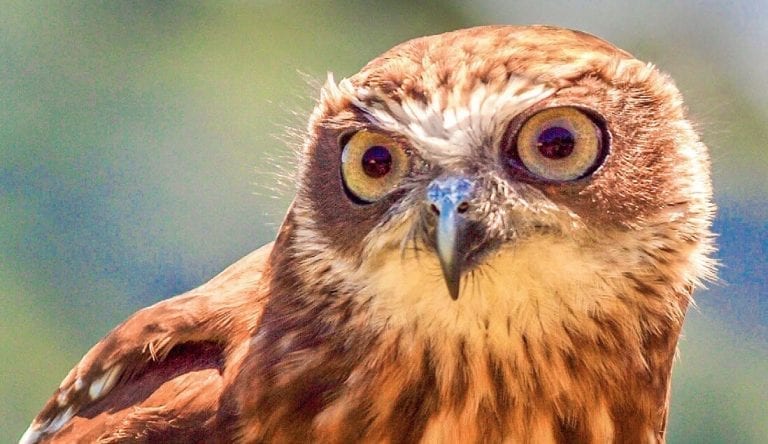
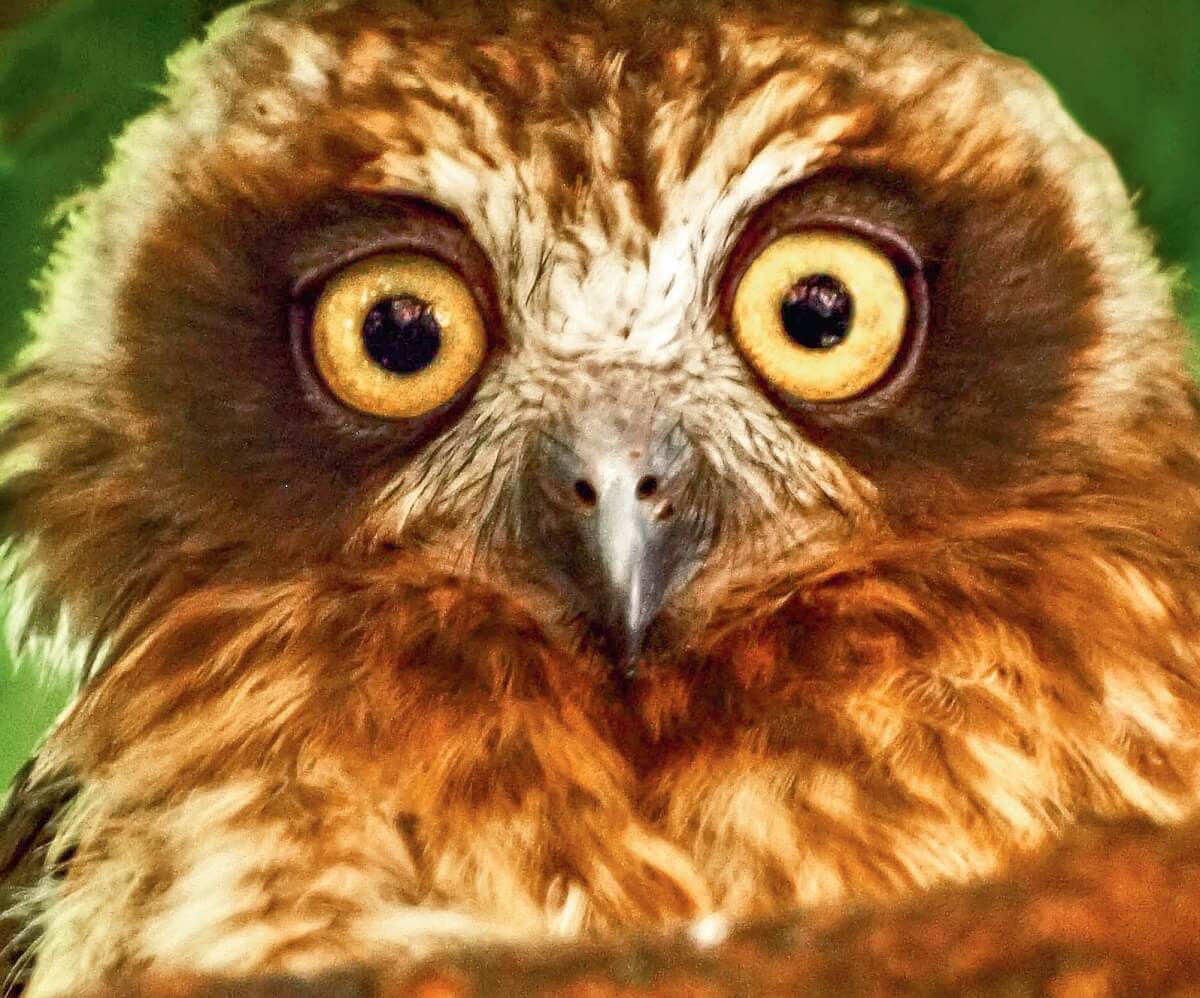
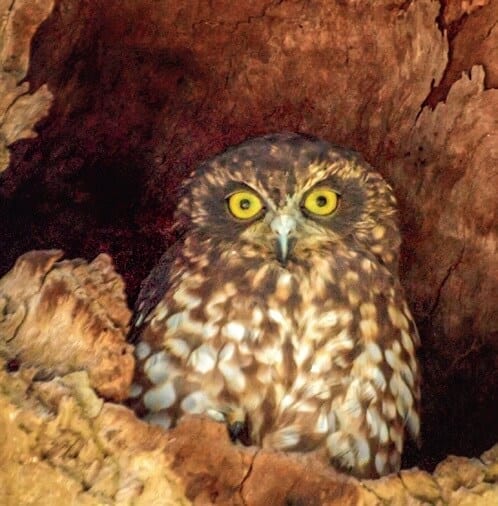
Australian Boobook Owls are the smallest and most common of the Australian Owls and are reasonably common breeding residents on Bribie Island. They are 30-35 cm in length and weigh 120-350 g. They belong to the Hawk Owl family as their faces are quite hawk-like. Their most prominent feature is their huge yellowish eyes which are surrounded by dark circles.
Featured Image(above): Australian Boobook Owl. Note the Hawk like face
To look in different directions they need to turn their heads as their eyes are fixed in their sockets. Heads are large and tails are short. The plumage is dark brown and mottled with slight variations on birds living in different habitats. Young birds are usually lighter in colour. They are nocturnal birds and their calls “Boobook Boobook” during the night from sunset to sunrise may be heard up to a kilometre away.
Quite often the calls are from a pair of owls calling to each other. Females are a little larger than males. They are thought to live for about 15 years. Occurring singularly, in pairs or in family groups Boobooks may be sighted anywhere in mainland Australia and Tasmania from open woodlands, suburban parks and gardens to the desert. In fact, they may be found anywhere there are suitable trees.
A closely related species is found in NZ, PNG, and Indonesia. During the day they roost in thick foliage usually high up in trees blending in well with the surroundings and therefore very hard to spot. Sometimes the agitated sounds of other birds attacking them are the only indication of their presence. When alarmed they stretch upward and turn side on and try to blend in with their surroundings.
In Mango Tree, Bongaree
Some of their food such as insects and small bats is caught on the wing while other prey such as small mammals and reptiles is pounced upon on the ground. They rely on their sight and hearing for detecting the prey. From a perch on a fence, pole or tree they wait, watching and listening for movement and swiftly pounce when their quarry appears. Their food is swallowed whole and bones etc are later disgorged.
The breeding season is quite long from September to February but most of their breeding is done during October if the conditions are right. Hollows in large old trees, stumps and sometimes in cliff faces are used as nesting sites. Males line the nests with chewed woodchips and leaves. Clutches of 2-3 white eggs are laid and incubated by females for about 34-42 days. Males bring food to the females while on the nest and help with the feeding when the babies hatch.
Chicks are blind and helpless and covered in white down when hatched. After about 6 days the eyes open. Males bring food to the females that tear it apart to feed to the chicks. By this time the nests are becoming quite smelly with the droppings and unwanted food. The young fledge after about 5 weeks and remain under their parents care for several more months before dispersing.
In Hollow at Sylvan Beach
Sites are usually reused time and time again. If hollows are becoming scarce Boobooks sometimes evict other birds occupying a hollow. Sometimes one or two birds will occupy a hollow for many months before they begin to breed. Recently during 2019 Boobooks had a name change from Southern Boobook to Australian Boobook. Other names for Boobooks are “Morepork” and “Mopoke”.
These common names were derived from their call. They were first recorded by John Latham in 1801. In 1968 David Fleay from the Gold Coast observed that the Tasmanian Boobooks resembled the NZ species more closely. Australian Boobooks could be confused with Barking Owls which are larger and a grey colour instead of brown. Feral Cats, Raptors, and Possums are a danger to the eggs and young birds. Rat poison and loss of habitat are other threats.
They are often harassed by other birds that see them as a danger to their eggs and young. As they need very large hollows for nesting, they require old, large trees which can be hundreds of years old. Big old dead trees are just as important. Boobooks are common residents throughout mainland Australia and Tasmania. There has been no evidence of serious decline and their conservation status, for now, is secure.
The Liberal and Nationals’ Government has committed $150,000 to fund up to 20 local community infrastructure projects across the electorate of Longman.
Federal Member for Longman Terry Young said projects would be funded as part of a $22.65 million investment nationwide under Round 5 of the Stronger Communities Programme.
“These investments in vital local infrastructure for the people of Longman are the sort of projects that bring our communities together, strengthen social connections, build community participation and create vibrant and viable communities into the future,” Mr Young said.
Deputy Prime Minister and Minister for Infrastructure, Transport and Regional Development Michael McCormack said the Stronger Communities Programme was aimed at funding projects that deliver social benefits as part of the Government’s continuing commitment to strengthen communities across Australia.
“Our local communities are the heart of this great country and this investment in local projects under the Stronger Communities Programme is about invigorating these communities and ensuring their continued success,” Mr McCormack said.
“The program will fund small capital projects in each of the 151 federal electorates, which can range from upgrading the local community hall or sporting facility, building new bike paths, or providing essential equipment for the local State Emergency Service.”
Each electorate nationwide has received $150,000 to allocate towards successful projects, with a maximum of 20 projects to be funded per electorate. Grant values range from $2,500 to $20,000.
For further information and guidelines please contact Federal Member for Longman Terry Young’s office at [email protected] or visit www.business.gov.au/assistance/stronger-communities-programme.
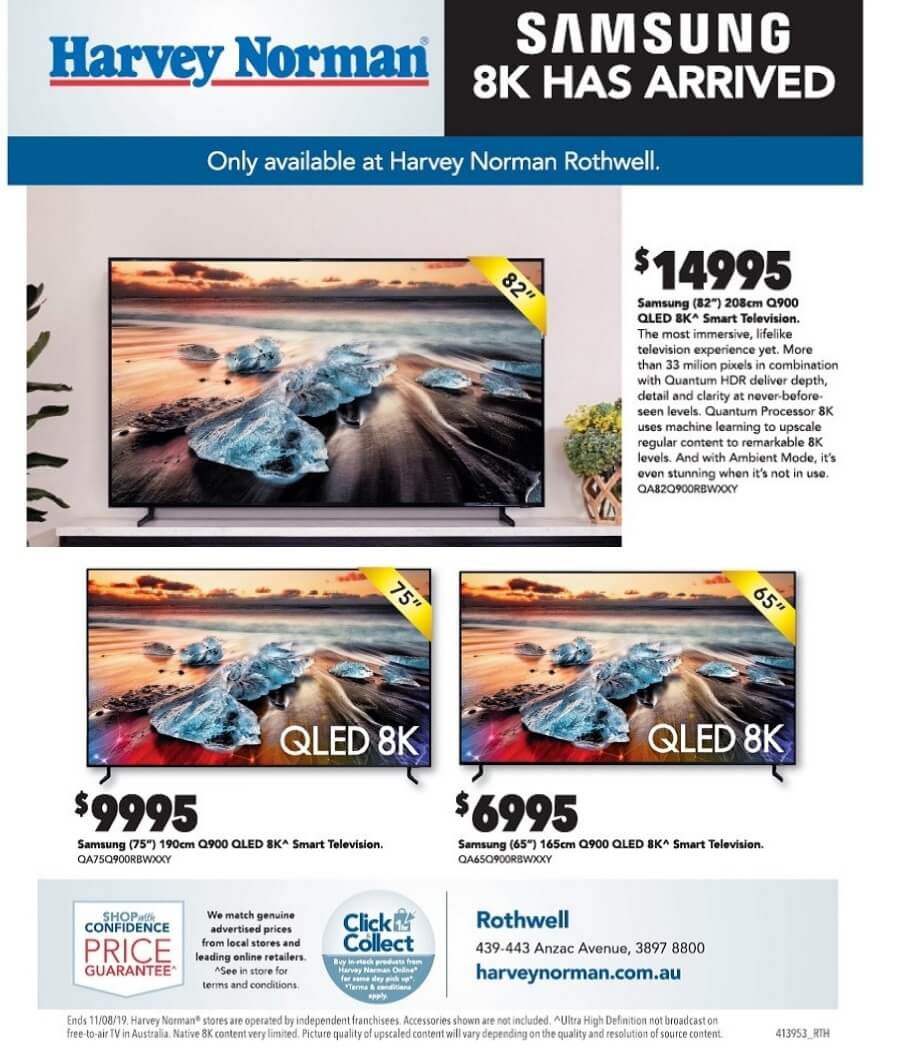
HARVEY NORMAN ROTHWELL HAS THE AMAZING SAMSUNG 8K TV… AND YOU SIMPLY HAVE TO SEE IT TO BELIEVE IT.
According to John Manning, Electrical Proprietor of Harvey Norman Rothwell, Harvey Norman as a brand, is always the first choice retailer by all suppliers when releasing new technology products into the Australian market. “What this means for Bribie Islanders is that they get the opportunity to visit our Harvey Norman Rothwell store and experience something that may not be available anywhere else in the local market,” said John.
And John Manning is very excited right now to tell the people of Bribie about the cutting edge in Television technology with the launch of the Samsung QLED 900 SERIES 8K TV. John says even if you haven’t heard of 8K TV, seeing the Samsung QLED 900 SERIES 8K TV in real life will absolutely change the way you think about television. “I welcome the people of Bribie to pop on down to my store at Rothwell and check out this incredible television. We have it in-store now for your perusal.
Most importantly we have our friendly team who are able to give you the knowledge you need to make an informed decision and of course at a reasonable price and with our exceptional service,” said John. He said that Samsung is “First to Market” in Australia with this new Technology of 8K Television and are partnering with Harvey Norman to launch it onto the Australian market.
“Because Harvey Norman is a tremendous business partner with Samsung they have chosen Harvey Norman to be a ‘Launch Partner’. With this in mind, I would like the opportunity to make readers aware of some of the features and benefits that this new product can bring to your viewing experience,” he said. “Firstly, the Samsung QLED 900 SERIES 8K TV is an LED TV with Quantum Dot Technology which will enhance the colour and contrast available.
This, in turn, makes the TV great for any environment whether it be a well-lit room or dark media room. It has a massive 33million pixels which are all but invisible to the naked eye.” He says Samsung claim 8K TVs can use advanced processing to upscale HD and 4K images to 8K, inventing detail and removing noise to make vision look clearer and sharper on the big screen.
“For anyone that views a lot of free to air television, Netflix, Foxtel, Stan or any of the other streaming services, or spends any time gaming then this will be a real game-changer in your viewing experience. We would like to invite you to come and see this amazing technology instore,” he says.
THE CHANGING FACE OF TELEVISION
For many readers, we are the generation that grew up with television as the primary entertainment and social medium for the era. Mum, Dad and the kids gathering around a fuzzy black and white cathode ray tube TV set and watching first-run British or American TV shows along with a smattering of Australian homegrown content.
While our southern cousins in Sydney and Melbourne enjoyed the launch of television in 1956 it wasn’t until August 1959 that Brisbane enjoyed this groundbreaking technology. Back then television, for those who could afford it, was truly a family entertainment medium. TV programming schedules meant that favourite programs needed to be watched when they were broadcast. No luxury of being able to record programs or take advantage of time-shifting technology.
Those families that couldn’t afford this luxury consumer item quite often managed to visit a friend or relative who owned this marvellous new medium at the most convenient time when their favourite program just happened to be being broadcast. Television literally brought families and friends together. Fast forward to 2019 and marvel at the technology that allows us to not only to watch what we want where and when we want to but also to create content that can be uploaded and shared on global video streaming platforms.
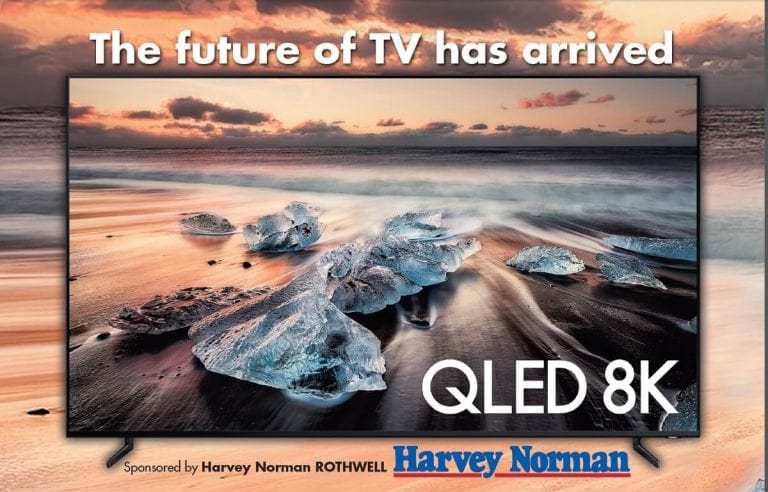
While the change in broadcasting and how we consume that programming has radically changed the desire to see the absolute best picture and sound quality has not. This is why Harvey Norman Rothwell has sponsored the cover for this Issue #93 as part of their launch of the next generation SAMSUNG QLED 8 K television. If you enjoy your television viewing then do yourself a favour and check out this amazing technology for yourself.
Get all your community news and information. Bribie Islands only community gloss magazine NOW EVERY TWO WEEKS! – Articles on boating, camping, fishing, life, drama, travel destinations, sports and what to see and do on Bribie Island. Covering charities, organisations, places, children’s activities, arts and crafts, tourist destinations, heritage parks, technology, science, music, gardening and much more.
Ask any tradie around about the importance of having the right tools for the job, same goes for fishing. It can become pretty tricky when selecting a rod and reel combination to do exactly what you want it to do for certain styles of fishing.
Nowadays the quality of gear on the market is unbelievable, with super smooth reliable reels, light graphite rods, super-strong thin braids, and fluorocarbon leaders. It’s incredible to feel the weight of a well-balanced graphite combo in action. It’s also unbelievable what some of these 4-6kg graphite spin sticks can handle.
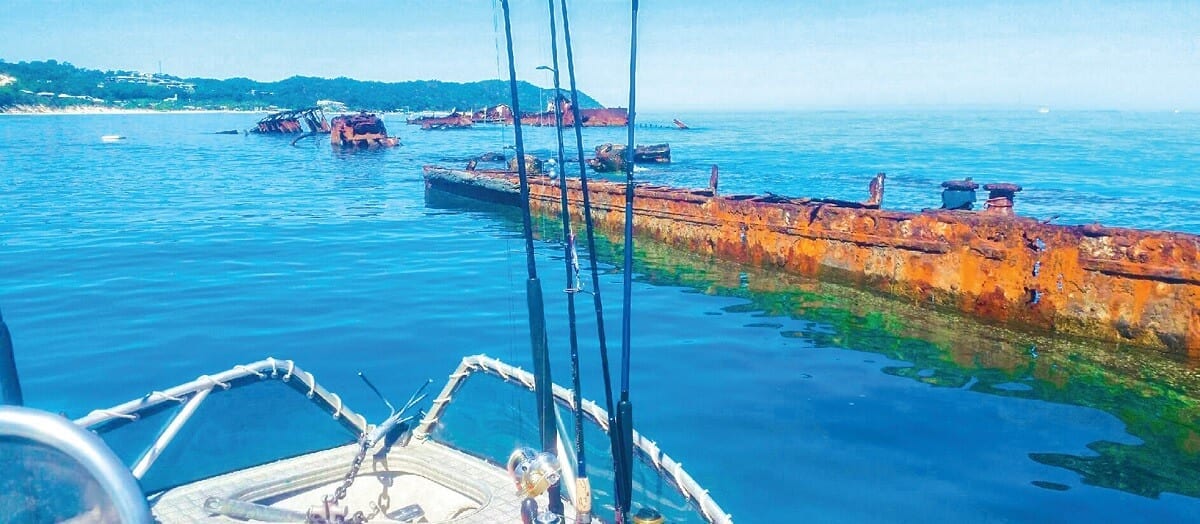
Beautiful glassed out winters day at Tanga’s
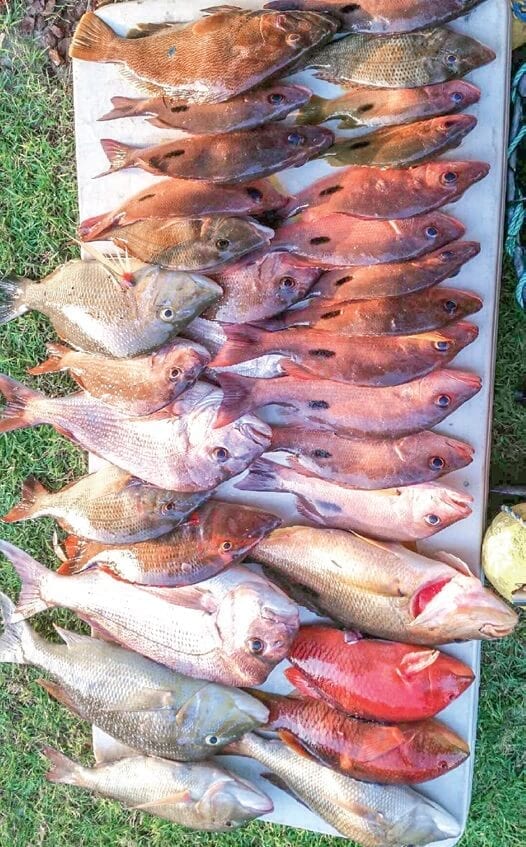
Over the last few trips, I’ve put the 20lb combos through their paces on some nice 3-6kg snapper, 6-14kg Yellowtail kings and a heap of other mixed reefies. I’ll run a 10m plus wind on leader of between 30 and 40lb on my 20lb combos and on the 30lb combo’s I would usually run between 50-60lb leader. Over the last ten years or so I’ve mainly been targeting the nice pan size fish of between 1-4kg.
Most trips we usually end up with a good catch of beautiful eating reefies. It’s hard out there some days when you have already bagged out one species and all you keep on catching is that same species. The last two trips have been like that with Snapper. We ended up not being able to get away from the Snapper with 4 spots we fished all holding Snapper. It was a great day fishing with 3 of us fishing we caught and released over 40 plus Snapper all between 2-3kg.
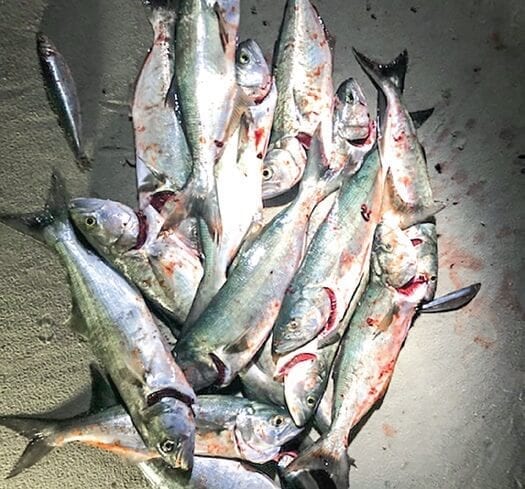
Late afternoon school of tailor from the bunkers up near Caloundra
A lot of the ground we fish holds a variety of species including Snapper, Sweetlips, Pearl Perch, Moses Perch, Cod, Parrot, and Cobia. These species are all getting taken off the Caloundra and Moreton reef systems at present. Hopefully, the great weather continues over the next few months. Now’s the time to drift the Hutchies 45-70 m zone high-speed jigging metals for kingies, Aj’s and Samsomfish.
1 – 4kg beautiful eating reefies
Fishing plastics around the same line will produce some great Snapper and mixed reefies. Anchoring up around Brennan’s, Flinders, Roberts, Smiths, Hutchies, Tempest and setting up a good burley trail and float lining is another great way to enjoy the winters fishing offshore. This winter has seen higher levels of winter rainfall than in previous years. Meaning more windier days around due to all the rain squalls. The whales are out in full force so always be on the lookout for moving pods.
Generally, they are quite peaceful and slow-moving other days they are more inquisitive and fast-moving. When anchoring up at night offshore in the whale highway always stay alert or do what we do and move in closer to the break at Moreton or tuck in behind Flinders for the night.
Setting your drift alarm on your sounder/GPS combo is a must. In the passage, the weed still has been downright terrible. Dropped the pots out about 3 months ago and got completely weeded up. Dropped them out over school holidays and same story blanket weeded up hardcore.
Fresh winter sandies
Hopefully, it clears up out of the passage soon. There are some nice Sandies out there at present. The winter whiting is biting well also with all the usual spots fishing well. Cockle banks, Sandhills, The Aquaculture Centre and Deception Bay fishing well. Fresh squid, worms, peeled prawns and yabbies’ are the go. Drifting around covering lots of ground is a good way to find these tasty delights. In the passage, there’s been quality Bream, Squire, Jew, Tailor, and Cod getting taken.
Avon wrecks, Tiger rocks and up pretty much all the passage creeks are where the Bream are getting caught. Squire, Jew, and Tailor around the bridge. There’s also been some great big Tiger squid around the passage jetties, rock walls, and lighted areas. So hopefully you guys get out and enjoy the next few months of colder weather and beautiful winter days of fishing, camping, and boating.
And “don’t destroy what you came to enjoy”……. Happy fishing!
It would seem that St Patrick never visited Bribie Island, or if he did, he had forgotten his Irish miracles. Now that the cooler weather has arrived and the snakes are snoozing, I feel I can recount a few snake stories without tempting fate. The first of my tales are not about a snake at all, but a magnificent lace monitor which was quietly minding her own business in the sun, half-way up a tree in our yard.
The recently arrived European grandmother from next door was attending to her flowerbeds when she looked up and saw this large reptile just above her head. Elderly though she was, she took to her heels crying “‘Viper, viper!” It took some time before she could be persuaded to come out again, and appreciate the beauty of this large lizard.
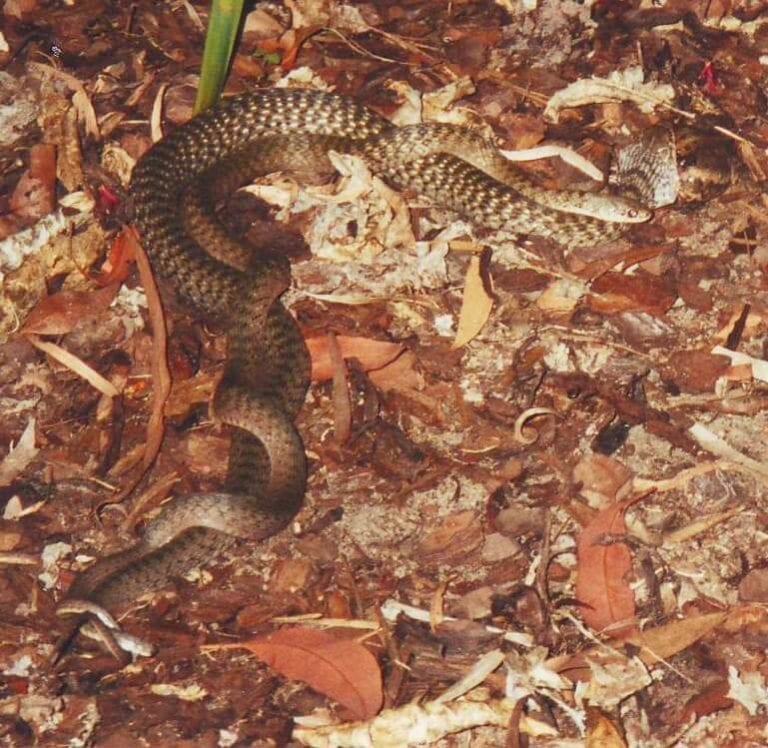
Loss of habitat and increased development in our area, has not removed our more venomous “pets”. The eastern brown snake is a common visitor, and in the summer months, we keep the yard mowed and watch where we put our feet. Even so, we have had our fair share of excitement. Entertaining friends at a B.B.Q. we took shelter in the shed from a shower.
An uninvited guest also decided to escape the rain and join the throng, and so we had the privilege of seeing twenty, or more, folk simultaneously levitate, with many a panicked squeal. Of course, there is always the skeptic that will claim your venomous Roughscaled snake is nothing more exciting than a harmless Keelback.
Identification can be tricky. Most snakes are a little shy when asked to roll over so you can count their ventral scales. Certainly, my husband Don did not wait upon such niceties before diving to snatch the bouncinette, complete with infant grandson, and placing both on a high outdoor table, as Joe Blake slid by. The tree-snakes in our yard can vie with the lorikeets as regards to their beautiful colouring.
The slender olive-green tree snake with its stunning yellow throat and belly set off with turquoise flecks that curled up on the chairs set out for our English visitors caused quite a stir. Romance is alive in Paradise. My neighbour and I were entranced at the sight of two snakes twisted around each other in a tight embrace apparently, amongst other things, dining together on an unfortunate frog.
We left them to their honeymoon. Finally, a tall but true tale. A few houses down from us, in an old-style fibro cottage, lived professional fishermen and their two dogs, one a poodle, and the other a large Alsatian. Around 11 pm we heard the dogs yelping and barking and the sound of shouting. A large carpet snake, a python, had the poodle in its coils and was squeezing the life out of the poor dog.
The big brave Alsatian was reduced to jelly, knees knocking. The owners rushed out and tried to unwind the snake and save the poodle, but without success. The python was not about to give up its supper without a fight, and, whilst not venomous, nobody was keen to risk a bite from the angry reptile.
Lateral thinking saved the day. The vacuum cleaner was brought out, the hose pushed over the snake’s head and the power switched on thereby immobilising the toothed end. Beginning at the tail end, the snake was forcefully unwound. This was no mean task. Eventually, our poodle friend was free, albeit with bruised ribs, and later made a full recovery. We trust the python also recovered from his ordeal. We never attempt to kill our serpentine friends.
Not only would that be illegal since Bribie is a Fauna and Flora Reserve, but it can be dangerous; being threatened with a large spade would no doubt bring out the aggression in you too. We give them the respect that we feel that they deserve as another fascinating part of our wildlife, and allow them to go on their way unmolested, whilst teaching our grandchildren to look, but never touch.
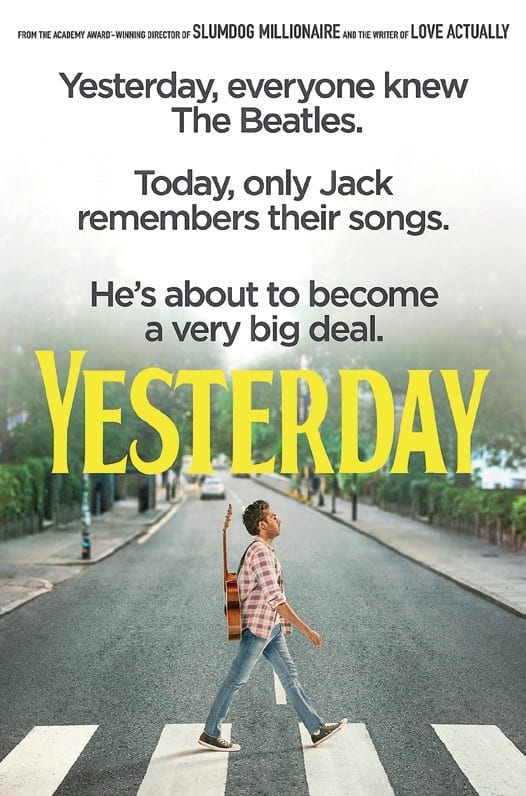
Bizarre or imaginative; far-fetched or creative… You will be on one side or the other as a viewer of Yesterday by filmmaker, Daniel Boyle. Jack Malik, played by Himesh Patel is a struggling British musician hoping for fame and fortune in the industry. Close to abandoning his dream, the unexpected happens.
For mere seconds through a global blackout, the world loses power and everyone we meet, excluding Jack who was accidentally spared, is completely unaware that the Beatles and their music ever existed. Seizing this opportunity, Jack introduces the Beatles music as his own and is proclaimed an industry genius.
The story then changes gears as we follow Jack’s journey from this point forward. Patel, with an earnest and light-hearted touch, portrays not only Jack’s torment and guilt over his dishonesty but also the emotional costs attached to his newly found fame.
Patel is well supported by both Jack’s love interest and unwavering supporter Ellie, played by Lily James and by Jack’s industry facilitator, Ed Sheeran, playing himself in a film that remarkably parallels Sheeran’s own story of discovery.
See the story unfold in the dilemmas tackled dotted with the delights of hearing selections from the Beatles own musical gold mine.
The film’s pace is slow. The genre is mixed. The British accent is challenging but the music, played and sang by Patel tell himself, will be worth your while.
Tags: Sophia Loren Celebrities. Actors. Movie Stars. Famous People
Behind a large semicircular glass table, at London’s Harvey Nichols department store, Sophia Loren is holding court. The Academy Award-winning 52-year-old actress, born in Rome, is still one of the most beautiful women of the 20th century and a major international sex symbol.
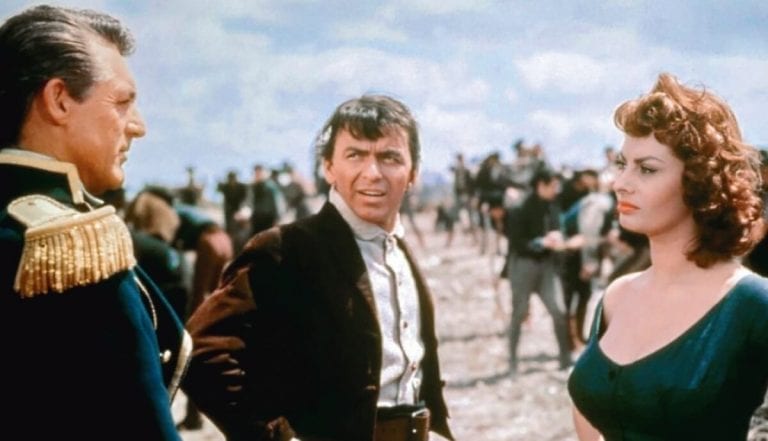
Featured image(above): With Cary Grant, Frank Sinatra in the ‘Pride and the Passion’.
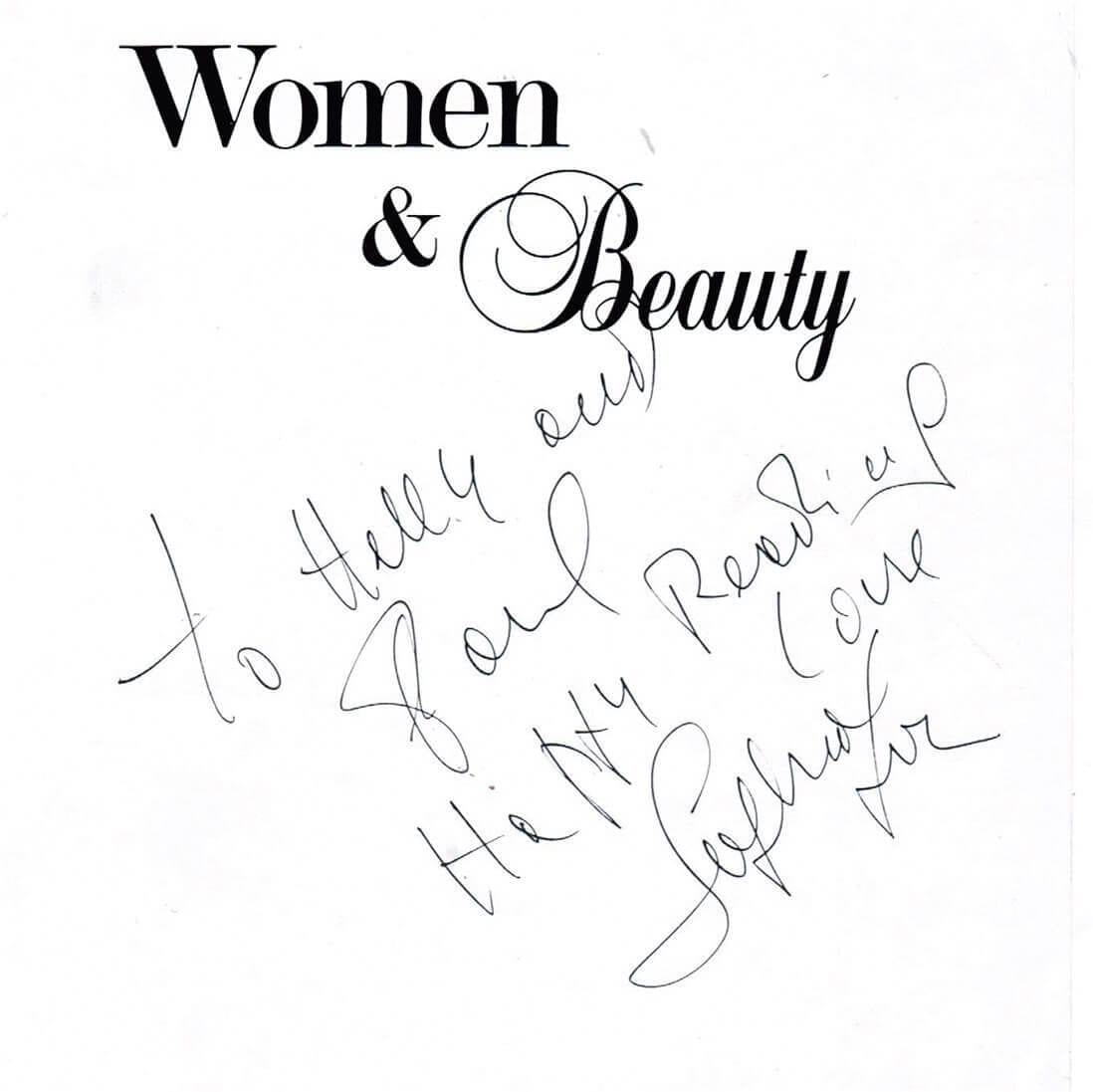
Promoting her book ‘WOMEN & BEAUTY’ – a book even making sense 35 years later in 2019 – Sophia sits tall and straight, her scarlet dress accentuating her rings, earrings, necklace and bracelets, worth a sheik’s ransom. The last of the classic screen’s goddesses shifts uneasily on her throne, as crowds have always frightened her. And crowds there are. Security guards for the dedicated fashion floor wing shuffle about, barely controlling the outer cordoned off area of fragile rope barriers as the crowds swell.
And swell they do. But the inner press barrier, allowing breathing space around the glass table soon topples, as 50 photographers shove and push, inching their way forward until they rest their elbows and cameras on the table itself, crouching between the knees of those still standing up, and shooting upward through the glass to get a closer shot. “Smile Sophia!” “Your hand on your chin, please.” “Throw your hair back Sophia!.” “Down here, Miss Loren!”
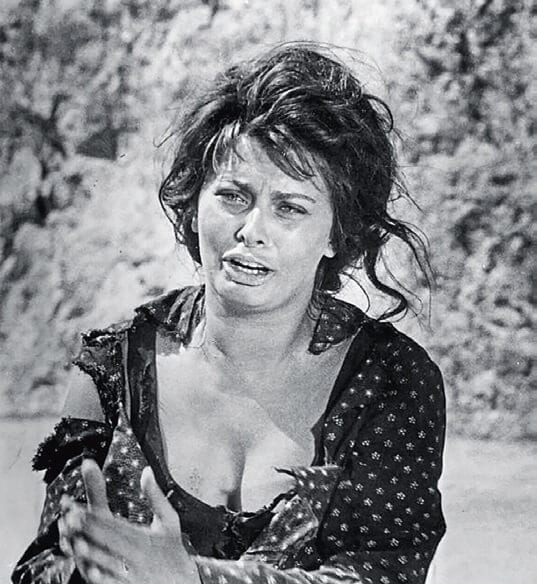
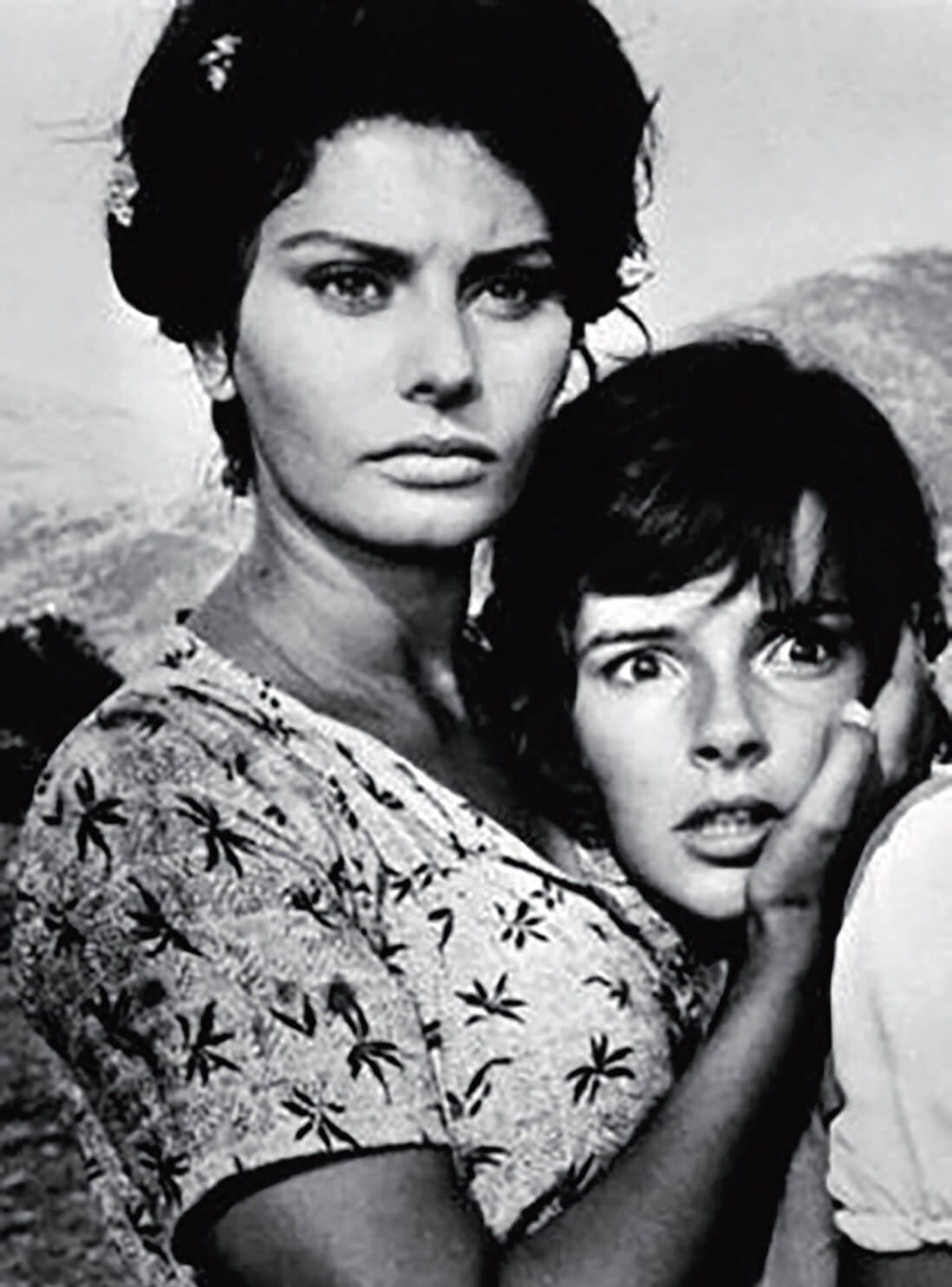
As World War 2 mother protecting her child in ‘Two Women’
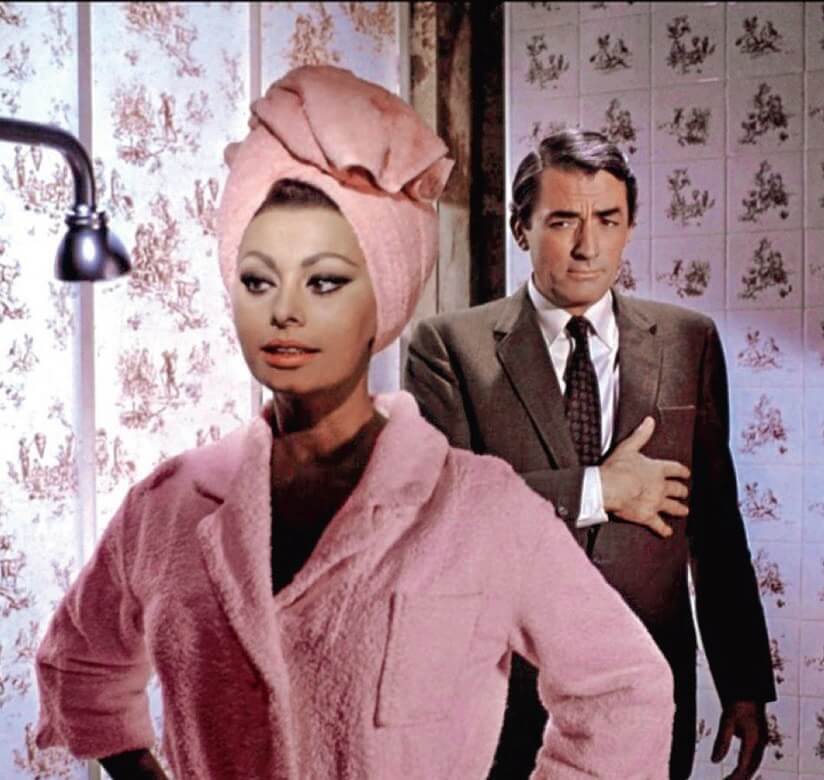
With Gregory Peck in ‘Arabesque’
Puppet-like and a little tense she obeys each command, laughing, turning, smiling, catapulting her body from side to side and lashing her lower half, both ankles and knees constantly touching, fused like a mermaid’s fin. She is both the queen in control and the cornered tigress pushed against the wall. It’s only when the photographers finally leave, that Sophia’s shoulders drop and she visibly relaxes, while soft music plays in the background, interrupted only by the discordant till ringing out endlessly in staccato.
Are they going to run out of books?
People file past quietly and respectfully now, as if it was a state funeral, the endless queues clutching their hardbacks, approaching one by one, preening themselves for a private minute with their idol, and yet the atmosphere is warm when they actually chat with Sophia: teenagers, pensioners, young couples, middle-aged women, men on their own. For over two hours Sophia never stops writing – often lengthy messages – in hundreds of books. One girl has a second bite at the cherry with an extra three books.
Sophia recognizes her, does not let on, smiles sincerely and genuinely with an aura of disciplined calm as she speaks to the girl at length and writes those extra three messages. Surveying Sophia at close quarters like this – millions around the world still think of her as the most beautiful woman of all (yours truly included) – is quite educational. The very long neck for which she was called ‘giraffe’ in school, is just a little wrinkled now. Small crease lines flash around the corners of the largemouth when she laughs. And Sophia Loren laughs a lot: To endorse a point? Embarrassment?
Academy award for movie ‘Two Women’
The beauty book of the eighties
Her overwhelming desire to please? Sometimes seemingly for no reason at all? The sweeping eyes too, show the odd line or two and the long nose is slightly hooked in profile. The grey in her hair is tinted out to a soft, deep auburn. She flicks back her head, the long tresses of exceptionally fine hair falling casually and carelessly, but a look you darn well know takes many hours to create. Her nails are short and without coloured varnish, the hands and fingers slim and betraying a few sunspots. They are working hands. Her elegant makeup is barely visible except for heavy mascara enhancing those famous long lashes, and black eyeliner, softening to grey eye shadow.
She seems exceptionally tall and slim, more than you would expect at 5’9”, but you can imagine the scrawny teenager who was nicknamed ‘stuzzi cadenti’ (toothpick) at school. As Sophia’s unorthodox beauty forms into the mosaic of the complete whole, not only does it outshine these individual irregularities, but it exudes an aura of peace and tranquility that rises as much from within than without. The queues are now getting even longer instead if shorter and Sophia stretches her sore hand and fingers in between books, occasionally clenching her fist, obviously averting a cramp.
There are now more and more fans depositing three and even five books on the glass table. And Sophia has the knack of anticipating the individuals’ moods and requests. So she just keeps writing and chatting with strangers she will never see again. The gentleness and calm with which she treats everyone around her including the fans are not artificial. This proves to be her most outstanding quality, making her outward beauty so appealing and giving her a presence and charisma, time will not erode. But my time for an interview certainly has done so, as more and more copies are sold.
Sophia’s entourage is hovering in the background. The publicity lady checks her watch, making sure the star will not be late for the next of the 18 scheduled press, TV and radio appointments, neatly sandwiched into Sophia’s 48-hour stay in London. Her tall suave chauffeur is waiting for a wink of an eye to rush her to the Rolls- Royce waiting downstairs. So Sophia agrees to do my interview at Heathrow Airport the next day while waiting for her plane to take her back home.
As Sophia Loren is whisked away from the department store to a BBC radio interview and a meeting with Terry Wogan for the evening’s show, she shakes my hand firmly with “See you at the airport tomorrow morning.” No break for her. No going out tonight. Just a quiet dinner at her hotel, the Ritz. Next morning the confusion at Heathrow Airport reigns supreme. In the hustle and bustle, Sophia is not to be found anywhere. “ No, Madam, Miss Loren is not in the V.I.P lounge yet.” “No, I’m sorry, she has not arrived in the C.I.P. lounge.” 45 minutes later the Swiss Air supervisor in a far-off upstairs office tracks her down when she arrives late.
“She’ll see you for 15 minutes downstairs at the First Class counter.” Scampering down several flights of stairs and endless corridors at the opposite end of Terminal Two, I find her queuing at the baggage check-in counter for her flight to Geneva. Her dark brown mink coat and matching leather gloves make her look a little fuller than yesterday, her black and red stiletto heels and tinted prescription glasses adding extra allure.
In London in the eighties
With Charlton Heston In ‘El Cid’
Sophia’s alluring charisma
And just as the helpful official tries to usher us into a cabinet-sized office behind the baggage counter, a group of teenagers having recognized the star, rush up to her, asking if they might photograph her. Sophia’s flight has been called by now, but like a clucky mother hen, both arms outstretched, encompassing the brood, she lets them snap her. Alone at last! But there can only be time for one question now, while the official assures Sophia that he won’t let her miss the flight.
What is the most important thing in Sophia’s life?
With her 40 years close family relationship: iconic Italian film producer husband of 140 films, Carlo Ponti, (he will live till 2007) and sons, Carlo, 17, and Eduardo,13, whom, because of miscarriages, Sophia had late, at 34 and 38, her answer is no surprise. “Motherhood. Absolutely. More than anything.
But the work is important too. Your inner peace and tranquility come through your experiences living your life day by day and trying to find a balance in your life. Only by finding that balance can you feel accomplished within yourself and feel fulfilled.” The all-consuming, passionate love that flows from Sophia’s lips accentuates her Italian accent more and more the quieter she speaks. “Motherhood has played such an important part in my life because I have always wanted children since I was a little girl.
That’s why I live my life for my children. I try to be a good mother, but I don’t know what makes a good mother. It depends so much on different circumstances and the characters of your children. It’s impossible to make a hard and fast rule on it. Like all mothers from the south of Italy, I am a little overprotective. But we do it in good faith, wanting to protect our children from risks and this violent world. “I want my children to believe in honesty, sincerity, and kindness. Not lies.
I hate lies. And I try to nourish a strong relationship between the two brothers, as I had with my sister, Maria. That is absolutely wonderful.” Are the boys being brought up religiously? “They are Roman Catholics but are not surrounded by organized religion. There will come a time, when they need to have much faith in God and when they will need to go to church. But it is something that has to come from them.
A mystic crisis that you have sometimes in puberty or between 12 and 18, is something that still has not happened in our family. “I hope it does happen because when you really believe in something, it means that you have faith in God, faith in yourself and faith in life. I think these moral qualities are extremely important in the world we live in today. “I try to bring the boys up with those good principles, with their feet on the ground. But it is very hard, being such a different situation: “I was hungry. They are not. My mother never had enough food for us. The meat was the greatest luxury.
‘A Countess in Hong Kong’ with Marlon Brando
We had it maybe once a month. I even made my own sandals by putting ribbons on soles. They never lasted.” Sophia pauses, becomes pensive, then continues: “But I do get fulfillment from my work as well as the family, especially when it really pleases me, like something creative and work I really want to do, a step forward in my career, playing older women and mothers, rather than the love or glamour interest.” I notice a little slight grey having been tinted out as Sophia flicks back those tresses, observing me admiring her glistening auburn hair.
“I’ve always dyed my hair, not just now that I’m getting older because my hair is very, very dark. Age has never bothered me and always living with the children you even like to age, to watch them grow up. I was never unhappy about becoming older. Maybe I have to thank my boys for that, anticipating the future rather than longing for the past.
“Oh, I have to go…….” Through an open slit in the door, the airline official is motioning for her to leave. And happy in the realization that in a couple of hours she will rejoin the children she so loves talking about, Sophia Loren makes her hasty exit.




 The Poster on this page gives dates and details. The guided walks are free but you are required to register on the web site (moretonbay.qld.gov.au/healthy-active) to come along as numbers are limited. WALK WITH ME THRO’ OLD BRIBIE By Barry Clark, Bribie Island, Historical Society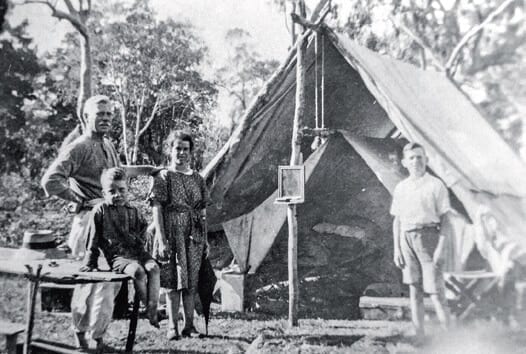

 “Because Harvey Norman is a tremendous business partner with Samsung they have chosen Harvey Norman to be a ‘Launch Partner’. With this in mind, I would like the opportunity to make readers aware of some of the features and benefits that this new product can bring to your viewing experience,” he said. “Firstly, the Samsung QLED 900 SERIES 8K TV is an LED TV with Quantum Dot Technology which will enhance the colour and contrast available.
 THE CHANGING FACE OF TELEVISION

 See the story unfold in the dilemmas tackled dotted with the delights of hearing selections from the Beatles own musical gold mine.