Hi everyone! We are nearing the end of the school holidays for another year hopefully you have all had time to relax and go fishing. Despite plenty of rain and wind, I’ve had good reports coming in with some excellent catches. The school and spotted Mackerel have been giving anglers plenty of fun around the channel markers live Herring and floating pilchards have been doing the trick. Also, small silver slugs with a fast retrieve are working. With the rain, the prawns are in big numbers and not far behind them are Trevally, Mangrove Jack, Bream and Queenfish. Target these around the canals and creeks on an incoming tide seems to be the best time. Also using surface lures to target these is a great way to get some action. There’s some really good Squire around the ripples and the odd Mulloway drifting with fresh Squid or Cuttlefish has been the choice baits. Flathead has been in good numbers around the flats at Buckley’s Hole and the fish trap at Sandstone Point, soft plastics with a slow roll and pause working, shrimp patterns like the atomic prong 3 inches are the go-to plastic and the Zman slim swim. Come check out the new colours we have in stock. Anyway, that’s all, for now, stay safe wet a line and relax.
Pioneers grow Cotton & Sugar
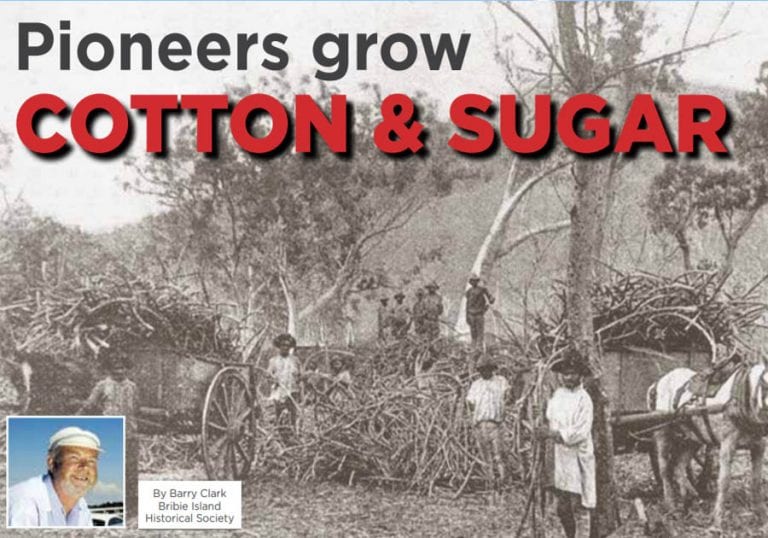
Long before anyone or anything was happening on Bribie Island, in the 1860s pioneer settlers tried first to grow cotton, and then sugar, on the Caboolture River. They had much to learn in that early “multicultural” environment. George Raff was a businessman and politician who had emigrated from Scotland to Sydney in 1839. He married the daughter of a retired missionary and moved to Brisbane in 1851 for new trade and investment opportunities. His house in New Farm he named Moraybank, a reference to his native Morayshire in Scotland.
Raff helped to establish direct wool trade between Brisbane and London. As a politician, he campaigned for the separation from NSW and served as a member of Queensland’s first Parliament.
With others, in 1861 he set up the Caboolture Cotton Co., one of 10 cotton companies established in Queensland, using expensive imported equipment.
MORAYFIELD
Raff built the large plantation homestead beside the Caboolture River, on a slight rise to protect from flooding, with outhouses, separate kitchen, carriage house and stables. The large property, he named Morayfield, was on rich alluvial soil, surrounded on three sides by the Caboolture River.
With 120 acres of cotton crops, it suffered severely in disastrous floods of March 1863, after which they soon switched from growing Cotton to Sugar.
OATLANDS
In the same year, Captain Claudius Whish, ex Indian Army, also established an adjacent property, which he named Oatlands, further up the Caboolture River.
The bridge over the Caboolture River, on the Bruce highway, is called Cpt. Whish Bridge, passing through the original Oatlands property.
KANAKA LABOUR
These plantations were substantial undertaking, in what was then a very remote area of European settlement.
Access by land was difficult and everything came by steamships up the winding Caboolture River. Sugar cultivation, processing and distilling became well established. Several kilometres of cane transport Tramways were constructed, and by 1868, sugar exported by river steamer, and 18,000 gallons of rum was produced. Between 1863 and 1904, more than 62,000 Kanakas were brought to Queensland from New Caledonia and Vanuatu as cheap labour.
Plantations were isolated communities, police were often days away, and treatment was harsh. The Reverend John Dunmore Lang visited the Morayfield plantation in 1868, to report on the treatment of Kanakas, at what was then one of the largest sugar plantations in Queensland.
SUGAR GROWING STOPS
After years of regular flooding of the Caboolture River, sugar-growing stopped in 1884. George Raff died in 1889, equipment was removed, land subdivided, and by 1909 new owner James Buchanan ran the largest milking dairy herd in Caboolture district with 250 head.
He sent cream to the Caboolture butter factory and leftover milk went to fatten pigs The river flats were extensively flooded again in 1953. Raff’s old plantation house abandoned, and a new house built on higher ground. In 1960, APM Forests Pty. Ltd. purchased the land, and for the next 40 years, it was a Pine Plantation. In early 2000s work began on the extensive North Harbour Residential Development and Business Park.
HERITAGE PARK
Surviving remnants of the original plantation were recognised as culturally significant, added to the Queensland Heritage Register, and a Heritage Park established. Informative signage has been erected, Information centre built, guide brochure printed, and the facility is open daily to the public.
The stone steps of the original Plantation house can still be seen, and a gravestone stands as a silent sentinel on the riverbank to Levi Walker who was just 27 when he emigrated from Scotland to Australia in 1869. He found work labouring at Morayfield plantation but sadly drowned just six weeks later in the unpredictable Caboolture River.
DISPERSED
The term “Dispersed” was often used in official documents of early European settlement in Moreton Bay, in relation to Aboriginal people. They were fast losing control of their tribal land, and can only imagine the issues resulting from the arrival of Kanakas. Let me finish with an extract from a letter, dated 10 Oct 1861, from the Caboolture Cotton Co. to the Colonial Secretary.
NORTH HARBOUR HERITAGE PARK.
This is a little known new local attraction, created in partnership with the Abbey Museum of Art & Archaeology. I have recently taken members of the Historical Society and U3A for informative walks, with our guide Cheryl Thornley, a teacher’s aide at Bribie Island State School, who lived in the old Morayfield plantation house as a child in the 1950’s.
MORE BRIBIE HISTORY
The Historical Society meets on the second Wednesday of the month at 6; 30pm at the RSL Club. Visitors and new members welcome, with notification.
Blessing of the Fleet

THE BRIBIE ISLAND SAILING CLUB, TOGETHER WITH AN OUTRIGGER CANOE FROM BIMOCC, WEATHER PERMITTING, WILL BE HOLDING A BLESSING OF THE FLEET CEREMONY FOR THE BOATS IN THEIR CLUB.
This will take place between 9 and 10am on Saturday, 30th January 2021, with the boats motoring northwards from Sylvan Beach, past the VMR Pontoon. A Minister from St Peter’s Church, Bribie Island, will bless the boats as they pass the pontoon. Members of the public may be interested in observing the proceedings from the waterfront. The ceremony has taken place in the past on Bribie and the BISC is trying to revive this annual event. After the ceremony, the BISC will be sailing off to Mission Point for one of their regular events.
CASPIAN TERN – Hydroprogne caspa
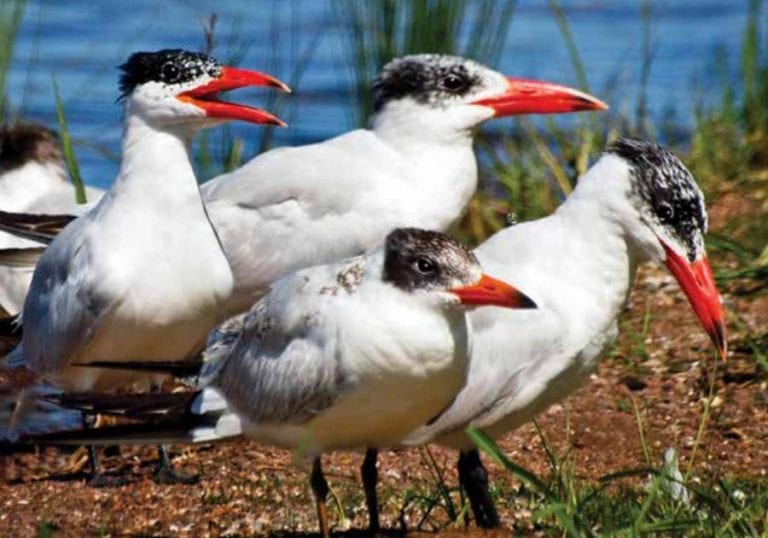
Caspian Terns are a common sight roosting by the water’s edge or flying over the Pumicestone Passage, and at Woorim. During the summer months, many of them fly off to their breeding grounds so you are more likely to see them at other times. They are easy to spot as they are the largest tern in the world and can be identified by their very large, red bill. They are 53-58 cm long, weigh 400- 750 g and have a wingspan of 1.1-1.4 m. Wings are long and legs are short. Their backs and wings are grey and the feathers below are white. As they age their feathers become darker which makes it easier for experts to work out the age of the bird. During the breeding season, they have black caps with small crests on the tops of their heads. These become streaked with white during non-breeding times. Calls are deep and harsh. Male and female are similar in appearance. Their average age is about 12 years. The oldest recorded bird in the world was 32 years. When moving to their breeding grounds they often fly at 80- 100m above the ground.
Habitats are mostly in coastal locations all around Australia. Usually, they stay relatively close to the coastline and do not fly too far out to sea. They do venture inland and are often seen roosting and flying around lakes, dams, lagoons and rivers. I have sometimes seen a small flock roosting at the Spit on Somerset Dam. They are found in every continent in the world except Antarctica. Caspian Terns are usually sedentary but do fly off to breed and to follow sources of food when necessary.
Mornings are when they do most of their hunting. They are usually solitary predators and fly with heads pointing downwards looking for food. Fish from salt or freshwater are their main diet which is obtained by diving from about 15m headlong into the water with folded wings. They are often fully submerged when procuring their prey. The food is usually swallowed head first while in flight or taken to the nest to feed their young. Insects such as grasshoppers and dragonflies, the young and eggs of other birds and small animals are also a small part of their diets.
Caspian Terns mainly breed in the summer months but given the right conditions may breed at any time of the year. Usually, a new mate is selected each season but sometimes couples remain together for several years. Their courting rituals are interesting in that the male takes a whole fish, flies high overhead with it then presents it to the female of his choice. If she accepts they immediately become a couple and soar together into the air performing tandem aerobatics. Breeding mostly takes place in small colonies but also some breed in solitary pairs. Nests are made on sandy beaches and off-shore islands. These built by both parents are scrapes in the sand sometimes circled by scattered debris. One to three creamy splotched eggs are laid and incubated for 20-22days by both parents that then look after the young chicks. Babies are fed with whole regurgitated fish. Both parents become noisy and hostile if the nest is threatened by animals or people. To protect the babies from the heat the parents stand over them with wings outstretched creating a shady shelter. Fledging occurs at around 35-45 days but the young birds are fed by their parents for months afterwards sometimes as long as 8 months. Young birds first breed at about 3 years.
Their scientific name is taken first from an ancient Greek word – Hudros meaning “water” and a Latin word Progne meaning “swallow”. “Caspa” refers to the Caspian Sea where early ornithologists associated them with the Caspian Sea where they were common. Conservation status is secure in all states except Victoria where it is listed as vulnerable. World population estimated at around 50 000 pairs is probably stable and maybe even increasing a little. Like other shore-nesting birds, babies and eggs are unprotected against fourwheel drives, people and animals on the beach. The mortality rate is high and in some parts is as much as 62%.
Mediterranean Stuffed Chicken Breasts

Feta cheese, roasted peppers, spinach and more flavors from the Mediterranean fill these easy stuffed chicken breasts. Browning the chicken in a skillet before baking gives it a beautiful golden color, and finishing it in the oven ensures that this healthy baked chicken recipe cooks evenly throughout.
INGREDIENTS
1/2 cup chopped fresh spinach
1/4 cup Kalamata olives, pitted and quartered
1 tablespoon chopped fresh basil
1 tablespoon chopped fresh flat-leaf parsley
2 cloves garlic, minced
4 boneless, skinless chicken breasts
1/4 teaspoon salt
1/2 teaspoon ground pepper
1 tablespoon extra-virgin olive oil
1 tablespoon lemon juice
DIRECTIONS
Step 1
Preheat oven to 220 degrees C. Combine feta, roasted red peppers, spinach, olives, basil, parsley and garlic in a medium bowl.
Step 2
Using a small knife, cut a horizontal slit through the thickest portion of each chicken breast to form a pocket. Stuff each breast pocket with about 1/3 cup of the feta mixture; secure the pockets using wooden picks. Sprinkle the chicken evenly with salt and pepper.
Step 3
Heat oil in a large oven-safe frying pan over medium-high heat. Arrange the stuffed breasts, top-sides down, in the pan; cook until golden, about 2 minutes. Carefully flip the chicken; transfer the pan to the oven. Bake in a moderate oven for 20 to 25 minutes. Drizzle the chicken evenly with lemon juice. Remove the wooden picks from the chicken before serving.
Healthy Eating on a Budget

PLANNING IS THE SECRET TO HEALTHY EATING BASED ON THE AUSTRALIAN DIETARY GUIDELINES WHILE STICKING TO A BUDGET:
• Plan your meals and snacks for the week.
• Make a list and stick to it.
• Don’t shop when you’re hungry. (Not only does this limit unplanned purchases, it also limits unplanned kilojoules when you’re trying to control your weight).
• Spend most of your money on the Five Food Groups.
• Think hard about why you are buying discretionary foods and how much you really need to buy. This is especially important if you are trying to lose weight, because if you don’t buy it and take it home, it’s much easier to stick to your goals.
• If you would really like to have a high kilojoule food, buy the smallest amount that will satisfy you, the best quality you can afford and eat it slowly, savouring it with all your senses.
• Try to limit discretionary foods and drinks to special occasions and small amounts. Avoiding discretionary foods not only saves you money but the extra kilojoules too
• Drink water instead of juice or sweetened drinks, it’s free and has no kilojoules.
• Use what you already have, what’s in season and what’s on special. For example, almost any vegetable can be cooked in stock and pureed to make a delicious winter soup. Just add wholegrain bread and you have a meal.
• Freeze leftovers for other meals or for lunches.
• Use leftovers in different ways.
• Substitute ingredients.
• Use powdered skim milk in recipes.
• Make your own custards and milk based desserts using low fat milk and limit added sugar.
• Buy smaller amounts of lean meat, skinless chicken and fish and extend meals by adding legumes, extra vegetables and grains. By adding extra vegetables to meat dishes, you will also reduce the kilojoules in the dish.
• Know how you will use what you buy, how much and when.
• Only buy what you need.
The World’s Best “Computer”

EVEN RECOGNISED COMPUTER “NERDS” (AND GENUINE EXPERTS IN I.T.) MUST ASK THEMSELVES THE QUESTION, OFTEN: “JUST HOW GOOD IS THE HUMAN BRAIN?” IS IT THE WORLD’S MOST IMPRESSIVE “COMPUTER,” EVEN?
There is compelling evidence to suggest that it still is … despite all the “experts” telling us that as a species, we draw on less than 10% of our personal mental capacities… and I don’t doubt that assessment in the slightest. (Some suggest less than 5%, even).
The older I get, the more I am in awe of what the human brain is capable of – and that feeling of awe has been strengthened by my experiences in cobbling together several hundred thousand words in recalling (unprompted), and recording, memories back to my earliest childhood days, back to the mid-tolate1940s. And considering that I was born in 1942 that (I reckon) is a pretty fair effort.
The recall factor has stunned even me, on numerous occasions. I don’t claim any great level of intelligence to explain this; it just happened. But how is it possible for someone – anyone – to recall, so clearly, people and events dating back to the times when they (in this case, me) were only a handful of years old? It stuns me!
A FEW EXAMPLES ……
Just today, I was chasing up some details (on my man-made modern laptop computer) on a couple of old rugby league-playing mates who made the League “big time”, playing in the Sydney league in the 1960s and 70s. Inadvertently, I tapped into historical records of Sydney RL players back into the 1940s and 50s. Nothing “big deal” about that….. but what did surprise me greatly was that I recalled personal details(even where they came from and what clubs they played for) about players around the late 40s who were my “idols” when I first started playing footy at the age of six. That was when my reputation as a rugby league devotee – or “tragic”, as often described today – began.
• Throughout the scribblings of my family history and memoirs, I recalled (in quite specific and clear detail) incidents that occurred before I had even become of school-age (5 years, at that stage)….and that’s 73 + years ago, now
• Out of the “blue”, I recalled making (in my early-tomid primary school days) a boyhood version of today’s modern radio……a crystal set…..and lying in bed listening (late at night) to broadcasts of rugby league matches out of Brisbane and Sydney – and even Australia v England cricket Tests, out of England.
Someone much smarter than me (I don’t remember who!) told me how to make the crystal set radio and I just did what I was told. I didn’t understand, then, how and why it worked…. and I still don’t know. My brain just “clicked in” and produced the results, and so my experiences (and knowledge) of my two strongest sporting “loves”, rugby league and cricket, grew…..to linger for another 70+ years.
All this tells me that the brain “experts” are right in suggesting that we draw on less than 10% of our brains’ capacities …and I reckon that certainly applies to me!.
As an invention of “modern man”, computers need the input of human brains to record, store and recall the facts and events punched into them(by humans). So who punches the “what, where, when, how, and why” of our life’s experiences and memories into our brains for later recall, so extensively and so accurately? THINK ON IT!
Tackling Poverty should be a top priority

The majority of Australians surveyed agree, with 83% of respondents saying students affected by poverty should be given extra educational support to help them realise their potential. 82% of people said helping young people poverty should be a top priority for the country.
“We’re heartened that so many Australians are concerned about this critical issue. Together we can do something about it, one child at a time. Something as simple as providing financial support for families so they can afford textbooks, stationery and the right uniform, can have an enormous impact on a child’s engagement and sense of belonging at school.”
Sponsors needed to support children’s education following such a harrowing 12 months, first with the bushfires, and then the outbreak of COVID, The Smith Family’s acting CEO is appealing to Australians to give children experiencing poverty a hand up, so their school year gets off to the best possible start.
“We’re urgently calling on Australians to support children in need returning to school this year. We have to find 9,486 new sponsors to help children make the most of their education in this important year where they need to catch up after the disruption of 2020,” said Wendy Field.
With one in six Australian children and young people living in poverty today, The Smith Family is also working with major partners like Officeworks to ensure students in need receive the extra educational support required to make the most of their school year. In the last eight years, Officeworks has raised over $3m for students supported by The Smith Family
“Our work over many years reinforces the evidence that supporting a child from a young age, and throughout their schooling, is the most effective way to help them break the cycle of disadvantage. The programs we offer to support students’ education help develop their confidence, skills and aspirations to strive for a better future,” said Wendy Field.
“Now 57,000 students are supported through our evidence-based Learning for Life program, and alongside generous Australians and our partners like Officeworks, we’re determined to keep growing this support, now and for years to come.”
HOW SPONSORSHIP WORKS
The Smith Family’s Learning for Life program provides emotional, practical and financial support to children and young people and their families. Through the support of sponsors, children can be sponsored from their first year of primary school right through to completing tertiary study.
Sponsorship starts from $52 per month for a child in primary school – or $1.70 per day – and provides:
• financial assistance for education essentials, including uniforms, shoes, books and school supplies • tailored personal support for the duration of a child’s educational journey
• access to extra out-of-school learning and mentoring programs.
To sponsor an Australian child in need visit thesmithfamily.com.au/sponsor
BACK TO SCHOOL AND OFFICEWORKS PARTNERSHIP
Until 7 February, Australians can also donate in store at Officeworks or online to help change the lives of students who need it most. With the support of Officeworks, The Smith Family is empowering more young people to create better futures for themselves.
Cousins

At family reunions, how wonderful it is to meet up with so many familiar faces.
Cousins, in particular, share a unique relationship and i’ve been blessed with a lot of them – especially on my mum’s side. Mum was one of six children, so the martin clan is numerous. Dad only had a sister so the cousin yield on the wighton side is smaller, though still precious. Somehow, cousins represent the comfort of family, the familiarity, without the overwrought closeness of immediate kin, which can be both wonderful and overwhelming.
Whenever I spend time with my cousins, I recognise the unique thumbprint, those genes that bring us all together. On Mum’s side, fair hair, freckled skin, blue eyes – in some of us these traits are fading with the passing of the years, but they still embody the physical evidence of our shared blood.
There’s proof of the power of blood when we get together and share old memories and old photos. We’re a water tribe – we Martins – and we have music and creativity in our DNA. I feel the catch in my heart when I see my mother’s beautiful face in faded family photos. Echoes of this face sometimes startle me in my own mirror these days.
The thing about cousins is that we recognise our parents in them – the shape of a fingernail, a wry smile, the sound of a laugh. We know these things and they sing to our own blood. Whatever vagaries exist between our mum or dad and their siblings, somehow the cousin relationship retains an integrity and an easy pleasure all its own.
In photos I see my cousin Barb. How to reconcile that whiteblonde-haired little girl with her long, tanned legs, stretching astride her brother Keith’s bike, with the mature woman who now has children and grandchildren of her own? But those ocean-blue eyes and the lanky good looks – the genetic hallmark of the Martins – they’re still there.
Like any family, we’ve had our share of both joy and tragedy – two of mum’s brothers, my uncles, were incarcerated in Changhi; my cousin Keith’s daughter died young – I sang at her wedding – all of us aching in the knowledge that this beautiful young woman wouldn’t be staying long.
But the happy memories somehow outweigh the sorrows. And when we get the chance we cousins delight in remembering the good times – the joyous family Christmas parties at Auntie Audrey’s house – Mum and her five siblings singing in close harmony around the piano.
Mum’s parents, my nana and papa, beers in hand, smiling benevolently over us all. I have vivid memories too of regular visits to Redcliffe to stay with the Martins – Mum’s brother Uncle Ted, Aunty Audrey, and my cousins – the old skating rink on the pier and the salty air streaming in from the bay. Don’t get me wrong. I’m a willing hostage to those original ties that bind us deep and close to immediate family.
But I’m ever so fond of my tribe of cousins.
The Bribie Islander Gloss Magazine January 15, 2021 Issue 131

Issue 131 OUT NOW. Get all your community news and information. Bribie Islands only community gloss magazine NOW EVERY TWO WEEKS! – Articles on boating, camping, fishing, life, drama, travel destinations, sports and what to see and do on Bribie Island. Covering charities, organisations, places, children’s activities, arts and crafts, tourist destinations, heritage parks, technology, science, music, gardening, and much more.
Fishing Report – January 15, 2021
Hi everyone, Happy New Year! We hope you all survived. So, there is not a lot of reports coming in over the last couple of weeks due to the weather and massive amounts of traffic on the waterways. There are still a few dedicated people getting out to get some decent fish and crabs. Finally, a few good-sized mud crabs are getting caught up in the canals and upper reaches of the creeks. Coochin Creek and Elimbah Creek are producing good size bucks. With the wind and rain, a lot of people have been fishing in the protected waters of the creeks and canals. With the prawns starting to move around, some good Grassy Sweetlip and Mangrove Jack have turned up in the canals, mainly caught on live baits such as Herring and Poddy Mullet. Plenty of Bream is feeding around the mouths of the creeks, a great way to target these are with surface lures like the Bassday Sugarpen. Also, it is definitely worth throwing some soft plastics out. Paul caught this nice little Estuary Cod on a Zerek prawn. Some really good catches of School and Spotted Mackerel are getting caught around the channel markers out in the bay and towards Moreton Island with small slugs and live baits working well. Once the water starts to clear up a bit, I am sure the fishing will improve dramatically! That is all to report for now, remember the shop will remain open through the covid crisis if you to get some exercise or fishing in, so come down and see us. Stay safe, wet a line, and relax.
Switching Aged Care Providers is Your Right
Moving into residential aged care is one of the biggest decisions that an individual and their family can make.
It is a decision affecting not only the person needing the care but also close family members such as the children and siblings. More often than not, the decision is discussed by the family and can be a stressful and uncertain time for all concerned.
Since the move into aged care is a high-involvement and an intensely considered purchase, it can be extremely upsetting if the care and service provided in your new home do not live up to the advertised or promised expectations. Whatever the reason, it is important to know that you have the right and freedom to switch to another provider.
McKenzie Aged Care provides warm and welcoming homes where people are cared for and cared about. McKenzie is here to assist and guide you through the process of switching to better care that meets your wants and needs.
Switching to a McKenzie home is easier than you may think. We make the process as smooth and stress-free as possible for everyone involved. We will also liaise with your current provider on your behalf, or with you, to ensure both parties efficiently manage the changeover. Call us today on 1300 899 222 and speak to one of our dedicated team members who will guide you through the process and answer any questions you may have.
Make the switch to McKenzie. It will be the best decision you have ever made.
Spinal Life
ROYAL AUSTRALIAN COLLEGE OF GENERAL PRACTITIONERS HAVE ENDORSED AS AN ACCEPTED CLINICAL RESOURCE FOR THE LATE EFFECTS OF POLIO “A GUIDE TO THE MANAGEMENT FOR MEDICAL PROFESSIONALS”.
Spinal Life Australia through Ross Duncan Executive Manager Member Services and his dedication to research, resources and references has developed a friendly user booklet to guide the Medical Care Professionals as a tool to understand and implement care and knowledge during medical treatment for Polio Survivors. Bribie Island has been instrumental in supporting Spinal Life Australia through their Peer Support Group covering the Island and surrounds. The World Health Organisation estimates that there are some 20 Million people worldwide currently living with some degree of disability caused by poliomyelitis (1). Not all Polio survivors were diagnosed with paralytic polio, however some 99% of all polio survivors may have experienced sub-clinical damage that becomes more evident with age. The late effects of polio are a neuromuscular condition that can occur in a high percentage of people with prior exposure to polio In Australia it is estimated that there are tens of thousands of polio survivors. International surveys indicate that there is up to 80% prevalence in the late effects of polio in polio survivors.
Many survivors of polio may have little or no visible disability however this may not influence the medical conditions of the late effects of polio and are often misdiagnosed or a condition that is the onset of age. This booklet is going to make a difference in the education of all communities and will recognise the management of the late effects of polio has on the human body. The Spinal Life Australia Peer Support Group get together every second month to chat and have an awareness of the future direction not only of polio but Spinal Cord Injury, Transfers Myelitis, or disability in all its diversity. Anyone wanting a copy of the booklet can telephone Spinal Life Australia or Bill Peacock. Everyone with a disability is most welcome to join Spinal Life Australia and join in;