Home Blog Page 31

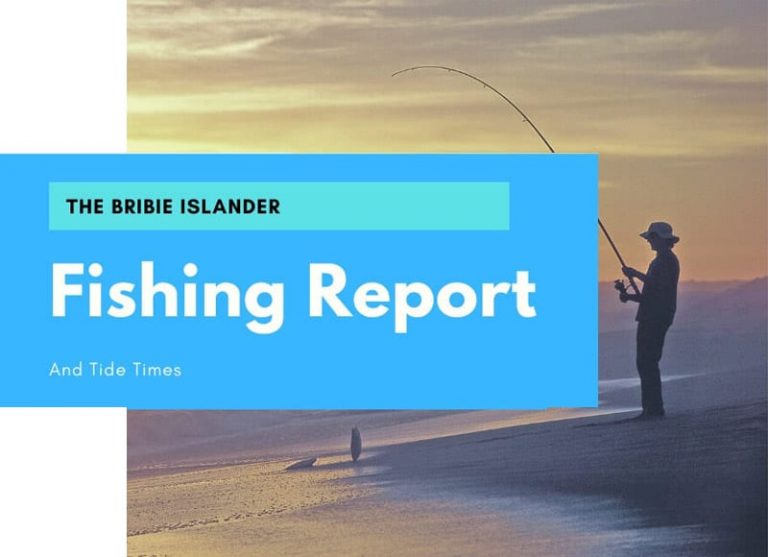
Fishing Report – January 01, 2021

Merry Christmas and Happy New Year to everyone! We are at the end of 2020 and it’s been a great year. Many fish have been caught and so many firsttimers to fishing have been hooked which is great to see. With summer in full swing and some huge storms that have got the baitfish and prawns moving, we are sure to some excellent fish taken. The Blue swimmers are in good numbers through the passage at the moment, throwing the pots in around 5 meters of water seems to be the best way to go. Some nice Jew has been taken around the Bribie bridge pylons, along with some good squire. White Patch is producing some really nice Whiting on surface lures like the bassday sugarpen. Plenty of good size Grunter Bream are around the creeks with squid and bloodworms getting them. Squire have also turned up around the ripples with fresh squid the best baits. Plenty of big Bream are feeding on the flats, small live baits and strip baits are working well on an incoming tide. That’s all for now till the New Year, remember any last-minute gift ideas come into the shop. Here are a few photos from through the year, I’d like to thank everyone for sending me information and photos, I really appreciate it. Stay safe wet a line and relax.

Arrival: My Mobile Phone

I understand our American cousins call their mobile phones cell phones. I can well understand why they do so. The operation of one of these contraptions can lead folk of my generation straight into a cell of the padded variety.

All I want my phone to do is to make and receive calls, perhaps text (not predictive please, I want to be in control, not the phone) and furthermore, I want a small book of instructions that I can read and refer to when learning how to operate my phone.

I do not need it to take photos, I have a perfectly good little camera if I want to do this and neither do I want it to have multiple apps, whatever they are. Yes, contact numbers are useful and how to put these numbers into my phone would be explained in the aforesaid instruction booklet. Even more useful would be a method of wiping contacts that are no longer relevant to my needs.

My present phone defeats me as it seems I cannot delete one number without deleting the lot! Yes, I know there must be a way of doing it but, as yet, I have not discovered it and as a result accidentally dialled the number of a dear gentleman, fairly recently deceased, who, in what I can only describe as a fit of pique, completely failed to answer my call.

As well as being in control of my contacts, I would like to be able to have a simple method of switching my phone on and off. Before COVID, when air travel was still possible, I lived in fear of being responsible for the deaths of all of my fellow travellers by interfering with the navigation of the aircraft, place your phone into Flight Mode before take-off, they say. I try, I really do, but I still worry. And then there are the signs requesting one to switch off your phones when talking to doctors or trips to the cinema. I tend to just pray no-one will attempt to contact me at these times. I am reassured when during T.V interviews etc. someone’s phone rings and I realise I am not the only person on the planet who has not mastery over this piece of modern technology.

Have you noticed that more and more people are abandoning their landlines and only retaining their mobiles? Fine for them, they are obviously far more intelligent than your humble scribe, but whilst I have no problem in remembering the number of my landline, in fact, I can give you the number of my phone when I was a little girl, 686726, but do not try ringing it, nobody is home, but when asked for my mobile number I go blank. Which brings me to another drawback of mobiles, deciding if it is my phone that is ringing or yours, and then, if it is mine, rummaging for it in the deepest, darkest recesses of whatever bag it is hidden. If I do catch it in time, I have to attempt to answer it. If a green receiver is displayed I just tap it and we are fine but sometimes, and I have never worked out why, instead of the receiver I get two vertical lines, one red and one green which I am supposed to swipe. When I see this I know I am doomed to failure! Do I swipe to the left or swipe to the right, do the Hokey Pokey and shake it all about? I often do this in sheer terror.

I was beside myself when the government exhorted us to put on the COVID app and we were told what bad citizens we were if we did not immediately do so. They must have spent thousands of dollars on that campaign but did they spend any money at all on showing us HOW to put on this app? No! Or how to operate it when it was on, of course not! Or how to get rid of this seemingly useless piece of technological junk? You must be joking! And as for the builtin obsolescence of your average mobile, I despair. Who on earth wants a new phone every year or two so they have to go through the whole, gruelling process of learning how to fly the soand-so thing all over again. When I was young, (BM, before mobiles), we still managed to arrange our social lives and have phone conversations in privacy with our beloveds. Whilst not denying the usefulness of a mobile phone in some situations, all I am pleading for is the simplification of them and a book of instructions road-tested, not by someone who knows what to do in the first place, but by someone like me.

The Winnett Diary

August 22nd – sorrowful news (becalmed) porpoises playing round the ship; splendid morning; another baby born last night – a little girl, that makes six births and two deaths on board. August 23rd – very wet morning; still becalmed, `tis a great blow to our hopes of seeing land tomorrow; we are 90 days sailing now and no signs of land; the hospital patients are doing well also the babies. August 24th – morning delightful and warm; we had to turn out on deck early as the men have to scrub and clean the berths again. We got fresh supply of groceries, so it is a blue look-out; it doesn’t look like seeing land so soon.

August 25th – another lovely day. In the morning we were told to run on deck and see the land. Away we went and sure enough far away we could discern a mountain against the horizon, by and by it became clearer. We all thought it was our destined land, but the first mate told us it was called Solitary Island; behind we could see the Australian Mountains; he also said that we were going against a current 40 miles long and `twould be long enough before we would see Brisbane; at night we observed a revolving light which we were told was the Clarence River Lighthouse; a dead butterfly floated by today.

August 26th – the wind is against us today, so the ship is like a horse going up a hill, first, tacking one way and then another every half hour. The Captain puts her about as the current is drawing her into land and `tis not safe as we might founder on the reefs.

August 27th – a bright morning; going slowly; `tis very pleasant on deck and the sunset is beautiful; such pretty tints in the sky.

August 28th – we are going a little better but tacking as usual; the Captain thinks as we shall soon arrive at Moreton Bay, have only one candle now between 40 families, and have to go to bed in the dark.

August 29th – a dull and very wet day, some heavy showers during night; in the evening the rain cleared off and we went on deck for a breath of air; no signs of land; all well.

August 30th – morning wet; the men and sailors are dull; towards mid-day it cleared up, the sun shone, we can dimly see the land, but as there is very little wind we wont get into the bay tonight; there are great flashes of lightning and some thunder; the air is oppressive and hot.

August 31st – A fine and lovely morning and hurrah – we can sight Moreton Island. Another day I hope will see us anchored; a shoal of seapips are flying round the ship; one was caught which measured 9 ft. 4 inches; about 2 p.m. the land became more distinct; could see the waves breaking against the shore. A steamer passed near the land, our Captain signalled, but no notice was taken of us; we have to go round to get into the Bay and then sail down the bar. We have scarcely any wind and are depending on vessels that may pass to bring in the news for a Pilot. At 6 p,m. another steamer hove in sight which our Captain also signalled but it passed by without answering; the evening was coming on and there was a slight fog, so I presume they didn’t see our signals. At 8 p.m. a vessel could be seen coming round the point of the island, we all thought it was the looked for Pilot. The Captain signalled again sending up the Pilot Jack, also the British flag. While the signals were up, we observed a Lighthouse in the distance ahead of us, then the Captain signalled with lights, some blue, some white, the vessel answered with lights and said for our Captain to go ahead and round the point, but that it was easier said than done as we had no wind and the current was driving us rather too close to the rocks. When the last vessel passed we felt completely boycotted. As a last resource the Captain signalled the lighthouse informing them we were Emigrants, he received answer to lay to all night as the coast was dangerous, so we all went below grievously disappointed and tumbled into bed. To be continued……

Some History of Money and Trade

For this holiday edition, with hands in pocket and purse a lot lately, this article reflects on some world history of how Money & Trade drives Empires and Scientific development.

It is not easy to grasp the true role of economics in modern history, so I will start with a very simple example. Mr Buck establishes a new Bank on Bribie Island. Mr Stone, a new building contractor, finishes his first big job and gets paid $1 million in cash, and deposits it in Buck’s bank. The Bank now has $1 million in capital. Mrs Cook comes to Bribie and sees a business opportunity to open a new restaurant, but does not have the money to set it all up. She goes to Mr Buck at the Bank, shows him her detailed business plan, and he credits her account at his bank with a loan of $1 million. Mrs Cook contracts Mr Stone to build her Restaurant for his quoted price of $1 million. When the restaurant is completed, she pays Mr Stone, with a $1 million cheque from her account, which Mr Stone deposits into his account at Mr Bucks bank.

Mr Stone now has $2 million in his account. How much cash is actually in Bucks Bank? Yes, just $1million. Banks can repeat this many times over until Mr Stone might eventually have $10 million in his account, although the Bank has just $1 million in its vaults. If account holders, in all the Banks, decided to demand their money at the same time, you can see how there would be major collapse and financial crisis. The entire world economy is based on the belief that the future will always be better.

CREDIT for FUTURE

The modern era created a new system, based on the belief in the future, and a special kind of money called “Credit”, which enables us to build the present at the expense of the future, and an assumption that the future will be far more abundant than our present resources.

In the long course of history, this is quite a new concept. Historically, people with good ideas found it difficult to start new businesses. Kings built palaces and waged wars, raising funds by taxes and tariffs, but kitchen maids with great ideas could only dream of wealth while scrubbing the royal floors. Prior to Captain Cook’s scientific world exploration, the Dutch East & West India Companies raised funds selling shares to investors to participate in the exploitation of distant lands.

The Dutch built a defensive walled settlement, on an island in the mouth of the Hudson River, and called it New Amsterdam. The British repeatedly attacked and finally captured it, renaming it New York. The remains of the wall, built to defend against British and native attack, is now totally paved over by one of the world’s most famous roads …… WALL STREET

Crown did not conquer the subcontinent of India, but private investors in the British East India Company, who had a huge private army. They ruled the Indian Empire for over 100 years with a military force that considerably outnumbered the armed forces of the British Crown. Likewise with the Dutch in Indonesia.

CHINA OPIUM WAR

The most notorious example of how Governments did the bidding of big trading Companies was the First Opium War, between Britain and China. In the early 1800s the British East India Company, with its many influential business investors, made fortunes exporting drugs, particularly Opium, to China. Millions of Chinese became addicts, creating social and economic disruption. In the 1830s the Chinese government issued a ban on drug trafficking. British drug merchants simply ignored the law, so Chinese authorities began to confiscate and destroy drug cargos.

However, the drug cartel leaders were well connected at Westminster, with MP’s and Ministers as stockholders, so they pressured the British Government to take action. In 1840, Britain declared war on China in the name of “Free Trade”, and quickly brought China to the negotiation table with their modern weapons. A subsequent peace treaty was made in which China agreed not to constrain the activities of British drug companies. Britain demanded, and received, control of Hong Kong island, which they then used as a secure base for drug trafficking. By the late 1880s about 40 million Chinese, a tenth of the population had become opium addicts. Hong Kong remained in British hands until 1997 and is now experiencing separation conflict.

SLAVE TRADE

When Europeans conquered America, they opened gold and silver mines, established sugar, tobacco and cotton plantations, which became the mainstay of American production and export. Nobody wanted to work in terrible conditions, so about 10 million African slaves were taken to America, with 70% working on sugar plantations. They lived short and miserable lives, in terrible conditions, so that Europeans could enjoy sweet tea and candy. Private slave trade companies sold shares to investors, and the companies bought ships, soldiers and slaves, and sold the plantation products for huge profits. The Industrial Revolution saw Belgium gain control of 2.3 million square kilometres in the Congo basin of Africa, an area 75 times the size of Belgium, which was known as the Congo Free State. Belgian officials and investors established Rubber Plantations and exploited the 25 million inhabitants between 1885 and 1908, driven by growth and profit, costing the lives of 6 million of them. Countless other examples accompanied the growth of the modern economy throughout the world.

Here in Australia South Sea, Islander Kanaka Slaves were brought here to work on the Morayfield sugar plantation on the Caboolture River in 1870. TODAYS WORLD In today’s world, the above stories seem to be part of the world’s forgotten history. On many criteria such as life expectancy, child mortality and calorie intake, the average standard of living of humans is significantly higher than it was 100 years ago…..despite the exponential growth in the number of humans. The economic pie has grown bigger, but can it go on doing so indefinitely? Some say that eventually, Homo Sapiens (that’s you and me) will exhaust the raw materials and energy of Planet Earth. What will happen then? The world does not lack energy, what we lack is the knowledge necessary to harness and convert it to our needs. The total amount of energy stored in all the fossil fuel on earth is negligible compared to the amount the sun dispenses every day, free of charge. Most people throughout history have lived under conditions of scarcity. Modern psychology has convinced people that indulgence is good, and we now live in a world driven by “Consumerism”.

We buy countless products we do not need, that until yesterday we did not know existed. Manufacturers deliberately create short-term products and invent new models of perfectly satisfactory goods that we are urged to purchase. Religious and public holidays have become Shopping Festivals. Access to money is encouraged through Loans, Credit Cards, BPay, After Pay, Pay Pal and many others. The rich remain greedy and make more money, and the masses give free reign to their cravings to buy more and more. Perhaps we are all part of the first religion in history whose followers actually do what they are asked to do. Merry Christmas. How do we know if we will get paradise in return? We have seen it on TV!!
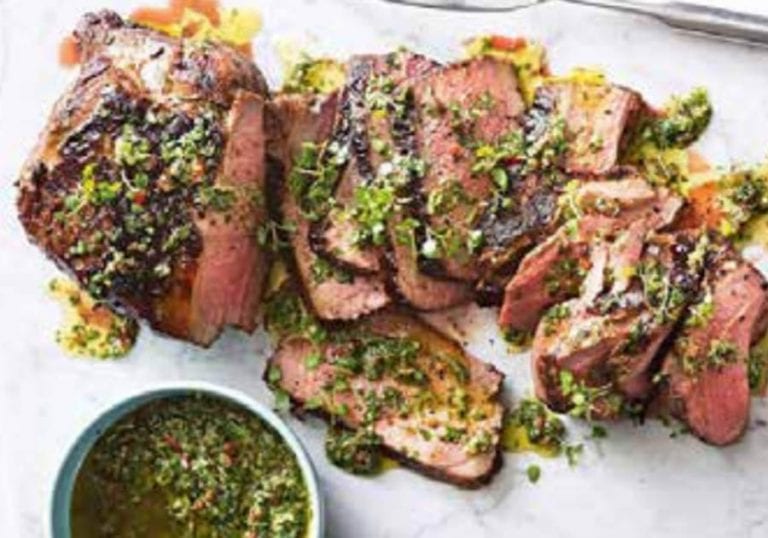
Gluten-free Lamb Leg with Coriander and Mint Chimichurri

INGREDIENTS
1kg boneless lamb leg
Micro mint to serve (optional)

CHIMICHURRI
3 garlic cloves, crushed
1 bunch each mint and coriander, chopped
1 each long green and red chillies, chopped
1 tbs finely grated ginger
Finely grated zest and juice of 1 lemon
1⁄2 cup (125ml) extra virgin olive oil

METHOD
1. For the chimichurri, place all the ingredients in a small food processor, season and pulse until finely chopped. Rub half the mixture
over the lamb and set aside for 10 minutes to marinate.

HOW TO CHOP MINT, SAGE, OREGANO AND BASIL
2. Preheat barbecue over medium-high heat. Cook the lamb on the barbecue for 8-10 minutes a side until charred then remove from the heat and rest, lightly covered in foil, for 5 minutes for medium.
3. Add any resting juices to the remaining chimichurri, then slice the lamb and serve topped with the reserved sauce and micro mint.

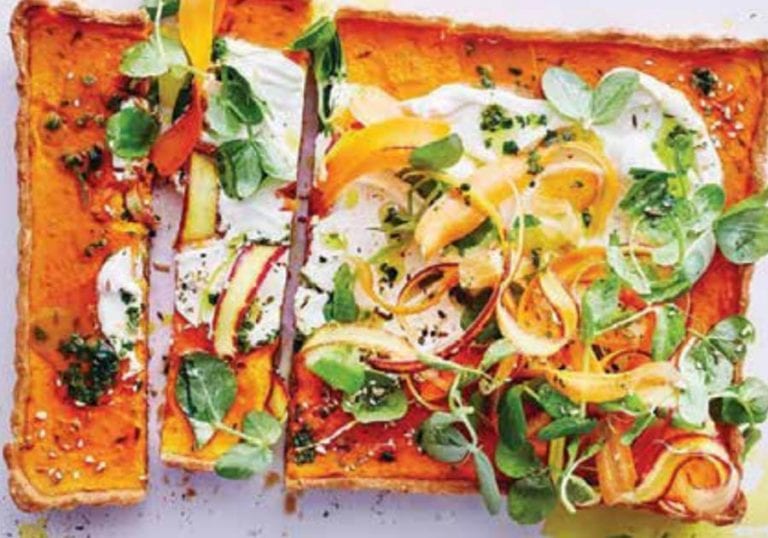
Gluten-free Caramelised Carrot tart with Carrot-Top Salsa Verde

INGREDIENTS
Gluten-free plain flour, to dust
400g frozen Careme Gluten Free Sour Cream
Shortcrust Pastry, thawed
1 bunch unpeeled mixed baby (Dutch) heirloom carrots
700g unpeeled carrots, cut into 3cm pieces
2 tbs extra virgin olive oil
11/4 tsp caraway seeds
4 eggs
1/2 cup (120g) sour cream
Labneh, dukkah and snow pea tendrils, to serve

CARROT TOP SALSA VERDE
1 garlic clove, finely chopped
1 tbs baby capers in vinegar, drained, finely chopped
1/4 cup (60ml) red wine vinegar
3/4 cup (180ml) extra virgin olive oil

METHOD
1. Grease a 18cm x 25cm fluted tart pan. Lightly dust a work surface with flour. Roll out pastry until 3mm thick, then use to line
pan. Freeze for 1 hour.
2. Preheat oven to 200°C. Line pastry with baking paper and fill with pastry weights or rice. Bake for 25 minutes or until just dry.
Remove the weights and paper, and bake for a further 10 minutes or until golden and dry. Set aside.
3. Meanwhile, reserve 2 baby carrots to garnish. Cut off tops from remaining baby carrots and wash and reserve, then chop flesh
into 3cm pieces. Place in a microwave bowl with regular carrots, then cover with plastic wrap and microwave on high for 10
minutes or until slightly tender. (Alternatively, steam in a colander set over a saucepan of simmering water for 20 minutes.) Drain
liquid, then place carrots on a baking tray. Drizzle with 2 tbs oil, scatter with caraway seeds and season. Roast for 40 minutes or until caramelised and tender. Cool. Reduce oven to 160°C.

HOW TO MAKE CARROTS
4. Whiz the carrot mixture in a food processor to a puree, scraping side of bowl. Add the eggs and sour cream, and whiz to combine. Pour into pastry shell and bake for 40 minutes or until filling is set. Cool completely.
5. Meanwhile, for the salsa verde, finely chop reserved carrot tops, then combine with all remaining ingredients in a bowl and season.
6. Using a vegetable peeler, thinly slice reserved 2 baby carrots and place in a bowl of iced water. Drain just before serving.
7. To serve, spread tart with labneh and scatter with dukkah, snow pea tendrils, salsa verde and thinly shaved carrots.

Food Waste

COVID-19 DERAILS AUSSIES’ PROGRESS IN FIGHT AGAINST FOOD WASTE

Australians’ annual food waste bill hits $10.3 billion during lockdown Average annual food waste increases from 11% pre-pandemic to 12.7% The use of food delivery services correlates to individuals wasting twice as much food.

Rabobank has released its 2020 Food Waste Report showing that the Coronavirus pandemic has derailed Australia’s progress in reducing food waste, leading to a spike in the amount of food Aussie households are throwing out.

This year, Rabobank surveyed Australians in March and again in September, finding that food waste increased significantly after the onset of the pandemic as people focused on keeping safe at home, spending more time cooking (46%), experimenting with recipes (37%) and ordering food delivery services (23%).

The research shows that Australians were making positive inroads to reducing food waste before the pandemic hit, with food wastage dropping almost two percentage points from an average of 12.9% of food purchased in 2019 to 11.1% in early 2020.

The latest September results show a lapse in progress, with Aussies’ annual food waste creeping back up during the pandemic, with the average household now wasting 12.7% of the food they buy, totalling $10.3 billion nationally. The dollar value of food waste also hit an all-time high, reaching $1,043 per year per household, reflecting a greater weekly food spend during lockdown months.

Glenn Wealands, Head of Client Experience, Rabobank Australia, said, “It’s to be expected that food waste has been de-prioritised by Australians during this stressful year when our attention has been focused on other urgent issues. ‘We were making headway in terms of minimising food waste before we faced this pandemic, however, our research shows we’ve headed off track. The average household is now wasting nearly 13% of the groceries they buy and also spending more on food delivery and self-prepare food services. We’ve also seen almost 10% of households increasing their spend on food to stockpile items in case supply ran out during lockdown.”

Mr Wealands said, “As the country emerges from the pandemic, we can begin to make changes to jump start the fight against food waste”. “Think about how and when you can use the excess food in your pantry and freezer, check your cupboards and the use by dates on packages to ensure you’re using what you have, make a weekly meal plan before you shop online and factor in a night off when you order your favourite local takeaway,” he said. “These measures will have a huge impact on reducing our food waste collectively, as well as being kinder to the hip pocket for Aussies.”

Delivery services soar relating to increased food waste Findings also spotlight that there has been an increase in the number of people using food delivery services in 2020, rising from 54% prepandemic to 61% currently, with more people using these services at least once a week (23%, which is up 9% from pre-pandemic).

As dining out took a hit, Australians have also increasingly turned to self-prepare ‘meal-kit’ food services, from 28% prepandemic to 36% currently. While food delivery and ‘meal kits’ have offered a welcomed release for many from the monotony of cooking every evening, the research shows a worrying correlation between uptake of these services and increased food waste; those most likely to use these services also waste over double the amount of food when compared to those who don’t. “This is a real watch out for consumers,” commented Mr Wealands. “We note through the research that consumers are working harder than ever to keep their finances in check, so it’s especially important for those that order pre-prepared meals, to be mindful that unless you’re using these services wisely it’s bad for your wallet and bad for reducing food waste.”

It’s time for change The research shows that the majority (77%) of Australians care about reducing waste, with 78% annoyed when they see food wasted and 64% wanting people to think about the impact on the environment. However, only a small group is concerned with the connection between food waste and wider environmental impacts such as climate change (24%), the loss of animals / extinction (21%), water shortages (16%) and pollution (12%). “Aussies clearly care about reducing their food waste, but we all need to understand that the impact is far greater than just hip-pocket savings. It’s our collective responsibility to make changes and start to minimise waste across the entire food supply chain,” Mr Wealands said

“There are some inspiring innovations going on at all stages of food production from farmers to manufacturers, retailers and at a government level. If we all do our bit, we can have a huge impact on the amount of food wasted and create a more sustainable future.” For more insights on the highs and lows of Australia’s fight against food waste, including the latest research data visit www.rabobank. com.au/foodwaste/

You are what you eat

YOU ARE WHAT YOU EAT. I BELIEVE I MAY HAVE EATEN A WHALE. FADS OF ALL KINDS CREEP UP ON YOU. AND FOOD IS PARTICULARLY TREND-DRIVEN THESE DAYS IN UNPREDICTABLE, OCCASIONALLY UNPALATABLE AND OFTEN PRETENTIOUS WAYS.

Like, enough with the rocket already! Consuming mounds of this scratchy green that is but a poor substitute for salad is a gastronomical nightmare. Even cows balk at it. The stalks catch at the back of my throat and the leaves poke unceremoniously out of the corners of my mouth as I try to stuff them back in. I look like a very self-conscious (if slightly corpulent) giraffe. What’s wrong with a little iceberg lettuce every now and then?

I like sushi, though apparently I can’t pronounce it. Every time I say it my daughter corrects me. ‘Mum, it’s sooshi not sooshi.’ Huh? I’m now so nervous about the word, that I’m forced to order something I can actually pronounce, for example, a sausage roll. Or a plate of chips. While we’re on the subject of fried foods, whatever happened to wedges? For a while there, wedges with sour cream totally replaced the humble chip. Ah those were the days.

Then there’s the Paleo movement – ancient grains and stuff like that. These are the foods (and I use the term loosely) that used to be obtained from hunting and gathering. Why did our ancestors eat these foods? Because there were no restaurants or supermarkets. Der.

A well-known TV chef has probably come up with the most pretentious diet ever – Paleo of course. A typical day’s food for this ‘expert’ includes alkalised water (what IS that?), ‘activated’ almonds (you GO almonds!), cacao nibs, cultured vegies (I imagine they’re all on the plate, jostling for attention while they quote Shakespeare and sing arias from Rigoletto) and emu meatballs (doesn’t bear thinking about). Anyway I’m not sure I actually want to eat anything Paleo, including ancient grains. I prefer my grains to be more now and happening. As for a brontosaurus burger, can you imagine how tough that would be? And a bugger to slice.

Surely we’ve moved beyond the age of cave dwellers and dinosaurs? What next? Will the man next door knock me over the head with his rake and drag me unconscious into his cave as foreplay?

Menus in restaurants now are practically indecipherable. I keep seeing ‘labne’ and ‘sugo’. If they insist in introducing a new food term they should at least include a glossary and a pronunciation guide.

And what’s with this ‘pulled’ pork? Pulled lamb? I get a pulled muscle in my brain just thinking about this stuff. Food terminology is a dark art in itself. It sure sorts out the sheep from the lamb – avocado and potatoes and even peas are ‘smashed’ now instead of mashed. This smacks of a sort of devil-may-care anarchy when it comes to food prep which just screams ‘Look at me!’ ‘See how passionately violent I am with my avos?‘ As for the ‘bruised’ ginger salsa – are we going to eat this stuff or take out a DVO against the chef? If you want to be really pretentious, tell us where the produce comes from in the name. For example, double smoked free range Burpengary bacon, free range organic Kilcoy eggs and Caboolture wild (it must be wild) salmon. Stop mucking about and just give me some bacon and eggs, with a side of salmon, will you?

Another way to be truly unique and pretentious about food is to be surprising. I’ve seen ‘salmon pastrami’ and ‘filet au prawn’, for example, on menus. These strange juxtapositions are precisely what make the modern foodie salivate in anticipation of being on the culinary cutting edge. Of course it’s always good if you can serve extremely young produce like baby spinach, and baby beetroot. I quite like the odd childish sausage myself.

If you want to be totally innovative there’s a restaurant in Hartford that might do the trick. Try the entrée of almond-crusted South Texas antelope medallions, blue cheese risotto, wild mushrooms and cranberry gastrique. For dessert how about a mincemeat pie of Axis venison with sweet cornbread crust and lemon thyme sorbet? Or you can come to my place for bangers and mash

Laugh At Your World

Progressively, as I got older, I used to think that nothing was as it seemed; the whole world was going mad….crackers…..ready for the “funny farm” and all that. Well, I don’t THINK that any more. Now I KNOW it is….. but more to the point, I think it’s ME “going around the bend” – and all because I have taken things too seriously for too long!

I mean, seriously, what’s the sense in taking seriously our culture, our governments, society’s pressure groups and officialdom in all its forms, when the messages we get from them all change with the wind and the mood of the time, almost daily? Have the most “unlearned” and unsophisticated of us been getting it right all along? Their mantra has been “just laugh at the world and roll along with the flow”! So what has brought on this burst of latent sanity and clear insight into how to handle the foibles of our modern-day society? It all started at a recent preChristmas party.

When our modern-day Aussie linguists tell us that something is “wicked”……they really mean that it isn’t actually wicked, but good, nice, pleasing even. And cool doesn’t really mean “cool” anymore; that’s “hot” now. But “hot” doesn’t actually mean “warm” (or over-warm) as it has for hundreds of years; that now means it’s good, nice, pleasing even. Are you paying attention? Did you get that?

Well, then we have the PC (political correctness) advocates. They’re close to the best comedy act around, often, these days.

A “chair” isn’t something we sit on any more. It’s someone (gender-neutral of course) who presides over a formal meeting now…….not a Chairman, a Chairwoman, or even a President (or “Lady President”, heaven forbid!). Of course, it’s simply out of the question to call a WOMAN a “LADY” (even though she might be….or might not be!). And (at risk of massive ridicule and bullying) a “girl” is no longer a “bird”, a “Sheila”, a “dame” (untitled of course) or anything else …..Other than a woman (even if she hasn’t yet reached womanhood status). But the crowning glory of absurdity in the Political Correctness armoury is …… we can’t even call GIN GIN “Gin Gin” anymore! Racism and all that wicked stuff, you know (or should that be “non-wicked?). Then we get to “our” Government spokesmen, officialdom in general – and economists and economic advisers, in particular.

For multiple generations, growing up, it was drummed into us that “saving is good, mounting debt is bad, surplus budgeting is the key to good fiscal management for individuals, households, businesses, and our governments”. It was good for everyone, wasn’t it? But no, not today. PostCovid (which scared the pants of just about everyone and sent many, including me, into periods of mental imbalance, it seems), borrowing and increasing debt are good…..or “wicked”, depending on your language preference. So now our public debt – that’s the spiralling amounts of borrowed money we DON’T give our governments after they have spent all the money we have given them – is to shoot up to astronomical levels (never reached before)….and that is good for us, now (or should I say “wicked”, again?). It’s all too much for a simple soul like me to take in and rationalize! I think I’ll just roll over and retreat into my genuine dreamland; at least the illusions are REAL there! By Colin Walker

Faulty Towers: Oh what a night – it really was such a night

The Bribie Island contingent of d9560 Passport Club would like to thank our wonderfully supportive local community for making our ‘Faulty Towers the Dining Experience’ such a successful event.

The sell-out performance was held at the Bribie Island RSL on Wednesday 9 December 2020. Faulty Towers – the world’s longest running and most successful tribute show to the BBC’s iconic sitcom ‘Fawlty Towers’ – was thoroughly enjoyed by all attendees. The event was organised as a World’s Greatest Meal and we have raised $3,000 for Rotary’s End Polio campaign. The night started quietly with Sybil meeting guests and getting them to use hand sanitiser before Basil and Manuel showed them to their tables. Sybil’s greetings and laugh raised a number of smiles and giggles as did the antics of Basil and Manuel.

During the show, many of the classic Fawlty scenes were performed. Most of the scenarios involved audience participation and those singled out for special attention took on their roles with great enthusiasm. By the end of the night the smiles and giggles had turned into loud sidesplitting laughter.

Manuel ‘served up’ the bread rolls like a young John Newcombe, while Basil did his best to cause utter mayhem all about him. Sybil was her usual calm, efficient self with her melodic laughter ringing out across the auditorium. All in attendance played along with the show – turning it at times into a pantomime – much to Basil’s utter disgust.

Lots of ‘Ooohs and Aaahs’, and ‘poor Manuel’, rang out as Basil admonished Manuel for his failings – of which he had quite a few. This had Basil in a ‘rage’ and he turned on the audience/ diners telling them that ‘this was NOT a pantomime!’ ‘Oh yes it is’ the audience chorused back – too much laughter.

Michael, my husband was called a ‘pervert’ because Manuel found a pair of ladies knickers under the table next to where he was sitting. Basil then put the knickers on his head and did his famous ‘Nazi March’ which evoked many guffaws.

The Siebenhausen’s at Table 10 received Basil’s attention as the ‘Germans’ for the night – ‘Certainly I’ll just get you your hors d’oeuvres which must be obeyed at all times without a question. Sorry, sorry sorry’. Top marks to Bill Peacock and Peter Sheehan for all the organising they did. Thanks to Samantha Thornton and the staff at the RSL; to Di Wells of Anna’s Fashion Boutique for a lending us props for the performers Dressing Room; to performers Andy, Gemma and Cameron and managers Rajna Barry and Claire Housden, from Interactive Theatre International; to our wonderful supportive community and our back up helpers Michael Matthews, Elaine Lutton, Julie Robbins, Patch Roycroft and Tom Dutton.

Watch this space for details of our July 2021 performance of ‘Confetti & Chaos’ which is a classic take on a wedding reception gone widely wrong. The audience become the wedding guests who get caught up in the crossfire.

Bribie Island Butterfly House: The Butterfly Effect

Have you been to the Bribie Island Butterfly House yet? If not, you are missing out on one of the islands, if not the world’s most exquisite little gems. Yes, it is about the enchanting beauty of butterflies, but also about so much more! You may even relate the simple beauty and colours of the butterflies with complex mathematical, philosophical, and scientific properties entwined throughout the earth and universe…….’the butterfly effect’.

Established and opened in 2017, the Bribie Island Butterfly House is a not-for-profit tourist and educational destination. It is the dream and now the reality of the founders’ Ray & Delphine Archer who retired to the island in 2013 and started breeding butterflies at a residential property in Banksia Beach. Word soon spread and more and more nature lovers got involved with their passion for growing plants, gardening, and breeding butterflies.

In 2016 Bribe Butterfly Volunteers Inc. was formed and plans were underway to build a butterfly house to attract tourists to the island and help raise money to donate to the less fortunate people in Australia and around the world.

Moreton Bay Regional Council designated a block of land and building was underway. Local tradies, sponsors and volunteers donated their time, money, and skills to construct the magnificent facility we have today which has welcomed 70,000 visitors from around the world and allowed us to donated $300,000 to charities locally and abroad.

Projects like this help people reconnect with the beauty and importance of our natural world. We hope to encourage an awareness of our delicate ecosystems and natural habitats and to prevent their ongoing destruction. Everyone can start in their own backyard and help bring back the butterflies, plant trees and influence positive change for our environment, the earth and all its creatures.

The facility consists of the breeding laboratory where the caterpillars grow and can be viewed by guests, food gardens to feed the hungry caterpillars & butterflies, toilets, undercover area, and an enclosure where you can immerse yourself amongst a kaleidoscope of hundreds of butterflies.

It is also wheelchair friendly. To this day the project is run by volunteers and provides a place of peace, education, tranquillity, and fun for everyone who enters. Volunteering is proven to improve people’s mental, physical health and wellbeing. Our Volunteers are trained and continue to learn new skills, while also passing on their knowledge and skills to others. This gives a great sense of purpose and allows the butterfly house to donate 100% of the profits earnt from entry fees to charity. So not only do our volunteers give back to the community and environment, but they also help spread joy, fun and peace to the world. Bribie Island Butterfly House continues to donate around $10,000 per month to many wonderful, trusted partners helping in our ‘global village’. Some examples and we thank these groups for their crucial work helping people in our local community include The Neighbourhood Centre, B.I.K.E.S, Rotary, GIVIT, ‘Pay a Sack Forward’, School Chappies, BIDCA, Bribie Hospice, RizeUp, Global Care, CICADA, Meant to Rise, Wallum Action Group, Bribie Respite, Camp Quality and more….. Helping the homeless, kids at risk, bushfire victims, and drought relief for farming families, emergency assistance, domestic violence victims, food hampers, counselling, help for survivors of sexual abuse, Cochlear Implant recipients, disability support and assistance for cancer patients and their families.

The world is a large place and we certainly live in a lucky country. The project also donates on a more global level via two trusted partners: Entrust Foundation and Empower. This way 100% of the funds donated go directly to helping people who live in some of the toughest parts of the world. This includes some of the most basics we take for granted such as clean drinking water, suitable sanitisation, education, basic life skills, health assistance, help for abuse victims, homelessness, assist communities to achieve economic empowerment, emergency relief in times of disaster and stopping human trafficking. There is a huge list and you can find out how this project helps further on the website www. bribieislandbutterflyhouse.org. This brings us back to the ‘butterfly effect’ and ‘chaos theory’. The world is a very chaotic place…..filled with both beauty and trepidation. To think a seed (both physical and metaphorical) can be planted and grow to feed the larvae that metamorphose into magical butterflies or how the seed of an idea can develop into a community project like this and offer transformational hope to people locally and on the other side of the world cannot be underestimated. The small flap of a butterfly’s wing at Bribie Island can influence a large change across the planet……a tornado of hope. Whether you contribute a little or a lot we thank you!

FREEDOM, FACTS & FALSE PROPHETS

I think just about everyone would agree that our freedoms of speech and expression are basic pillars of any true democratic system; but they can be double-edged swords too, at times. Good examples of that are the personal views presented as (unsupported) facts, and aired widely in recent times by very vociferous anti-vaccination protestors…..some even urging people NOT to “take the jab” when Covid 19 vaccines ultimately become available. Other protestors, similarly high on emotion but short on facts, claim that the current Covid 19 pandemic is a giant international fraud and conspiracy.

And still, others deny recorded facts of our national and/or world history and seek to re-write them – simply because, they say, they don’t believe in them or like the stories they tell. These “doubting Thomases” and knockers of anything and /or everything relies on top-level, bigcity national and international media exposure for their continuing existence and impact. It is the oxygen that keeps these protest movements and alternative lifestyle causes “alive”. And the bigger the celebrity (or genuine authority) in any given field that they target, in airing their “views” as “alternative facts”, the bigger and wider exposure they get.

That’s one of the downsides of a democratic system….but one worth tolerating. In some notable dictatorships or one-party-State regimes worldwide, people with alternative or different views to those dictated by “the State” just don’t get the chance to express them. And if they do, they often face serious discrimination (against themselves personally, and their families), harsh penalties, incarceration…or worse. Some critics simply “disappear”. So – whether critics and/or their alternative views are right or wrong – they have a right to the same freedoms (of speech and expression) that the rest of us ….all of us, in fact….have.

However, sometimes the prophets of gloom and doom go a mile( or three) too far down the “protest road” – like the anti-vaxxers, the history denialisms and re-writers, the conspiracy claimants and the PC (political correctness) movements we hear so much about, so regularly. One of the best examples, recently (in my view!) has been the antics of the anti-vaxxer brigade. Amid Covid 19 and the world-wide scramble to come up with a vaccine to stop this wicked virus from killing many more millions of people globally, the anti-vaxxers are telling people to reject ALL vaccinations, and clashing with police(and other authorities) in street protests, to ram home their “message”.

And all this against a backdrop of indisputable evidence, worldwide, of vaccines eliminating many communicable diseases (and other previously fatal conditions) which had plagued our communities and countries for hundreds of years….. maybe thousands of years…..until the arrival of vaccination remedies over recent decades and generations.

I happen to believe strongly in the research and development processes of the medical profession and science, not just in Australia but worldwide. I am living proof, in fact, of how it can extend people’s lives well beyond their expectations – and well beyond the mortality rates that our forefathers and ancestors faced, before the developments in medical science and practice that we have come to accept as “normal” today. I have calculated that the efforts of today’s “medical marvels” have given me an extra 30+ years to spend with my family, to enjoy all that our world has to offer

Maybe (because of this) I’m a bit more sensitive to the thoughtless nonsense that our anti-vaccination advocates present, with such zeal (day-in-day-out) to gullible people who are largely ignorant of facts that they haven’t bothered to research).

In fact, I believe that the anti-vaxxers present, potentially, a very real threat to public health at all levels of Australian society. They are collectively, in my view, a potentially very dangerous movement. Well, I have a message for all of the protest groups referred to (genuine, or otherwise) who continue to portray their “views” as “facts” that we should all take heed of:

“Do your research. Take the time and effort, and spend what you have to (as others have too!) to establish your facts and prove your case, then publish it on the open market (as other genuine researchers and advocates do!) and – in our “true democracy”…….let the people decide, but on FACTS, not just your views. Accountability applies to you, too!”

I’m an avid reader of biographies and autobiographies on notable people who have made their mark in many fields and on people in many societies throughout the world……in music and the arts, in medicine, public health and welfare, in sport, and politics (across the spectrum), and other areas of endeavour

I don’t always agree with what they have to say or advocate, but I respect their right to present their views as they have (and do), and I respect the fact that they take the trouble to research what they write about, spend the time and effort to put it all together, and then spend the dollars necessary to have their works published – to be open to public scrutiny and accountability.

If the protest movements and anti-everything brigades who make such a public “splash” in the media and elsewhere), so often, followed the lead of the biographers and auto biographers and researched, presented and advocated their causes similarly, maybe people like me would have more respect and time for them.

Recently, I got a deserved rebuke (publicly) for a couple of basic “facts” I got wrong, in a published article….and I was happy that my error was detected, and corrected. Facts, as a record of history (in all its forms), are important. That’s accountability ….and that’s how it should be. Protestors and advocacy groups (right or wrong, genuine or otherwise) must be subject to the same scrutiny and accountability. Maybe, if they were, we wouldn’t have to tolerate so much of the nonsense we have to contend with, from them, now. But that’s where “freedom of speech and expression” kick in, isn’t it? And so we have come “full circle”!

Golden Whistler – Pachycephala pectoralis

Male Golden Whistlers are one of our most beautiful birds and we are lucky on Bribie Island to have many of them living and breeding in our bushlands. Common places to see them are in the bush along Red Beach Road and Hornsby Road but are likely to be seen anywhere there is suitable bushland. They are constantly on the move and is difficult to have them stay still long enough to take a photograph. A flash of yellow darting through the trees or their loud ringing, melodious call is the clue to alert us that Whistlers are present. They are one of our loudest and most beautiful song birds. If you are lucky enough see the male while perched you will notice the beautiful, bright yellow on the under body and the back of the neck, black thick head, white throat and dark wings with yellow edged feathers. Females are ordinary grey birds with a yellow splash under the tail. Immature birds are like females but have rufous wings.

Golden Whistlers are quite small being only 16-18 cm in length and weighing just 25-35 g in weight. They have several different calls and are most likely to be heard during spring. During winter they are relatively silent. In Australia they are found in eucalypt forests, rain forests and in Mallee and Brigalow areas along eastern Queensland, NSW, most of Victoria, eastern South Australia, Tasmania and the south west of Western Australia. Norfolk and Lord Howe Islands, Fiji, Indonesia, PNG, and the Solomon Islands are also homes for Golden Whistlers. They like to stay in thick bush where there are lots of places to hide from danger. In Australia they are mostly sedentary with some movement in the south during winter.

There are seven species of Whistlers in Australia with two of the most attractive species residing on Bribie Island. The more common Rufous Whistler is the other whistler found here in similar habitats. Favourite foods are insects and their larvae, spiders and occasionally berries. Mostly they are lone feeders in the lower and middle parts of the forest picking their food from the foliage and under bark. Breeding is mostly between September and January. Males use a special song and much strutting to attract the females. When the deal is clinched both parents set to work to build a cup like nest of leaves or fern fronds and small roots bound together with cobwebs and lined with softer materials found in the area. Nests are mostly built in forks and are usually 50 cm to 6 m from the ground. 2-3 brownish-cream mottled eggs are laid and incubated by both parents for 14-17 days. Nursery duties are shared by both mum and dad. The young leave the nest after about 12 days. There is usually only one clutch per season.

Golden Whistlers were noticed in the early days of settlement in Australia and were first described by English Ornithologist John Latham in 1801. They belong to the family Pachycephalidae which means “Thick Head” after the large heads of this family. Similar species in PNG are actually poisonous, thought to be caused by eating poisonous beetles.

They are covered with a neurotoxin which will numb your skin if you touch them. Conservation is still secure in Australia with the ongoing habitat loss always a worry.