Home Blog Page 44

History of Grog & Booze

Many of us use the word GROG as a slang term for any alcoholic drink. This article explains the fascinating story of how that strange word, and other drink related expressions, came into the English language.

James Cook was among the first to use the word GROG aboard the Endeavour, as he sailed the world, eventually claiming the east coast of Australia. The word GROG was first documented 250 years ago in 1770.

When Cook set sail on the Endeavour in 1769, with a crew of 94 sailors and special scientists, his huge load of cargo included 604 Gallons of Beer and 4 Ton of Rum in Barrels.

It is an interesting fact that very few sailors could swim, including James Cook himself. It was considered unlucky aboard old sailing ships, because if you fell overboard it could not stop or turn quickly to pick you up……. so better to drown quickly rather than drift for days.

DAILY RUM & BEER
A daily Rum ration for British navy sailors was first introduced in 1655. In the absence of reliable and safe drinking water, sailors were issued a daily ration of half pint of Rum (300ml.), and a Gallon (3.8 litres) of Beer every day. This daily issue was codified in 1731 and remained in place, but in ever reducing amounts, for almost 240 years.

British sailors enjoyed a drink. Then they enjoyed another drink! However, some would sell their ration to others, who enjoyed it even more. “What shall we do with the drunken sailor” is a song with a long tradition and naval history.

DRINKING GROG
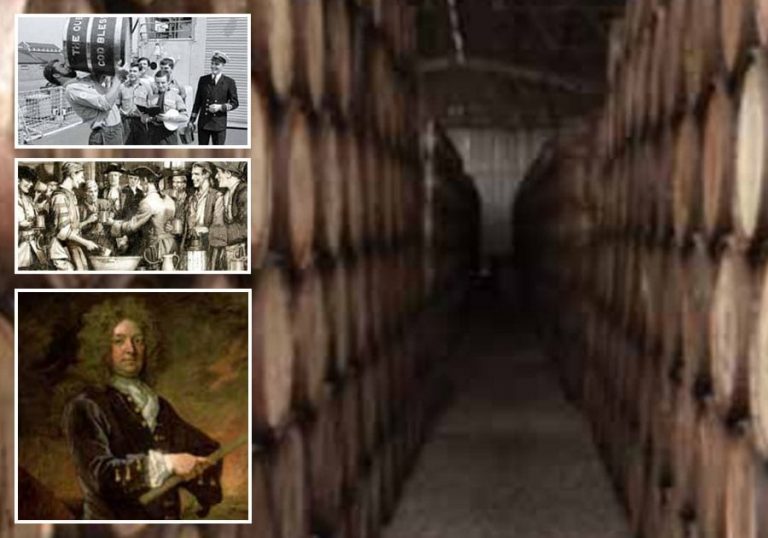
British Vice Admiral Edward Vernon was in the West Indies in 1740’s, the heartland of Rum production. He became increasingly concerned about the behaviour and health of sailors receiving their large strong daily rum ration. He decided on the very unpopular step of mixing Rum with water prior to issue. This extended the liquor drinking volume, but achieved little else in terms of behaviour. Vernon became much disliked.

Vice Admiral Vernon always wore a very old, and much loved, coat made of Wool, Silk and Mohair, made waterproof with the application of gum, making it tough, hardwearing and very scratchy. The cloth was known as GROGRAM.

This old coat was his uniform, in all weathers, and sailors gave him the nickname OLD GROGRAM, often shortened to OLD GROG.

Because of his unpopular decision, over time the word GROG came to be a word used for any kind of alcoholic drink. You probably use the word yourself …..now you know its origin.

The daily issue of a half pint of Rum continued until 1823 when the ration was cut by half. Then again, 47 years later, in 1850, the daily allowance was again cut by half. At this stage, it was regarded more as TOT, being just a mug or cup. Some senior readers of this article, who were in the navy until 50 years ago, may have enjoyed it. On 31st July 1970 the last daily Rum ration was issued. That is known as BLACK TOT DAY.

DRINKING WORDS
There are many another fascinating old words in common usage that relate to sailors, beer, rum and drinking. Lord Nelson is famous for his defeat of the combined French and Spanish fleets, losing his life to a bullet, at the Battle of Trafalgar in 1805. It was decided to preserve his body in a barrel of Rum for the journey home to give him a ceremonial burial. It seems that thirsty sailors sampled some of the barrel in transit, which gave rise to the expressions “Nelsons Blood” or “Tapping the Admiral” with reference to Rum.

Another word is SCUTTLEBUTT , which some pommie readers may know, is still used today to refer to gossip or rumour. The word SCUTTLE is a term used when a ship is deliberately sunk by putting a hole in it. A BUTT is a large wooden Barrel usually for holding water or collecting rainwater. Over the many years that sailors received their daily Beer and Rum rations aboard ship, they assembled on deck and queued up around serving barrels. During this popular and sociable daily ritual, the men chatted and exchanged stories, which would often be classified as rumours of gossip. Hence, the word SCUTTLEBUT got into our vocabulary.

Today that same behaviour goes on, but now it around the water cooler at the office.

RUM FANNY
Sailors often had their own personal drinking receptacle or mug, which acquired the interesting name of FANNY CUP.

In 1867 a sweet young eight year old FANNY ADAMS was abducted, brutally murdered and dismembered. Parts of her body were widely scattered and not all were found. It was a horrific case, and the criminal, a solicitor’s clerk, was eventually arrested and hung. The case was amongst the most brutal of crimes in England, and remained a topic of concern and gossip for many years.

In 1869 a new daily ration of tinned mutton was introduced for British navy sailors. It was not a popular dish, and sailor’s distain for this processed tinned mutton started rumours (Scuttlebutt) that parts of Fanny ADAMS may have found their way into the tins. The metal containers were found to be ideal receptacles as mess tins or collecting Grog rations from the Tub, and became known as “Fanny Cups”.

We still use the term Sweet Fanny Adams or even “Sweet FA” to refer to things that are non-existent, mediocre or minimal.

The sailor who was selected to carefully distribute the daily Rum ration to his men was known as the Rum Boss. Any small amount left over after distributing Rum to his mess group was known as “Queens Share” or simply “QUEENS” and was saved for a special occasion.

An Admiralty gift of an extra Grog ration was sometimes given to navy vessels at a time of national pride, or on completion of a difficult task. Such a job could include the challenging task of “Splicing the Mainbrace”, which is a term some people still use when having a toast or special drink.

Smuggling or stealing Rum was a regular and profitable pastime for many . Customs officials spent a lot of time searching for such contraband and coined the term RUMMAGE when they were looking everywhere for hidden goods. We still use that term today.

BOOZE
Booze is a word that is even older than Grog, and dates back to the 13th Century. It originates from an old middle Dutch word BUSEN or BOUSEN meaning excessive drinking. In the 16th Century, when Dutch and English sailors had sailing encounters, the word became anglicised and corrupted to the word BOOZE.

The term is used for excess drinking, and people being a BOOZER. Since the 1700’s the word Booze became used for any king of alcoholic drink, in much the same way as Grog. You become GROGGY if you drink too much ……and are known as a BOOZER.

TOO MUCH DRINK

Other expressions like “Three sheets to the wind” are still widely used to describe a drunk person. This also has a nautical origin referring to sheets (ropes) not properly secured, caught by a strong wind, resulting in loss of control of the ship.

Many other terms commonly used are Stoned, Sloshed, Plastered, Tipsy and Tanked. I am sure there are others that you know. They all have interesting origins, most of which relate back to sailors and ships.


Full Circle Histroy Repeats Restoration of Ian Fairweather Cottage

‘It’s an ill wind that blows no good’, meaning that even a very bad situation must have some good results is very apt in this story. So, without the Moreton Bay Regional councils Covid 19 stimulus package, the Ian Fairweather Cottage would still be waiting to be repaired.

Ian Fairweather lived at Bongaree Bribie Island from 1953 until he died in 1974. He had a great love for the solitude and beauty of Bribie. His artwork production flourished in this time and he became world-famous.

He was 62 when arrived and lived in a rather rustic and basic way, craving the simple life and enjoying the isolation. The Caboolture Shire Council became concerned for his wellbeing as he aged and insisted that he provide a suitable dwelling for himself upon the site where he was living during the late 1960s.

After his death, the Council burned his grass hut, and the small house was relocated into the garden of Coungeau House, Banya Street in 1978.

This was at the request of his niece who knew that he, as a veteran of WW1, understood and admired the work of Toc H. Toc H had purchased Coungeau House from the Anglican Church to further their mission to provide holiday accommodation for disadvantaged and disabled people in need.

Toc H, an organisation, started during WW1 opening Talbot House in Belgium as a refuge for war-weary young men returning from the battlefields. It is from this beginning Toc H has become a worldwide movement built around fellowship and unselfish service. They have used the ‘Fairweather Cottage’ as a home for their caretakers until 2019 when the cottage became termite damaged and needed extensive repairs.

During the Covid 19 pandemic, the Moreton Bay Region Council offered grants and loans to community groups to stimulate our local economy and provide work to local trades and businesses. The Council has loaned Toc H the funds to eradicate the termites, install a barrier and repair the damage.

During the past months, the cottage has been restored by local trades and Toc H Bribie Branch members who have worked tirelessly to make the cottage habitable once more and beautify the grounds.

Toc H are now looking to engage new caretakers, an individual or couple, expressions of interest can be sent to [email protected].

Apple, Raspberry and Rhubarb Pie

INGREDIENTS
• 6 Granny Smith apples, peeled, cored, thinly sliced
• 1 bunch rhubarb, trimmed, cut into 3cm pieces
• 1/3 cup (75g) caster sugar
• 1 teaspoon ground cinnamon
• 1 tablespoon cornflour
• 300g frozen raspberries
• 1/4 cup (30g) almond meal
• 1 Egg white
• 1 tablespoon caster sugar, extra

SHORTCRUST PASTRY
• 2 1/4 cups (335g) plain flour
• 1/2 cup (80g) icing sugar mixture
• 185g butter, chopped
• 3 Egg yolks
• 1 tablespoon chilled water

METHOD
• Step 1
To make the shortcrust pastry, place flour, icing sugar and butter in a food processor and process until mixture resembles fine breadcrumbs. Add the egg yolks and water. Process until mixture just comes together. Shape into a disc and cover with plastic wrap. Place in the fridge for 30 mins to rest.

• Step 2
Meanwhile, place the apple, rhubarb, sugar and cinnamon in a large saucepan over medium heat. Loosely cover and cook, stirring occasionally, for 5 mins or until apple releases its juices and is just tender. Add the cornflour and raspberries and cook for 5 mins or until raspberries are heated through and liquid thickens slightly. Set aside to cool.

• Step 3
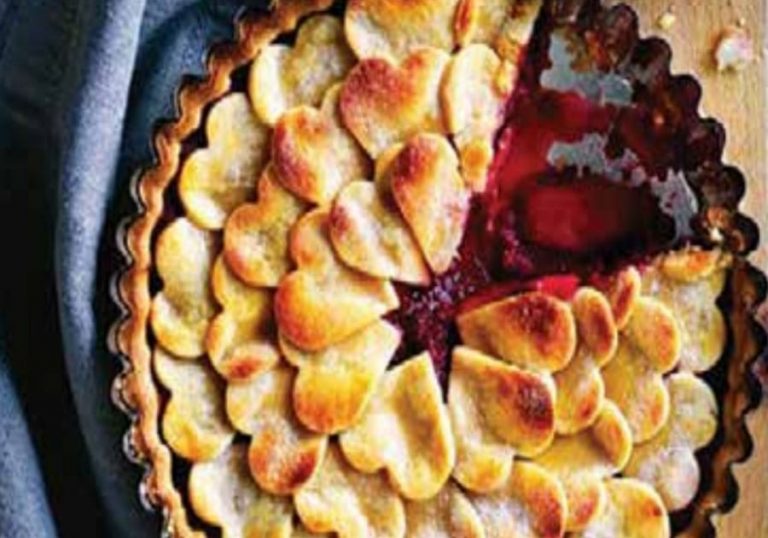
Preheat oven to 180C. Divide pastry into 2 even portions. Roll out 1 portion on a lightly floured surface to a 3mm-thick disc. Line a 5cm-deep, 22cm (base measurement) fluted tart tin or pie tin with pastry. Sprinkle with almond meal. Spoon the cooled apple mixture into the pastry case. Roll out the remaining pastry on a lightly floured surface to a 2mm-thick disc. Use a 5cm heart-shaped pastry cutter to cut shapes from pastry. Arrange pastry hearts over filling, overlapping slightly. Lightly brush with egg white and sprinkle with extra sugar. Bake for 35-40 mins or until pastry is golden brown and filling is heated through.

ON THE ROAD – Rarest Cars Part Two

1961 Ferrari 250 GT California SWB Spider – $17.16 Million

This beautiful car probably looks a bit familiar to a few readers, and that’s because a Ferrari 250 GT was the same car that was used in the ‘80s blockbuster, “Ferris Bueller’s Day Off.” “Only 55 of these cars were ever made, making it one of the most sought-after Ferraris on the market,” says Shayrgo Bazari of CarSumo. The Ferrari 250 GT was built between 1953 and 1964, with many racing models built in between those years.

In 1959 Ferrari gave the 250 GT sharper handling and reduced its wheelbase to create the 250 GT California Spyder SWB. The car was showcased in Geneva in 1960. The revised Spyder also had disc brakes and a most powerful, 276-hp version of the 3-liter V12 engine of its predecessor. The car featured in “Ferris Bueller’s Day Off” was a replica, fiberglass-bodied version of the 250 GT Spyder California. A 1961 SWB was sold by James Coburn to radio DJ Chris Evans for £5.5 million. Another ’61 SWB, a barn find that was used in the film “Les Felins” with Jane Fonda, sold for $15.9 million in 2015. And finally, on March 11, 2016, at the Omni Amelia Island Plantation, a ’61 SWB was auctioned off for $17.16 million.

1953 Jaguar XK120-C – $13.2 Million
The Jaguar XK120-C, or the C-Type, was a racing sports car from Jaguar produced between 1951 and 1953. The car was built using a lightweight tubular frame and an aerodynamic body developed by Heynes, RJ Knight, and Malcolm Sayer. Only 53 of these cars were built, and 43 of them were sold to private owners, making it possibly the rarest Jaguar in the world. One thing is certain: When a ’53 C-Type sold at an RM Auction in Italy in 2015 for $13.2 million, it became the most expensive Jaguar ever sold.

The road-version car ran on a 3.4-liter twin-cam straight-six engine that produced between 160 and 180 bhp, while the track-version had a 205 bhp tuned engine. The C-Type was very successful at racing, proven by its two wins at the Le Mans 24 Hours race, first in 1951, and then in 1953. They lost in 1952 because Jaguar was worried about the reported speed of the new Mercedes- Benz 300SLs, so they modified the aerodynamics to increase speed, but the rearrangement led to overheating from a vulnerable cooling system.

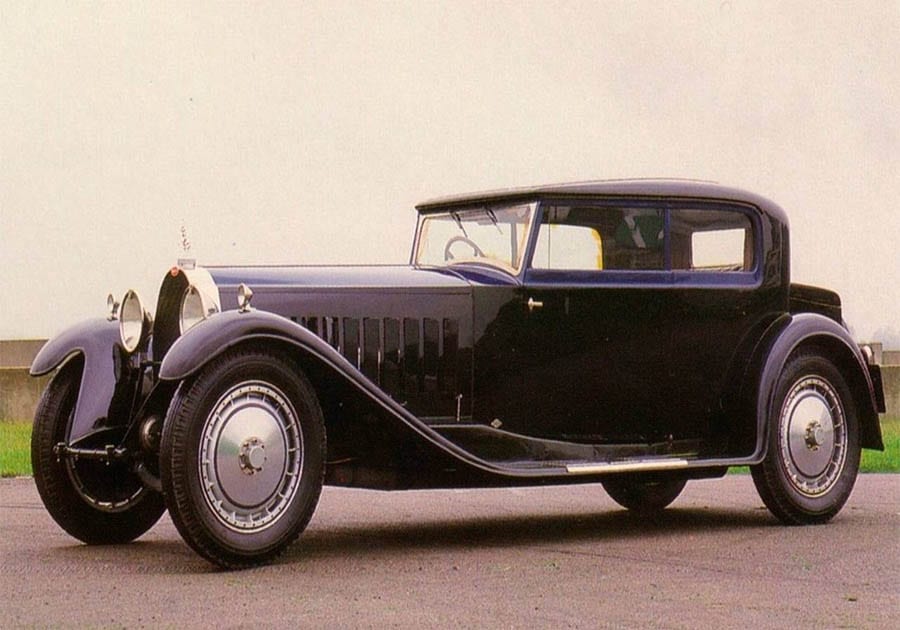
Bugatti Type 41 Royale Kellner Coupe – $9.7 Million
Before Bugatti was known for its high-end, high-priced supercars, they were known for their luxury vehicles. The Type 41, better known as the Royale, was a large luxury car built between 1927 and 1933. It weighs approximately 7,000 pounds (which is a lot) and used a 12.763-liter straight-eight engine (which is huge). For comparison, a modern Rolls-Royce Phantom is 20% shorter and 25% lighter than the Bugatti Type 41. In fact, Type 41 is one of the largest cars in the world—and unofficially, it’s one of the most stylish.

Ettore Bugatti planned to build 25 of these cars and to sell them to royalty as “the most luxurious car ever,” but you’ll note that the cars were built during the Great Depression, so his timing was a bit off…

Not even European royalty was buying cars such as this during that time, so only three of the seven made were sold. The chassis alone cost $30,000 to build when it was first made. Today, six of the cars exist, and one of them was destroyed in a wreck. In 2001, Forbes reported the price-tag of this car at $10 million, though CarBuzz reported in 1987 that one had sold at auction for $9.7 million.

2008 Maybach Exelero 2008 Maybach Exelero – $8 Million

The Maybach Exelero is a one-off high-performance sports car made by the German manufacturer Maybach- Motorenbau GmbH, a subsidiary of DaimlerChrysler. The car was unveiled in 2005. It was powered by a twin-turbo V12 engine that produced 690 horsepower, a top speed of 218 mph, and a 0-62 mph acceleration time of 4.4 seconds.

The car was used in an episode of the long-running German show Cobra 11, which made it somewhat famous. According to Top Gear, the car was purchased by American rapper Birdman in 2011 for $8 million, though Motorvision tracked down the car and reported the previous sale was unfounded. They found that the car was owned by Mechatronik and located in Germany. Jay-Z also featured the car in his music video “Lost One,” which gave the car a renewed high profile. Barazi of CarGurus has said, “The Exelero combines the first-class experience you’d expect from a limo with the performance characteristics of a high-end sports car.” We don’t know if all of that is true, but what we do know is that it sells for $8 million. Maybach has always been known for its high-end luxury cars, so this one was quite a deviation from their norm.

1964 Ford – $7 Million
The Ford GT40 is the original high-performance race car that was the precursor to the now-popular Ford GT supercar. The GT40 was based on the British Lola Mk6 and was powered by a series of American-made engines built solely for the car. The GT40 won the 24 Hours of Le Mans four consecutive times, from 1966 to 1969, and finished 1-2-3 in 1966. With Henry Ford II in attendance at Le Mans, the Mk II GT40 gave Ford the first Le Mans victory for an American manufacturer in 1966.

The car was produced to win long-distance races, primarily against Ferrari, who won Le Mans six times in a row from 1960 to 1965. As you can see, Ford succeeded in their one- sighted mission.

The car was named after its style, a Grand Tourer, and its overall height of 40 inches. Only 105 of these cars were produced between 1964 and 1969. They all ran on different sized V8 engines, including a 4.7-liter engine in the Mk I, a 7.0-liter FE engine in the MK II (the same engine that got them the 1-2-3 finish in 1966), a detuned, 306- hp 4.7-liter engine in Mk III, and the same engine in Mk IV as in Mk II. These cars are extremely rare and valuable these days, as a prototype GT40 was sold in 2014 for $7 million, according to AutoBlog.

Volunteering can help you make friends, learn new skills, advance your career, and even feel Happier and Healthier

Why volunteer?
With busy lives, it can be hard to find time to volunteer. However, the benefits of volunteering can be enormous. Volunteering offers vital help to people in need, worthwhile causes, and the community, but the benefits can be even greater for you, the volunteer. The right match can help you to find friends, connect with the community, learn new skills, and even advance your career.
Giving to others can also help protect your mental and physical health. It can reduce stress, combat depression, keep you mentally stimulated, and provide a sense of purpose. While it’s true that the more you volunteer, the more benefits you’ll experience, volunteering doesn’t have to involve a long-term commitment or take a huge amount of time out of your busy day. Giving in even simple ways can help those in need and improve your health and happiness.

Benefits of volunteering:
4 ways to feel healthier and happier
1. Volunteering connects you to others
2. Volunteering is good for your mind and body
3. Volunteering can advance your career
4. Volunteering brings fun and fulfilment to your life

Volunteering combats depression.
Volunteering keeps you in regular contact with others and helps you develop a solid support system, which in turn protects you against depression.

Volunteering makes you happy.
By measuring hormones and brain activity, researchers have discovered that being helpful to others delivers immense pleasure. Human beings are hard-wired to give to others. The more we give, the happier we feel.

Volunteering increases self- confidence.
You are doing good for others and the community, which provides a natural sense of accomplishment. Your role as a volunteer can also give you a sense of pride and identity. And the better you feel about yourself, the more likely you are to have a positive view of your life and future goals.

Volunteering provides a sense of purpose.
Older adults, especially those who have retired or lost a spouse, can find new meaning and direction in their lives by helping others. Whatever your age or life situation, volunteering can help take your mind off your own worries, keep you mentally stimulated, and add more zest to your life.

Volunteering helps you stay physically healthy.
Studies have found that those who volunteer have a lower mortality rate than those who do not. Older volunteers tend to walk more, find it easier to cope with everyday tasks, are less likely to develop high blood pressure, and have better thinking skills. Volunteering can also lessen symptoms of chronic pain and reduce the risk of heart disease.
When it comes to volunteering, passion and positivity are the only requirements.

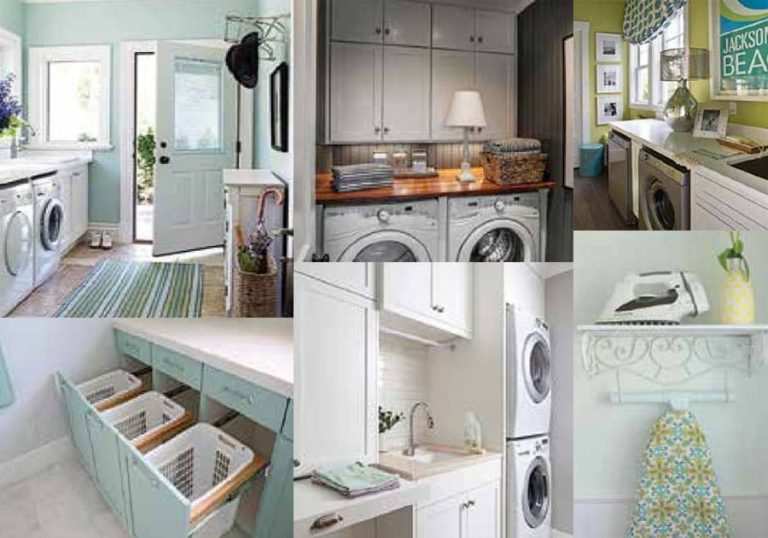
7 secrets to styling your Laundry

LAUNDRY AND MUDROOM
Incorporating with the mudroom is one of the most popular small laundry room ideas and designs. It’s sensible and traffic smart especially if you need extra space to hang and dry clothes. This light green colour scheme is laundry room perfect – fresh, clean, airy.

WHITE AND ORGANISED
White expands the room and creates the illusion of space. This white and well-organised laundry is complete with a sink, folding station, ironing board, stacked washer and dryer, and lots of storage. And it only took half a wall of space.

LIGHTING
We often don’t think of the laundry room when choosing light fixtures. But with new fixtures, or even a chic lamp, you can change the mood, look and vibe of your laundry room in no time at all.

RETROFIT CABINETS
Retrofit the inside of your cabinets with additional storage options. In this example, wire laundry bins were installed to help manage the chaos of all the dirty laundry that a family might produce. You can add other upgrades, such as extra drawers, shelves or even extra storage for all of your pet items.

PRESS THE ISSUE
“Our laundry room and kitchen pantry is a small multi-purpose space, so we needed to maximize the storage options,” to create a solution for storing both the ironing board and iron. A standard shelf with hooks from a craft store fits the bill. A silicone iron rest atop the shelf protects the shelf surface if a still-warm iron is put away.

HANG ARTWORK
Adding artwork to your laundry room immediately elevates your space and makes it feel less like a utility room and more like a true living space. You can pick up on any design themes you already have going on in your home with your artwork. Or, go in a completely different direction, and do something fun and bold in your laundry room.

ADD A NEW SINK
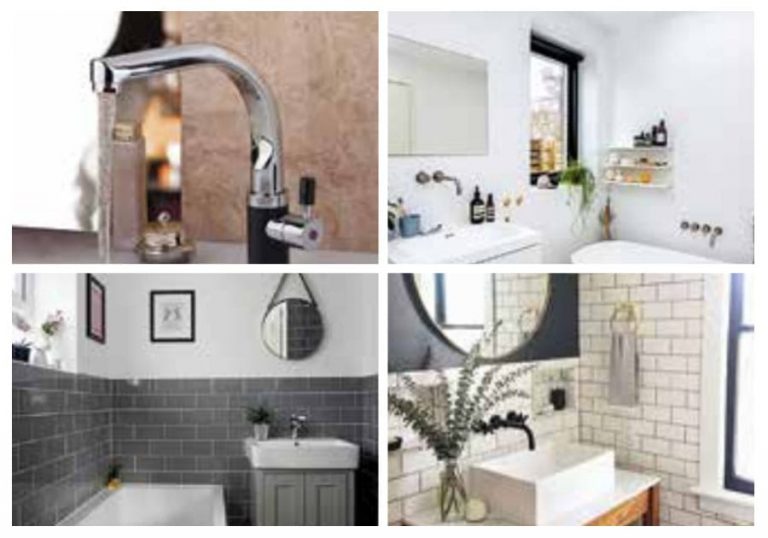
If you have a sink in your laundry room, switching it out is a great option if you want to dip your toe in the renovation pool. Your options are limited by your budget; however, there are some lovely sinks that you can find in home improvement stores that will elevate your space. Pair your new sink with a new faucet for an extra design punch.

Flowers on the Water

SATURDAY 25TH JULY DAWNED TO A DREARY HORIZON OBSCURING CLOUDS OVER THE GLASSHOUSE MOUNTAINS WITH A POTENTIAL SQUALL PREDICTED FOR THE PUMICESTONE PASSAGE. IT WAS A COLD, SHOWERY AND MISERABLE MORNING BUT A SOMEHOW FITTING ONE FOR SUCH A SOMBRE OCCASION.

Members of Dragons Abreast, Bribie Island (DABI) paddled in the rain to conduct “Flowers on the WaterTM, a very special Dragons Abreast Australia ceremony.

This is one of the most emotional and important traditions within dragon boat paddling for Breast Cancer survivors. It is conducted on rare occasions to honour those who have been, and are continuing, to travel the path of a Breast Cancer diagnosis, as well as those who have lost their battle with breast cancer.

Belonging to a breast cancer survivor group means that inevitably some of us do lose our lives to BC and in Australia, we have coined the name, Angels Abreast for the members who have left us.

Our Flowers on the Water ceremony is trademarked by Dragons Abreast Australia to maintain the significance and to protect the dignity and respect for all.

Thankfully, the rain stopped at the right time to enable us to have the Memorial Service without getting soaked. Our onshore Commentator introduced the ceremony to gathered friends whilst to honour our Angel, her teammates from DABI paddled out in purple and pink dragon boats. The two boats rafted up together as our own Chaplain evoked very moving and beautiful words while we scattered multi-coloured flower petals onto the swell.

A poignant minute of silence accompanied soulful music and the carpet of floating colour as we remembered our Angel; thanked her for being part of our lives, and contemplated the special times we had together. Both boats then paddle-tapped a circle of honour to shore where all were invited to join us and participate by sprinkling petals into the water.

We felt that we had farewelled our Angel uniquely as a glorious rainbow dipped into the channel at Ningi Creek.

Island Gardens – July 31, 2020

WELCOME BACK TO ISLAND GARDENS. TODAY WE’RE LOOKING AT PRUNING ROSES AND OTHER PLANTS IN TIME FOR SPRING GROWTH JUST A FEW WEEKS AWAY NOW. THERE IS A LOT OF ADVICE AVAILABLE ON ROSES, AND OFTEN MUCH DEBATE AS TO WHAT IS RIGHT AND WRONG. SO THE ADVICE I GIVE HERE IS FROM MY EXPERIENCE, THAT OF MY CUSTOMERS, AND A LITTLE RESEARCH. AT THE END OF THE DAY – DO IT WITH A LITTLE COMMON SENSE AND YOUR USUAL LOVE AND CARE.

So here we are close to the end of Winter and most of our roses are leafless and flowerless. Although the springlike days that Bribie Island gratefully receives in winter means that many roses are still sending out a flower or two. Either way, we are nearing the end of the dormant period in which they should have their big winter prune – many of our experienced rose growers will have done this in July – but it’s not too late. The temperatures shouldn’t warm up much for at least a couple of weeks yet.

The pictured rose bush here is a “standard rose” (also referred to as a stem rose) – a variation of the normal bush rose but grafted at a height of 90cm or 60cm (patio standards). The same pruning advice applies to bush roses.

When pruning, create a bowl shape as shown in the lower photo. This allows sunlight and air to reach all parts of the bush when growth returns. Also, black spot is a common affliction and this aerated shaping will help to alleviate or negate the problem.

Aim to cut off around half to even two-thirds of the bush’s size. Any branches which are facing inwards are best cut off. As much as possible, have your branches fanning outwards. Cutting about 5-10mm above an outward-facing node will encourage the Spring growth to continue outward, allowing the sunlight and airflow to continue reaching the whole bush. The bowl-like appearance will be the result, creating a very healthy basis for your rose’s upcoming season. Although you now have what may appear to be a boring bunch of sticks, you can look forward to a magnificent display of roses in the months to come.

It is okay to do minor pruning throughout the year to help keep your bush nicely shaped, including removing the dead flowers whenever you see them. As with most flowering plants, “dead-heading,” these flowers promotes the growth of new flowers.

And just a little hint to keep in mind every year for Mother’s Day – at the end of March or very early April – prune back a few inches of lots of stems and branches. 6 to 8 weeks later, you will have a spurt of new roses to give to all the special mums you know 🙂

Have a wonderful August and see you again in issue 121 on the 28th August.

Have a wonderful August and see you again in issue 121 28th August. happy gardening.

Worst Food Mistakes You Can Make

Although you rarely think of your kitchen as a playground for dangerous foodborne germs and illnesses, there are common food safety mistakes that can make it just that. Bacteria like E. coli, salmonella, and botulism toxins can appear anywhere, anytime, even when there isn’t a known outbreak going on. This is why it’s extra important to always practice good hygiene in the kitchen and build habits for safe food handling, cooking, and storing. In addition to avoiding them, make sure you’re cleaning the germiest parts of your kitchen regularly. you rarely think of your kitchen as a playground for dangerous foodborne germs and illnesses, there are common food safety mistakes that can make it just that. Bacteria like E. coli, salmonella, and botulism toxins can appear anywhere, anytime, even when there isn’t a known outbreak going on. This is why it’s extra important to always practice good hygiene in the kitchen and build habits for safe food handling, cooking, and storing. In addition to avoiding them, make sure you’re cleaning the germiest parts of your kitchen regularly.

WASHING RAW MEAT OR EGGS
Let’s put this one to rest once and for all. If you’re having debates with your family mem- bers about whether you should be washing raw meat, the answer is no, no, no. The same goes for eggs. Although you may think you’re doing the right thing by washing these germ-prone foods, you’re actually helping spread those germs all over your sink and countertops. The best way to kill food germs is by cooking your food properly.

NOT WASHING FRUITS AND VEGGIES
Fruits and vegetables, however, you’ll definite- ly want to wash, even if it’s something you’re peeling. The germs on the skin of fruits and vegetables can contaminate the parts that you’re actually eating, so rinsing them under running water is a must. It’s also good to have a designated vegetable brush on hand.

USING THE SAME PLATE FOR RAW AND COOKED MEAT
Please don’t ever reuse the plate or bowl where you kept raw meat during the same cooking session. Anything the raw meat has touched should be washed with dish soap immedi- ately, and that goes for cutting boards, too. It may seem like a good idea to use fewer dishes when you’re cooking so you don’t have a lot of cleaning up to do on a full belly, but this is not the place to skimp—raw meat germs will most definitely contaminate the cooked meat you’re about to eat. Same goes for fish and shellfish, too.

NOT COOKING MEAT, SEAFOOD, OR EGGS THOROUGHLY
The best way to kill the germs on your food is by cooking it thoroughly, and the temperature should be high enough to actually do the job. Use a food thermometer to make sure you’ve achieved the correct temperatures that will prevent germ-spreading:

EATING RAW OR UNCOOKED FOODS THAT CONTAIN EGGS OR FLOUR
Uncooked flour and eggs can contain an array of harmful germs, the most well-known being E. coli. Our dessert preferences aside, the best way to prevent food poisoning is to avoid the following high-risk foods altogether: runny or undercooked eggs, homemade mayo, home- made hollandaise sauce, homemade eggnog, and uncooked dough or batter of any kind. This is especially important for those who are immunocompromised—why take any chances?

TASTING FOOD TO SEE IF IT’S BAD
If you have a suspicion something in your fridge has gone bad, tasting it to make sure is a bad idea. First of all, you’ll rarely be able to taste or smell the germs that may be present on the food. Second of all, if you think a small piece of spoiled food can’t possibly cause much harm, you’re wrong. You can get seriously sick from a very small amount of spoiled food.

Eco Village Hair

Welcome to Eco Village Hair, located at the Bongaree Shopping Precinct First Avenue, on beautiful Bribie Island. With a gorgeous and friend;y Team, we offer quality products made for allergy-sensitive customers. Our range is extensive, vegan, PPD free, sulfate-free, and paraben-free, and Clever Curl, most of our products are sourced locally and Australian Made.

This Salon was designed as a homage to the retirees of Bribie Island; it is warm and welcoming. We have antique hair accessories, and interesting and beautiful things to look at. We are starting a Wall of Fame for our amazing customers and to their lives and experience. The majority of the antiques have been donated in dedication to their loved ones and each display has a story. We learn from them every day just how beautiful each and every one of them are; the stories, the love, the heartache, and the memories they share with us are heartwarming. We really do love our customers.

We believe that good old – fashioned quality of service is deserved to our Bribie Island residents. We want our lovely clients to feel nostalgia as they step foot into the Salon.

We always have a Senior hairdresser on that has completed an aging support certificate and first aid. Our health and safety measures are strict and aligned with the COVID health and safety standards. Come in and say G’day to the Eco Village Hair Team.

NOELENE LAKE Bribie Accounting Services

I am often told by my clients that I am “different” to other Accountants. This is actually a very positive affirmation that my “point of difference” is noticeable.

To be successful in business, it is necessary to find your points of difference, develop them, to make your business “stand out” from your competitors.

It is important for people to find an Accountant who is familiar with the special requirements of their business, family, and tax situation. The strategies I suggest for one client can be quite different to those I suggest for someone else and an Accountant cannot strategize effectively unless they have an in-depth knowledge of their client’s situation.

It is important to have a good discussion with your Accountant, about your situation and requirements, then gauge how well you might work together. I have been told that some people are scared to ask their Accountant questions. Feeling comfortable with your Accountant and being able to communicate with him or her is very important as you are going to have a long-term relationship with them.

Ask questions of your Accountant about their “availability” when problems arise, their “returning phone calls” policy, their method of informing you of tax system changes that impact you, their proactive approach to giving you advice before it is too late to make tax-saving decisions and the general support they offer you throughout the year.

At Bribie Accounting Services, we pride ourselves on being available for our clients, addressing their needs quickly and ensuring that they understand the information we provide.

We talk with clients, listen to them, inform them of tax effective strategies and then let them make their own decision whether they wish to appoint us as their Accountants and Tax Agents. Building a relationship starts at that very first point of contact and continues as we work together to achieve the best outcome for you-our clients. You are paying us to do the best job for you.

When you contact Bribie Accounting Services, you get to speak with a fully qualified and experienced Accountant. You will be speaking directly with either myself or Angela and WE attend to your enquiries and your work…

No receptionists, no juniors, no trainees- just fully qualified and knowledgeable Accountants. Our services included Accounting; Bookkeeping; Business Activity Statements, Financial Reporting; Business Coaching, Management, and Training; Super Fund accounting and auditing, Budgeting and Cash Flow Management; Payroll support. Have a look at our website www.bribieaccounting.com.au for some great tips and advice.

Please contact Bribie Accounting Services so we can help you. Tel: 3408 9539 or 0438 719619 or Email: info@ bribieaccounting.com.au

NOELENE LAKE
Accountant (Bachelor of Commerce-Accounting/ Finance), Registered Tax Agent Registered
Super Fund Auditor Fellow-Institute of Public Accountants,
Fellow-Institute of Financial Accountants Justice of the Peace Qualified,
Quality Assurance Auditor.

Winner: M.B.R.C: Excellence in Professional Services Award

Winelander

LAST TIME WE LOOKED AT PINOT NOIR AND WHAT A VERSATILE GRAPE IT IS, UNFORTUNATELY, THERE IS GOING TO BE LESS OF IT AVAILABLE OVER THE NEXT TWELVE MONTHS WITH WINE AUSTRALIA REPORTING THAT ALONG WITH RIESLING THE SIX OF THE 2020 CRUSH WAS 20% DOWN FOR PINOT NOIR AND 28% FOR RIESLING. THE OVERALL AUSTRALIAN WINE GRAPE CRUSH IN 2020 WAS DOWN 12% YEAR-ON-YEAR AS THE INDUSTRY BATTLED EXTREME WEATHER EVENTS AND BUSH FIRES.

Red varieties fared slightly better than white varieties in 2020 being down 11% compared with 2019 while white wine varieties were down by 13% and our largest variety Shiraz decreased by 10%. The main contributor to the reduction in the white wine crush was Chardonnay which was down 19% and Riesling which was down 28% which was a 20 year low at a total of just under 17,000 tonnes.

Whilst the crush was down it still resulted in a crop of 1.52 million tonnes the equivalent of more than a billion litres of wine being produced even so it was the lowest crush since 2007 but very similar to the 1.61 million tonnes of grapes crushed in 2010 which also turned out to be an exceptional year for quality.

Wine Australia reported that whilst the crop was down the quality was again expected to be very high as Autumn temperatures were generally around average or slightly cooler leading to ideal ripening and harvesting conditions which resulted in reduced yeilds but with more concentrated colours and flavours in the berries.

Whilst I appreciate that the largest produced red wine in Australia is Shiraz and in Grange, we have a wine that can match some of the Grand Crus of Bordeaux I still have a warm spot for Australian Cabernet Sauvignon which I believe can match any produced anywhere in the world. I find a really good Cabernet is a lot more approachable especially with food than Shiraz and in my time with Penfolds always preferred a glass of Bin 707 Coonawarra Cabernet Sauvignon to that of Grange Hermitage as was known in those days. I find Shiraz seems to have too many different characters depending on where the grapes come from whilst Cabernet Sauvignon from Margaret River or Coonawarra has the lovely blackcurrant aroma and regardless of age has a more rounded softer finish to that of Shiraz, which is the great thing about wine everyone has different opinions and tastes. Cabernet Sauvignon first arrived on our shore in the early 1800s with the cuttings originally coming from Bordeaux in France and is the prime component of the great Grand Crus of the region when blended with Merlot and Cabernet Franc and is known as the ‘King of Red Wines’

Today it is the most planted red wine grape grown around the planet being grown in every grape growing country including in The Northern Hemisphere North America, Eastern Europe, Italy and Spain. In the Southern hemisphere, it is grown in Australia, Chile, Argentina and South Africa and was introduced with many other varieties to Australia by James Busby, a wine pioneer who imported the grape in 1832. Initially used for blending it was recognised as being able to make a great wine in its own right and for many years was the great red wine grape of Australia.

The majority of grapes grown in Coonawarra go into making a 100% varietal wine and the wines produced can vary to medium-bodied to full-bodied styles. Expect a supple palate and balanced tannins with aromas of cassis, blackcurrant, redcurrant, blackberry and mulberries when young and with age more earthy, savoury and spicy characteristics.

In the Barossa some of the great wines of the region, especially those pioneered by the late Max Schubert of Penfolds and Grange fame, haves used Barossa Cabernet Sauvignon as a part of the blend with Shiraz especially in cooler vintages when the cabernet fruit is rich and ripe.

Cabernet Sauvignon is also one of the great wine styles of The Clare valley being bold, powerful and earthy, Taylors was a vineyard founded on producing great Cabernet and their Jaraman Cabernet is outstanding matching any Shiraz they produce.

Over in the west, Margaret River produces Cabernet similar to The Coonawarra and although wines from the region only go back to just short of fifty years they have become a Cabernet powerhouse. Margaret River only accounts for around 10% of the total wine production of Australia but around 30%of premium wines come from this region. Wines from this region have won the Jimmy Watson Trophy on no fewer than six occasions and include Cape Mentelle 1982 and 1983, Flametree 2007, Joseph River 2009, Deepwoods 2014 and Xanadu 2016. Also look for Evans and Tate, Cullens, Woodlands and Mosswood who also make outstanding Cabernet Sauvignon.

Back to Victoria where the Yarra Valley excels especially Yarra Yering and Langhorne Creek in South Australia where Cabernet was first planted in the 1800s by Bleasdale founder Frank Potts. Not to forget The Hunter Valley and Lakes Folly where Dr Max Lake produced an Australian icon. Lakes Folly, Deep Woods Estate, Evans and Tate and Millbrook wines are now all part of the Fogarty Wine Group.

To finish James Halliday has a couple of interesting wines in his latest article a couple of old favourites and a couple of newcomers. He recommends Majella “The Musician” 2018 Cabernet Sauvignon $18, Wirra Wirra “Church Block” 2018 $22 and in interesting blend Longview Fresco Red comprising of Nebbiolo, Pinot Nero, Sangiovese and Barbera a real Italian mix $26.