Home Blog Page 70

History – The STORY of our BRIDGE

Tags: Bribie Island Bridge. History. Historical. Landmarks. Queensland. Australian

With community concern being expressed about building another Bribie Bridge, it is appropriate to remind you about how the existing Bridge came into being 56 years ago, and some of the social issues that resulted from that. Another bridge will certainly be constructed at some future time, but will it be an addition or a replacement?. Previous Engineering surveys indicate that the present Bridge is adequate until about 2031.

There were even proposals back in the 1970s for a second bridge to be built over the Passage far to the north, using Egg Island as a platform. Current thinking is a new Bridge would be constructed parallel to the existing one, about 15 metres north. I am not going to speculate about where, when and what size a new Bridge might be, but simply to remind readers that such decisions should be driven by cost, political commitment and providing solutions to clearly defined and agreed to needs.

Bribie Island Bridge. History. Historical. Landmarks. Queensland. Australian-150 years of Private Enterprise transport
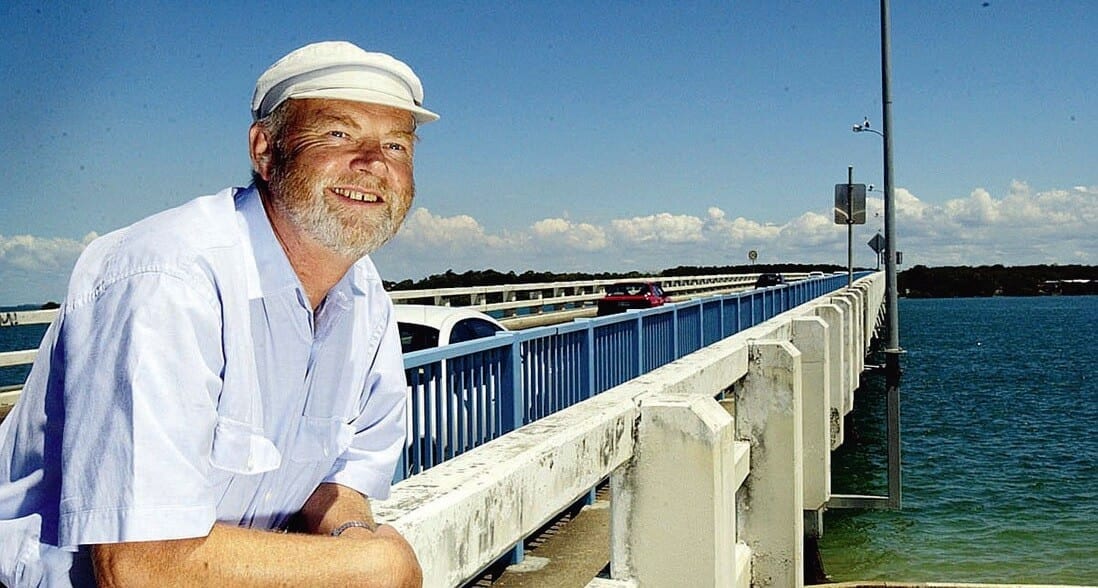
From the start of the development of Bribie island as a residential and tourist destination access and transport was entirely provided by private enterprise. Back in 1912, when there were just 25 residents, the Brisbane Tug & Steamship Co. leased land at Bongaree, had the Steamship Koopa built in the UK, built the Bongaree Jetty and began regular trips for visitors from Brisbane via Redcliffe.

Thousands of people came to camp at Bongaree but it was 12 years before the first private company road was built from Bongaree to Woorim. This road had a Toll placed on it, and initially, it was a very basic truck and bus services as there were few if any private cars on Bribie. Tourism peaked in the 1930s when there were more people coming to camp and stay in the few Bribie guest houses, than the entire population of Caboolture Shire. All of this happened as a result of private enterprise investment.

Bribie Island Bridge. History. Historical. Landmarks. Queensland. Australian-1During World War Two (1939/45) most residents and tourists were evacuated from Bribie and it was taken over the by the military, and the steamships were requisitioned into War service. The first road was constructed from Caboolture to Toorbul Point and a large military training camp was established at Toorbul (now Sandstone) Point, and Defence installations built on Bribie Island. Barges were used for military personnel and vehicular transport, and after the war, these barges were purchased by Bribie residents and began operation as private Car Ferries.
The first mention of a Bridge to Bribie was made in 1947 by Queensland Premier Edward Hanlon when Development funds were announced, and he suggested a Bridge. However, nothing happened then, and it was 10 years later in 1957 when Premier Vince Gair spoke about a possible “Pilot Station” being built on Bribie Island for shipping in and out of Brisbane. In the 1957 State Election campaign opposition leader, Frank Nicklin promised Bribie islanders “If I am returned to office I will build you a bridge”.

Frank Nicklin was elected Premier, but his first action was to approve a “Pilot Station” to be constructed at Mooloolaba, in his own electorate. From 1957 to 1959 there was a lot of agitation, public meetings and deputations regarding Nicklin’s promise of a Bridge to Bribie Island. In 1958 a proposal was made by developer Alfred Grant Pty. Ltd. to obtain a large area of Crown Land on Bribie in return for building a free bridge to Bribie.

This offer was never taken up. In 1959 the State Government made an official announcement that Tenders would be called for the construction of a Bridge to Bribie. A year later a contract was awarded to K.D.Morris to construct a bridge for 358,000 pounds ($716,000). Construction started in July 1961 and in October 1963, after many years of political wrangling the Bridge was opened.

A Bridge too Far

During the post-war period, private motor cars had become increasingly popular, and the long steamship trips from Brisbane were no longer attractive. The Tug Co. relinquished their Steamships and assets on Bribie in 1953, and an attempt was made to maintain the service by a few residents who purchased the SS Koopa. It too soon failed, and from 1954 to 1963 motor vehicles by private car ferry was the only access to Bribie. The resident population of Bribie was then about 500 people and the car ferry cost was an expensive 10 shillings return.

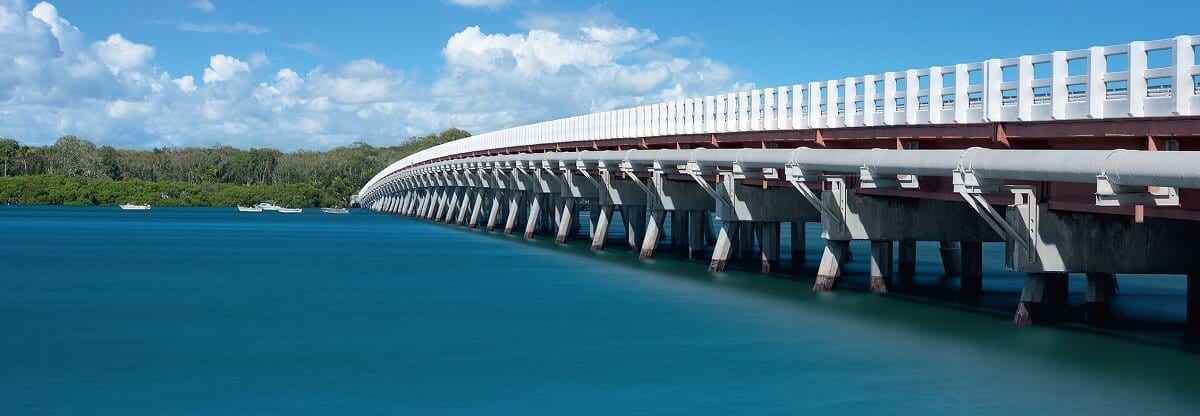
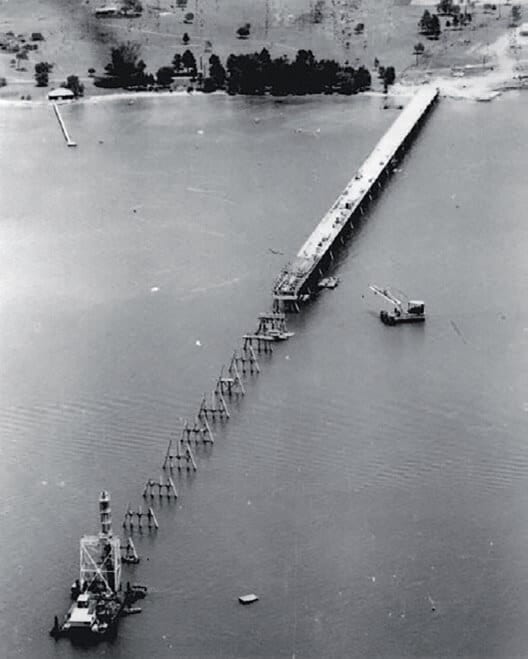
There were increasingly long queues of cars waiting to get on and off the island. Building the Bribie Island bridge was a challenging job from 1961 to 1963, watched with great interest by residents and visitors alike. A long-awaited bridge would certainly transform the future of the island. With 206 concrete piles 26m long to be accurately driven at different angles 10m into the sea bed, 104 girders weighing 12 tons each to be erected over 38 spans, it was the longest precast prestressed concrete bridge in Australia with an 832-metre span.

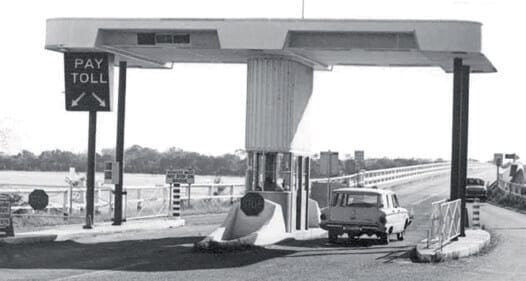
A most impressive piece of Engineering produced a structure that was economical, durable and requiring minimum maintenance. The Bridge was officially opened by Premier Nicklin on 19th October 1963. However, the years of promises and waiting, and the planned celebrations were crushed by the last minute announcement of a very expensive Toll for crossing the Bridge. In June 1963, just weeks before opening, and in the middle of plans for great celebrations, the Government announced that there would be a toll of 10 shillings ($1) return for crossing the bridge.

1963 Bridge Toll was $14.70 in today’s money.

This was the same expensive cost as the car Ferry, and ten times higher than the toll on the Hornibrook highway and the Storey Bridge. Ten shillings was a lot of money in those days and would go a long way towards buying Petrol for a return trip to the Gold or Sunshine Coast.

After years of expectation of the bridge opening up a new era of development and tourism on Bribie, the expensive Toll would, in fact, be a deterrent to development. It was the most expensive road toll of any in Australia!! The 10 shillings ($1) Toll was equivalent to $14;70 in today’s money.

Community reaction to paying for Bridge

Everyone was outraged at this last minute Political announcement. After years of planning and preparation the “Celebration Committee” disbanded and for a while, it looked as if the opening event would be boycotted. However, the opening day was a very special occasion with thousands turning out to see the colourful Parade of floats, vehicles, procession, surf carnival and Black Tie Ball.

Bribie Island Bridge. History. Historical. Landmarks. Queensland. Australian-1

Bridge Toll Booth 1964

A plaque was unveiled and Premier Nicklin announced that “it was not the Government’s intention to keep the Toll any longer than necessary.” This was all too late and people felt cheated and deceived by this blow to Bribie’s long-promised development. Despite the disappointment 14,000 cars paid the toll to cross the bridge in the first week, it was open, for a new experience of Bribie.

Further disappointment followed as these new “Paying Guests”, as the residents called them, found that the infrastructure and amenities were totally inadequate. Roads, Parking, Toilets, Shops, Food outlets and street signage were just not up to expectations. Development plans and expected increase in residents just did not eventuate as expected, and the bridge was nicknamed the “Ned Kelly Bridge” as it was felt to be highway robbery.

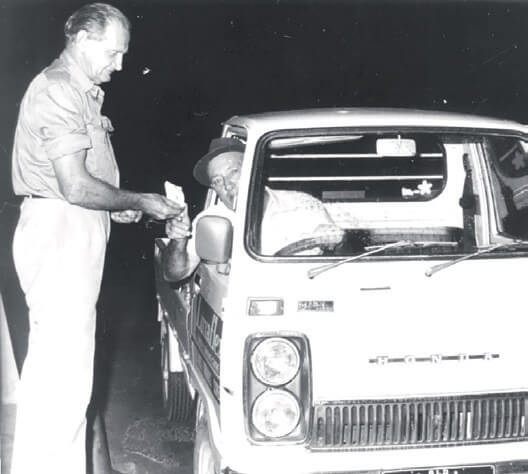
The Bridge Toll remained in place for 12 years and was finally lifted in 1975 when the Government announced that the Bridge had been paid for. When decimal currency was introduced in 1966 the 10 shilling Toll became $1, and throughout the 12 years, there were constant demands for concessions and reductions, some of which were eventually granted for Bribie residents. When the bridge was opened in 1963 the resident population was about 700 people, and 12 years later in 1975, there were just 2000 residents.

Bribie Island Bridge. History. Historical. Landmarks. Queensland. Australian-1

Bridge Last Toll being paid 1975

A Plan for Bribie…. and the VOICE of the PEOPLE.

Back in those days, there were two elected representatives of Bribie on the Caboolture Shire Council. The Bridge had been a State Government project, but there were many issues with the Council that required appropriate action. Electing the right people to represent Bribie was critical.

This quote from the local “Bribie Star” newspaper in October 1963 sums it up. “Bribie must have strong, vigorous representation at Caboolture and it will be necessary to guard against electing representatives who, as is often the case with Shire Councillors, place the questionable honour and glory of being a Councillor before their duty to the island residents they represent.

The office of Councillor is an unenviable one that carries with it more brickbats than bouquets, but the only good Councillor is one who has the moral fibre to say “Yes” and “No” at the right time to both fellow Councillors and electors.”

BACK to the FUTURE

I think it is interesting to reflect on the political and social processes that went on nearly 60 years ago and consider the situation we are in today. Much is being said about the need for a new Bridge and improvements to the Bribie Island Road. Even if all this should happen in the next few years, or at least by the 2031 date mentioned in the Engineering review, should we anticipate a Toll to be placed on a new Bridge?

We now pay a Toll on every new Road and Tunnel constructed in recent years. That’s what happens these days……….User Pays. If that is likely to be the case then perhaps a Toll should be introduced now on the existing Bridge, to pay for a new one….. perhaps to be built sooner. What would be the impact of a Toll on the current bridge, would it seriously impact Bribie development, or perhaps reduce the traffic issues that are planned to be resolved by spending hundreds of millions of dollars on new infrastructure?

New Bridge and road improvements are inevitable but is it clear just what problem is being solved. I raised this question with a few complete strangers in coffee shops over the last few days, and these are few of the responses…..

“Seeing that the daytrippers to Bribie make little contribution to the island, except traffic congestion, why not place a toll on the bridge for all non-Bribie residents? This could be very easily done electronically or via number plate recognition. This way we would get a duplicate bridge sooner rather than later and the cost to the taxpayer would be subsidized by user pays” “The current bridge is more than adequate for local traffic use, it only gets congested on weekend with the influx of visitors.”

“Shouldn’t we get Bribie Road fixed before a new bridge?” “Toll Bridge is a great idea especially with free right of way to vehicles registered on Bribie.” “Toll bridge construction could start immediately and bring much-needed jobs to the area.” “Cost of toll could stem excessive traffic to the Island and improve the quality of life”.

More Bribie History We can all learn a lot from History. The Historical Society has monthly public meetings at the RSL Club on the second Wednesday of each month commencing at 6:30 pm with interesting guest speakers on a wide range of topics, and you can see many more photos and articles on our Blog Site at http://bribieislandhistory.blogspot. com or contact us on [email protected].

Mad Poets Society – May 2019

Tags: Poetry. Poems. Poets

JUST BREATHE

I take it for granted for some it is a matter of life or death.

For me it is my mantra within my head.

I thank God that I did not succeed.

Just breathe Just Breathe tattooed on my wrist.

Permanent reminder. I do not take things for granted.

I’m alive. Able to breathe on my own, my choice.

Be yourself, be gentle and kind to myself.

Love myself, and forgive myself.

Just breathe

In another time and in another place.

Soft breeze on my cheek; an angel’s kiss.

I hear the ocean; the waves have a song of their own.

The gulls are soaring above me; they are free.

Life is good. The kids are playing and laughing they are safe.

Close my eyes and visualize and take control

Just Breathe

By Kerry Chapman

BRIBIE IN THE WAR YEARS.

Bribie featured in the war, in a most unusual way,

They thought the “Japs” would come in here,

So arrangements were all made.

Apparently, MacArthur said, ”We can’t save all Australians”.

Their men are fighting far away, I know, we’ll give them portions!

Thus it was “the Brisbane Line”

Was thought a good solution,

It went from Bribie to the top,

And south would stay Australian.

But still, activity went on, two naval guns, Caloundra.

Fort Bribie housed the ‘Yanks” and gear, and locals made them welcome.

Soon the headlines did appear, “Japan strikes hard at bases,

“ Nauru, Singapore, Hong Kong, Hawaii, then they landed in Malaya.

And crippled “Yankee” bases.

The Japanese planes bombed up north,

they flattened Darwin down,

Ninety-three enemy planes in all,

First contact with our towns.

Meanwhile, on Bribie, they heard it all,

and knew that things were hazy,

They built a hospital underground and waited for invasion.

Meanwhile, Papua New Guinea fell,

and “Japs” came for our land,

Just two hundred troops were stationed here,

in mosquito-riddled sand.

They called Bribie, “Fort Hell”. And couldn’t wait to leave,

But locals did their washing and sewed things on their sleeves.

They couldn’t walk along the beach. or swim in waters cool,

They waited for the bombs to fall, to swim would be a fool.

Finally, the threat was gone,

And all the “Yanks” went home the forty locals left behind,

Waited for loved -ones return.

‘Cause there were evacuations except the forty here

But they played a part in history, which we can never share.

by Lurline Thomson

REAL ACCOUNT FROM FRANK SIMPSON, COUNCILLOR FROM 1945/ 1943 AND 1946/1952.

These were truly depressing times for our century. Almost all families lost loved ones., in the bitter struggle. The cream of both nations on both sides was ruthlessly slaughtered, so it was not comforting, in these circumstances, to read in the paper,” glorious Victory, trifling losses.” Perhaps the most critical period was when the “Japs” were bearing down on us., It was then that the “Brisbane Line “, was arranged.

Our Shire Councillor distributed evacuation forms. All cattle, horse and livestock were moved south-west out of Japanese hands. Australians should think deeply, and access how near we were to being under Japanese control., and we should realise how our country could be threatened again.

by Lurline Thomson

THE HOLOCAUST – REMEMBRANCE (A DANISH ACCOUNT)

I’m a war survivor, I’ve seen The worst men do.

I’ve been to HELL and back again, I’ll tell my tale to you.

My family, they were Danish Ann-Marie is my name, I had a lovely family

But now they are all gone

It was the third year of occupation

When people disappeared Mrs Hirsh, the grocer and

Many, many more indeed I didn’t worry at the first

My Pappa was a teacher

But in reprisals for resistance

Things soon got even grimmer

We wore yellow stars pinned to our coats

Our businesses shut down

We were “Relocated” And Nazis ruled our town

Some brave people hid us

At the risk of their own lives

But still, the transports headed

East It was a bad surprise

Some brave fishermen

Put false bottoms in their boats

They saved 7,000 Jewish people

From camps of certain death

Through it all King Christian

Though surrendering, bravely led

His people through the dark times

To better times ahead

And now as we remember

The Jews from everywhere

That died with all the others

We need to show we care

by Lurline Thomson

Australian Wildlife – STRIATED HERON

0

Tags: Australian Wildlife. Birds. Heron. Native. Queensland. Bribie Island. MIGRATORY BIRDS BAR-TAILED GODWITS

STRIATED HERON

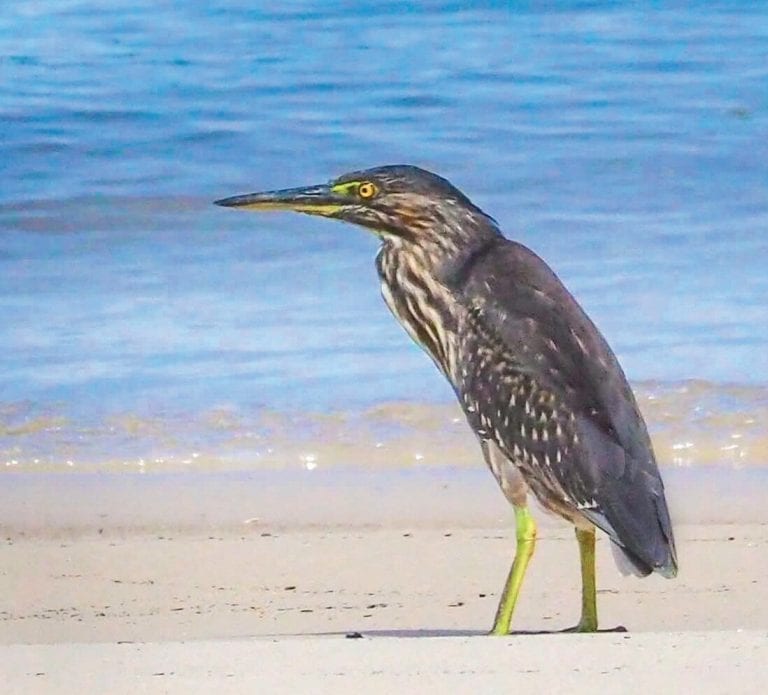
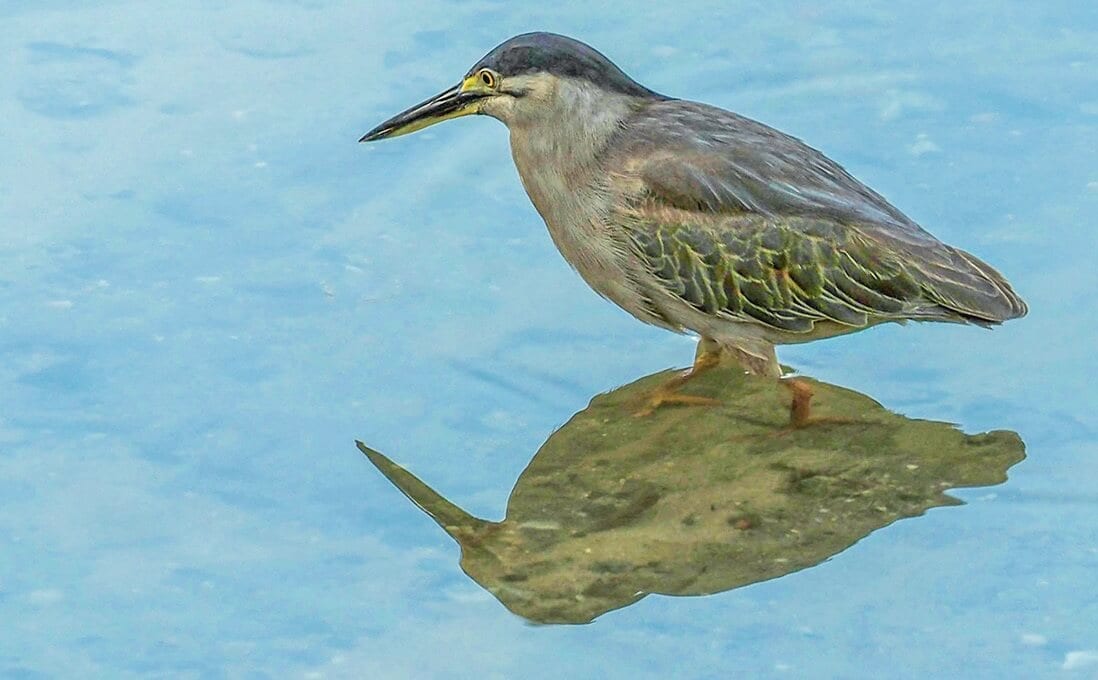
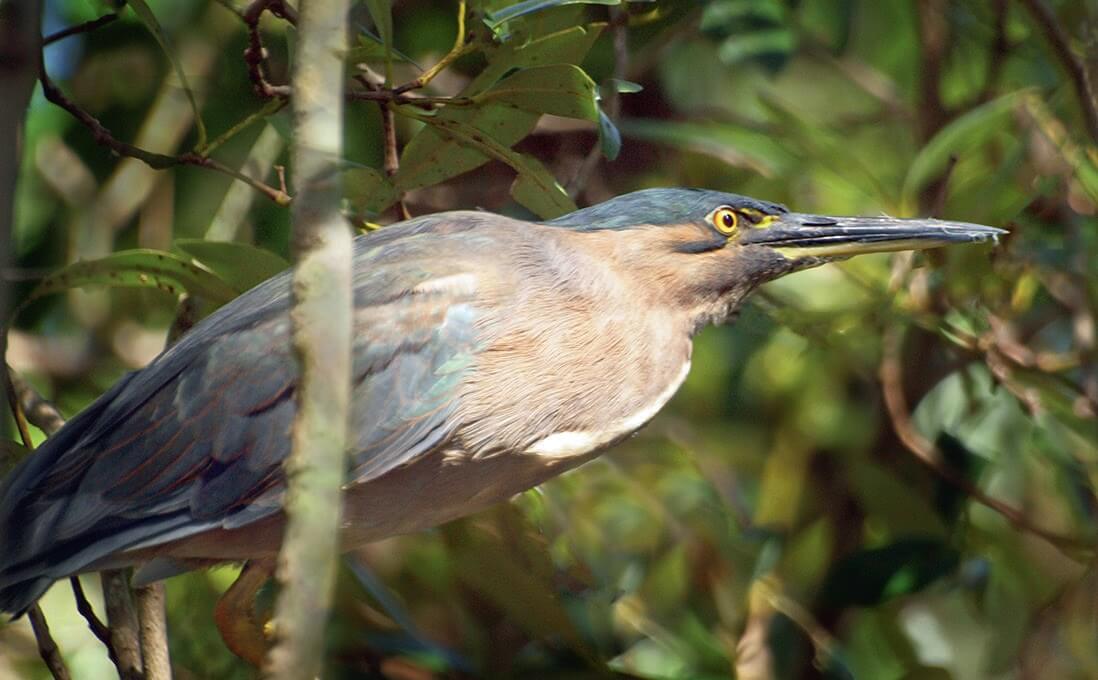
Striated Herons are common to Bribie Island and can be seen near water, in mangroves, and on mudflats. Just recently much to my surprise, I saw a juvenile standing on the sand at the water’s edge near the Bongaree jetty. They are a reasonably small, predominately grey Heron of stocky build with short legs and tails and looking a lot like bitterns in shape. On their wing feathers are lovely yellow patterns which are visible when seen up close. Their legs are yellow and there is also a yellow patch around the eyes.

Featured Image(above): Juvenile at Bongaree Jetty

They are around 44 cm tall, 45-50 cm in length and weigh approximately 200g. Males are larger and a little brighter than females. When flying, they keep close to the ground with their necks tucked in and feet trailing behind. Striated Herons are solitary birds mostly feeding and roosting alone. Normally they are silent except if disturbed on their nests. There are two distinct morphs. The grey morph is the one we are most likely to see in our locality whereas the rufous morph is mostly found in Western Australia in and around the Pilbara area.

In Australia, they are confined to a narrow coastal strip from near Carnarvon in Western Australia to the border of NSW and Victoria where they are found in mangroves, river mouths, and mud flats. They are mostly sedentary, so they don’t move far from their normal territories. There are several other countries in the world where they have established themselves including PNG, Pacific Islands, Asia, Africa, and North and South America. Food is obtained by stalking on the ground near water mainly at low tide.

They creep up on their prey in a crouched position with head extended and tail flicking and when the victim is sighted it is pounced upon and eaten quickly. The main foods taken are crustaceans, mollusks, and fish which are skewered with their sharp bills. Sometimes they sit on a low perch and swoop on their quarry from there. August to December is the most likely time for Herons to nest in our area.

Solitary pairs build their nests in forks of Melaleuca, Mangrove or Casuarina trees in or near water. Nests are quite small, untidy, flimsy and made with sticks and twigs by both parents. Three to four pale green eggs are laid and incubated for about 21-25 days by both parents that also tend to the young. Chicks do not remain in their nests for very long and soon venture forth onto the branches nearby growing their wing feathers and learning to fly. Sometimes two broods are produced in one season.

Other names sometimes used are Mangrove Heron, Little Heron or Mangrove Bittern. Striated Herons are sometimes confused with Little Bitterns. Little Bitterns have more chestnut and orange colourings. There are several names for a group of Herons e.g.: battery, hedge, scattering, and pose. If threatened on the nest Striated Herons squawk loudly and remain in the area making loud clucking sounds in the hope the predator will be frightened off. Young birds when alarmed will stretch out their necks with their bills pointing upwards. I do not know if this is an effective predator dissuasion.

Manmade threats to the Heron and many other birds are the destruction of habitat and the introduction of feral cats. Conservation status is still secure even though the numbers are decreasing.

MIGRATORY BIRDS

BAR-TAILED GODWITS – LIMOSA LAPPONICA

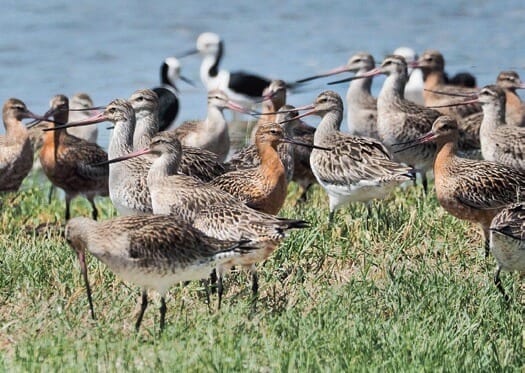
These smallish birds are close to my heart as every year they fly up to 11,000 km to the Arctic Circle to breed in the very short summer then fly the same distance back to Moreton Bay again to spend our summer on the mud flats eating and resting and trying to gain enough weight to make the journey again.

They lose up to 70% of their body weight on each flight so it is important for them to be able to eat and rest without too much disturbance. Recently I visited Toorbul at high tide to wish them a safe journey and to take photographs as they will be leaving soon on their annual trek. Many of the birds were in breeding plumage and some had already left. When they reach their nesting grounds there is very little time for them to lay their eggs and raise their chicks before it is time for them to return.

Development along the flyway across Eastern Asia has made it very difficult for them to survive this arduous flight. Increasing numbers do not make it. Little by little many of their nesting and feeding grounds in Moreton Bay are being developed as well. In a few weeks, most of them will be gone with only a very few remaining for the winter.

LET IT FLOW

Hello, Dear Bribie Islanders, peace to you all! May this new season bring clarity and joy to each one of you on your daily walk. I’m trying to remain positive. Hope seems to flicker dimly in the far distance; it’s light struggling to reach me as the foggy, foggy… mucous, clouds around me. Yes, ‘The Mucous’. Like something out of a 1958 horror, “It Eats You Alive!” Well, it feels like it does anyway.

To anyone else on this Island who has discovered their bodies have become temporary stations of viral colonisation: I feel you. It all began when a wild influenza virus (aka the enemy) deceived an unsuspecting cell in my body by disguising itself as an ally. It was a dire and yet innocent mistake on the cell’s part to let the enemy in. From there, the virus used the cell’s resources to reproduce and masses of the enemy virus’ spawned from the cell – thus the invasion began.

Alarms resounded as the normal functioning of Nikita1.0 ceased and total quarantine was conducted to restrict enemy movement. It didn’t take long before immune fighter T-cells and B-cells along with phagocytes landed to survey enemy infiltration. Immediately the soldiers got to work consuming the enemy at site and recording data in the case of a future attack. It’s been a testing time for the troops: some have fallen heroically in battle, others – have risen.

Although this dark and dismal time has fallen upon the land, her ladyship, The Queen, declares undying faith in her loyal troops, grace over her deceived cells and confidence of victory for her people. “Unconquerable”, she shouts! To be continued… So now that you’re up to date with the (soon to be defeated!) jeopardy that is currently taking place in my body, let’s talk about… you. Yeah, you! “How are you doing? Good? Just good? Well, good is better than not good.

What have you been up to lately? My lovely Islander, I think it’s time that you try something new. I’ve been surveying two different kinds of people in my life lately: those who give it a go and those who don’t. And I’ve also noticed that the people in my life that seem to be creative and have interesting skills got there, not because of an inner prodigy-like talent, but because they just thought why not and went out and tried. It’s time you go out and try something creative or a hobby that you’ve never thought you would be good at. I hear people say they wish they could be creative and have the talent and compare themselves negatively to others.

And then I see them do something amazing and skillful and shake my head in confusion. Often, becoming good at something new doesn’t include a whole lot of natural talent. Rather, a consistent belief that creativity lives within the very cells in your body and desires to be expressed in new ways. Just like the mucous, it has to come out. As well as you must have a willingness to start from the bottom and work your way up, which, I know, can make you feel vulnerable.

Not to mention the impatience that settles in after the initial excitement! But that’s all part of it too. If you push past the impatient side of learning and really just dig in and immerse yourself into the process, you’ll begin to see the magic. Instead of focusing on accomplishment as your destination you’ll start being present in the journey. You’ll be content with your past, happy in the now and wistfully dreaming about the future without the pressure of performance.

Hard work and consistency does come into it, but let your hard work be fuelled by a steady and subtle passion for life and creativity. I encourage you today to think about yourself as a creative individual. You are ever-learning and you bring uniqueness into the world. So don’t limit yourself with your thoughts about who you are or what you can or can’t do. You’re more capable than you think. It’s coming into the cooler season now so it’s the perfect time to learn peaceful indoor activities like painting, knitting, and other needle-work or whip up some new recipes.

Or what about leather-working, photography or woodcraft. That’s cool! Or if you’re already good at those things, why not teach a friend or a struggling young person that a skill set includes: knowing what the perfect emoji to use in a sentence is, making two-minute-noodles and having a boss meme collection. We need help. Get into letter writing with a friend, or learn how to build a shed!

Or learn to dance, or learn all the words to a 90’s rap song. Be random, be creative and have fun. Also, make sure you’re eating and sleeping well and don’t get cold while you’re out, please. I don’t want any of you getting a dose of this flu. Until next time, Nikita.

HOME EQUITY RELEASE FOR THE OVER 60’S

Tags: Money. Financial advice. Equity. Retirement.

Preserving the equity in your home is a very worthwhile objective to provide financial security for you as you age. However, if you are over 60 there may be some situations where using your home equity may be an option to consider. These include drawing a small amount each year to supplement your income; drawing a lump sum to pay off a high interest charge credit card; drawing a lump sum for home maintenance or renovations so you can stay in your home; funding a critical medical expense or borrowing to secure aged care accommodation until you sell your home.

Even though home equity release might be suitable for people in the circumstances listed above, keep in mind that it is a long-term commitment and any money borrowed will continue to accrue interest until the debt is repaid or the property used as security is sold. This will result in the equity in your home reducing unless property prices increase sufficiently to offset your borrowings plus interest. Equity release options include the Commonwealth Government Pension Loan Scheme (CGPLS) and a Reverse Mortgage. The CGPLS is quite restrictive.

It is only available to top up your income to the amount of a full pension and not to draw a lump sum whereas a Reverse Mortgage lets you draw a lump sum and or a regular weekly income supplement. You may be able to apply for a CGPLS if you or your partner are of age pension age, own real estate in Australia that you use as security for the loan, your partner receives a rate of payment that is less than the maximum pension amount due to either the income or assets test and you meet the Age Pension resident rules. The amount you get each fortnight from the CGPLS can be up to the maximum rate of income support payment you qualify for.

Free money and finance advice. Financial Counsellor. Retirement funds. Nest egg. SuperannuationThe total loan you can get depends on the equity you have in the property you offer as security, the equity that you want to keep in your property, your age or your partner’s age whoever is the younger. A CGPLS generally has lower interest charges than a Reverse Mortgage – currently 5.25% compound on the outstanding loan balance. You can repay the loan in part or full at any time.

A reverse mortgage is, as the name implies, a loan that you don’t have to repay until you sell the property that you used as security for the loan. It may seem like an easy option to access money to lessen your money worries but a reverse mortgage it is not something to be entered into without properly understanding the long-term implications of the loan contract. With a normal mortgage, you have to make regular payments to at least cover interest charges whereas the interest charges accumulate with a reverse mortgage resulting in your equity in your home falling. Only a few financial institutions now offer reverse mortgages.

They have generally fallen out of favour for a number of reasons. Reverse mortgage interest rates are typically about 1.5% higher than the normal home loan rate, currently about 6.5%, meaning the debt doubles in about 11 years. This is why the maximum loan is set at only 15% of the property value for someone aged 55 as they may live another 40 years. Most reverse mortgage loans are variable rate exposing borrowers to rising interest rates. Lenders are also concerned about behavioural issues such as cognitive decline, especially given the ages of many of the borrowers.

Heirs to the estate see their asset being whittled away by interest and fees, and lenders worry about their rights being challenged. Beneficiaries to an estate could claim that their ageing parents did not understand what they were doing. So if your circumstances are such that you need a small amount each year to supplement your income, a lump sum to pay off a high interest credit card, a lump sum for home maintenance or renovations so you can stay in your home, funding for a critical medical expense or borrowing to secure aged care accommodation until you sell your home, a reverse mortgage may be appropriate. It may also be an option to consider rather than downsizing to free up cash.

However, make sure you fully understand the implications of giving a lender some control over your most important asset. You also need to understand any potential adverse implications for your Centrelink payments. Check out moneysmart.gov.au for more information.

Peter is a Registered Financial Counsellor at the Bribie Island Neighbourhood Centre. He can be contacted through the Centre on 3408 8440 or by Email at [email protected]. You can make contact if you are experiencing financial hardship or would like general information on financial matters. The service is free.

NEW FAMILY NATUROPATH CLINIC FOR BRIBIE

Tags: Bribie Island Naturopath.

With good health and well being a priority for most of us here on Bribie it is good news when a new business in the complimentary health area opens its doors to the general populace.

Featured image(above): Owner and therapist of Bribie Family Naturopath Clinic, Sheridan Blanchard

On Wednesday, May 1 the Bribie Family Naturopath Clinic will be open for business at Shop 8/9 Toorbul Street Bongaree. Owner and therapist of the practice Sheridan Blanchard who holds an Adv Diploma Nut, Bachelor of complementary medicine. Sheridan is a fully qualified and practising naturopath, covering a range of therapies and ailments. A credited member of the Australian Traditional medicine society, Sheridan has a great passion for helping her clients to regain health and balance in their lives. “I am an avid believer of the body’s innate ability to heal.

Utilising time-proven and evidence-based naturopathic methods I aim to support this process of restoration,” said Sheridan. On meeting, Sheridan comes across as having a friendly, empathetic and non-judgmental nature which is perfectly suited to the naturopathic profession. She says her passion for naturopathy and her desire to better the lives of her friends, family and the community with her education is a strong driving force for her.

“It is my goal not only to assist people in achieving their perfect state of health but to educate people and empower them with the tools to live not only a healthy life but a life of happiness and longevity – the birthright of each and every one of us,” she enthuses! According to Sheridan, she aims to cut through all the confusing and conflicting information that is out there and deliver sound evidence-based advice tailored to the individual.

Sheridan says her clinical points of difference include accurately determining patients’ health and appropriate treatment plans based on a careful acquisition of individual case history. Using pathology for in-depth testing and referring and communicating with doctors and specialists. She provides analysis of blood pathology, mixes custom blended herbal liquids from the herbal dispensary as well as providing clients with advice on natural treatments/supplements, specific food, and diet knowledge/advice.

“I am also constantly researching and learning about up to date information in the health care sector to ensure I provide the very best advice to my clients,” she said. You can contact Sheridan to make an appointment on 0468 479 144.

The Bribie Winelander – May 2019

There is a phrase in life known as the Eureka moment or Aha moment when one has a sudden understanding of a previously incomprehensible problem or concept. I want you to imagine for one moment you are the owner of one of the nation’s largest family wineries and after studying a picture of a shepherd tending his flock of sheep somewhere in Greece come up with an idea that will revolutionise the Australian wine industry for the next forty years.

In 1966 Mr Tom Angove of Angove Family Winemakers based in South Australia is looking at a shepherd with his animal skin wine pouch full of wine around his shoulders, which is there to satisfy his thirst with lunch and comes up with the idea to develop something that differed to the traditional bottle and cork. With this idea in mind, Mr Angove invented the first Australian Wine Cask which was a plastic bag holding 1 gallon (4.5 litres) of wine inside a cardboard box which he then patented.

Bulk sales of wine had previously been in 2.25 litre glass flagons but once opened oxidised often before the flagon was emptied, however Mr Angove’s method of cutting a corner in the bottom of the bag in much the same way as the shepherd and sealing it with a special peg solved the oxidising problem but proved clumsy and in 1971 Wynn’s developed a tap and sales of casks took off. In the 1980s every major wine company sold 4 or 5-litre casks with the average selling price being just over $1 per litre in the shops, however as the sales grew the quality could only be described as ordinary however they introduced thousands of consumers to the pleasures of wine drinking.

In the mid-1980s Australia had developed a huge lake of surplus wine and many wine companies resorted to ‘dumping’ the premium wine excess in their casks, this was the best period in the life of this size of cask as the quality improved albeit at a loss to the wineries. Then to alleviate the oversupply problem South Australian Government started to pay vineyards to pull vines out and convert the land back to normal farming, a move that almost proved a disaster for the industry as within a few years the rest of the planet discovered Australian wines, especially Jacob’s Creek, and in the early 1990’s we had a severe shortage of fruit to fill the bottles, it was during this period some wineries resorted to bringing in wine from Chile to fill their casks!

Fortified wines and brandy. Wine. Red. White. By selling casks to a style rather than using the correct fruit also led to regular wine drinkers losing their interest in Australian Riesling because although the cask was marked Riesling the fruit used, sultanas, made for an insipid drink which bore no resemblance to the beautiful crisp white wines in the bottles, however as a bonus the price of Australian Riesling has never fully recovered and today makes for great value, if you are having oysters or prawns this weekend grab a bottle from your liquor outlet, especially one from The Clare Valley, The Eden Valley, The Great Southern of Western Australia or perhaps a Leeuwin Estate from Margaret River and you won’t be disappointed, one of the great matches in food and wine.

The wine cask in its heyday occupied huge amounts of the liquor store floors and it was not uncommon to see pallets from different vineyards, the most popular ones nationally being Kaiser Stuhl, Coolabah (known as “lady in the boat”) and Berri, but each state had their own favourites. The decline started when wineries decided that rather than producing huge volumes of wines just to sell for very little return it made more sense to concentrate on the bottle market and around this time ‘cleanskins’, or bottles without labels, started to appear on the shelves and offered a way to convert a four-litre cask selling for $5 into five 750 ml ‘cleanskin’ bottles selling for $15.

In recent times several wineries such as Yalumba and De Bortoli have actually introduced two-litre casks containing better quality wine and selling for around $10 – $12 so Tom Angoves Eureka moment still survives. Actually ‘cleanskins’ had been around for years as wineries found it a convenient way to sell the remaining leftovers from the previous year’s vintage rather than invest in a short run of labels which would have been very expensive. Having no label meant they weren’t suitable for sale in the liquor store but only at the cellar door at the winery and in those days it was possible to pick up many a bargain.

Of course, some smart individual, probably a liquor store owner looking at wines in a winery, saw an opportunity to sell an outstanding wine at a reduced price by discounting it without a label and bought the lot so the winery was happy and a new market was born. Soon everyone was getting in on the bandwagon as wineries started to sell surplus stock to the stores without labels and it was so successful some wineries started to make wines for sale as ‘cleanskins’ so much so that in Melbourne, where the licencing laws are a bit more flexible than the punitive laws of Queensland, ‘cleanskin’ shops opened their doors.

It is unlikely that any of the ‘cleanskin’ wines sold in most liquor stores are anything better than the old cask wines, unfortunately it is these wines that will eventually become responsible for an added cost to cheap wine in the form of a minimum floor price on wine based on the number of drinks per bottle, which will make the cheapest bottle of wine be around $11 with a four-litre cask at around $40.

This was introduced into the Northern Territory in June and it is claimed that crime and drunken behaviour has already been reduced, time will tell on this one as it is still possible to order anything you want online and as usual it is also the responsible drinkers that also suffer, strangely it doesn’t affect beer because of the glasses per bottle so the breweries will be very happy, take my word that it will be only a matter of time.

Italian wines. Red. White. Wine. Online sales of wine have become extremely popular, but have been around for many years especially with consumers who live in out of the way places, and have made it very easy for anyone to access good wine and have it delivered to your door, often at very competitive prices. Sites such as Cellarmasters (owned by Woolworths), Naked Wines, Vinomofo, Wines Selectors, Wines Direct, Laithwaite’s and Theonlinewineshop offer such a service, some even offer free delivery, if you have a computer and have access to the internet it is worth considering.

Also traditional retailers such as Dan Murphy’s (Woolworths owned) and Vintage Cellars (Coles owned) also offer this service, I took advantage of a deal from Dan Murphy’s last week of 1 dozen McWilliam’s Hilltops 2014 Cabernet Sauvignon selling for $12 per bottle instead of $24 and the delivery cost was $6.50 for the case which I felt was good value, also Graysonline carry out wine auctions and it is possible to buy some very good wines at outstanding prices but it pays to know what you are looking for!

I see Joe at The Dock and Dine at Spinnakers is opening a wine bar early May, I have often thought as the demographics of the Island continue to change this would be a welcome addition to the entertainment scene. With views of the Marina, his coffee bar next door and he now owns the Ignite restaurant on the other side this is a perfect spot for a lazy afternoon lunch or relaxing dinner. I believe the wine bar will also be serving Tapas which is a perfect accompaniment to wine, for those lucky enough to have visited Spain will know exactly what I mean!

It was reported in the liquor trade magazine ‘Drinks Trade’ this week that if you are a fan of wines from Margaret River, The Clare Valley or The Barossa Valley the 2019 vintage has proved to be one of the most challenging on record leading to lower yields. Some of the region’s growers are reporting yields of some varieties, particularly the more sensitive ones, to be down as much as 30-40%, unfortunately this is what happens when nature doesn’t play the game, however as usual there is a silver lining as the quality of the Shiraz and Cabernet wines from The Barossa are described as having great colour and intense flavours, whilst the Grenache and Mataro wines are described as exceptional and are shaping up to be the 2019 standouts, no doubt the shortages will be reflected in the prices.

Don’t forget if you need help in selecting any wines or suggestions for a special event or anything to do with wine please feel free to email me on [email protected]. Cheers, Philip Arlidge [email protected]

“I can see you know your wines, most of the guests who stay here wouldn’t know the difference between a Bordeaux and a Claret”

Basil Fawlty

“Age is just a number. It’s totally irrelevant unless, of course, you happen to be a bottle of wine”.

Joan Collins

HAIL THE OLYMPIAN’S RETURN

Did you recognise the medal festooned young man on our front cover in our Issue 86 Magazine?

No? Well if you have driven across the Bribie Island bridge and glanced at the magnificent Dale Marsh mural billboard at the Island’s roundabout then you have more than likely seen him for sure, possibly daily if you are a regular commuter. You see our cover story this issue focuses on that young man.

Featured image(above): Timothy – the boy in the painting – seen below

His name is Timothy Gould and Timothy just happens to be that little boy you can see in the David Marsh artwork playing in the sand while the two girls leap off the dune. But this story is more than an “I wonder what became of…” moment. It is a story that shows how with the love, support, and encouragement of his family and an outstanding personal drive and determination this young man has succeeded at the highest international level of his chosen sports.

Because you see Timothy was born with Down Syndrome, which is a genetic disorder that causes intellectual disability and other physical and learning challenges. The disorder is also known as ‘trisomy 21’ as it is caused by the presence of an extra copy of chromosome 21. It affects about one in every 700-900 babies. Timothy’s obviously proud mother Jennifer, tells us that he was just three years old when the painting was produced. He is now 27 years of age.

“At the time the mural was painted there was a lot of issues in the media about prenatal chromosome testing for Down Syndrome and issue of abortion of pregnancies with positive testing,” said Jennifer. “Having Timothy in the mural showed that he just looked like any other three-year-old playing in the sand.

He has been brought up like any young man being given every opportunity to achieve his personal goals.” Jennifer says that Timothy has demonstrated his ability and prowess in the sporting arena. “Timothy started to learn to swim as an eight-month-old baby and swimming continues to be a big part of his life today. He also started learning to play tennis as a seven-year-old,” she said. Jennifer tells us that he has been involved with Special Olympics since he was eight years old. She says this involvement with the organisation has given him the opportunity to try multiple sports.

Biggest supporters

“He represented Australia at 16 at the World Summer Games 2007 in Shanghai, China for Tennis,” said Jennifer. This year Timothy represented Australia at the World Summer Games in Abu Dhabi in March. These Games were the biggest Humanitarian and sporting event in the world for 2019. The swimming was held at the Hamadan Sports Complex in Dubai. “He won Gold in the 4 x 100-metre freestyle relay, 4th in the 100-metre backstroke, 5th in 100-metre and 200-metre freestyle.

On our arrival back in Australia, Timothy got the notification that he will represent Australia in the INAS Games that is being held in Brisbane in October this year,” said Jennifer. “Our family moved to Bribie Island in 1990. Timothy was born in 1991. He attended Primary school at Banksia Beach until grade five and then went to Caboolture East State school. He was enrolled at the Mueller College for his High School years.” Jennifer says the family lived in Bellara and had a business in Benabrow Ave called Island Video for five years before moving to Ningi in 1999 where they lived until 2015.

“Timothy works as a groundsman at Arethusa College in Deception Bay five days a week. He has swim training three times a week and trains and plays tennis weekly, “ she said. According to Jennifer, Bribie is still a place Timothy and her family love to visit. “It is still one of our favourite places in the world. There are still several friends that live and work on the island that Timothy love s to catch up with,” she said.

So the next time you are heading back to Bribie and cross the bridge, take another look at the Dale Marsh mural that greets you and now know that the little boy in the iconic painting who is playing in the sands on Bribie went on to become an Olympian doing, himself, his family and Australia proud.

EASTER ORCHID SHOW HUGE SUCCESS – Spring Orchid Show to be held in October

Tags: Bribie Island Orchid show. Orchids. Groups and clubs.

Despite the weather, The Bribie Island Orchid Society’s Easter Show has been deemed a great success by the organisers with a record crowd of more than 1200 people attending over the two days.

Here are a few photos of the event including some of the winners and spectacular orchids. The show’s committee thank the Vietnam Veterans for putting on an awesome sausage sizzle for lunch.

Planning is already underway for the Spring Orchid Show to be held in October. For further information contact the Bribie Island Orchid Society’s Secretary Teresa Watson 0407 782 290.

DEMOCRACY IS ALIVE AND WELL ON BRIBIE ISLAND

Or at least there are the tentative positive signs that a good protest march and some vigorous lobbying by our local politicians may have had an effect on our Mary Street Tower of Power political masters.

A follow-up call to the Minister for Transport and Main Roads’ office from the Bribie Islander Magazine on Monday after the “Save the Pelicans bridge protest march” was greeted with a wary “Oh is it about the pelicans?”.

So you could say that Mark Bailey’s staffers were certainly reading the mood of the people up here and were fast getting on top of the issue that had so many on Bribie turning out to voice their concerns about our beloved pelicans’ roosting spots on the Bribie Bridge lamp posts.

Anyway, suffice to say the fact that we had a Ministerial statement sent to us for publication in less than 24 hours gives you some idea of how important The Honourable Minister Mark Bailey sees the issue.

It will take time to see a solution provided for our feathered friends but in the meantime, you can at least read the Minister’s statement and draw your own conclusions.


Media Release

Minister for Transport and Main Roads The Honourable Mark Bailey MP 1 May 2019 Statement from Transport and Main Roads Minister Mark Bailey Bribie Island residents have shown how much they love the island’s pelicans, and we are listening to them. Transport and Main Roads (TMR) were constantly replacing lights on the bridge that were damaged by waste from the pelicans sitting on top of them.

Workers replacing the lights also needed to partially close traffic lanes, so the frequent light changes were costly and inconvenient for locals. During a recent lighting upgrade, TMR installed new LED lights and metal bars on top to stop pelicans damaging the lights and potentially getting injured from overheated light casings.

The switch to energy efficient LED lights will provide better lighting on the bridge and reduce costs, but I want to make sure the pelicans have a safe place to rest that also allows people to continue enjoying them. Following representations from Longman MP Susan Lamb, I’ve asked TMR to look at options that might allow Bribie’s beloved pelicans to stay around the bridge.

MUMS TOO COOL FOR SCHOOL

The cooler weather is making for a pleasant change but have a think back a few months ago and remember when we had day after day of mid- 30-degree temperatures. Even our beautiful Island paradise wasn’t spared this last Summer’s blistering heatwave conditions.

Featured image(top): 1st Prize

Well if you are a parent who sends their child or children to Bribie Island State School then you will be well aware of the committed folk on the Parents & Citizens Association who are madly fundraising by holding a Mother’s Day raffle that will see their efforts rewarded with yet another school block air conditioned.

Speaking with their P&C president Leanne White it is clear that all these women have done a tremendous amount of work cajoling and persuading business owners to donate to such a worthy cause. So let’s mention them here.

  • President: Leanne White
  • Secretary: Jo Meyers-Cave
  • Treasurer: Bronwen Savige
  • Events: Jess Hampson
  • Grants: Belinda White
  • Book Club: Jess Lunniss- Read

And a special mention to the Operations manager/ uniform shop coordinator (who has specifically asked not to be named BUT has been a huge reason why the raffle donations have been so successful). Leanne said that the generosity of the local business community has been amazing. We agree!

Just look at how generous the local business community has been and the value that has been packed into the raffle prizes! All for just $2 a ticket or $5 for 3.

2nd Prize

A list of the Raffle Prizes and Donors

1St Prize For Our Mother’s Day Raffle!!!

Slice N Dice meat voucher Haircare pack from Hair Haven 2 x Bribie Cinemas movie tickets gift card from Woolworths voucher from The Coffee Club voucher from Mode Hairdresser Bribie Island RSL Club voucher Beauty Retreat voucher Splash of Tash nail voucher

2nd prize for our Mother’s Day raffle!!!

Basket of goodies from Woolworths Banksia Beach The Coffee Club voucher from Brooke Savige to Beauty Retreat Kinnaree Thai Restaurant voucher

3rd prize for our Mother’s Day raffle!!!

3 glass vases from Mitre 10 Bribie Island Bowls Club voucher Savige’s Seafood voucher Annie Lane voucher

4th prize for our Mother’s Day raffle!!!

Scentsy basket from Jessica Lee Bernard

5th prize for our Mother’s Day raffle!!!!

Scentsy basket from Jessica Lee Bernard

6th prize for our Mother’s Day raffle!!!!

Charlie’s Restaurant voucher Mayyada Bazaar voucher 2hrs of cleaning from Evermore Cleaning

7th prize for our Mother’s Day raffle!!!

Voucher from Cuts Colours and Curls Cafe Bella Voucher Ladies Skin Care from Bribie Discount Drug Store

8th prize for our Mother’s Day raffle!!!

Beautiful Ladies clutch purse from Woorim Surfside Pharmacy Village Deli voucher Hogs Breath voucher

9th prize for our Mother’s Day raffle!!!!

The Surf Club Bribie Island voucher Beach Bag Make up Bag Yoga Mat

10th prize for our Mother’s Day raffle!!!

Croqueted rug donated by Good Start Early Learning Bongaree Al’s Gutter Clean voucher Anna’s Fashion Boutique voucher

11th prize for our Mother’s Day raffle!!!

Blue Pacific Hotel vouchers

12th prize for our Mother’s Day raffle!!!

Catch voucher 13th prize for our Mother’s Day raffle!!! Aussie Meat and Seafood Voucher

14th prize for our Mother’s Day raffle!!!

Bundle of things from Star Discount Chemist A wheel alignment from Bribie Care Car

15th prize for our Mother’s Day raffle!!!

Signature Essentials Box from Priceline Pharmacy 2 Vouchers to Maleny Dairy for a Farm & Factory Tour Voucher & Farmer’s Tractor Ride Voucher for 4 people

DO YOU LOVE A GOOD FOSSICK?

On May 18th, most of us will be fossicking for our next “national treasure” so if you are out and about already, you may like to continue to the Uniting Church in Webster Street, Bongaree and join us at the Annual “Trash and Treasure Trove” from 8 am to 12 midday.

This is a community event and there are many stalls from different service organisations and others such as sausage sizzle, art and crafts, freshly baked cakes and sweets, plants, morning tea and, inside the church hall, lots of different treasures that have been donated for sale.

This allows many folks to raise funds for their particular organisation. This is a fun time of fossicking for treasures and sharing time with others. On sale will be furniture, jewelry, electrical items in working order, records, books, almost anything that one can imagine.

It’s fun looking through such items to find “just the right thing” to suit our needs or desires. Get along and find a bargain!

Gloss Magazine Bribie Islander 10th Edition May 10 2019 Issue 87

The Bribie Islander Magazine
Get all your community news and information Bribie’s only community gloss magazine NOW EVERY TWO WEEKS! – Articles on boating, camping, fishing, life, drama, travel destinations, sports and what to see and do on Bribie Island. Covering charities, organisations, places, children’s activities, arts and crafts, tourist destinations, heritage parks, technology, science, music, gardening and much more.

You can now download the Bribie Islander digital edition by clicking here.