Home Blog Page 78

Laugh Riot – March 2019

0

Tags: Funny jokes. Humour. Riddles

“I used to work at McDonald’s making minimum wage. You know what that means when someone pays you minimum wage? You know what your boss was trying to say? ‘Hey, if I could pay you less, I would, but it’s against the law.’”

“Life is like a box of chocolates. It doesn’t last long if you’re fat.”

“The first time I met my wife, I knew she was a keeper. She was wearing massive gloves.”

“I saw a documentary on how ships are kept together. It was riveting!”

“What’s a couple?’ I asked my mum. She said, ‘Two or three’. Which probably explains why her marriage collapsed.”

“I was in my car driving back from work. A police officer pulled me over and knocked on my window. I said, ‘One minute I’m on the phone.’

” I said to the gym instructor: “Can you teach me to do the splits?” He said: “How flexible are you?” I said: “I can’t make Tuesdays.”

“A man walks into a chemist’s and says, ‘Can I have a bar of soap, please?’ The chemist says, ‘Do you want it scented?’ And the man says, ‘No, I’ll take it with me now.’”

“Alright lads, a giant fly is attacking the police station. I’ve called the SWAT team!”

A sandwich walks into a bar. The barman says: “Sorry, we don’t serve food in here.”

Mad poets society

I’m watching a Mother bird

Sitting on her eggs

Only moving occasionally

To stretch her legs

She’ll stay there and stay there

Until they hatch

Her nurturing and dedication

Nothing can match

She’ll feed and protect them

Until they can fly

Then she’ll send them into the world

With just a tender goodbye

But watch, she’ll return again

Next breeding season

With love and commitment

As her only reason

KMH.


Now if I was a tree

I could be a towering eucalypt

All mighty and strong

At least I’d never be nondescript

Or maybe a palm tree

Basking in the sun

Living somewhere tropical

That could be fun

Or a stunning jacaranda

All dressed up in purple

Its grace and its beauty

Are truly universal

Or I could be an apple tree

Covered in delicious fruit

I would certainly be popular

I think that would be beaut

But when all is said and done

I think that if I was a tree

I would just want to be nurtured

And to live my life happy

KMH

Mental Health – GRATITUDE

Tags: Definition of gratitude. Mental health and well being.

Gratitude

“Piglet noticed that even though he had a very small heart. It could hold a rather large amount of gratitude”

– A.A. Milne

Over the past 10 years, we have seen a huge increase in the scientific study of happiness. Though findings thus far are complex, and incomplete. However, if they could be distilled into one simple prescription for happiness, it would probably be this: “Say thank you”.

Some definitions of gratitude:

1. Gratitude as an (effective) trait: A built-in, personality level trait which determines how often and deeply we feel gratitude.

2. Gratitude as a mood: Gratitude as a singular emotion lasts for only a few seconds. To explain how gratitude inducing interventions like a gratitude journal work, rather than changing our personality trait, they instead induce a mood of gratitude, which in turn gives rise to more gratitude emotions.

3. Gratitude as an emotion: The actual positive emotions which recognize the intentional, beneficial actions of others – lasts only a few seconds.

Gratitude definition

The Science of gratitude

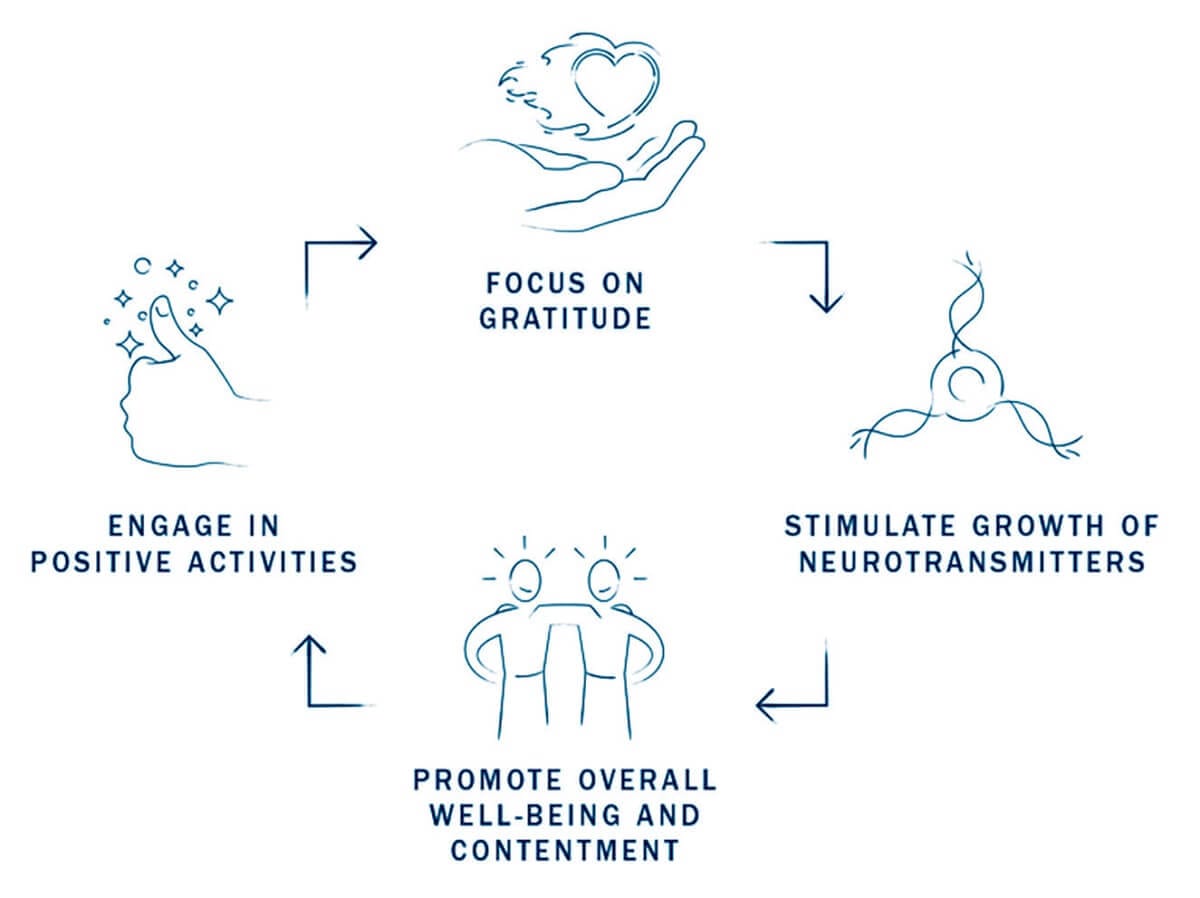
Shifting our mindset to focus on the good, acts as a natural antidepressant. Neuroscience research has found a link between positive thoughts and the activation of certain neurotransmitters (chemicals released from our nerve cells that inform other parts of our body).

Simply put, this means that focusing our attention on things we are grateful for actually forces a shift to the positive. This act stimulates more neurotransmitters in our brains, specifically dopamine and serotonin, which promote feelings of contentment. Gratitude is a fundamental thread that holds the tapestry of our social fabric together. Feelings of gratitude nurture our individual mental health and fortify our bonds with other people.

The personal and interpersonal benefits of gratitude occur at both a psychological and neurobiological level. Gratitude is linked to decreased depression, increased optimism, less physical complaints, and higher levels of Dopamine in the brain. Perhaps what is best about gratitude is that it’s free and it feels good. The idea that being thankful may make you feel better has also been supported by neuroscientists, suggesting that practising gratitude can encourage changes in the brain that improve mood.

A 2009 National Institute of Health study, for example, found that gratitude may trigger a stronger blood flow to the hypothalamus, which plays a role in stress levels and sleep patterns. Gratitude has also been found to activate the neurotransmitter dopamine chemical. Research has informed us that gratitude is a key to psychological well-being.

Gratitude can make people

• happier

• improve their relationships

• potentially counteract depression and

• suicidal thoughts.

But might the benefits of gratitude go beyond that? Could gratitude be good for your physical health, too?

We know that practicing gratitude can;

• Help us feel more zest for life

• stress less

• sleep better

• express more compassion and kindness

• forge stronger relationships

• may even boost our immune system.

When we focus our thoughts on good, we feel good, which then informs our actions. Feeling good is what enables us to engage in activities that fuel us. It helps shape our essence, how we perceive the world around us, and our ability to analyse and reflect. “Gratitude rewards generosity and maintains the cycle of healthy social behaviour.” In fact, generosity and gratitude work in tandem, and in ways that benefit both the giver and receiver. How do we practise gratitude?

Here are some ideas for practising gratitude.

• Journal five things each day that you are grateful for.

• Write a letter to thank someone who has impacted positively on your life. Be specific about what it is you appreciate about them and send the letter. Alternatively, hand deliver the letter and read it to the recipient.

• Be on the look-out for things to say thanks to. For instance, a stranger performing a kind deed, a friend providing a listening ear, receiving fabulous customer service.

• Take a ‘gratitude walks’ and observe your environment with the intent to appreciate the beauty of your surroundings. Examples include spotting a beautiful flower, a rainbow, striking architecture, witnessing acts of kindness amongst others.

We can be grateful for a wide range of things, both big and small, such as:

• Having positive people in our life

• The smell of coffee in the morning

• Our senses such as sight and sound

• Living near the ocean

• Good health

• Family and friends Gratitude can be used as a moral barometer, we use it to emotionally feel the size and nature of a gift from another.

Research shows that people are more likely to feel gratitude towards:

• Acts done by strangers than family members

• Larger acts than smaller acts

• More inconvenient acts

• Gratitude can be used as a moral motive

mental health gratitude what is definition

Research has indicated that those who felt gratitude were more likely to help others. Because;

• it encourages pro-social behaviour

• discourages societally disruptive behaviour

Studies show that expressions of gratitude encourage pro-social behaviour in the future. Simply by thanking people can lead to them offering to help more and, freely.

Gratitude can be correlated with certain personality traits. This is proven only half true

• only agreeableness is shown to be positively correlated with gratitude (and narcissism negatively correlated)

• unexpectedly, extroversion, conscientiousness, and neuroticism had nearly no correlation with gratitude

It is important to note that whilst gratitude can promote mental wellbeing, there are also times when we can benefit from professional support to manage life’s challenges. In these situations, GPs are a great starting point and can assist with identifying a mental health professional suitable for your needs.

“We make a living by what we get; we make a life by what we give”

– Winston Churchill – 1874 -1954

Woorim Beach Meats – National Pi Day – March 14th

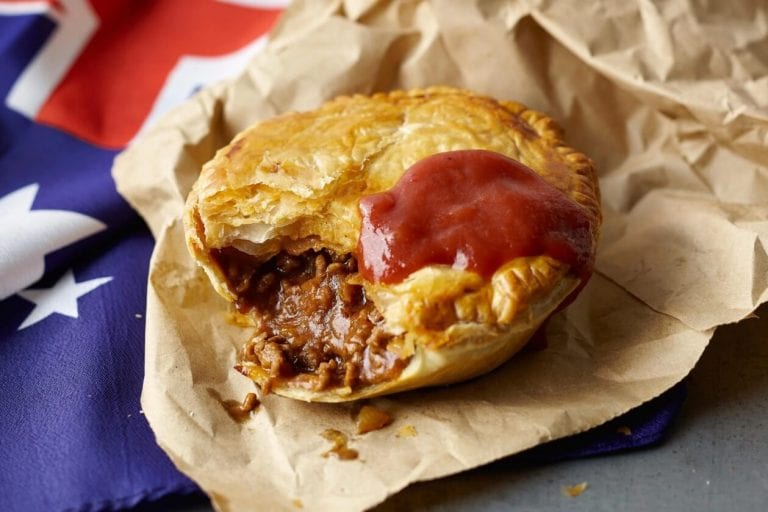
It’s #PiDay today… so of course, we had to celebrate with a dozen pies for the crew while out on the road! 🥧

Where’s your favourite pie shop?

It was National Pi Day on March the 14th and Creek to Coasts cameraman was out an about at Woorim Beach Meats on Bribie.

National Pi Day is a celebration of Pi – the ratio of a circle’s circumference to its diameter – is celebrated around the world on March 14th.

Celebrations include Pie eating contests, Pie competitions, and eating and baking pies.

Even though a meat pie has nothing to do with the mathematical equation, people celebrate the invention of the mathematical equation on March 14th.

Check this out, it’s not Christmas day, not my birthday, not news year day, it’s better than that, its National Pie Day!

Wheres your local Pie shop? Comment below!

More info found here: https://www.smh.com.au/technology/what-is-pi-day-and-why-do-we-celebrate-it-20160314-gni83p.html


It’s #PiDay today… so of course we had to celebrate with a dozen pies for the crew while out on the road! 🥧

Where’s your favourite pie shop?

Posted by Creek to Coast on Thursday, March 14, 2019

History – REMEMBER WHEN WE FORGOT OUR PAST

0

Tags: Bribie Island History. Moreton Bay. Brisbane. Queensland. Australia

There are some disturbing aspects of all our history and previous social attitudes that we probably need to be reminded of from time to time. For much of the last century, public feelings and prejudice towards some minority groups were common and acceptable behaviour.

All sorts of people often tried to deny or hide their personal background and heritage. Nowadays anyone who can trace even a slight link to a “Convict” ancestor in Australia now feels proud and keen to let it be known.

That has not always been the case, and it was not until about the 1960s that some people who had tried hard to conceal aspects of their own heritage, began to publicly embrace it.

Who do you think you are?

Modern technology now enables people to discover personal and often tenuous links to distant ancestors who came to this country as Convicts. This is an interesting reversal of “prejudice” in our society. Aboriginal people were also subject to great injustice for many years, despite the fact that they had lived in harmony with this land for countless generations, long before white man came and took it from them.

Aboriginal occupation of this area can be traced back thousands of years to a time before Moreton Bay was even formed when there were no islands, and the coastline was more than 50 km further to the east, on the other side of Moreton Island. This ancient coastline was a recognised pathway for Aboriginal people, and there is much archaeological evidence to support this. When Bribie and the other islands of Moreton Bay were formed by progressively rising sea level over a ten thousand year period, the land was rich and plentiful, providing a variety of foodstuffs from coastal swamps and waterways.

The coastline of Queensland has been the way it is now for only about 1000 years, since sea levels reached their highest point and started receding. Bribie has only been an island for a few hundred years. Matthew Flinders was the first white man to come to Bribie Island and explore Moreton Bay in 1799.

This year marks the 220 year anniversary of that event when he came ashore with his Aboriginal companion Bongaree, after whom the first settlement was named 113 years later in 1912. Bongaree was from the Broken Bay area near Sydney and could not communicate with the local people in their language.

Bribie Island… …a land of Plenty

The indigenous “Joondoburrie” people of Bribie Island enjoyed a rich seasonal diet of plants, animals, and seafood that included kangaroo, possum, goanna, snakes and birds as well as oysters, prawns, crabs and fish throughout the year.

It was indeed an island of plenty that may have supported several hundred people in various seasonal camps around the island and the Passage. With the coming of white man it took less than 100 years for these proud and traditional people to be wiped out. By the 1870’s when pioneer settlers moved into this area, the Indigenous people around the Bay area were eventually reduced to a disparate group of less than 50 people.

This resulted in the first Aboriginal reserve in Queensland being established right here on Bribie Island in 1877, in the area known as White Patch. Under the supervision of Tom Petrie as the visiting Manager they were brought together to grow a few basic crops and were provided with flour, sugar, fishing nets and a small boat to support themselves. Needless to say it didn’t last very long, and within a couple of years funding stopped and it was disbanded.
Bribie Island History. Moreton Bay. Brisbane. Queensland. Australia

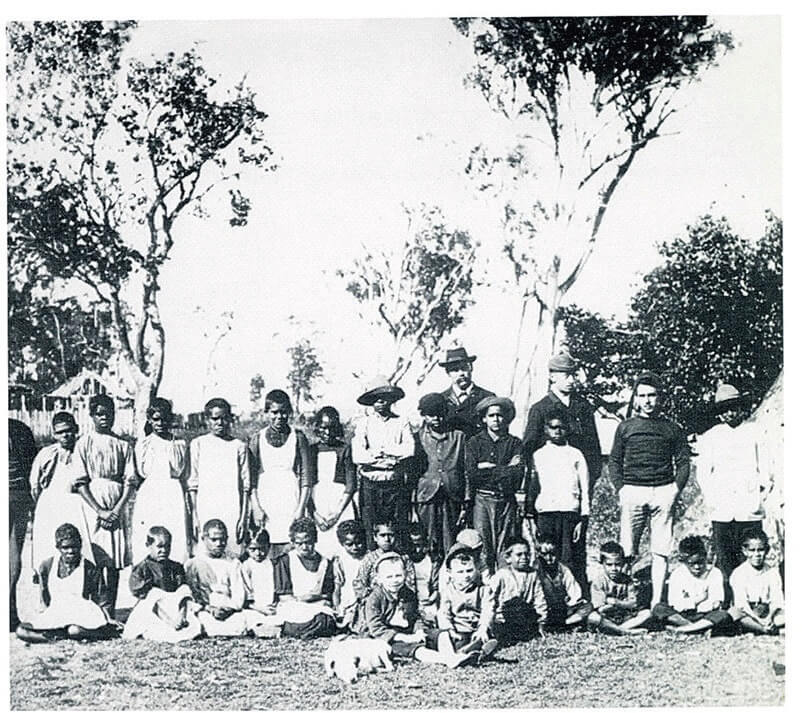
“Mission Point School 1892”

A few years later in 1891 a Mission School was established for local indigenous children at what is now Mission Point, but this too lasted only a short time before being relocated to Myora on Stradbroke Island There was little respect for the few remaining Aboriginal people in those days, but an increasing number of mixed-blood people were even more despised by both the whites and full-blood aboriginals.

Archibald Meston was the Government “Protector of Aboriginals” for this area and in 1891 and he reported that there were very few remaining, and specifically mentioned a lady named Kal-Ma- Kuta from Bribie Island.

This remarkable lady died in 1897 and she was the last of the Joondoburrie people of Bribie Island. Her life story is an interesting one that highlights some prejudices and values from our not very distant past. She had married a white man, Fred Turner, and they lived on the water at Ningi for 23 years where they had 8 children.

Two of their children were at Mission Point School when it closed and the children were moved to Myora. At Christmas time in 1894, just 125 years ago, Fred and his wife wrote a letter to the Colonial Secretary asking for their two children who had been relocated to Myora to be allowed to come home for a few days over Christmas. The request was refused !!

The last of the Joondoburrie.

Fred Turner was the son of William Turner and his mother Eliza, who came out from the UK with two sons in 1862 . Fred was the second son at 8 years of age and had been born in UK in 1854. When Fred grew up he met and fell in love with a local Aboriginal girl named Kal-Ma-Kuta whom he married, and they set up their home at “Turners Camp” on Ningi Creek where she became known as Alma Turner.

They had 8 mixed-blood children, and over the subsequent years all of their children, grandchildren and even some great-grandchildren were taken away from their mothers “for their own good”. During their 23 years living at Turners Camp they were officially responsible for maintaining the navigational Pilot Light on Toorbul Point, where the new Sandstone Point Hotel now stands. Every evening Fred or Alma would walk around the beach to the light, with a bottle of Kerosene balanced on their head, and refill the important navigation light.

Each morning they would walk back and put it out. They did this every day for over 20 years to provide safe passage for the many ships travelling up Pumicestone Passage. Prior to the huge rainfall and floods of 1893, Pumicestone Passage was a major waterway for many vessels travelling to and from Campbellville timber mills on Coochin Creek.
Bribie Island History. Moreton Bay. Brisbane. Queensland. Australia

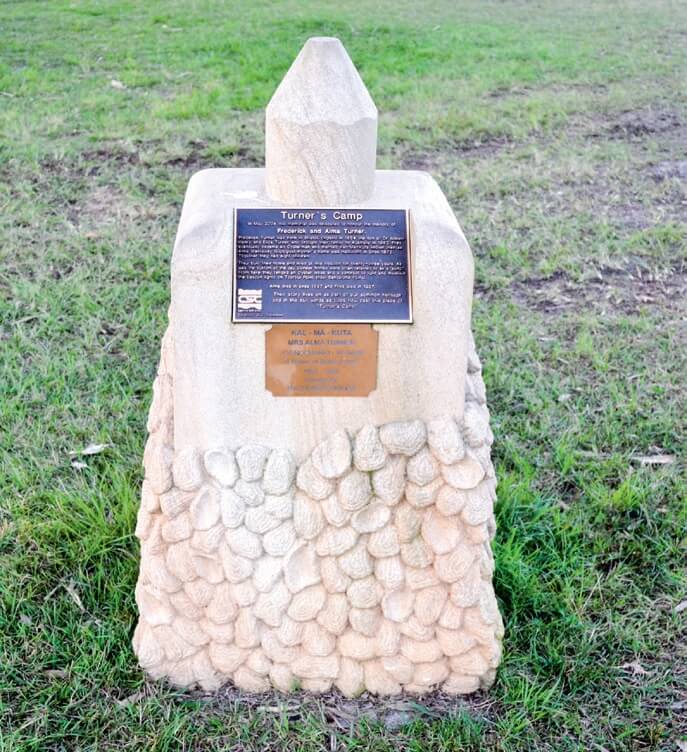
Turners Camp Monument

The Turners home “Camp” site was originally on a small island which years later became part of the mainland when the Military built the road from Caboolture to Toorbul Point in WW2. Alma Turner was a much respected and admired lady, born Kal-Ma-Kuta she died in 1897 as the last of the Joondoburrie people. She was buried in the traditional way and the site marked with a Fig Tree, which later became the resting place for three other descendants, including a box containing the ashes of her daughter Florence who died in 1961.

Florence was one of the daughters who was at the Mission Point School, and was refused permission to go home for Christmas to be with her family back in 1894. Her mother died just three years later in 1897.

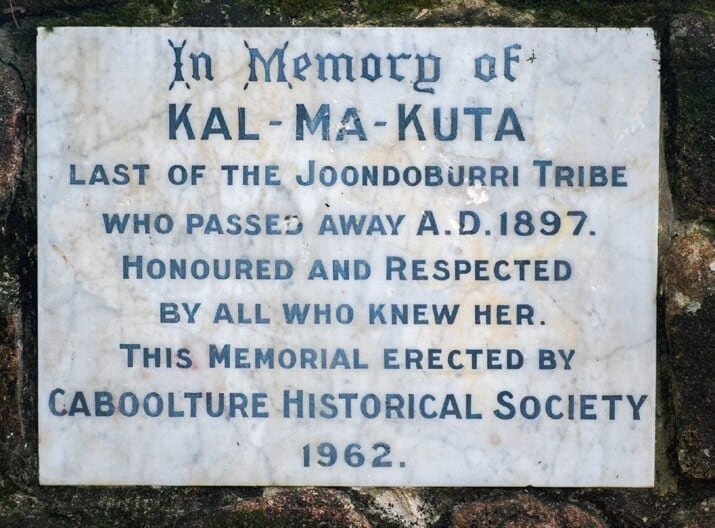
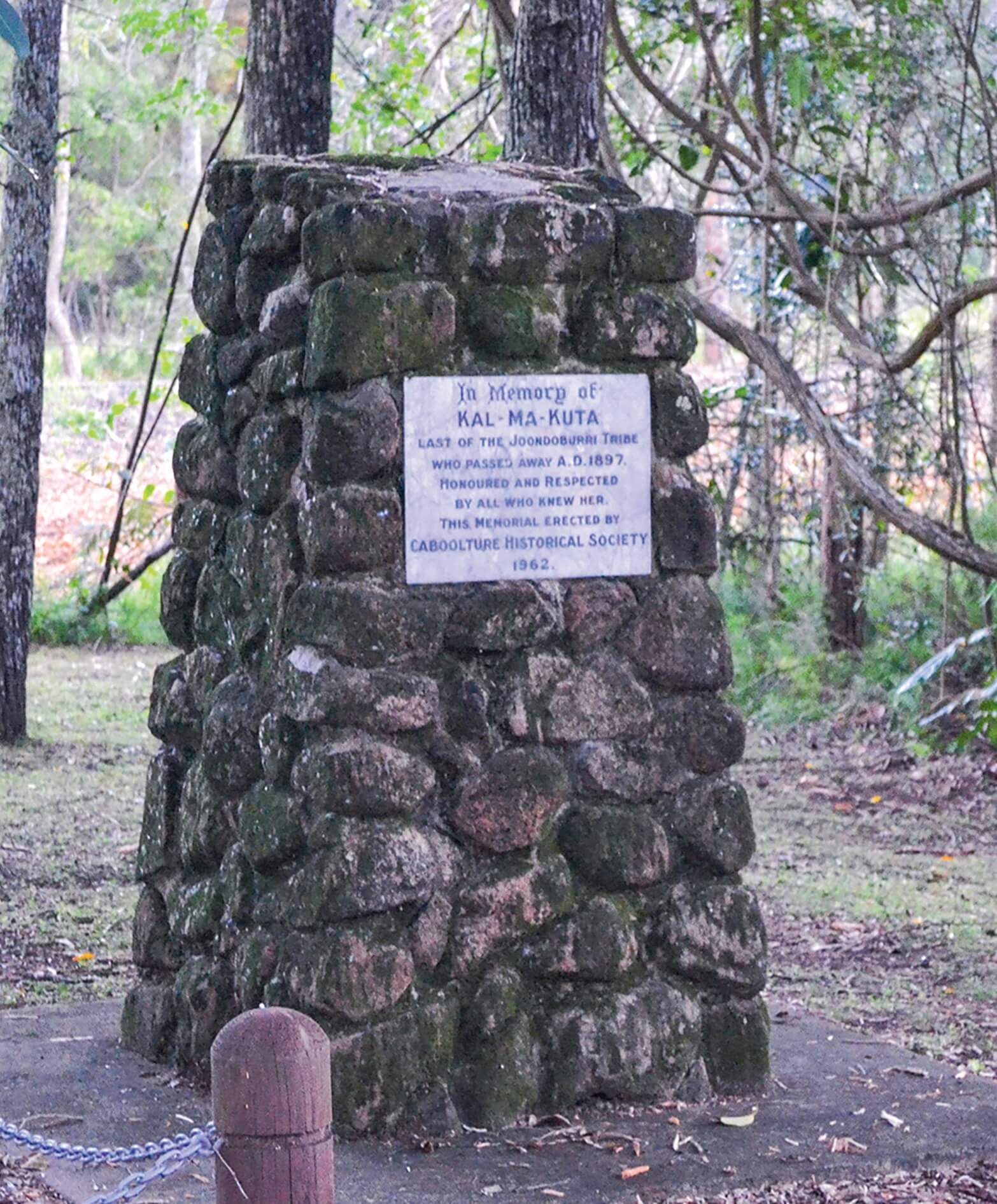
Kal-Ma-Kuta Memorial

However, it took 65 years before Kal-Ma-Kuta was recognised for her remarkable life with Fred and her contribution to the area. The Caboolture Historical Society decided to erect a memorial cairn to tell her story and mark the burial site. Most of the Toorbul Point land had been owned by the Clark family for many years, and had been a military training camp during the War, but a small piece of land was made available for the memorial to be erected.

The new Bribie Island Road had to be constructed as two divided carriageways and the memorial site and fig tree were retained in the centre of the road reserve. The memorial was erected and unveiled in 1962, immediately prior to the completion of the new bridge. The memorial had remained virtually unnoticed for many years but in recent times had been looked after by local taxi owner, the late George Goold, out of respect for this significant aboriginal lady.
Bribie Island History. Moreton Bay. Brisbane. Queensland. Australia

Kal-Ma-Kuta Plaque

Kal-Ma-Kuta and her husband Fred started a large family with their 8 children, and today the family tree numbers more than 200 direct descendants. These include great-granddaughters Daphne Dux and Liesha Krause, both of whom have contributed much to local history records. In 2004 Daphne Dux asked the then Caboolture Shire Council to erect a monument at the Turners Campsite.

A wonderful stone carving was commissioned that portrayed the old Navigation Light encrusted with Oysters. However, the wording on the initially erected plaque gave no indication that Alma Turner was in fact aboriginal, and the last of the Joondoburrie people. Such was the public dilemma even just fifteen years ago, in giving recognition to this heritage.
Bribie Island History. Moreton Bay. Brisbane. Queensland. Australia

Kal-Ma-Kuta Memorial

A subsequent and additional plaque was later added to correct that omission. The “Turners Camp” memorial sculpture and plaque can be seen on Turners Camp road, a left turn off the Bribie Island Road, just before the Kal- Ma-Kuta memorial. It is an important reminder of the Joonboburrie people who were here long before us.

Bribie Island – A Handy History

The Bribie Island Historical Society has just published a great new book titled “Bribie Island- A Handy History” that has fascinating old photos and brief summary stories about many aspects of local history. It costs just $10 and is available at the Museum and through the Historical Society.

They have monthly public meetings at the RSL Club on the second Wednesday of each month commencing at 6:30 pm. with interesting guest speakers on a wide range of topics, and you can see many more photos and articles on our Blog Site at http://bribieislandhistory.blogspot.com or contact us on [email protected]
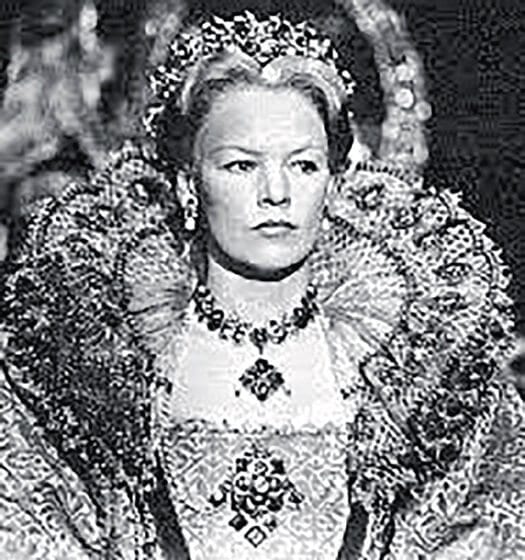
HELLY’S CELEBRITIES OF THE 20TH CENTURY – GLENDA JACKSON

Tags: Celebrities. Famous people. Actors. Glenda Jackson

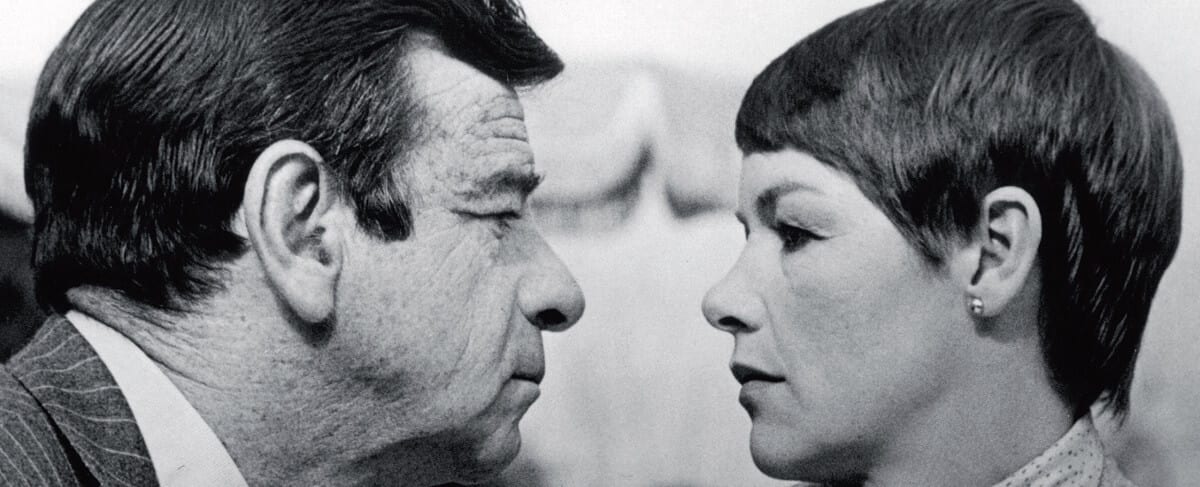
THE FORMIDABLE GLENDA JACKSON CBE ‘AS SOFT AS AN OLD MARSHMALLOW’

After her recent 1976 gory divorce, which English icon Glenda Jackson, 39, describes as “An issue of personal independence as much as emotions, as you have to accept responsibility for yourself and can’t go through life saying you would be better off if….” she sits down, lights a cigarette, breathes a long sigh of relief and begins to talk about the subject nearest her heart – little son Daniel, who dominates her mind, her actions and her life. As the Birkenhead, Cheshire star takes another draw of the cigarette with the manner of one let into heaven for the first time, she admits being a secret smoker now and it has nothing to do with the nun’s black and holy garb she is wearing on the British film set of NASTY HABITS (1977).

Celebrities. Famous people. Actors. Glenda JacksonBut seven-year-old Daniel’s budding awareness of the evil of the demon weed weighs heavily on Jackson’s mind. Then the famous, unique voice of MARY QUEEN OF SCOTS (1971), with the quality of translucent steel, softens and warms.

Celebrities. Famous people. Actors. Glenda Jackson“Daniel knows it’s dangerous and he stands in front of me, saying accusingly, ‘Mummy, you’ll die. You’ll just die! Why don’t you stop, Mummy?’ So I do when he is around, but it’s all a hell of a strain.” Dan’s entertainment taste is also impeccable.

Celebrities. Famous people. Actors. Glenda JacksonAt this young age his favourite outing is the Imperial War Museum. But Jackson has faced and accepted philosophically that Daniel will be her one and only child. And with vigilant concern the star of many movies, TV films, TV series and the theatre declares, “I shall be 40 on my next birthday, and sadly that makes me too old to have another child, because of mongoloid births.

I could easily cope, but it strikes me as dreadfully selfish to take that risk with someone else’s life.” But what doesn’t strike the women’s libber and winner of 24 Awards including several GOLDEN GLOBES, EMMYS and two OSCARS for WOMEN IN LOVE (1969) and A TOUCH OF CLASS (1973) at all, is her reputation of being tough. “God knows why. I’m certainly unsentimental. I believe in sentiment, but not sentimentality. I’m essentially matter of fact, partly because I’m Taurean and partly because I come from a family that’s always had its feet firmly on the ground.

But I’m not tough. And when I’m with Daniel, I am as soft as an old marshmallow.” Jackson is blazingly and uncompromisingly honest, with a look-right-through you sincerity, guaranteed to make most of us feel small. “Of course, it can be hard for a man to live with a successful and independent woman.” She goes off into a clear laugh that has a touch of school girl hockey stick about it.

“If I were a fellow, I certainly wouldn’t like to take me on now. I’m very dogmatic and bossy by nature and an all or nothing person. It’s hard to know what I’ll be like now that I am single again.” Then the voice that can put fires out, becomes gentle once more.. “But the older you get the less self- centred you become. You begin to realize the world is a bigger place than your particular desires, feelings and problems and so you become more aware of other people and their needs.”

“I think I will give acting up some day. Maybe Daniel will ask me to. But even if he doesn’t, it will happen. If I were to give it up now, it would be permanent. Honestly, I don’t see myself doing this in my old age. I have spent the greatest part of my life perfecting my profession, and I believe that you should stick with that and work at your craft.” And what a craft! Being predominantly a dramatic actress, you don’t see her in too many comedies . So if you have never watched Glenda Jackson and Walter Matthau in HOPSCOTCH (1980), you have missed one of the most delightful comedies ever, co-starring Herbert Lom and Ned Beatty.

I highly recommend it, and I play it regularly on DVD. Streaming services like NETFLIX and STAN have it too. Jackson’s voice becomes nostalgic now and very quiet as she sums up her craft and a life maybe not quite complete. “But equally, the amount of energy and simply blood, sweat and tears that go into making a performance, could be harnessed to something a bit more useful.”

Is the 1.69 m tall woman who plays the Virgin Queen Elizabeth I with ferocious greatness in the TV series ELIZABETH R (1971) debating with herself already, whether to become a Member of Parliament? This she does in 1992 and for 23 years! But in 2015 the political blogger and Labor Party stalwart retires as a Member of the House of Commons. And although she describes those decades as “my most meaningful achievement,” Jackson returns to the love of her life – the theatre – in the male role of KING LEAR at London’s Old Vic in 2016 and Best Actress awards for King Lear and other performances keep coming through to 2018. And now, aged 82, Glenda Jackson will return in the powerful role of King Lear on Broadway in April 2019. How I wish I could be there!

Pet Care – March 2019

The Right Question

Love without agenda… that is what our pets give us. Dogs especially demonstrate the sort of attachments that humans are evolved to expect, yet our modern society often makes it difficult for us to fulfill our emotional needs. Our Pet Care pets will do absolutely anything for us… if only we know how to ask them the right question.

Dogs with jobs at airports, prisons, or with police and military, as well as assistance dogs have all been asked the right question and are sharing their amazing sensory and therapy abilities with people. Why? Simply because they love without judgment. All we have to do is ask.

Phone Dr. Jackie for a Veterinary appointment on… 0400 699 704

NUTRITION IN DOGS – Part Two

The last article was about diet and obesity and how certain foods can affect behaviours. So what should we feed our dogs? The best food is to put them on a raw diet. Their digestive system was designed to eat raw meat. This is for all breeds from Yorkshire Terriers to Irish Wolfhounds. Prior to the 1950s dogs lived on a diet of fresh meat, bones and table scraps. There were fewer nutritional problems by feeding dogs a natural, raw diet. Then, commercial pet food was developed about 50 years ago.

This is a multi-million dollar yearly business. Today processed canned food and dry kibble have become so popular and convenient but with its new health problems such as allergies due to their diet. Dog’s digestive system has been finely tuned for millions of years from their teeth, saliva to organs and intestines to process digest and absorb raw meat. Wild dogs eat not only the flesh of the animal caught but the guts and organs such as liver, kidneys, spleen, and heart.

These are rich in vitamins, minerals and trace elements. The guts may contain semi-digested plant matter which can be digested by the dog in its natural form. Last to be eaten is the bones. Happy training, Yvonne

Tye Dying Business Bribie Island – LET ME COLOUR YOUR WORLD

Tags: Local Business Bribie Island.

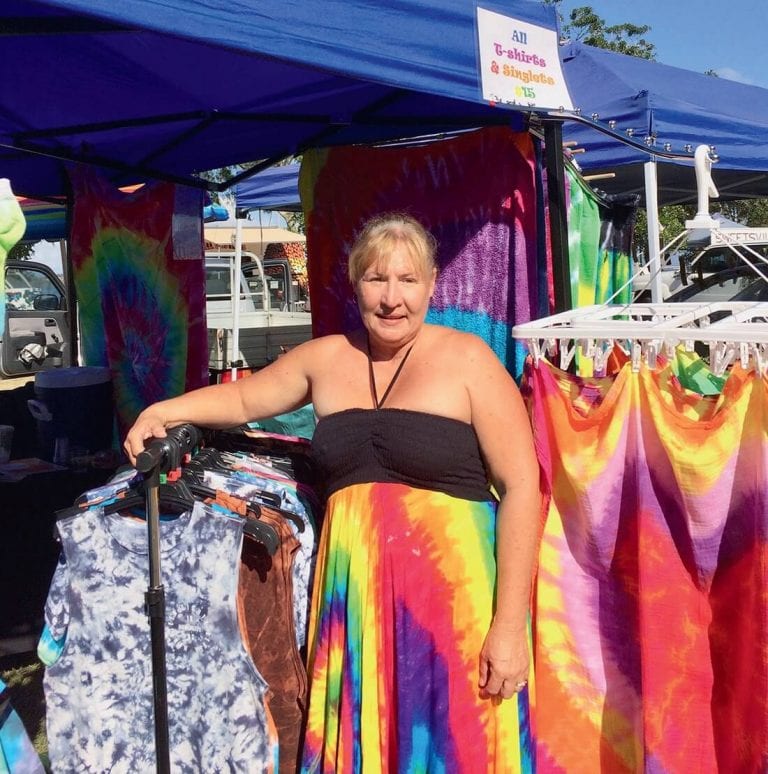
Businesswoman and owner of D.I.Y Tye Dye Robbie Huestis says she gets no greater joy from her business than brightening up peoples lives. “I enjoy making colourful tye dye garments and other items and I just want to share it with the world,” says Robbie. A Bribie resident of ten years Robbie says she has been into tye dying as a business for the past three years and was immediately addicted to her craft.

Robbie says that she buys in the stock items in white or base colours and then processes and tye dyes the items to their vibrant colourful finish. Robbie said she has operated a stall at BIDCA markets for the past 18 months and says that everybody comments on the brightness of her stall and tells her how much they love seeing the vibrant colours. “Every time that Gary Parsons walks past my stall he tells me that this is the most colourful stall they have at the markets,” she said.

Known fondly by all at the markets as the “Tye Dye Lady” Robbie also has a thriving online business where people can order all manner of tye dye products that she produces. “I am on ETSY as well as on Facebook as diytyedye and I ship products all over,” she says. So if you are in the market for tye dye singlets, tee shirts, doona covers, towels or even a set of tye dye curtains for the combi then do your self a favour and catch up with Robbie either at the Bribie markets or online or give her a call on 0431 223 158.

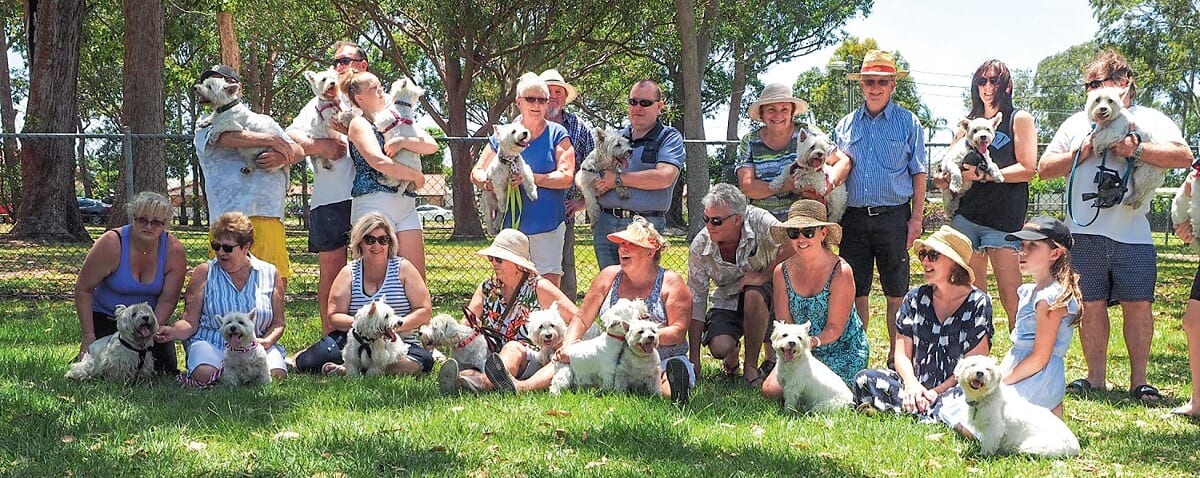
WESTIE GATHERING

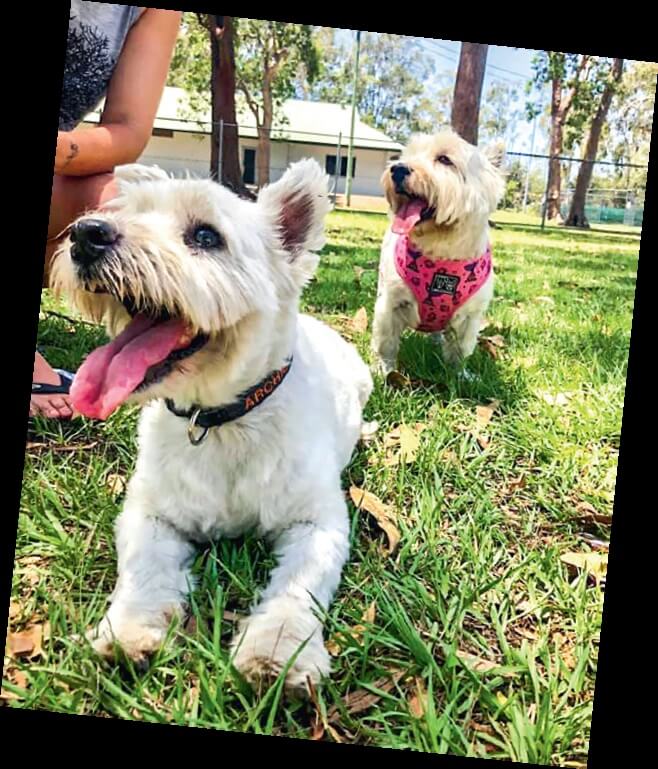
Sunday 10th February was a wonderfully Sunny Day for the WESTIE GATHERING. It was held in the Dog Park at Sunderland Drive with more than 30 westies with their owners and friends. It was a wonderful stop to have the gathering, with all the shade and grass for the dogs in such dry conditions.

Plus having the ability for the dogs to run and play in safety. All the West Highland White Terriers were very well behaved with no incidences. Just lots of running around and playing with each other. Some even showing off their agility skills on the obstacle course. Even though most had never met before, it was a great day all round. Westies and their owners came for Coolum, Mt Coolum, Wurtulla, North Lakes, Brisbane, Caboolture, Sandstone Point and Lakes and of course Bribie Island.

I thank all, the owners and dogs for making the day a great success. Looking forward to the next Gathering in about September. For further details contact Tina Winterton on 0403 558 138 Or email [email protected].

Artist of the month – RUSTY OLD RELICS

0

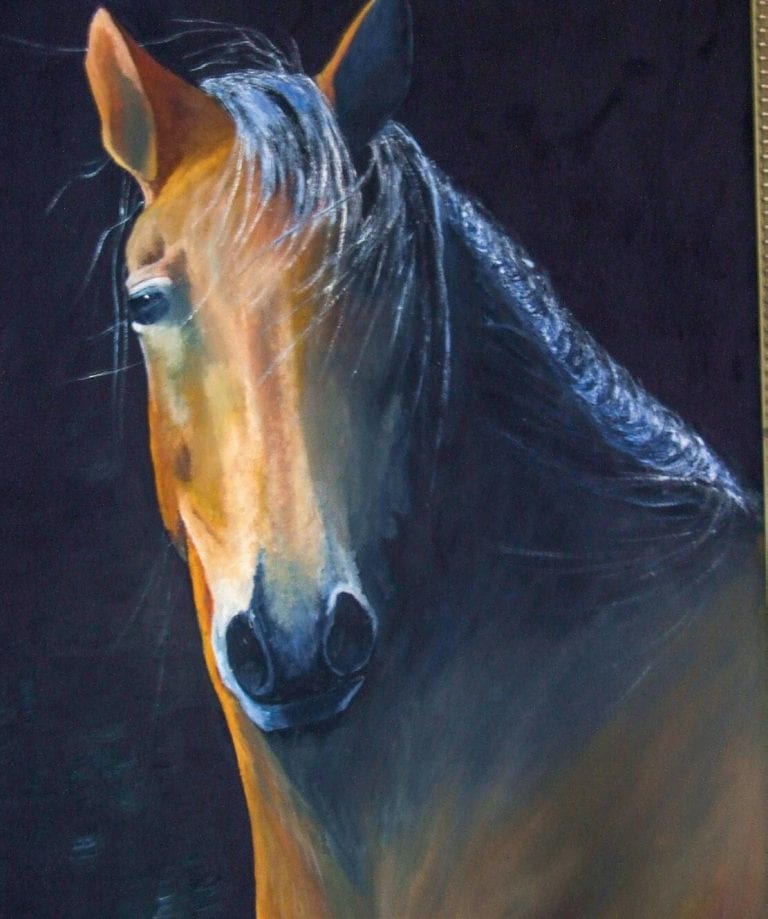
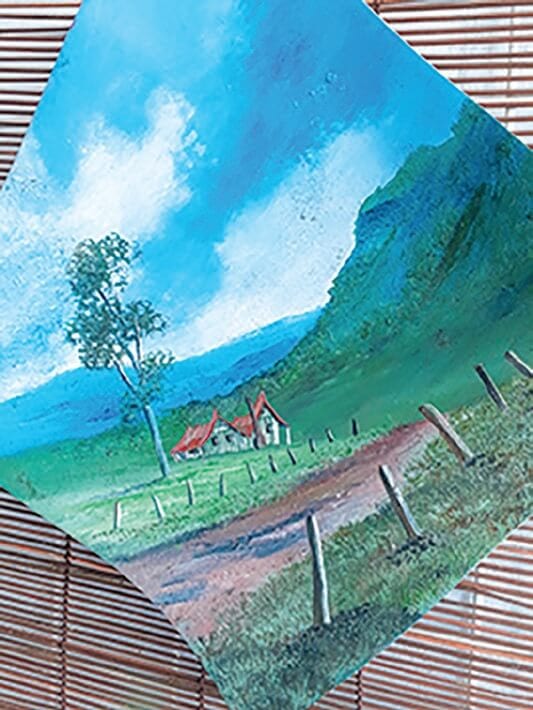
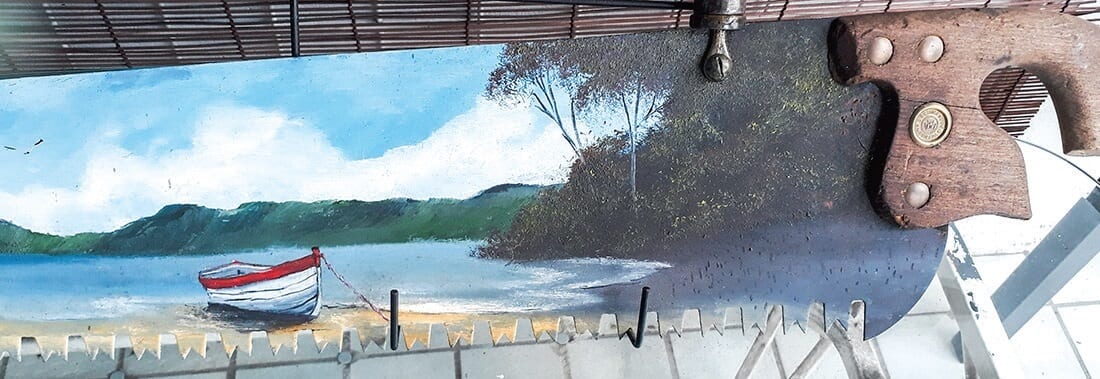
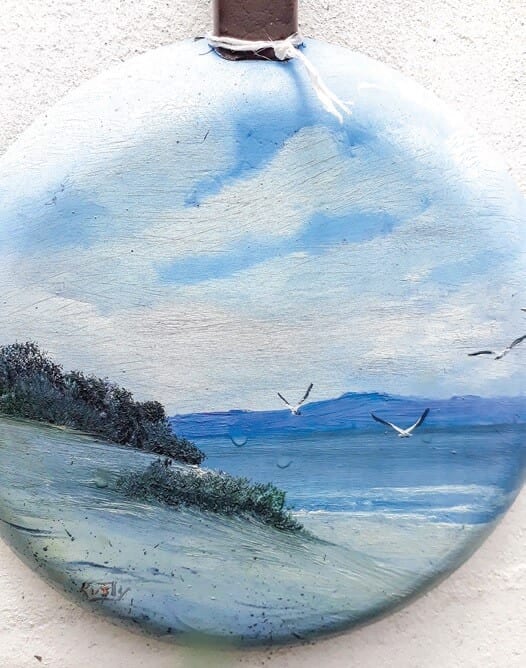
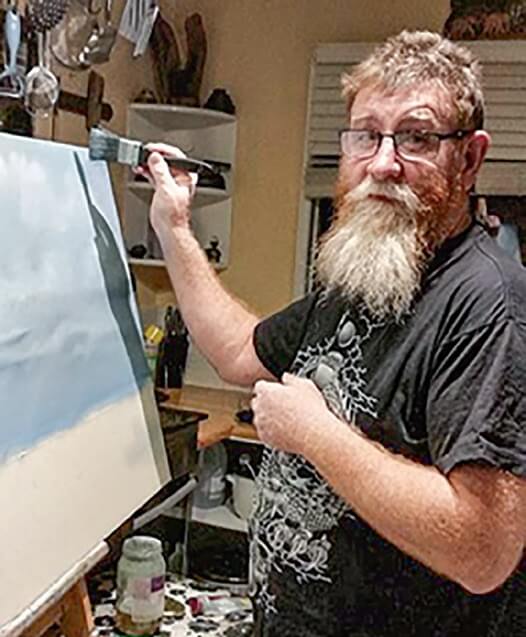
Most artists paint their masterpieces on canvas or paper. Not so the Bribie Community Arts Centre Artist of the Month for March, Rusty White. Rusty has been painting in oils for 40 odd years, starting as a teenager using tiny tins of model aircraft paint. Back then surreal fantasy was his preferred style. When his father introduced him to artist’s oils in the 1980s, painting became for Rusty an addiction.

Then, after meeting and befriending artist Colin Brown in the early nineties, Rusty earned his name when he branched into painting on old relics. About the only things he doesn’t paint on are people. “Their resale value is not good,” he jokes. His alternate canvases include hand saws, frying pans, milk cans, teapots, and teaspoons. Some three decades ago, Rusty traveled Australia in an old International bus selling his artworks at markets and festivals from the Tamworth Country Music Festival to the Barossa Valley Vintage Festival. At his Artist of the Month Talk and morning tea, I must ask him if he painted on the old bus!

Although no longer selling at festivals, he continues to set up shop at markets such as Mt Gravatt, Jimboomba and Rocklea. In addition to painting on the relics, even on the occasionally stretched canvas, Rusty undertakes consignments he calls his Heirloom Work. Clients bring an old photo they want to be reproduced in oils to cherish for future generations. He specializes in painting photos and subjects relating to family history. Local residents with such a photo they’d like reproduced are most fortunate that Rusty has recently moved from Archerfield to Bribie Island after falling in love with the place whilst visiting a few years back.

His AOM talk would be the ideal time to discuss this with him. Bring your photos! So far as living on our picturesque island is concerned, “Bribie,” comments Rusty, “is an artist’s paradise, offering so much inspiration with its natural beauty which can be identified in my work.” Any further information you may require can be obtained by ringing the Arts Centre on 07 3408 9288.

The Bribie Winelander March 2019

Having a glass of wine should be a special event even if it’s just relaxing after a day at work, over dinner or sitting with a friend. It can change an ordinary meal into something special, it can stimulate conversation, it can create friendships, wine can also be served to celebrate a special occasion, or enjoyed on one’s own.

However, there can also be a bit of theatre when opening a bottle as the waiter removes the cork from a favourite sparkling wine especially Champagne, not so table wines nowadays with the screw tops (Stelvin Caps), but remember when the cork would be removed with a waiters friend.

After running the blade around the foil the waiter would twist the screw into the cork then lever it out gently especially an old cork before smelling the cork and then placing it on a saucer, you would smell the wine, sometimes even the cork yourself, have a taste and give the nod of approval, which if you enjoy imported wines is still an option but not on Australian wines.

We have looked at the development of the screw cap before but it I think it was some time ago and it is now timely to cover old ground and refresh our memories as to the reasons why we have Stelvin Caps in the first place and nowadays enjoy almost 100% perfect wines which were not the case 25 years ago when corks were the preferred method of sealing our favourite tipple.

In the late 1970’s someone came up with the idea of developing an enclosure that would allow the wine to develop in the bottle in a screw top version and named it a Stelvin Cap, it was probably an economic situation at that time because corks have never been cheap and as we will find out quite often unreliable.

Initially it was used on wines such as Ben Ean, Black Forest Moselle and Rhine Keller which were all fairly inexpensive sweeter style wines, also some good quality Rieslings were tried, I think from memory Pewsey Vale was one of them, but the public wasn’t convinced and as winemakers weren’t game to try more expensive or red wines with this form of closure the idea was dropped. Strangely when the Stelvin Cap came out of retirement some 20 years later the Rieslings that were bottled all those years ago were still in drinkable condition and had improved in the same way as they would have done under a good quality cork.

Cork is harvested from the bark of cork trees of which over 60% are grown in Portugal and Spain, and it takes twenty-five years before the first stripping can take place then every nine years or so and because the trees can live for many years is considered sustainable. The first harvest usually produces poor quality cork which can be used in industrial products such as flooring, shoes etc. before the quality is suitable for wine bottle corks. In the mid-17th century The French Winemakers were using oil-soaked rags stuffed in the necks of the bottles then it was found that corks were a more suitable way of sealing the neck of the bottle.

The corks can be made of a single piece of cork or of composed particles as in the case of Champagne corks and it seems that corks made in this were proved less troublesome than a single cork. Corks used to be responsible for about 80% of the 20 billion bottles of wine produced each year and after a decline in use due to the increase in synthetic alternatives they are making a comeback and currently represent around 60% of wine stoppers today but it is doubtful whether they will ever return to the level they once were.

A chemical compound, known as Trichloroanisole (TCA) found in some of the corks changed the Australian winemaking industry in the mid-1990s by causing a high percentage of wines produced to develop an unpleasant odour similar to damp cardboard, and the wine was deemed ‘corked’. It was a difficult situation because until the wine was opened it wasn’t detectable and at its worst it was estimated that up to 10% or more of wines had this cork taint and to make matters even worse probably 99% of this wine was poured down the sink with drinkers thinking the wine was at fault and many consumers would probably not buy that brand again and a solution had to be found.

To give an indication of the problem I was involved in the sale of around 12 million bottles of wine from 1980 to 1995 and I doubt whether 3 dozen bottles were ever returned by customers. A solution had to be found and wine companies resorted to synthetic corks made of plastic, glass corks, corks that unwound the list seemed endless until someone remembered the Stelvin Cap and the day was saved.

The cork industry recognised they were about to lose everything so set about solving the problem treating the corks before TCA ruined them and managed to keep a high percentage of the world’s wine producers on side but wines made in New Zealand and Australia are pretty well all enclosed in Stelvin, although some exporters, especially to America and China, do use cork as in some countries screw tops still give the impression of cheapness.

In America, for instance, they use plastic corks in their cheaper wines which makes the wine look even cheaper but they consume huge amounts of New Zealand Sauvignon Blanc and still have a love of Australian wines all sealed with Stelvin, I think the words slow learners may come to play here.

Anyway enough of the chemistry lesson, there are some good deals out there at the moment and it pays to be a member of Dan Murphy’s loyalty scheme. Occasionally they will email a special directly from a winery, I grabbed a dozen Clare Valley Riesling from Claymore including delivery for $8 a bottle the other day and have used them several times in the past. There’s not a lot of difference between Liquorland and BWS except Liquorland have more single bottle buys which I prefer instead of having to buy 6 bottles at a time.

Liquorland is regularly promoting Annie’s Lane Shiraz at $12, Samuel Wynn Last Rights Cabernet Sauvignon $10, William Hardy Langhorne Creek Shiraz $10 and a couple of interesting labels from Constellation Wines called The Mingler Shiraz and The Mingler Cabernet Sauvignon packaged in bottles that look more like large beer bottles but the wine is very good. Cheers, Philip Arlidge. [email protected]
“Wine enters through the mouth, love through the eyes, I raise a glass to my mouth, I look at you, I sigh” Jalaluddin Rumi “There are thousands of wines that can take over our minds. Don’t think all ecstasies are the same!”

William Butler Yeats

Severe Thunderstorm warning for SE coast

0

Australian Government Bureau of Meteorology
Queensland

Featured Image(above) – radar image taken at 4.00pm 15/03/2019

TOP PRIORITY FOR IMMEDIATE BROADCAST

Severe Thunderstorm Warning – Southeast Queensland

for DAMAGING WINDS, HEAVY RAINFALL, and LARGE HAILSTONES

Latest storm warning track map

For people in Ipswich, Logan, Scenic Rim, Lockyer Valley, Moreton Bay and parts of Somerset, Southern Downs, Toowoomba, Gold Coast, Sunshine Coast, and Brisbane City Council Areas.

Issued at 3:52 pm on Friday, 15 March 2019.

The Bureau of Meteorology warns that at 3:40 pm, severe thunderstorms were detected on the weather radar near Beaudesert, the area south of Toowoomba, Mount Nebo, Jondaryan and the area east of Dalby. They are forecast to affect Laidley, Gatton and Caboolture by 4:20 pm and Strathpine, Beerburrum and Mount Beerwah by 4:50 pm.

Damaging winds, heavy rainfall (locally intense) that may lead to flash flooding and large hailstones are likely.

Mulgowie has recorded 62mm in 30 minutes.

Queensland Fire and Emergency Services advises that people should:
* Move your car under cover or away from trees.
* Secure loose outdoor items.
* Never drive, walk or ride through flood waters. If it’s flooded, forget it.
* Seek shelter, preferably indoors and never under trees.
* Avoid using the telephone during a thunderstorm.
* Beware of fallen trees and powerlines.
* For emergency assistance contact the SES on 132 500.

The next warning is due to be issued by 4:55 pm.

A more general severe thunderstorm warning is also current for the Southeast Coast and parts of the Central Highlands and Coalfields, Central West, Wide Bay and Burnett, Maranoa and Warrego and Darling Downs and Granite Belt districts.

Warnings are also available through TV and Radio broadcasts, the Bureau’s website at www.bom.gov.au or call 1300 659 219. The Bureau and Queensland Fire and Emergency Services would appreciate warnings being broadcast regularly.

Latest warnings from the Bureau of Meteorology

Latest radar imagery from the Bureau of Meteorology

Gloss Magazine Bribie Islander 6th Edition March 15 2019 Issue 83

The Bribie Islander Magazine
Get all your community news and information Bribie’s only community gloss magazine NOW EVERY TWO WEEKS! – Articles on boating, camping, fishing, life, drama, travel destinations, sports and what to see and do on Bribie Island. Covering charities, organisations, places, children’s activities, arts and crafts, tourist destinations, heritage parks, technology, science, music, gardening and much more.