Home Blog Page 82

Tourism & Travel destination – Ulladulla

0

Tags: Travel Spots. Australia. Tourist destinations. NSW. New South Wales

Episode 24 – On the way to Ulladulla

with Sabine Von Graz

As I mentioned in the last episode we decided to slowly wind up our adventure on the road and start a new one by moving to Bribie Island! This would have meant heading East but wait, there was still my birthday surprise we had to pick up at Ulladulla, just South of Sydney. Our route took us first from Charleville to Bourke, with the side of the road littered by hundreds of roos, emus and goats, occasionally slowing us down to walking speed, when some live ones would suddenly appear from the bushes and stroll leisurely across the highway in bright daylight.

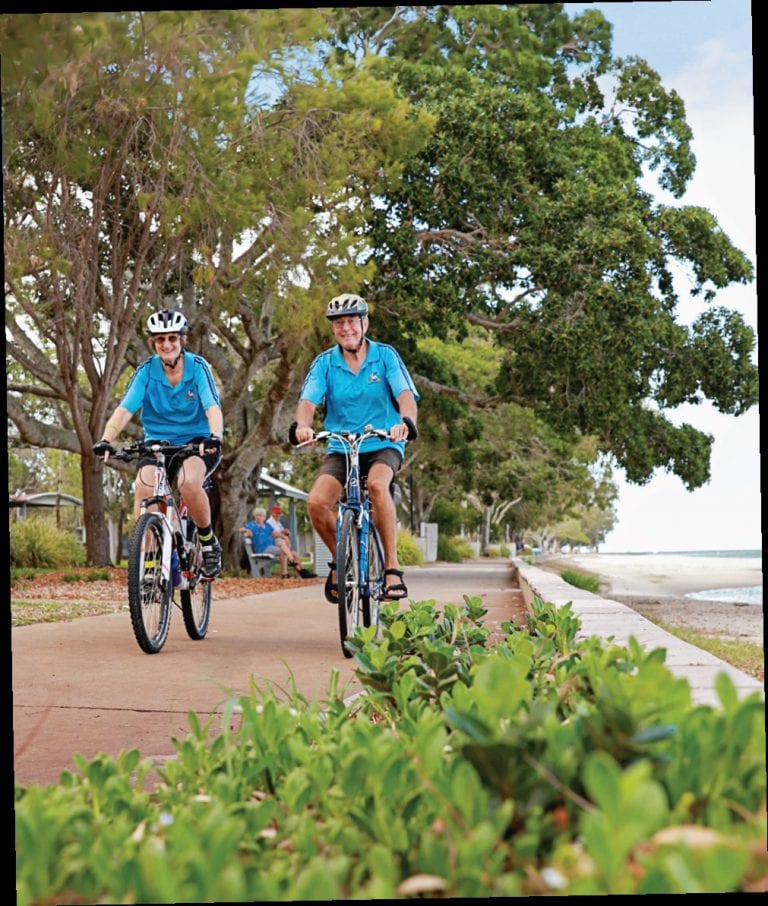
Featured image(above): A great bike path leading around Cobar Lake

From Bourke we headed to Cobar and Forbes in NSW, catching up with some of Richard’s clients, and to check out the amazing Parkes Dish. But the attraction we loved the most was the whispering installation, which was put there to drive home the point of how a radio telescope actually works. There are two mini dishes one hundred meters apart, where you can stand in one…whisper some words…and the person standing in the other dish, far away, can clearly hear what you said! It sounds good, you think, but actually experiencing it is even better and mind-boggling, I was told by Ginger, who filled me in as I stayed home sick and missed out.

However all was good again once we headed to Cobar, where we loved our nightly ritual of walking up a little mountain to be rewarded by a sunset viewing over a working copper mine. It was fascinating to see those entrance tunnels so far and small below us with trucks and machinery appearing and disappearing into the mountain. A little bit of sadness crept in on our part, knowing we were leaving the outback behind, and diving back into the hustle and bustle of life on the coast and cities.

The Rocket

Still aiming for Ulladulla, we had to do the big hike with the ‘big ‘ rig over the Dividing Range, leaving us feeling rather car sick from all those curves. Ginger, probing Richard at every possible rest stop to lift his secret of the huge present being shipped to Ulladulla, found out that the present was something I collected… The only collectable item I could think off were small orange Buddhas, which were hard to come by in the outback, and as such luckily kept a lid on my collecting habit.

Cobar Mine

However, in Darwin, we went through a huge store filled with Buddhas and there we saw some life-size ones!! I know it was me leading Richard down that garden path, but now that we were moving back into a three bedroom unit on Bribie Island, where for God’s sake could you put a life-size statue of a Buddha! As Richard mentioned on the due day, it would take a while to pick up, assemble, and load the present onto the Dodge… Ginger’s suspicion was that he could not get an orange one to match my small collection, but rather a pink one to match the huge pink bow and ribbon they went to buy!!!

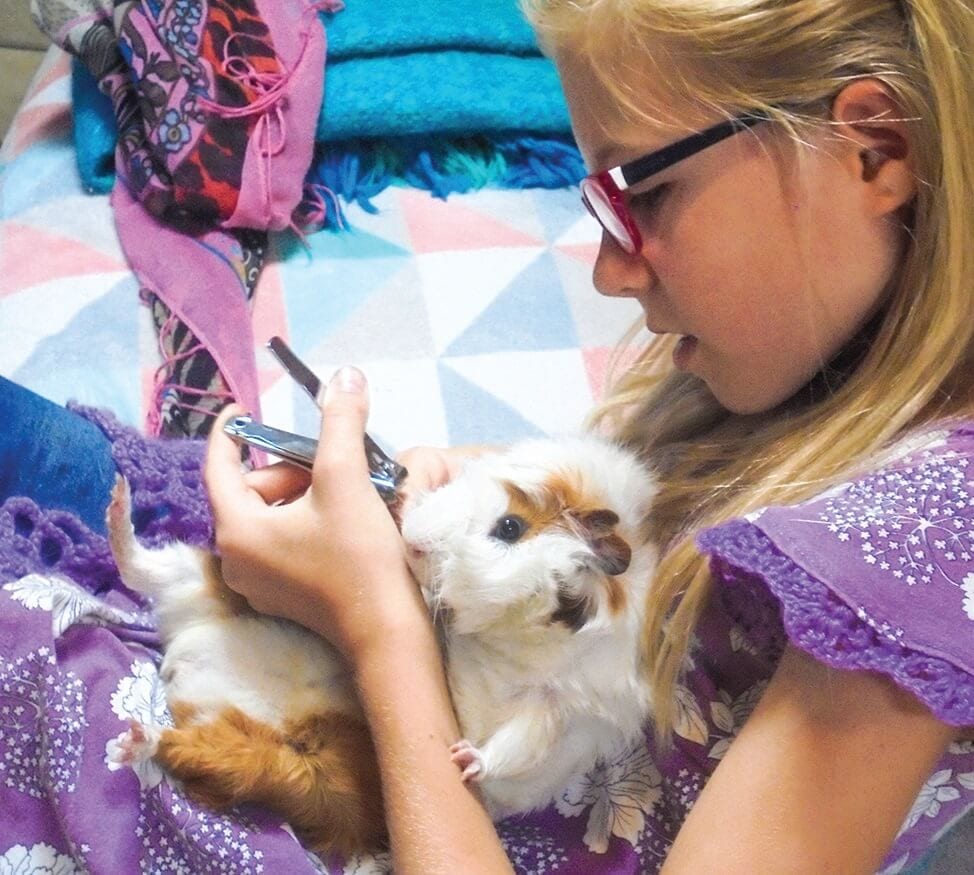
Coco getting his nails clipped

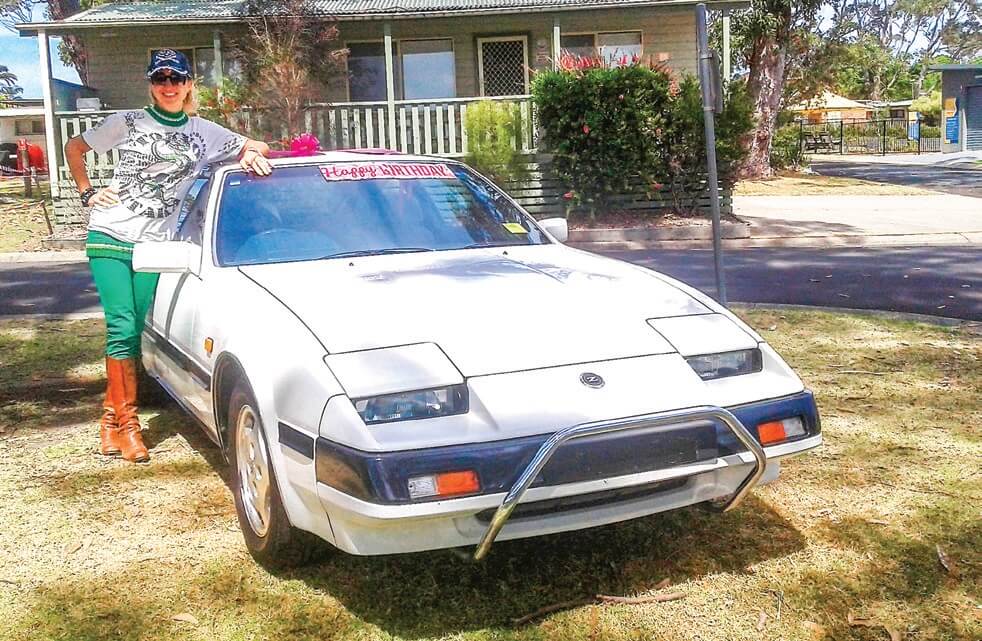
Once Richard had the present up and ready, he phoned, and I had to sit at the back window of the caravan to wait for the black Dodge to appear at the boom gate down the other end. While Ginger and I were waiting and complaining how long it took… I noticed a little white car stopping at the gate. I pointed out to Ginger that this car looks a bit like the Rocket, a car I loved but had to give away once Ginger was born, in exchange for a more sensible car, which could fit a baby and a pram.

The Rocket, I told her, (a Nissan 300 ZX) got its name as it made lots of noise when I was driving it, due to holes in the exhaust. It also had a few minor faults with the windscreen wipers, heater and speedo out of action, the drooping headlining occasionally blocking the driver’s view, and sometimes catching fire under the bonnet when waiting at traffic lights… But I just loooved that car – it was so imperfectly me. As this white car came closer I said to Ginger:” This is just like the Rocket!” and then I saw Richard driving the car with a big pink bow on top it!!! What a relief, it was not a life-size Buddha after all!!!! And how exciting to have a new Rocket in my life!

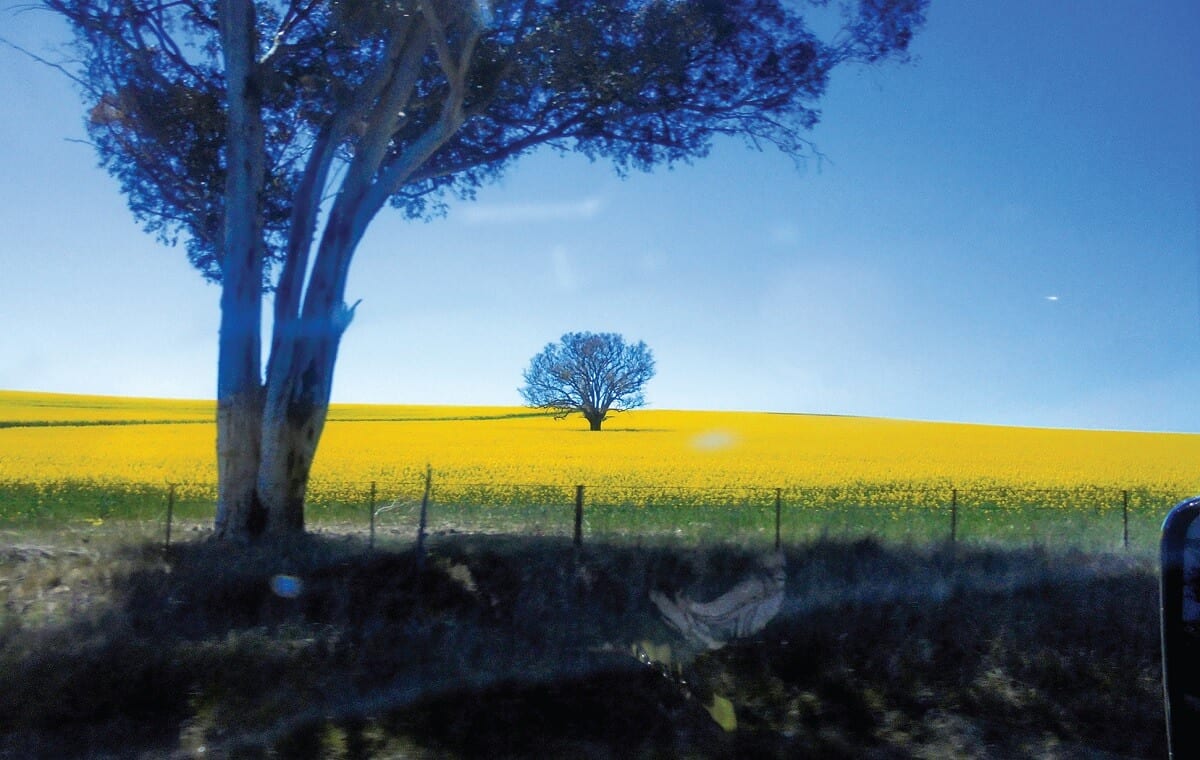
Passing by Canola fields

A true sign of love and dedication from my car-loving hubby! I think he enjoyed the secret search over the years just as much I did the present! Off I went for a test drive, and like the original Rocket the aircon was not working. Never mind, we took the Targa top off and had all the fresh air we needed! It also had the sound of the original Rocket emphasized by the 80’s music blasting from the rather perfect stereo system. Now of course it was up to me to drive the Rocket home, and with no navigation system on hand, I could not afford to lose Richard driving the rig in front of me.

I sat right up his clacker, when we all of a sudden got lost through Sydney, and to top it off the brake lights on his van started to play up! My mind on full alert and my body close to a heat stroke I was driving with all windows down, while I was targeted by other drivers furiously trying to point out that I had no number plate! Little did they know I actually had a permit, but that did not stop them from yelling, honking and having a conversation with me through my window, while driving!

A great bike path leading around Cobar Lake

I don’t know how we made it through all that chaos, but it was sheer relief when Richard finally pulled over and I could tell him all about the carry on behind the rig, and his non-existing brake lights! I think I can hear your big sigh of relief, and although this is the end of this episode, I hope you can join me for the next one, when we catch our breath at Shoal Bay!

BUSY FINGERS Feb 2019

Tags: Busy Fingers Second hand Store. Bribie Island. Charity. Pre owned.

CHRISTMAS CLOSURE ISSUES

As most residents would be aware there were numerous complaints from people about the items deposited outside our gates after Christmas. We would like to advise that we advertised our closure over a 3 month period including in the Busy Fingers article in the October, November and December issues of this paper and we also posted signs in the shop itself. Many of our residents knew we were closed and kept their donations until we re-opened and we thank them sincerely for their cooperation and patience.

Our break was from Monday 24th December for 2 weeks re-opening on Monday 7th January and in all our advisements we asked people not to leave any donations during this period. We advised that we would arrange to pick up any items that you had as soon as we returned if you were unable to bring them down yourselves after Monday 7th January. The volunteers who donate so much of their time in making this a successful fundraising organisation deserve a well-earned break at the end of the year.

Our staff also require a break after the full on month of December which is always hectic, surely noone objects to that. Since erecting the fence around the property, which you may recall was forced upon us by the continual acts of theft and the many occasions of rubbish dumping which were causing unaccounted for expenses, money that would have been used for the benefit of the island. We have closed the gates over all Public Holidays and afterhours, we do have a lovely volunteer who opens the gates for 2 hours on Sunday mornings for anyone who needs to donate goods over the weekend, but the gates are always closed otherwise.

Some of the excellent condition items left over the Christmas break were either stolen or ruined due to the rain especially mattresses, cushions and pillows. But there were also bags of household rubbish dumped there, which was very disappointing, these bags were opened by our volunteers, this is not a pleasant job. During the first week we had to arrange for numerous industrial green bins to be emptied and the council sent a truck to assist us for which we sincerely thank them. We thank the volunteers and staff for all their hard work in dealing with this issue during their first week back.

FOR FUTURE REFERENCE:

PLEASE BE ADVISED that the footpath outside our gates is the responsibility of the Moreton Bay Regional Council, and leaving items on the footpath is classified as illegal dumping and on the spot fines can apply. Both the council and Busy Fingers do not want this to occur so please refrain from leaving items once the gates are closed, once again, it appears we will be forced to purchase and erect more signs!

BARGAINS

The shop is continuing to have sales on different items which will be advertised daily on the blackboard as you enter the shop. We currently have plenty of furniture, kitchen items, books and a wide variety of clothing so please check out the bargains when you are visiting the shop.

SPEED LIMIT

Please be aware that our speed limit in the car park is 5 kph, the last few days have seen near misses with cars and our volunteers working in the shed. It is very dangerous when customers are not driving slowly with due care and attention, so we are arranging another speed bump – a further expense.

REQUEST FOR DONATIONS

If you are a member of an island club or association and require assistance please let us know. We try to assist all non for profit associations and sporting clubs, we also assist the Police, SES, VMR and the BI Hospice.

Our President Karen is quite happy to come along to your club and present our aims and goals and how your club can apply for assistance. Please call 3410 1920 or email [email protected] if you wish to have a presentation or if you wish to apply for a grant of assistance. A big thank you to Mavis Howard who has supplied us with many lucky dip bags for the children over Christmas and the school holidays, these are always a great attraction. Thank you also to the Bribie Islander for our advertisement and this article which will appear in every second glossy magazine throughout the year. Hope to see you in the shop soon. Sandra.

Helly’s Celebrities of the 20th Century – YBONA PRICE

Tags: Celebrities. Actors. Famous people. YBONA PRICE

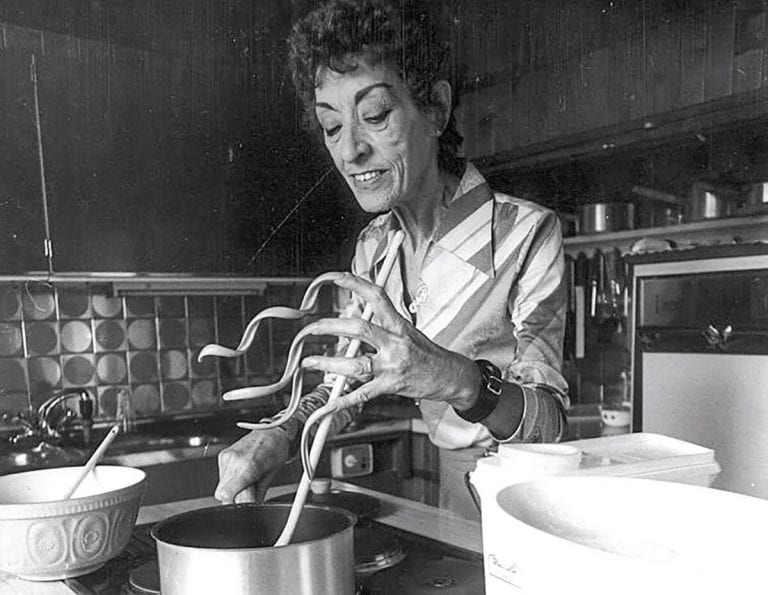
SPAGHETTI OR NAILS?

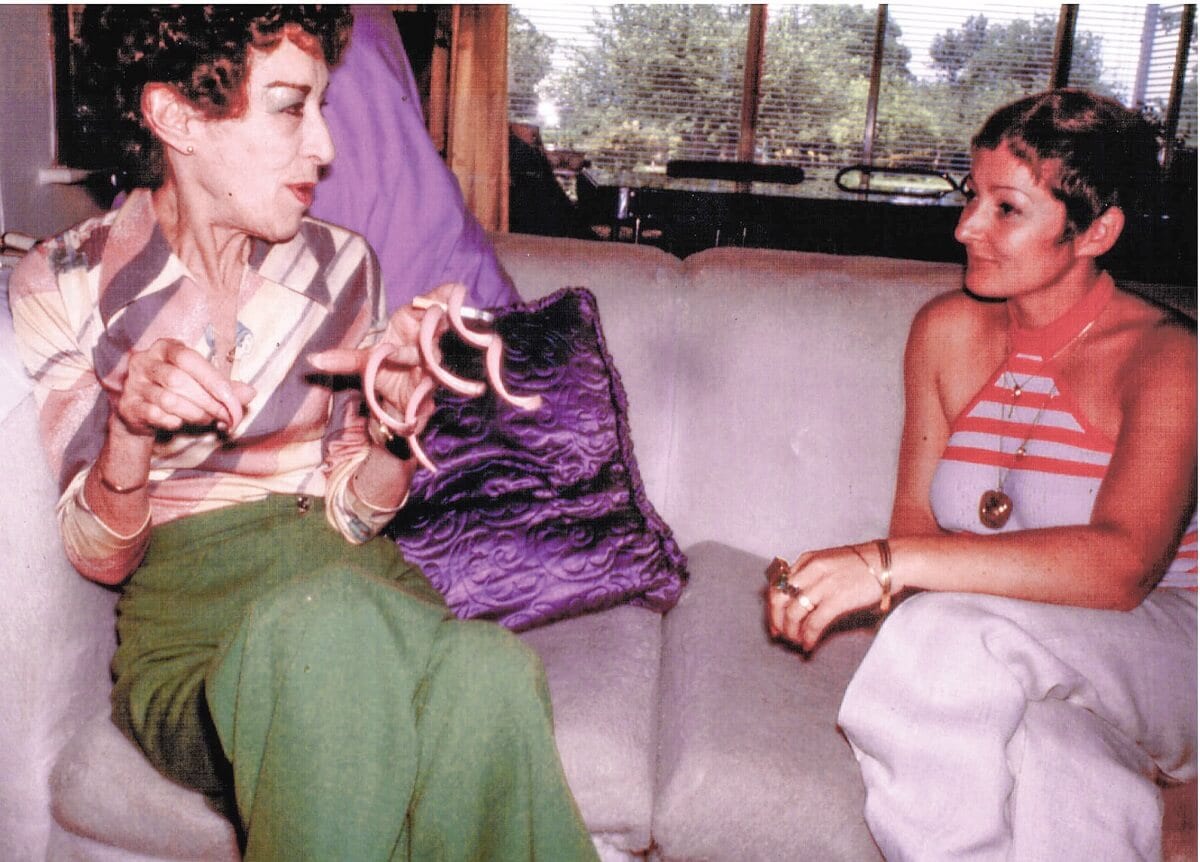
Most teenagers like to conduct a little rebellion against their parents. Few, however, can have seen it get so much out of hand as England’s YBONA PRICE. When she was 13 she began to grow her fingernails long, in emulation of Marlene Dietrich’s starring role in ‘THE BLUE ANGEL’. Ybona’s mother said, “Cut them.” Ybona said, “No.” 47 years later, the nails on her left hand are still over 10” long, and she still enjoys the little extra ‘zip’ they give to her life. “And early in the 20th century, it was the same at school. We used to write with pens and nibs in those days – none of this biro business – and the teachers would never give me the nibs.

They’d just say, ‘You write with your nails.” And when they decided enough was enough, they wrote to my father. But in my father’s eye, I could do no wrong and he said the nails could stay. Ybona has been invited on TV and been published in several London newspapers. “Once it started,” she declares, “It snowballed and I just could not bear to cut them. “I don’t really understand all that fuss, because until recently nobody had taken any notice of my nails and they have been this long for decades.

“My poor old Mum hated them and my annoying dinner behaviour caused me having to leave the table more times than you’ve had hot dinners.

You know what it is – they can’t quite figure out, that a woman my age should be such a fool. But I don’t have them for other people. It’s for me. The children too have always loved Ybona’s extraordinary nails. And she adds, “The grandchildren think it’s the beginning and the end of life. Oh, they’re so proud of me! “I can understand people thinking my nails are terrible, especially women. But they should not say that to my face. Men seem to like them more.” “Over the last five years, I have thought that it is ridiculous and that maybe I should cut them off.

But my children say, ‘No Mum, it won’t be you without your nails.’ ” I tell Ybona that her sense of humour and proportion are so obviously in the right place, that despite that weird left hand she appears far from eccentric. The ex-ballet teacher goes off into a roar of laughter. This ability to appreciate how she might look to the rest of the world is one of her most engaging qualities. She wiggles her left hand for inspection, revealing the curling, tentacle-like growths that sprout from her fingers, each one beautifully kept, manicured, and shining with 5 coats of pink nail polish both on top and underneath, as they are easier to clean and keep clean that way.

Five decades later, with three grown-up children as well as five grandchildren, Ybona and her husband, Eric, live in the small English village of Balsall near Coventry. And far from objecting to his wife’s strange appearance, he seems to love the nails even more than Ybona herself and is totally bewildered by the attention paid to her. Ybona recalls a vivid memory. “We were on holiday in Cyprus when the war broke out. We were airlifted, jumping in and out of lorries, being pushed from pillar to post, from one transport to another. You name it – it happened to us.

“Like a cat’s claws, aren’t they,” she explains, laughing.

And suddenly in the pitch dark with guns and bombs popping all around us, Eric called out, ’Darling, be careful of your nails.’ “As if it mattered. We could have been blown up at any moment.” Ybona assures me that she has no trouble doing her own housework, as the nails on her right hand are almost bordering on normal. And when she uses her left hand she simply turns it sideways. “You might not think so, but I am a very, very shy person. You know how stiff it can be when you walk into a new party and you don’t know what to say. It’s my nails that have always broken the ice.

Celebrities. Actors. Famous people. YBONA PRICEAll my life they have been an asset to me, not a hindrance.” Ybona’s favourite story though is the one when she was alone in Cyprus in 1975. “I was sitting outside by the hotel swimming pool and a lot of children were about. Fascinated, they kept circling right around me, but would not come close or speak to me. “Then the mothers came out and asked if they could take photos. And after that, the children came near, sat by me, touched the nails and played with them. “At last one little girl about six, looked up at me innocently and whispered, ‘You know people think you are a witch, but you’re quite ordinary, aren’t you?’ “To this day I still have not made up my mind which word was the greater insult!”
AUSTRALIAN PELICAN – PELECANUS CONSPICILLATUS

0

Tags: Australian wildlife. Birds. Pelican

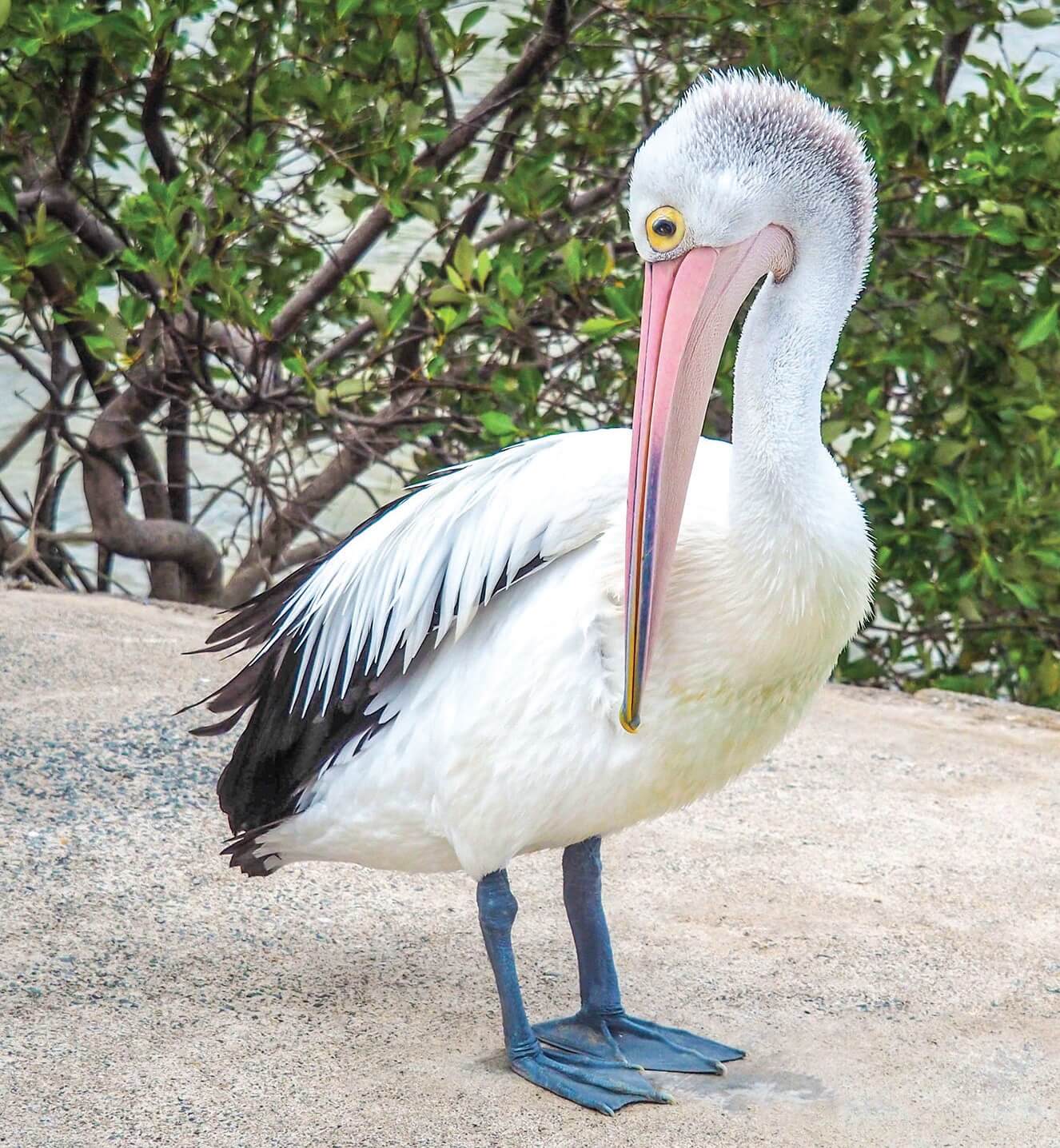
Probably the most observed and loved birds on Bribie Island are the iconic Australian Pelicans. They are likely to be seen wherever there is water and the Pumicestone Passage is one of their favourite haunts. With a wingspan of 2.3-2.5 m and a length of 1.6-1.8 m and weighing 4-6.8 kg they are extremely hard to miss. They are Australia’s largest flying bird. Their bills are longer than any other bird in Australia being 36-46 cm in length.

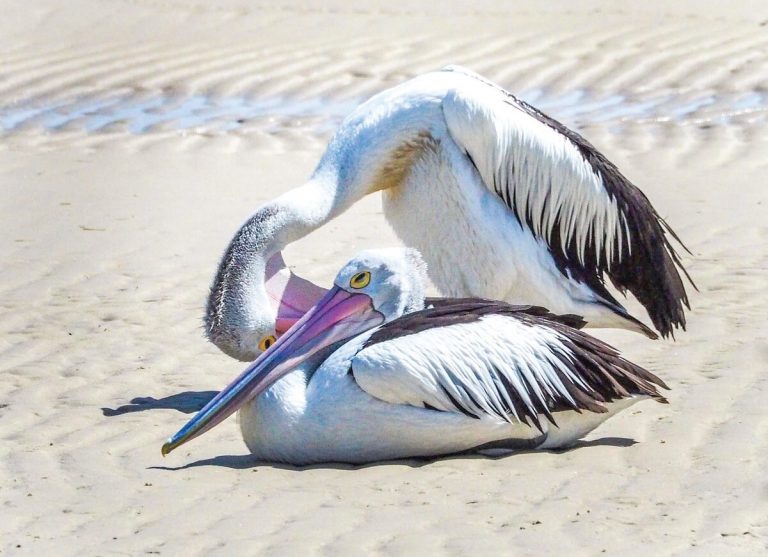
Featured image(above): Preening on the Beach

Attached to their bills are pink gular pouches which can hold up to 13 litres of water. At the end of their bills are large, yellow, claw-like hooks thought to help in the management of their prey. They belong to the Order Pelecaniformes which is a group of birds with four toes joined by webbing and one toe behind. Nostrils are almost closed which prevents water entering their airways when diving for food.

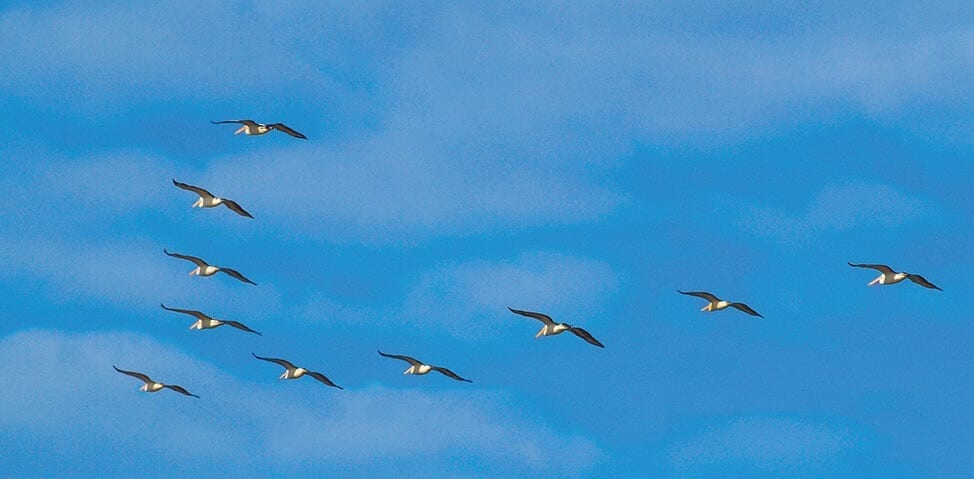
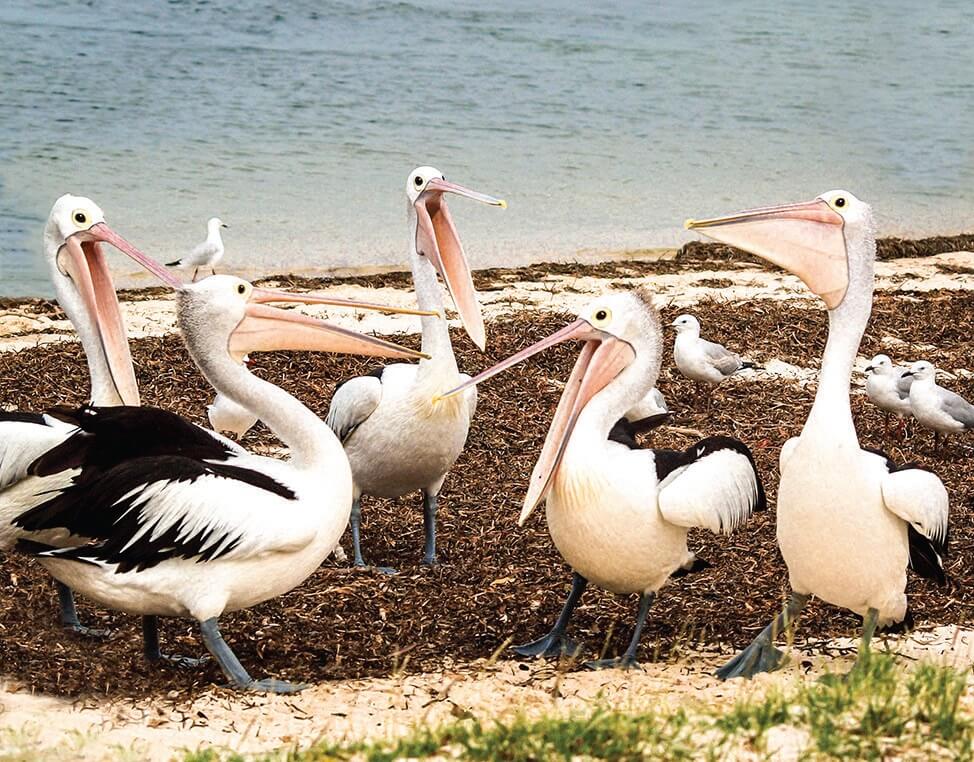
Because of this, pelicans breathe through their mouth. Their calls are a series of grunts and deep croaks. They fly with their heads pulled back, soaring with wings outstretched and using thermals to attain great heights sometimes up to 900 m and often travelling in V-shaped formation. If necessary they can remain soaring for up to 24 hours and can travel several hundred kilometres in one flight.

pelican australian wildlife birds

Posing

Males are larger than females, but their markings are similar. There are seven species of Pelicans in the world but only one in Australia. Australian Pelicans are also found in PNG, Western Indonesia and some of the Pacific Islands. They can be found all over Australia even in the arid regions where there is water. Pelicans begin breeding at 2-3 years and will nest at almost any time of the year depending on weather conditions and rainfall. If there is enough rain to fill the waterholes in the outback, pelicans will fly in their thousands to reach their favoured breeding grounds.

pelican australian wildlife birds

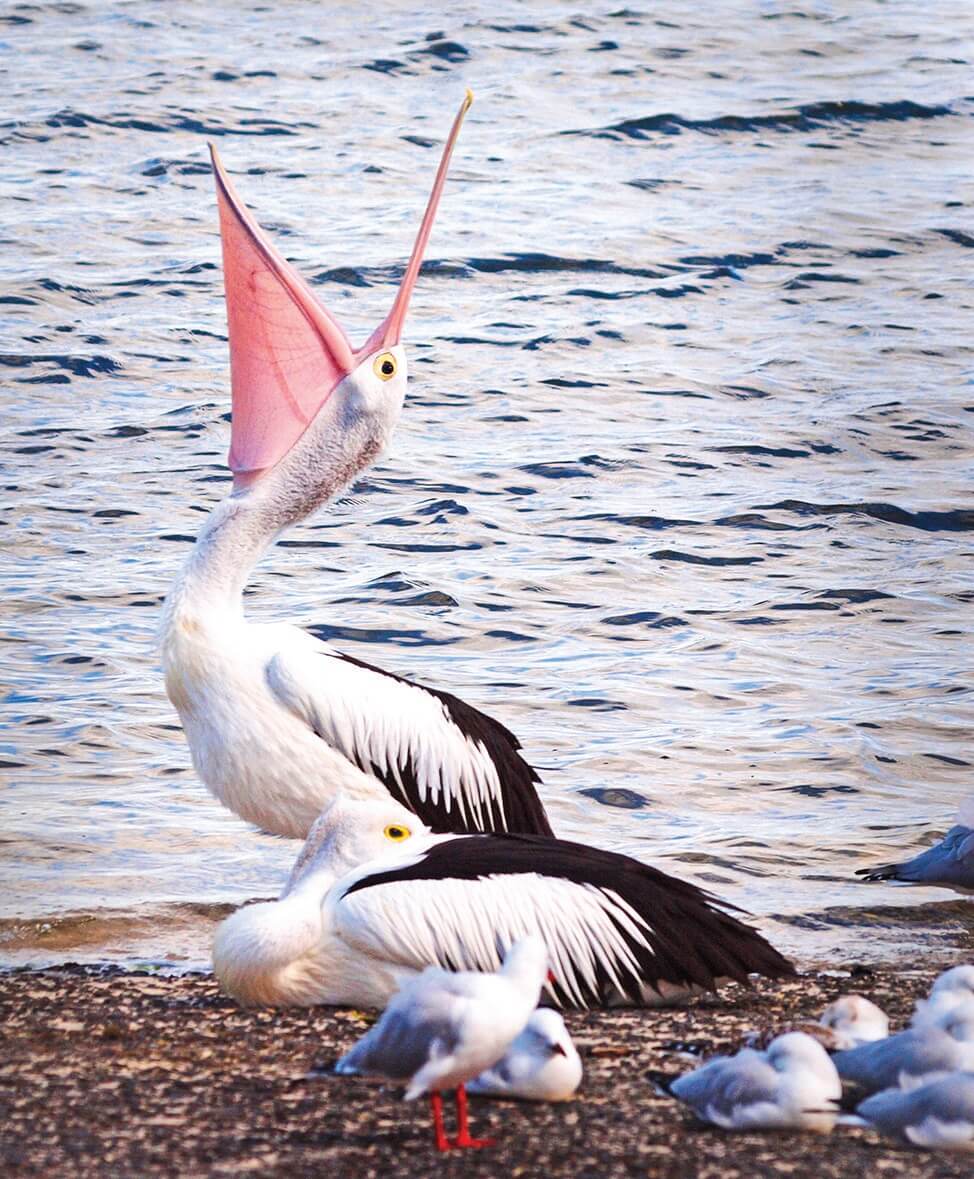
Waiting for a Handout

Lake Eyre when it fills with water is a favoured destination for a multitude of pelicans and other birds. Large colonies form at these sites and the breeding begins. Each year Pelicans choose a new mate for the season. For a short time, parts of their bills turn blue while parts of the gular pouches become red and yellow. Mating rituals take place when the females select their mates for the season. Up to eight posturing and fighting males follow a female until there is only one male left.

pelican australian wildlife birds

Flying in Formation

He is then taken to the nest site and remains for the season. Nests are just scrapes on the ground decorated with whatever is handy at the time. Two to three large white eggs are laid which are incubated by both male and female parents. Unlike other birds, pelicans incubate their eggs on their webbed feet. When hatched the chicks are naked, quite helpless and need to be protected from strong sunlight. The first chick hatched is larger than its siblings.

pelican australian wildlife birds

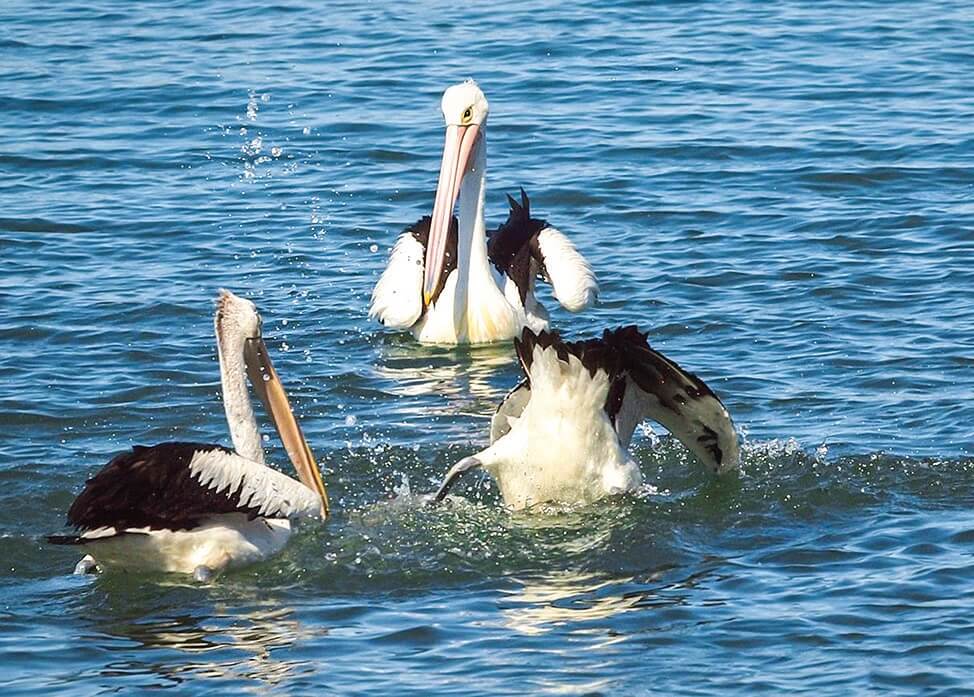
Diving for Squid

It takes most of the food and will sometimes attack and kill the smaller nestlings. Adults are able to tolerate extreme heat as they have a built-in cooling system. When it becomes very hot, they open their bills and vibrate their pouches which have a cooling effect. Eggs and chicks can be lost if parents endure too many disturbances. Chicks fledge at about 12 weeks. When the youngsters leave the nests they form crèches with up to 100 birds for several months. During this time, they learn survival and flying skills. Sometimes when the lakes are flooding in the outback pelicans leave Bribie Island for a short time to breed there while the water remains.

Flocks of Pelicans often follow fishing boats expecting titbits to be thrown overboard. Fishermen on the foreshore are another target for the ever-hungry Pelicans. Their diet consists mostly of fish, but they also eat crustaceans, squid, insects, turtles and sometimes the young of other birds. I have watched them forming circles and herding fish into a group then feasting on a trapped seafood smorgasbord. This is a wonderful sight to see and reminds me of a water ballet in progress.

pelican australian wildlife birds

Ready to snatch Refreshments

Pouches are used like nets to scoop up their prey which is manipulated till the heads are pointing downwards enabling them to be swallowed. When the pouches become filled with water, they press them against their bodies, and this allows the water to flow out. Pelicans can be affected by chemicals in the fish they eat which can cause loss of egg production. Other threats are habitat destruction, feral predators and litter left by fishermen, holidaymakers and residents.

It is very sad to see a pelican tangled in a discarded fishing line or choking on a plastic bag. Even so, the Pelican population is increasing. Life expectancy is between 10 and 25 years.

Other Articles

BLACKNECKED STORK – EPHIPPIORHYNCHUS ASIATICS

Pet care and health Feb 2019

Tags: Veterinarian advice. Pet Care health

Cool Dogs

My readers already know that dogs are cool! But Summer is here, and dogs succumb to heat stroke even more easily than people do. A dog’s cooling system differs from ours. Dogs do not sweat (as they’re covered in fur), but instead, pant, relying on evaporative cooling from their airways. In our slice of paradise, the air is humid and evaporative cooling is not so Pet Care effective (just think about how effective sweating is at keeping you cool on a humid day…), yet it’s all dogs have.

So, we must help them stay cool. They need plenty of cool, fresh water to drink, and you can try adding ice cubes to help keep their body temperature down. Air con and fans are great. Swimming pools work well too, but ensure your dog knows where the steps are. As with children, never leave your dog in the car during Summer, as they can become heat affected extremely quickly in our conditions.

Dr Jackie – Bribie Island Veterinarian

NUTRITION IN DOGS

Part One – One question I often get asked is what I feed my dog. My last dog was a bull mastiff x who lived for 16 years. Giant breeds life expectancy is 8 – 10 years. He died of natural causes and I believe the reason for his healthy longevity was his diet. There are many confusing information about dog nutrition. It is difficult to work out what’s right for us let alone our four-legged friend.

First let’s start; dog obesity rate has doubled over the past 20 years. It is estimated that approximately 41% of all dogs are overweight or obese. This is due to two main factors over eating and insufficient exercise. Signs of obesity:

  • when ribs cannot be felt
  • loss of an obvious waist
  • having to loosen the collar
  • difficulty walking
  • slow movement
  • shortness of breath
  • bad temper
  • sleeping more than usual.

There are health risks such as heart disease, skeletal and breathing problems, skin disease, diabetes and arthritis. According to Hills Science Diet a 28g piece of cheese given to a 10 kg dog is equivalent to humans eating 3.5 hamburgers. Other interesting fact about nutrition and animal behaviour, in the 1930’s Dr Pottenger demonstrated a marked increase in aggression in cats that were fed cooked food and also had a higher level of aggression towards their handlers. The behaviour changed when they were put on a raw diet.

Happy training, Yvonne

Other Articles

Pet care and Pet advice

CALLING FOR CANDIDATES FOR LEADERSHIP TRAINING

0

Tags Rotary Club Queensland. Bribie Island. Charity. Not for Profit

Do you want to uncover your true potential? Bribie Rotary is looking for a young adult aged 18-27 years to attend a training Seminar for Potential leaders. Rotary Youth Leadership Awards (RYLA) is a 7-day residential program held at Luther Heights Coolum between 4-10 May 2019.

The 7 days and nights are packed with activities and guest speakers, as well as social and Rotary functions at night. Each day begins at 0600 and concludes at 2300. Participants must complete the entire program. All costs are covered, including bus transportation to and from Luther Heights.

You do have fun and will make lasting friendships. Previous years participants have come from the business community, the self-employed, educational institutions, government agencies, community associations, Rotaractors and service organisations. You can work in Woolies, Aldi, Australia Post, Target, a Bank, a Real Estate agency on a Building site or the local Hotel or Restaurant – it doesn’t matter.

The key ingredient is that you want to develop yourself and are available from 4-10 May 2019. This may be the chance you have always wanted. Don’t let it pass you by. It costs you nothing but may change your life!

Applications must be in place by 29 March 2019. If you are interested or if you are a Manager who has someone who would benefit from leadership training, please contact our Youth Director, June Sturges on 3410 8817 or email [email protected].

Funny pet and animal photos and images Feb 2019

SHARE YOUR FUNNY PET PICS WITH THE MINI BRIBIE ISLANDER… SEND TO: [email protected]

This months winner! – This is Elroy or (Elroyance Stinkleton), trying to escape the
Neighbours, Ningi

THERAPEUTIC ACTIVITIES FOR CHILDREN WITH MENTAL HEALTH

0

Tags: Children’s mental health. Child health.

“Animals are such agreeable friends—they ask no questions; they pass no criticisms.” – George Eliot

A therapeutic approach is the lens through which counsellors address their clients’ problems. Broadly speaking, the therapeutic approaches of counsellors fall into two categories: behavioural and psychodynamic. Behavioural approaches are usually short-term and address the behaviour and thought patterns. The approach that I utilise is an integrative one, where I tend to blend of complementary theories.

I consider this to be flexible which allows me to tailor my approach to meet the specific needs of the individual. I always work with a client-centred framework. A few years back, I was involved with an adventure camp program for children. We took the children on camps and they were involved in activities like, surfing, flying fox, high ropes and abseiling. The motivation for the children was “Who can do this?” “I can!”. We witnessed amazing transitions with many of the children.

Children's mental health. Child health.When working with Children, therapy should incorporate emphasizing positive development, but still addressing negative issues and symptoms. Therapy sessions can focus on working toward an optimistic future, positive coping methods, and boosting the self-esteem, self-confidence, and other positive states and traits in children.

Counselling with children is best explained as;

  • Talk – Talking is a healthy way to express feelings.
  • Play and draw – Therapists use games that teach things like taking your time on schoolwork or other tasks.
  • Do activities – Therapists might teach lessons about feelings, coping skills, or facing fears.
  • Practice new skills.
  • Solve problems.

Children's mental health. Child health.

Some of the activities that I like to use with younger people are Art Therapy, Play Therapy, Music Therapy, Animal Therapy and other activities that assist in building self-esteem and confidence. These two aspects are always adversely affected in people who experience a mental health issue, child or adult. I recently took a few of my young client’s horse riding with the aim of building upon their confidence and to put in place the coping strategies, which we had been working on during counselling.

Animal therapy is widely recognised as having huge benefits for children emotional, mentally, physically and socially. I recently held a HUGE Garage Sale to raise fund to allow me to undertake more activities with children who are experiencing anxiety and depression. I had some much donated my garage and yard were overflowing. I would like to thank all those amazing people who donated and turned up on the day and bought items and tickets in the raffles.

A huge thank you to Natasha, Gary, Thomas and Rianna Barwick for their help and support, I could not have done it without them. We raised a large amount of money, which will be used to provide therapeutic activities to the young people I work with and who are experiencing a mental health issue. Cheers Veronica

“One man’s trash, can be another man’s treasure” – Unknown

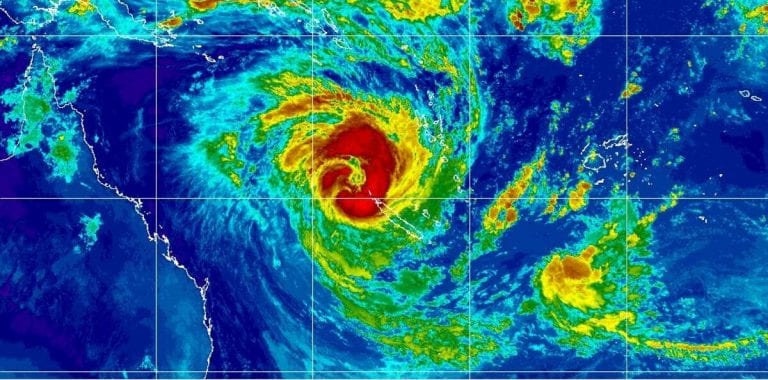
Historical tropical cyclones that have crossed the Queensland coast

0

Tags: Tropical Cyclones. History. Historical. Queensland. Brisbane. What are cyclones? How do cyclones form?

Tropical cyclones are a major threat to the Queensland coastline during the Summer season as well as to the Northern Territory and Western Australia.  These tropical disturbances are caused by deep low-pressure systems that form over the warm waters of the tropics and sometimes, depending on sea surface temperature and other factors can form over subtropical areas as well.

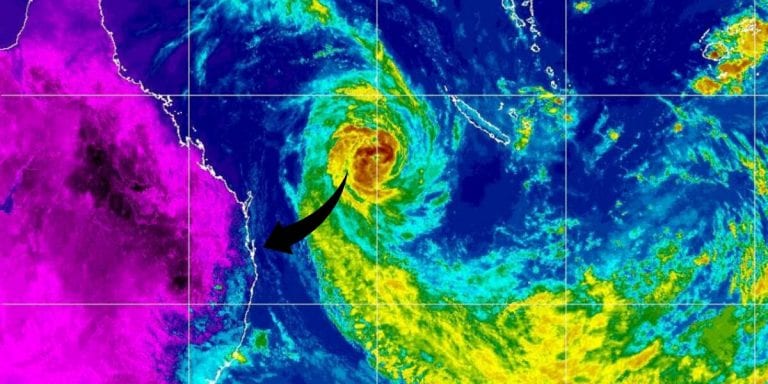
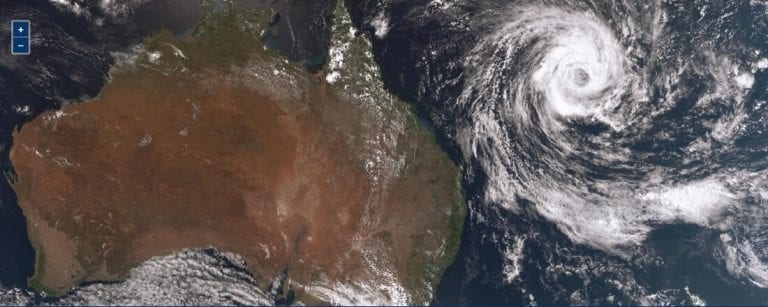
Featured image(above): Cyclone Yasi: February 2-7, 2011

They rotate clockwise in the southern hemisphere, and anti-clockwise in the northern hemisphere and have different names depending on where you are located on earth.  North America refers to these systems as Hurricanes or tropical storms, Australia refers to them as cyclones, and the Asia Pacific area refers to them as Typhoons.

A tropical low can be considered a cyclone if it has sustained winds of 63 km/h or greater and gusts in excess of 90 km/h, have organised convection, have a maximum mean wind speed of 34 knots or greater that extend more than halfway around the center and they persist for more than six hours.

Tropical Cyclones. History. Historical. Queensland. Brisbane. What are cyclones? How do cyclones form?

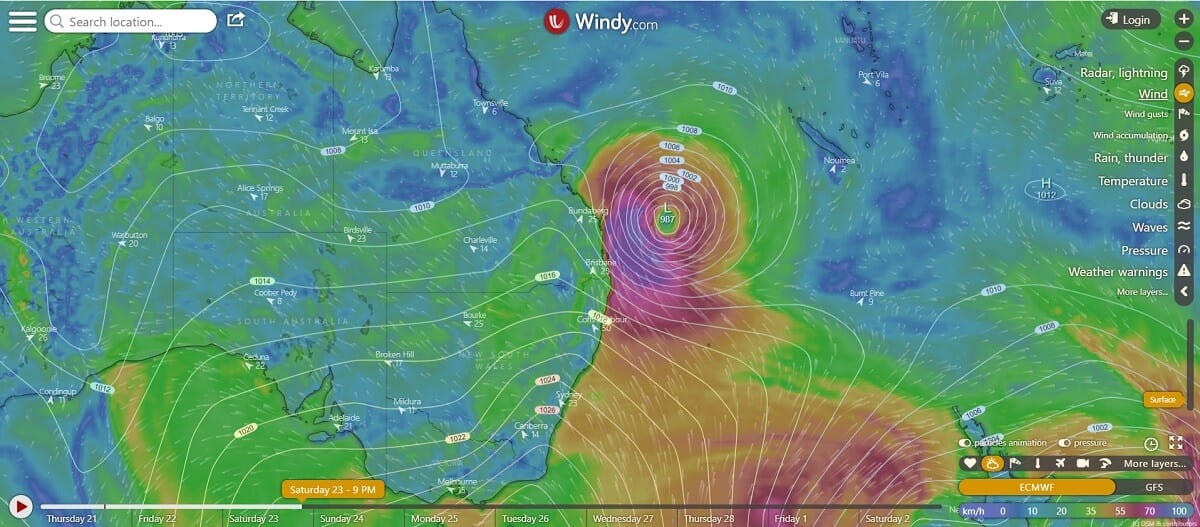
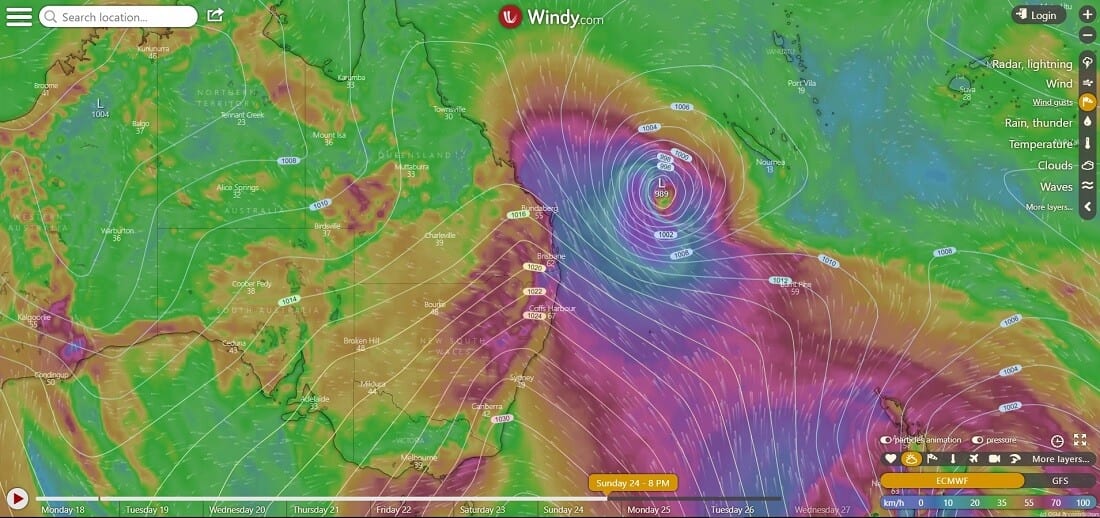
Cyclone Marcia approaches the central Queensland coast 15 February 2015 – 1 March 2015

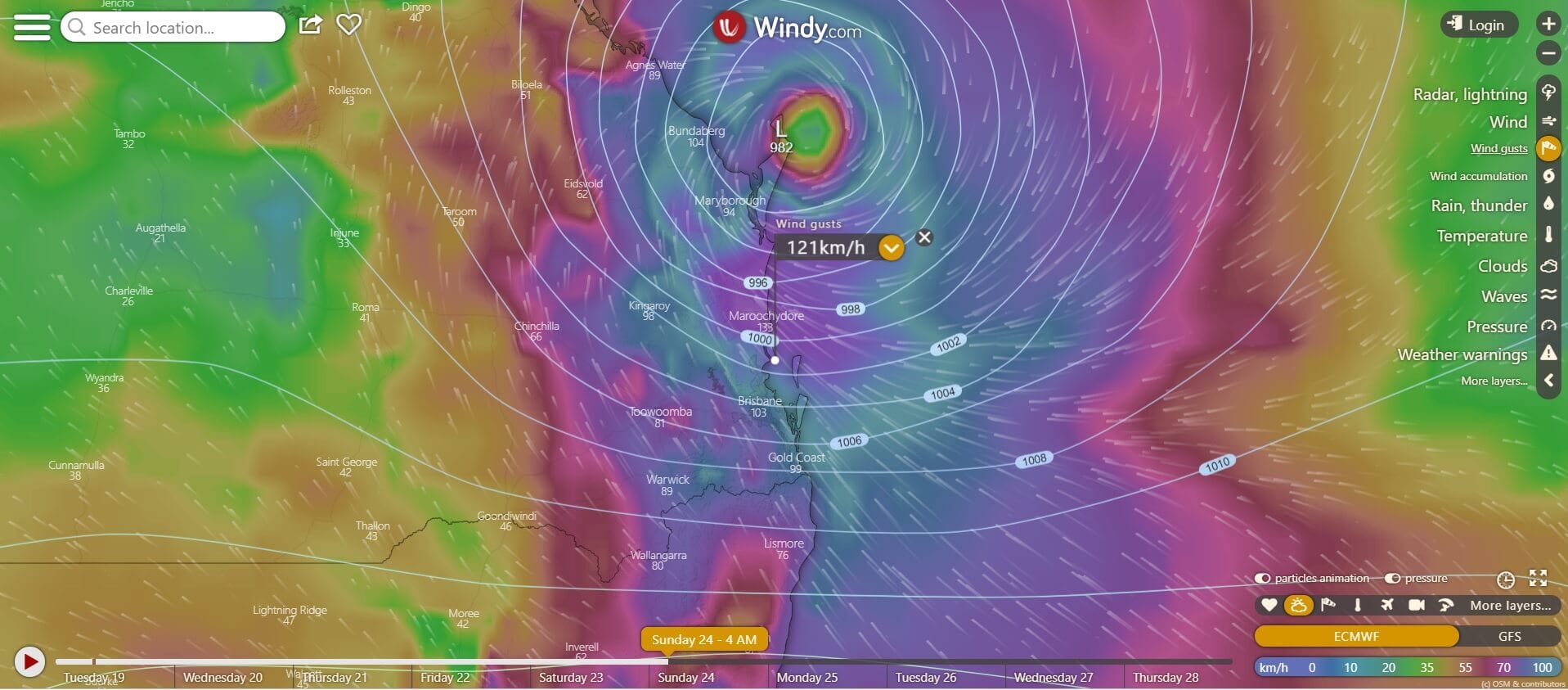
The destructive and damaging winds, as well as the storm surge that are associated with tropical cyclones, is caused by the extreme low pressure inside a cyclones vortex or area.  You could compare cyclones to a dip in the atmosphere of earth and the surrounding oxygen falls into the “dip” and rotates, much like water flowing down a sinkhole.  The lower the pressure or deeper the “dip”, the faster the wind flows.

The storm surge is caused by the low pressure, because there is less downward atmospheric pressure in the centre of a cyclone, the surrounding ocean rises, cause potentially dangerous and erosive storm surges which can cause inundation, flooding, erosion, and loss of life, which has been experienced on a number of occasions throughout Queensland’s history.

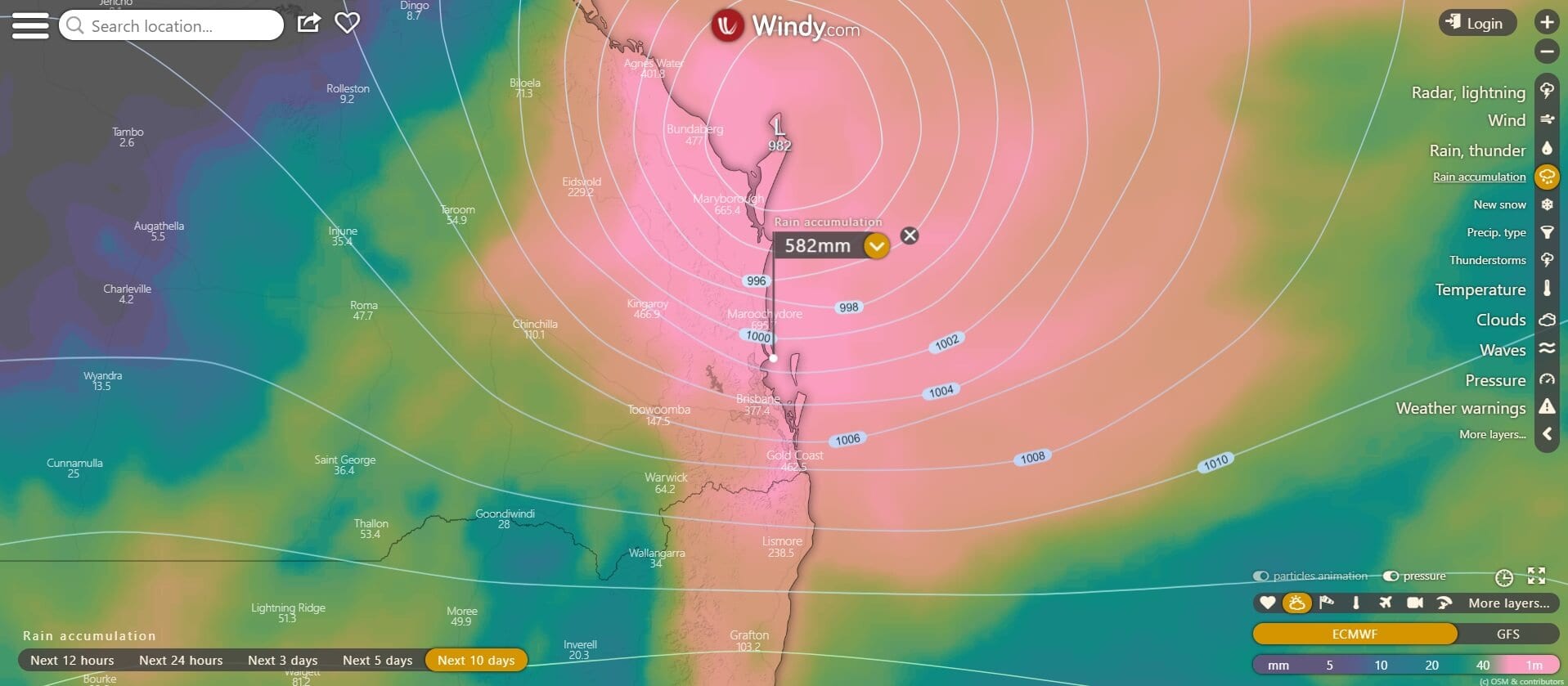
Apart from the effects from tropical cyclones that I have previously mentioned, there is also the potentially catastrophic floods that can occur from these systems.  If the system is fast moving, flooding can be minimal, but if the cyclone is slow moving, it can cause devastating floods, such as the 1974 Brisbane floods caused by the subtropical rain depression that at one stage was a cyclone called Wanda.

Brisbane 1974 floods

Tropical cyclones often come associated with a deep monsoon trough, which is an elongated area of low pressure extending out from the cyclone.  These deep troughs can cause severe flooding, an example of this was seen with the recent Townsville and Northwest Queensland floods, where over 2 and a half meters(2500mm) of rain fell over approximately 10 days in some places.

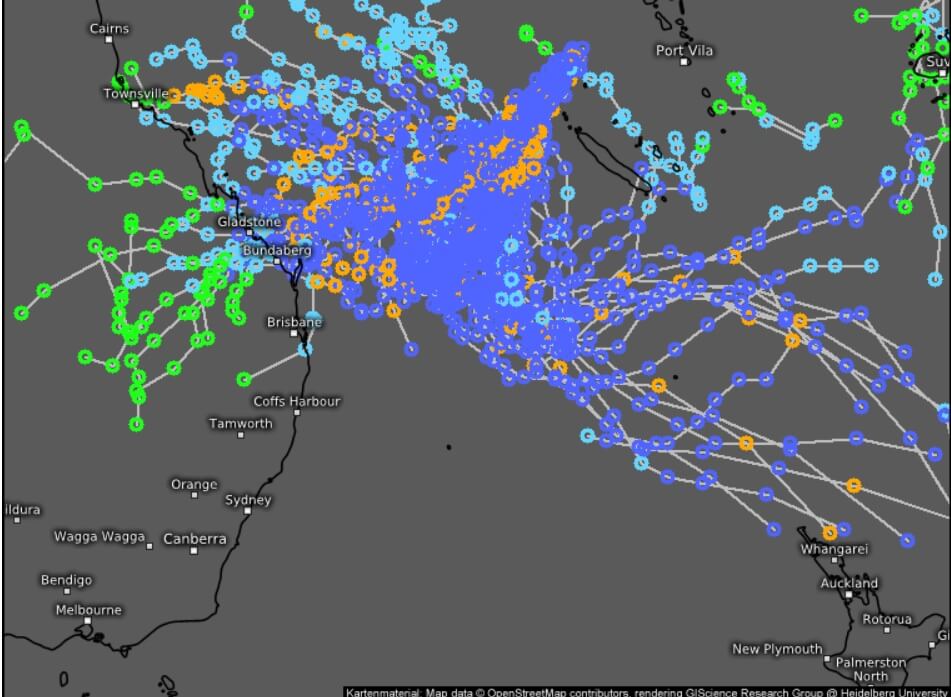
Typically tropical cyclones are less common in the far south of Queensland, due to lower sea surface temperatures, and high-pressure ridges that commonly form, the high-pressure ridges are the opposite to low-pressure troughs and are elongated areas of high pressure extending outward from high-pressure systems.  Most of the time they repel cyclones away from the southern Queensland coast, as low-pressure systems and high-pressure systems cannot interact.

Footage of cyclone Debbie lashing the central Queensland coast 23rd March 2017

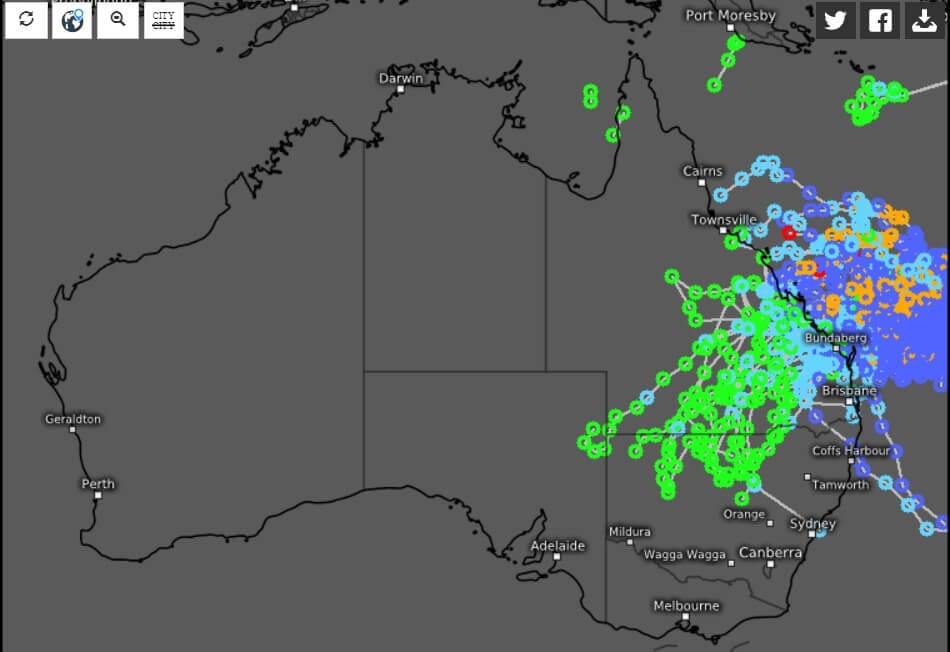
Click here to read about historical tropical cyclones that have crossed the Queensland Coast

A complete list of all tropical cyclones that have crossed Australian coasts

Stay up to date with the latest weather and warnings @ https://www.facebook.com/HigginsStormChasing

Further reading and sources


Gloss Magazine Bribie Islander 4th Edition Feb 15 2019 Issue 81

0

The Bribie Islander Magazine
Get all your community news and information Bribie’s only community gloss magazine NOW EVERY TWO WEEKS! – Articles on boating, camping, fishing, life, drama, travel destinations, sports and what to see and do on Bribie Island. Covering charities, organisations, places, children’s activities, arts and crafts, tourist destinations, heritage parks, technology, science, music, gardening and much more.

Last Issue

Gloss Magazine Bribie Islander 3rd Edition Feb 01 2019 Issue 80

The Bribie Winelander Feb 2019

Recently we had a look at the new varieties that are appearing on the market place but let’s not forget Australia has for a long time been producing outstanding wines from traditional French German and Spanish grape varieties such as Shiraz, Cabernet Sauvignon, Semillon, Riesling and Verdelho plus lesser known varieties such as Grenache and many outstanding fortified styles originally labelled Port, Sherry and Madeira although these terms have changed to accommodate European Rules and regulations.

This time let’s have a look at some of the above and see if we can’t get you to try something you may have not tried for some time or maybe never before. We all know about Shiraz and Cabernet Sauvignon but you may not be familiar with Grenache which until the early 1990s was mainly used in the production of fortified wine but this was all about to change thanks to the success of a wine called Jacobs Creek in The U.K.

In the 1980’s we had created a wine lake so big that wineries were being paid a dollar amount to pull the vines out of the ground, which included many old vines, so when all of a sudden the demand went through the roof and we were caught short and couldn’t fill the orders. In fact, a lot of our premium red wine had been put into the 4-litre casks just to use it up but once the U.K. had taken everything we could produce some wine companies started to import red wine from Chile just to fill the casks!


Wines. Sparkling. White. Red. Shiraz. Queensland. Australian


It was around this period that several vineyards rediscovered Grenache and although more difficult to pick as the grapes tend to grow on bush-like vines rather than normal vines. The grape produces medium to full-bodied red wines that tend to be higher in alcohol and one, in particular, comes to mind and that is The Richard Hamilton “Burton’s Vineyards” Old Bush Vine Grenache which if you can find is an excellent wine.

It is also a good variety to blend and if you see the words GSM on a label it translates to Grenache, Shiraz, Mataro (Mourvedre) a popular blend from The McLaren Vale area of South Australia. Both Semillon and Riesling produce outstanding wines in Australia but the general wine drinking public tend to steer towards Sauvignon Blanc or Chardonnay and miss out on not only some superb wines but also outstanding value for money.

“It’s a smile, it’s a kiss, it’s a sip if wine… it’s summertime!”

Kenny Chesney

Both of these grape varieties produce wines that if cellared correctly will mature over many years and can match food superbly and both wines are normally made without the use of barrels. Semillon was first planted in The Hunter Valley in N.S.W. in 1830 and was labelled under a variety of labels until DNA of the vines proved it was Semillon. It was initially thought to be a clone of Riesling and was named Hunter Valley Riesling, also Shepherds Riesling, Hock, Rhine Gold, White Burgundy and Chablis.

In the early 1980’s it was finally established to be Semillon but in many ways, it is probably closer to Chardonnay than Riesling especially as it ages. Drank young it has a lemon, grassy aroma and well suits most fish and chicken dishes especially served with wedges of lime, but as it ages over five years towards ten years it will develop toasty honeyed aromas and most wines are un-oaked but as they age they give an impression of spending years in barrels. Two of the standout producers of Semillon in The Hunter Valley are McWilliams and Tyrell’s who have championed this grape variety for years.

It is possible to find McWilliams Mount Pleasant Elizabeth Semillon under $20 from time to time with a regular price of $25 and when it ages expect to pay upwards of $60 or more. Tyrell’s Museum Vat 1 2005 at Dan Murphy’s will set you back $150, McWilliams Mt. Pleasant Blue Label $30 and Brokenwood Semillon $20. It also makes a great dessert wine, look for a Botrytis Semillon from De Bortoli that will complete a perfect dinner with a great match to fruit but magnificent with blue cheese.

Australian Riesling suffered a downturn in sales in the mid to late 1980s when 4-litre casks carried the name Riesling but were actually produced from sultanas and were a very poor semi-sweet concoction that bore no similarity to the crisp fresh wines in the bottle. The main growing areas for growing Riesling are The Clare and Eden Valleys of South Australia and The Great Southern Region of Western Australia but as with Chardonnay Riesling can be and is grown in almost any wine growing region in the country.

Written by… Charles Buadelaire, please take this in the right context!

“One should always be drunk. That’s all that matters…..But with what? With wine, with poetry, or with virtue, as you choose. But get drunk”

Wynn’s in The Coonawarra make a very good wine and at around $12 is always good value. I notice Dan Murphy’s claim to stock around 400 plus Rieslings and at one time every vineyard in Australia had plantings. It is very difficult with this number of labels to recommend individual wineries but I sold Claymore from The Clare and their Joshua Tree was a good example of that region but Rieslings from Leasingham, Leo Buring, Henschke, Yalumba, Pikes, Jim Barry, Pewsey Vale can all be found for around $20 and from Western Australia Leeuwin Estate Art Series, and Ferngrove are very well made wines.

When the new vintage of a wine called Rieslingfreak is released, made by John Hughes a friend of mine who attended The Roseworthy Wine College with me, it is worth trying a bottle, his last vintage was declared the best in Australia, I found a bottle in Fortitude Valley and it was excellent If you enjoy a feed of oysters or prawns with a wedge of lemon you couldn’t do any better than an Australian Riesling, Spinnakers Fish and Chip shop has a Yalumba in the fridge and it is great. I think I am pushing my space this time but for something different try a Tullochs Verdelho from The Hunter Valley, crisp and dry and a lovely drop.

Cheers, Philip Arlidge [email protected]

The Long Way Around to Bribie – PAINTED

Tags: Art. Artwork. Artist. Art Gallery. Bribie Island

Most readers know the Bribie Island Community Arts Centre February Artist of the Month from her regular contributions to The Bribie Islander. What few may know is that she is an accomplished artist. And a few may not be aware that Sabine Von Graz has in fact completed her Long Way Round (Australia) to Bribie trip, and now resides with her well-travelled husband, Richard, and daughter, Ginger, on Bribie Island.

Art. Artwork. Artist. Art Gallery. Bribie Island

Sabine Von Graz

Apart from being one of The Arts Centre’s dedicated volunteers, Sabine also has an impressive studio at Unit 1, 13 Industry Drive in Caboolture. Here she may be found printing t-shirts, modelling clay into pots and plates, and producing her magnificent masterpieces among various other creative endeavours. Next time you are over that way, call in. Sabine’s Long Way Round to Bribie Artist of the Month Exhibition focuses upon incidents and events occurring during her trip around our smallest continent, largest island nation. Like journal entries or a pictorial diary, these events are painted on small square canvases in only four colours.

Art. Artwork. Artist. Art Gallery. Bribie Island

Yellow Kangaroo

Each painting depicts the impression that struck the family in a particular location. A little yellow plastic kangaroo found in a second-hand shop was the inspiration for many of her paintings and logos. It became the trip mascot. When I first met Sabina, the name with which she introduces herself, from the clothes she wore and these paintings, it was my thought these four colours were her favourites.

Art. Artwork. Artist. Art Gallery. Bribie Island

Burnett Heads

But after attending the opening of her studio, seeing there the brilliant pinks, yellows, burgundies and virtually all colours, I’m not so sure. It’s a question I’ll be asking her at the Artist of the Month Talk on Friday 8 February to which anyone interested in hearing Sabine talk is invited to come. It starts at 12:30 pm and is followed by morning tea. For catering purposes, it is advisable to ring to book at the phone number below. Sabine comes from famed artist stock in Austria, her mother being Professor Gerlinde Bartelt- Stelzer, easily found by Googling the name.

Art. Artwork. Artist. Art Gallery. Bribie Island

Woodgate

In her mother’s household, Sabine and her brother ‘lived and breathed art’, never, so she told me, having any intention of taking it up herself. Upon arrival in Australia however, Sabine started painting using the pixelated character of modern photographs. In addition, she has a curious way of combining the pixels into several subjects within the same work. The only means of appreciating her style is to see it yourself. She describes her art as ‘beauty with bite, bold images fused by a combination of pop art and photo-realistic images.’ How glad we are that this lady did choose to embark on an art Burnett Heads career, as her skill with a brush is unique.

Few of us artists could sit for the hours required to complete the detail in some of Sabina Von Graz’s paintings. The exhibition may be viewed at the Arts Centre on Sunderland Drive, Banksia Beach throughout February. Any enquiries or bookings for the Artist of the Month morning tea may be made by ringing 07 3408 9288.

EXCITED BY FIRST FISHING TRIP

When Brisbane residents David Bycroft and his wife Wendy were planning to take their grandchildren Oscar (five) and Connor (seven) on their first ever fishing adventure they naturally chose Bribie Island as their destination of choice. David says they all had a very exciting time, hiring a pontoon boat and heading out into the passage to try their luck. “It wasn’t long before Connor caught his first fish.

Featured Image(above): Connor and Oscar proudly admiring their catch

But we don’t know what kind it is,” said David. The Bribie Islander has asked around and to the best of our knowledge, we can inform the Bycrofts that Connor has indeed caught a type of Leatherjacket also known as a Triggerfish. (Readers if you disagree let us know). Grandpop, as David is known by his grandkids also said that young Connor caught a bream and a stingray later in the day.

Grandpop Bycroft unimpressed with the grub he hooked

And if the grandkid’s first fishing adventure couldn’t get any better they also saw a Dugong! While Connor scored the catch of the day the same can’t be said for poor Grandpop who only managed to hook a grub! Better luck next time David. “What a great day we all had and we’ll definitely be returning to Bribie to try our luck again,” said David.