Home Blog Page 135

Australian Remembrance Day – Australian Defence Forces

Tags: Army. Military. Remembrance Day. Navy. Australian Army. Australian Defense Forces. Anzac Day. Anzacs.

WE WILL REMEMBER THEM – Australian Remembrance day.

On February 17th in 1967, three hundred members of 6 Battalion, Royal Australian Regiment engaged in a conflict with 250 Viet Cong in Phuoc Tuy Province, Vietnam, resulting in a total of eight Australian soldiers being killed and a further twenty-seven wounded.

This conflict was named Operation Bribie and has previously been described as a battle which demonstrated the resolve and professionalism of ordinary Australian soldiers, both conscripts, and regulars, who had to overcome extreme hardship.

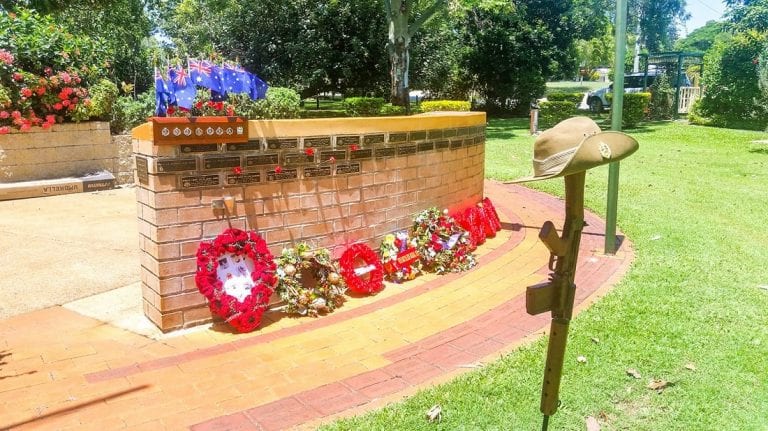
Each year on the anniversary of that fiercely fought battle, both veterans and current serving soldiers gather to remember and once again, on the 51st anniversary of Operation Bribie, the serene surroundings of the Vietnam Veterans Memorial Park on Toorbul Street in Bongaree were the venue for both the Memorial Service and a catch up by old mates.

army veterans australia

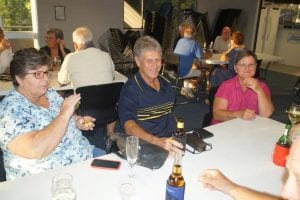
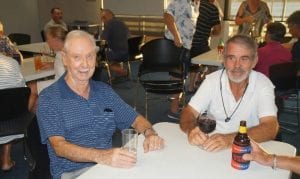
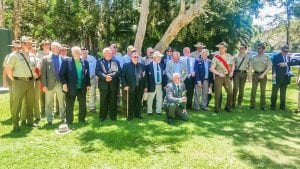
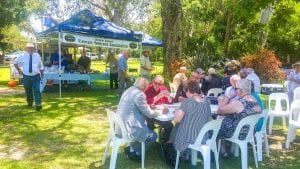
Veterans of Operation Bribie mingled with current serving soldiers from 6 RAR

Attended by veterans of the battle, other veterans, and current serving soldiers from 6 RAR as well as members of the public, the service was commenced at 11 am by Master of Ceremonies Paul Boyns calling for the Catafalque Party (provided by the current members of 6 RAR) to be mounted.

Phil Buttigeig, a Corporal from 4 Platoon in 1967, gave the Operation Bribie address and then Chaplain Rev. Colin Baxter said a prayer for those who suffered. The Honour Roll was then read with veterans placing a symbolic miniature Australian flag on the Memorial Wall for each of those who gave their lives during the battle.

After the reading of the honours and awards, wreaths were laid at the Memorial SWall by representatives from the various organisations including the 6 RAR Association, Bravo Company, RSL Sub- Branch and the Next of Kin.

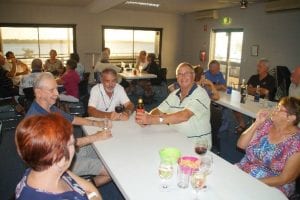
Wreaths were also laid by Division One Councillor Brooke Savige and the Member for Pumicestone, Simone Wilson. The ceremony then came to a close after a moving rendition of the Last Post by buglerPaul Jones, two minutes silence, the dismounting of the Catafalque Party and The Ode. The formalities over, those present enjoyed a BBQ lunch expertly cooked by members of the Bribie Island Vietnam Veterans Association and everyone took time to catch up with those who they had not seen for some time.

anzacs

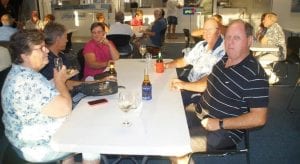
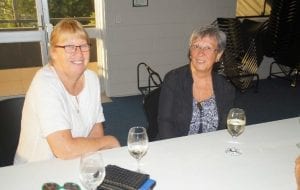
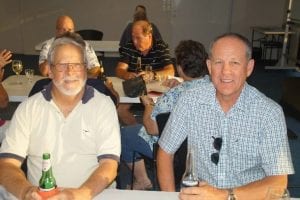
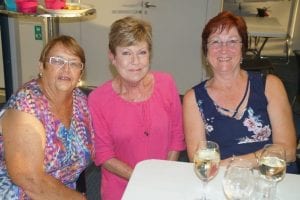
Enjoying a BBQ lunch cooked by local Vietnam Veterans Association members

As an indication of the importance of the anniversary, there were some there who had traveled from as far away as Western Australia.

As long as ceremonies such as the Operation Bribie Memorial are conducted each year, those who served and paid the ultimate price in defence of their country will never be forgotten.

LEST WE FORGET

Other Articles

https://thebribieislander.com.au/rsl-womens-auxiliary/

The Australian magpie – Australian Wildlife

0

Tags: Magpie. Wildlife. Birds. Australian wildlife.

AUSTRALIAN BIRD OF THE YEAR AUSTRALIAN MAGPIE – GYMNORHINA

Marj Webber, Bribie island photography club
Marj Webber

Guardian Australia bird of the year poll in 2017 came up with a pretty surprising result. The Australian Magpie was the winner. Not far behind was the Australian White Ibis pipping the Laughing Kookaburra which took out third place.

People who have experienced the endearing side of magpies may be delighted with the finding while those who have been attacked and injured by swooping male magpies may disagree with the result.

It has been established that only a very small percentage – less than 5% – of male magpies actually attack. While nesting and when the babies are still in the nest seems to be the times when agro magpies choose to dive bomb selected targets. Some people can walk or ride through the magpie war zone with no fear of being attacked while others will be targeted every time. Some magpies only attack people on bikes while others choose victims such as children on school grounds or hikers in bushlands.

Magpies are territorial and usually occupy a reasonably small area. Lots of their territories are entirely within urban surrounds and some studies have established that they can recognize people. Some say that magpies can recognize every person in their territory. They can become very tame and make lifelong friendships with people who feed them. Many, many households have daily visits from their resident magpies singing their melodious chorus as a reminder that they are there for a treat.

It is best to feed birds food that they will normally eat. Magpies eat grubs and insects and just about anything else but not all foods are good for them. Bread is a big no, no and should not be fed to any bird. After nesting these magpies will often bring their young to be introduced to their human friends.

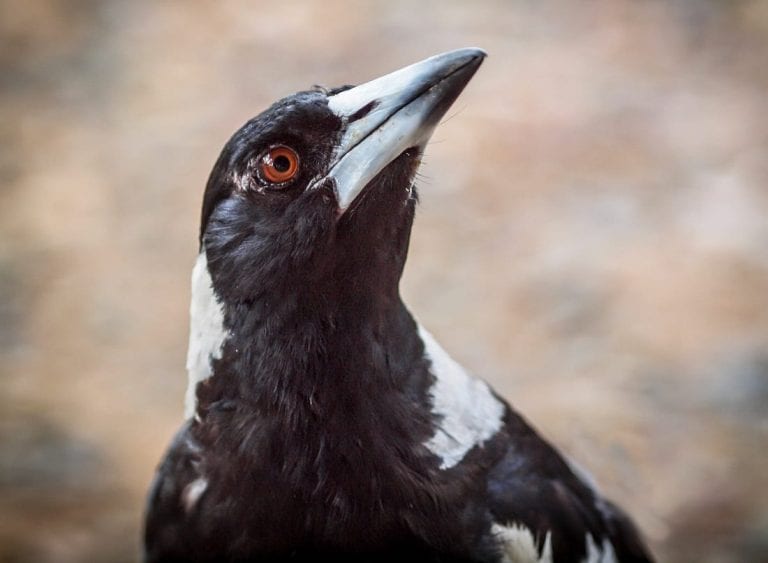
australian magpie

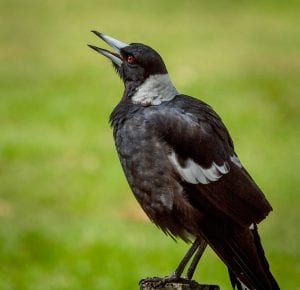
Magpie Singing

It is supposed that if the magpies in your area know you to be friendly you will not be bothered during the nesting season which is from August to November. Some common methods of trying to avoid an attack are to paint a pair of eyes on the back of your helmet or hat. The theory is that the magpie won’t attack if it thinks it is being watched. This, however, doesn’t seem to work.

Spikes on the helmet when riding or carrying an umbrella while walking are more effective but not foolproof. The best preventative is to try to avoid the area if possible during nesting. Magpies will nearly always attack the head from behind and occasionally from the side. All Australian Magpies are black and white with the markings varying over the 8 subspecies spread across Australia.

They are 37-43 cm in length and very common breeding residents on Bribie Island living up to 20 years. Their nests high up in trees are made of sticks with a bowl like centre which is lined with grass and hair. Most magpies mate for life while some prefer to change their partners occasionally. If the male is relocated or dies during nesting the female will almost immediately take on another male who strangely enough will help defend and nurture the adopted chicks. Usually, 3-4 eggs are laid and are incubated for 20 days.

When the chicks hatch they are without feathers and totally blind. After a week feathers begin to grow and after a month they are ready to fly. The survival rate is not high for the young chicks with only about 14% surviving. Snakes, monitors, raptors, feral and domesticated cats take their toll.

australian wildlife

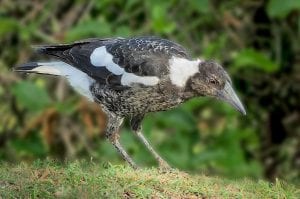
Baby Magpie

Magpies have adapted very well to human habitat. In some areas, their numbers are increasing while in others they are declining. They are excellent mimics and imitate calls of other birds and sounds they hear such as car horns and music etc. Their caroling songs have amazing, complex flexibility.
They have very good hearing and walk along the ground often with their head turned to one side listening for movement in the grass or grubs under the ground. Love them or hate them Magpies are truly ingrained in the Australian scene and their beautiful melodious caroling is a familiar sound to anyone who cares to listen.

Other Articles

https://thebribieislander.com.au/paperbark/

Bribie Island History

0

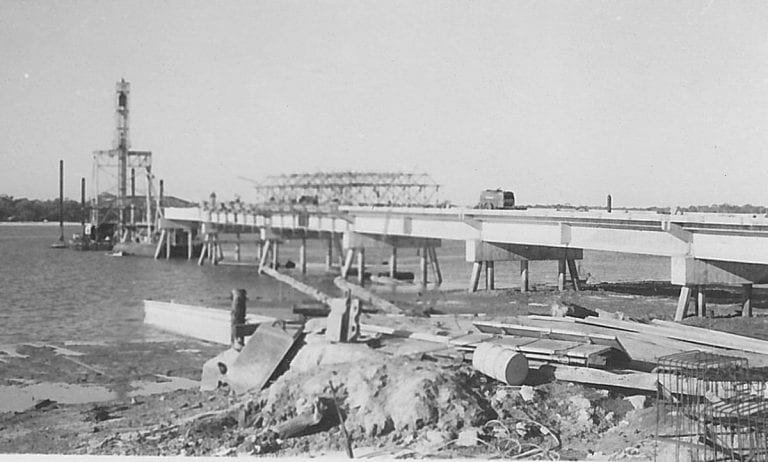
Bribie Island Bridge under construction(above)

Tags: Bribie Island. History. Queensland History. Nostalgia. Historical Society
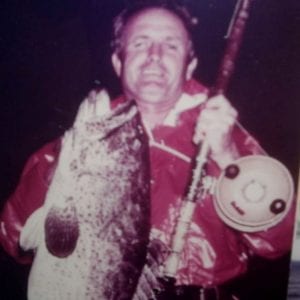
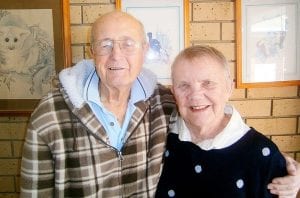
The following item of “Nostalgia” was first written by Ted Clayton back in 2004 and is one of several documents he has shared with me recording his memories of Bribie Island. Ted has over 80 wonderful and challenging years of memories to look back on and has lived on the island since he married in 1954.

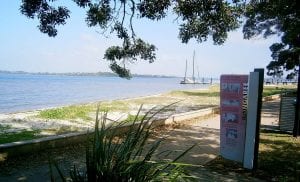
Ted and Pat Clayton are one of the “50+ years on Bribie” pioneers that I had commemorated on a plaque in Brennan Park. Ted’s parents Ernie and Marion met on Bribie Island in the1920’s when they had rental properties and lived most of their time here until 1984.

bribie island historyhistory

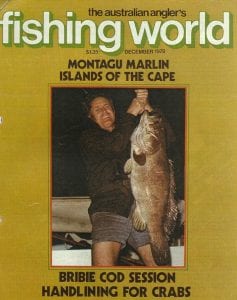
50+ residents plaque(left) and Ted Clayton Fishing World cocer 1979(right).

Ted grew up in Brisbane but spent much of his early childhood on family holidays on Bribie, attending the Primary School for periods during the 1940’s. In 1954 Ted married Patricia and they came to live on Bribie in a house Ted built himself at No.11 South Esplanade.

As a carpenter, Ted did contract building work and together they ran a bait and tackle store. Their family of three daughters and a son grew up on the island. During the construction of the Bribie Island Bridge in the early 1960’s Ted was the General Foreman.

Ted Clayton was also one of the islands most renowned fishermen and from 1970 wrote regular articles about fishing, and became a regular contributor and field editor for “Fishing World” for over 20 years.

Ted’s articles about fishing around Bribie Island created nation-wide interest. There is not a square inch of Bribie Island that Ted has not explored in his 80 years roaming the island. In 1990 Ted and Pat moved from South Esplanade Bongaree, to live a quieter life at Whitepatch.

The following document is one of several that Ted has written to document and share some of his memories of Bribie Island, and I hope to bring you more of his great memories in the months ahead.

NOSTALGIC REFLECTIONS OF BRIBIE 50 YEARS AGO

BY TED CLAYTON

Fifty years ago when Pat and I were married we settled permanently on Bribie. The Place was paradise – there is no other description for it. Making a living was a starvation pastime but that was the only drawback. In my Batchelor days, I worked in the scrub in North Queensland. My parents had more use for my spare cash than I did and they repaid the favour with an allotment in South Esplanade. To make it vacant I had to move a small house that was on it to the back of the allotment to the south. My parents owned that block. It already had one house on the front.

It was my first house move and I undertook it with more guts than brains. Looking back I wonder at my parent’s feelings. It was their house and they had a lot at stake. You are a bit thoughtless when you are young. My partner and I moved a couple of big houses from block to block with the Council tree puller. A bit of sherbet could get you that. There was no dirt for filling on the Island but sometimes a truck would conveniently break down outside the job.

history australia

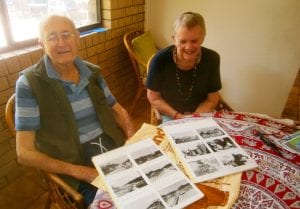
Ted & Pat Clayton Show photos Jan 2018

All perfectly good-natured. Life was a bit simpler then. The process with the houses was to jack them up – put longitudinal timbers on the stumps then place some more crosswise. The faces of both of these where they met were liberally rubbed with laundry soap (‘Velvet’). The tree puller was attached to the house and once the thing moved the timbers glazed and went quite well. There was a bit more to it than that of course. One had one-metre stumps that were rotten and as soon as we started pulling half of them snapped and we had to get under it to salvage things.

I was very fit – I built our house in my spare time in twelve months. We had no floor coverings or curtains, we bathed in a basin. The Rentons were next door and both houses survived on 1,000-gallon tanks. The Renton’s system, in the kitchen sink, was to wash themselves, wash the kids, wash the dishes then do the laundry. I made our furniture at night at a workbench in the main room.

The Council would have a fit these days but no one thought it odd at the time. The toilet was a thunderbox out the back. Pat accepted it all in good spirit. The best advantage was the position. In front, we had a pristine beach where one could swim and sunbake. Our children grew up with that. You could not put a price on it. Going fishing was as easy as crossing the road and stepping into a dinghy.

history south east queensland

Ted Clayton + big fish

The roads on the Island were simply wheel tracks in the sand. That was South Esplanade – two-wheel tracks. There was not a shovelful of road gravel anywhere. Early on we had a special Island Registration fee for our vehicles. In theory, they couldn’t get onto the mainland. Mostly we bought old ‘bombs’ that couldn’t run on main roads. One, I forget the make, needed an eighteen-inch piece of flooring jammed between the gear lever and the dash panel to keep it in top gear.

It had no brakes at all. You turned off the ignition coming into a corner and turned it on again as you came out. I had one vehicle, a Dodge Six, that had as much guts as any four-wheel drive that I have ever driven. Its failing was the steering box. It took about six turns of the wheel to have any effect.

On a bush track, you had a very active time. I used to drive it through the scrub to Dux Creek chasing mud crabs. That area is where Bellara now stands but in those days it was a very pretty marshy place with a lovely freshwater creek running through it. The old Dodge would chug through across a ‘corduroy’ of logs and up a greasy slope on the other side as easy as you like. One of my most respectable was a Chev, 1934 I think, that I bought in Brisbane for the equivalent of fifty dollars.

It was fully registered, I even took it on the mainland once. Today’s car buffs would cry. We did some shocking things to some lovely old cars but they were cheap and all that we could afford. I once went to Brisbane car shopping with my building partner. He finally found one out near Mt. Gravatt. It was a Rugby in immaculate showroom condition – hood, upholstery, the lot. He got it for the usual fifty bucks. I drove it back to Bribie. The barge was running by then.

We took a hacksaw and cut it off behind the front seat down to the chassis. Everything but the front seat was thrown into the scrub. He fixed some rough hardwood on the chassis and called it a utility. It lasted three years. One of the jobs that I took on for a while was a while was driving an eight-ton Bedford truck for the Rentons. Driving to the Darra Cement Works for cement was one task.

A bit hairy because at first, I had no idea how to get there. Cement had the advantage of being warm. If I missed the last barge I would crawl under the tarp and go to sleep. I have told you that gravel for building was worth a fortune on the Island in the early days. I later did trips to S&S Gravel at the Pine River for gravel. What one was allowed to put on a truck was foreign to us all. ‘As much as it could carry’. It certainly never occurred to me that anyone would give you more gravel than you paid for.

I paid at the office for the load and they directed me to an excavator that would load it. I stood back and watched. After a while, the operator looked at me and raised his hands and his eyebrows. Apparently, it was up to me to say when. I got to the gate and the mob in the office had a talk. The portable scales were working somewhere so they told me to take a dirt back road to avoid them. Things went OK until I reached a very steep hill and didn’t have enough power to get over it.

All that I could see half a kilometre back down the track was a very rickety and narrow bridge. Fortunately, I had Pop with me. I stood on the brakes, pulled on the handbrake, turned the motor off in gear and got Pop to put some big rocks under the wheel. Then I got into it with a shovel and put a pile of it into the gutter. You live and learn. Another choice run was to Attewell’s sawmill at Caboolture for timber.

history queensland

Ted & Pat Clayton July 2017

Again you simply loaded all that you could get on. The long stuff piled up on either side of the cabin until you needed to be a snake to get into the seat. I had to back it down onto the barge and at low tide and that was a spooky business. Another job that I took on for money was an eviction out at Woorim. The tenant wouldn’t get out. It required someone to stay full time on the front verandah for three days. I knew the bloke vaguely and he took it quite well. The inside of the place was a complete pigsty.

I put in a price and got the job of erecting steel towers along the Ocean Beach for the Coordinator Generals Department, and I also renovated one of the old navigation lights at the top end of the Island. I put the lookout cabin on top of A.P.M’s. (Australian Paper Mill) one-hundred-foot fire tower. Most of it got put together on the ground and was lifted by a crane but I did the finishing touches hanging on like a fly. Anything for a quid.

Ted Clayton

Other Articles

https://thebribieislander.com.au/history-bribie-island-fascinating-history-historical-society/

https://thebribieislander.com.au/the-history-of-time-science-and-history/

Museum and art gallery – Queensland

Tags: Art gallery. Artist. Art. Museum Queensland.

IT’S NOT CHILD’S PLAY

Leonie Meyers won the People’s Choice awards in the 2017 Mathew Flinders Art Prize with
this image of her niece sitting on a mangrove

In keeping with a reputation for featuring some of the most outstanding works by local artists, the Mathew Flinders Art Gallery in the Bribie Island Community Arts Centre will be exhibiting a display by renowned coloured pencil artist and Bribie Island Seaside Museum Venue Manager, Leonie Meyers and her students from March 5th through until March 18th.

Leonie is an artist who has a wonderful understanding of the correct combination of colours and dimensions and her entry in the 2017 Mathew Flinders Art Prize was an image of her niece sitting on a mangrove branch and won the People’s choice award. This was a sign that this medium is finally being accepted as art and Leonie says that anyone who thinks that coloured pencil work is child’s play should think again.

‘This form of art calls for exacting patience in order to bring all the coloured pencil strokes together,’ Leonie said.

This exhibition is one that art enthusiasts should not miss out on, especially considering that it is a chance to view a complete collection of this form of art.

The Bribie Island Community Arts Centre is on Sunderland Drive at Banksia Beach and is open each day except Mondays from 10 am. For more information, you can call the centre on 3408 9588.

Other Articles

https://thebribieislander.com.au/mini-train-rides-kids-amusement-rides/

https://thebribieislander.com.au/the-sensory-movie-day-group-aspergers-autism/

https://thebribieislander.com.au/love-for-bribie-tourist-destination/

The history of time – Science and History

Tags: Time, History. History of time. Life.

IT’S ABOUT TIME

For most of us, being able to divide each day into hours, minutes and seconds is just taken for granted and to a certain extent, it governs how we carry out our daily activities but I wonder, does anyone consider just how different the world would be if there were no accepted way of measuring time.

We could not accurately arrange to meet up with others at a certain part of the day, it would be almost impossible to use public transport without knowing when it would be at a certain place, athletes would never know their personal best and we would never know just how long we have worked each day.

Long before the invention of any device that was able to separate the parts of each day, in the Paleolithic era as long as six thousand years ago, the moon was used as a way of determining time. Lunar calendars were among the first to be used and these would have either twelve or thirteen months.

In places such as Mesoamerica, there were other early forms of calendars created by civilisations like the Mayans and these were religiously and astronomically based on eighteen months in each year and twenty days in a month. Of course, as the years moved on, time measuring devices were created and the current saxageism system of measuring time actually dates back to the Sumerians around two thousand years ago.

There were a number of early devices that relied on tracking the shadow from the sun and, whilst they were reasonably accurate in principle, they were useless at night or if the sky was covered with cloud.

time candle clock

A wooden hourglass(left) and a candle clock(right)

These were used by widely by the Egyptians and, as well as the sundial, they also used large obelisks to track the movement of the sun. Other ancient timekeeping devices included the candle clock which was used in China, Japan, England and Mesopotamia and also the time stick which was widely used in India and Tibet.

Perhaps the two most accurate instruments that were used for early time measurement are the water clock and the hourglass. Found to be ideal for use in navigation, the hourglass became relied upon by Ferdinand Magellan when he circumnavigated the globe in 1522. Eighteen hourglasses were installed on each of the ships in his fleet.

The water clock was widely used and an early example of one was found in the tomb of Egyptian Pharaoh Amenhotep who died in 1504 BC. The ancient Greeks and residents of south-eastern Mesopotamia regarded time keeping as an essential part of their astrological observations so used and made improvements on the water clock up until the middle ages. As a matter of fact, the first alarm clock was made from a water clock that was designed to set off a whistle when the water reached a certain level.

The first mechanical clock was invented in the eleventh century by Chinese inventors and engineers. As methods of accurate timekeeping were continually improved by inventors such as Galileo Galilei and Christiaan Huygens, the pendulum clock and the minute hand made measuring the most accurate that had ever been experienced to date. In fact, the pendulum clock remained the most accurate device until the 1930’s when quartz oscillators were invented followed by the atomic clock.

Atomic clocks are far more accurate than any previous timekeeping devices and are used to calibrate other clocks as well as calculating the International Atomic Time. This is a standardised civil system on which Co-ordinated Universal Time is based. Atomic clocks use the frequency of electronic transitions in certain atoms to measure the second. Since 1967, the International System of Measurement bases it’s unit of time, the second, on the properties of cesium atoms. In philosophical writings, the atom was a unit of time referred to as the smallest possible division of time.

To delve any further into the scientific calculations used to define the second is far too unsuitable for what I have written as an article providing basic information. Technology now allows the Global Positioning System in coordination with the Network Time Protocol to synchronise time systems throughout the world.

It is through these systems that our computers, tablets, and phones are programmed to display the correct time for our region. Speaking of the correct time, I am reminded of the joke about the city reared nephew of a farmer who lived just outside a country town. During a visit to his uncle, the city guy went to have a look at some new cows that his uncle had bought and was very proud of.

While they were inspecting the cows and standing beside a fine specimen, the nephew said, “Uncle, I don’t have my Atomic clocks use the frequency of electronic transitions in certain atoms to measure the second. Since 1967, the International System of Measurement bases it’s unit of time, the second, on the properties of cesium atoms. In philosophical writings, the atom was a unit of time referred to as the smallest possible division of time. To delve any further into the scientific calculations used to define the second is far too unsuitable for what I have written as an article providing basic information.

technology

A classic timepiece(left) and a water clock from the third century(right)

Technology now allows the Global Positioning System in coordination with the Network Time Protocol to synchronise time systems throughout the world. It is through these systems that our computers, tablets, and phones are programmed to display the correct time for our region. Speaking of the correct time, I am reminded of the joke about the city reared nephew of a farmer who lived just outside a country town. During a visit to his uncle, the city guy went to have a look at some new cows that his uncle had bought and was very proud of. While they were inspecting the cows and standing beside a fine specimen, the nephew said, “Uncle, I don’t have my watch on, do you know what time it is now.” The old farmer bent down and lifted aside the cow’s udder and then, as he straightened back up he told his nephew the time was 3.45 in the afternoon. The city slicker looked at his uncle with an amazed look on his face and said, “You farmers are absolutely amazing, I have just noticed that you don’t have a watch either but you were able to tell the time by moving aside the cow’s udder. Is it something to do with the sun?” The farmer gave a laugh and then replied, “Not at all, from where we are, if you look under the cow at the right angle, you can just see the town hall clock.”

And that, readers, is how they do it in the country. Anyway I have to go now because I’m out of time!

Other Articles

https://thebribieislander.com.au/technology-and-how-it-affects-our-life/

https://thebribieislander.com.au/technology-mobile-phones-health/

Financial advice and Mortgages

0

Tags: Money. Finance. Mortgage stress. Financial advice. Loans.

MONEY TALK WITH PETER DALLIMORE

Peter Dallimore is a volunteer Financial Counsellor at the Bribie Island Neighbourhood Centre

Estimates from a number reputable sources indicate that in excess of 900,000 households nationally are experiencing mortgage stress which is where more than 30% of household income is required to cover loan repayments.

Further a recent University of Canberra study found that a 2.5 percentage point increase in interest rates above current historically low levels would lift repayments for the most leveraged households to in excess of 50% of disposable income which is not sustainable. Low-interest rates and aggressive marketing by banks and other lending institutions have encouraged borrowers to overextend themselves and not think about how they will keep up the repayments if interest rates increase or some other circumstances arise such as illness or loss of a job.

Interest only loans are another cause for concern – a “ticking time bomb” as recently described by global investment bank UBS. The report coincided with the bank regulator APRA reporting that 35% of new loans taken out in 2017 were interest only. The UBS research found that some 30% of borrowers did not realise that they had taken out an interest-only loan or that repayments may jump between 30% and 60% at the end of the interest-only period.

If you have an interest-only loan check when the loan repayments will revert to principle and interest and start to make provisions for the higher repayments. If you are struggling to keep up your mortgage repayments the sooner you take action the more options you will have to get on your finances back on track. Don’t be embarrassed about having to explain your situation to your lender. Getting into financial difficulty is something that can happen to anyone.

If your problem is short term your lender may allow you to postpone payments for an agreed period. The missed payments will have to be made up at some time in the future. You may also be able to make a case for accessing your superannuation on compassionate grounds and draw up to 3 months of repayments. If your problem is a longer-term one your lender may agree to you extending your loan period and reducing your monthly repayment accordingly.

Financial advice

If your circumstances have changed significantly through such things as the loss of a job or a relationship breakdown and are unlikely to improve in the foreseeable future then more drastic action such as the sale of your property may be required. Here again, early action may allow you to keep control of the sale process. Delaying may see your lender foreclosing on you and selling your property at auction.

This may result in a substantially lower price than you could have obtained through an orderly sale. Bear in mind that if the proceeds from the sale are not sufficient to cover your debt, you will have to make up the shortfall. This is a double whammy. No house and a debt to repay.

Also bear in mind that if the property is jointly owned and mortgaged, both parties are responsible for 100% of the debt. If you don’t currently have a mortgage but are contemplating getting a home loan, only borrow what you can comfortably repay on a single income and avoid interest-only loans. Lenders will probably offer you a loan based on two incomes.

You should think of how you will manage if one income is lost. If you are a two-income family use some of the second income to pay down more of the loan. If the second income is lost you can revert to your agreed repayments. A smaller loan may mean that you have to accept a lesser property than you would like but you should be able to retain it when things go wrong whereas the more expensive property may be lost.

Also plan for the worst and have income protection, TPD and life insurance there for you and your dependents to fall back on.

For more information and assistance check out moneysmart.gov.au or the National Debt Helpline http://www.ndh.org.au/ Phone 1800 007 007 Peter Dallimore is a volunteer Financial Counsellor at the Bribie Island Neighbourhood Centre.

He can be contacted via email at [email protected] or you can make an appointment to see him by calling 3408 8440.

The Financial Counselling service is free.

Other Articles

https://thebribieislander.com.au/history-bribie-island-fascinating-history-historical-society/

https://thebribieislander.com.au/love-for-bribie-tourist-destination/

Music Review for Keith Urban

Tags: Music review. Keith Urban. Music. County and Western Music

Music Review for Keith Urban

No, Keith Urban’s latest hit single, “Parallel Line”, is not an ode to mathematical concepts, but rather in regard to two hearts coming together as a result of vulnerability. The beauty of this song is its power in simplicity whereby besides the gentle fingerpicking of guitar contributing as the main melodic instrument, there is only bass drum, guitar slapping and clapping as a beat, a singing electric guitar the arises sparingly and some sweet harmonies that flow in the background.

Another appealing aspect of this track is it under-emphasis on instrumentals and overemphasis on Urban’s masculine country-pop voice (which reaches falsettos on point). This amplifies (excuse the pun) the lyrical content over the music to drive home the romantic serenade-type theme of the song.

The overall feel is blue-eyed soul and its sway is not too dissimilar to that of Sheeran’s, “Thinking Out Loud”. Combine all this together in one pot and you get something that Aussie and beyond listeners are feeling; doing Australia proud Urban, keep it up!

Other Articles

https://thebribieislander.com.au/local-music-band-event/

The Bribie Islander Funny Pet Photos

Tags: Funny pet pics. Cats. Dogs. Pets. Birds. Pet pictures.

Send your funny pet photos with the Bribie Islander Local newspaper to [email protected] 

Other Articles

https://thebribieislander.com.au/taking-pets-on-overseas-holiday/

Taking pets on overseas holiday

Tags: Pets. Dogs. Pet advice. Veterinary advice. Taking pets on overseas holiday.

TAKING YOUR DOG ON HOLIDAY

It is becoming more and more popular to take your dog on holidays with you. But what happens if it’s a plane trip you want to do? Only service dogs are allowed to stay in the cabin with their owners all others must be placed in cargo. Most airlines in Australia will take your dog.

First thing is to get him vet checked to make sure he is fit and healthy. Next, is to get a crate that is large enough for him, you can buy or hire them. If you have time familiarise your dog with it by letting him sleep inside it. Best time to fly is either early morning or late afternoon, to minimise heat stress as there is no air conditioning inside the cargo section of the plane. You need to arrive up to two hours before departure and to save time do the paperwork online.

Very important do not medicate your dog. As they need to maintain normal breathing and it is important to be able to tell if the dog is sleepy or sick. On the day of travel give them plenty of opportunities to exercise and go to the toilet before handing them over. If you are traveling overseas, check quarantine laws here and in the country visiting to see if it’s worth taking your pet.

Also, check on vaccinations for eg do they need rabies shots entering the USA? Information can be found online and through Dept of Agriculture website especially on re-entering. Some countries once you arrived and need to fly domestically will allow your dog in the cabin. Some airlines such as KLM, Air France, United Airlines and US Airways will let small pets inside the cabin. A few years ago I took a return flight from Vancouver to Creston, Canada.

It was 1.5-hour flight. First flight one of the passengers was a Miniature Poodle, who sat on his owner’s lap and never made a sound. On the way back was a Border Collie, who sat on the floor and was no trouble at all. Do your homework beforehand.

If you have read my articles on dogs in Europe, you will know how easy it is to go around with your dog. This is ideal if you choose to travel for a few months if its only short term then maybe best to leave behind as they may spend longer in quarantine here than on holidays.

If you are leaving them remember I look after dogs in my home and they are treated as my own.

My repeat houseguests see my home as their second home.

Another website to check is https://www.ipata.org/, stands for International Pet and Animal Transportation Association.

Other Articles

https://thebribieislander.com.au/pets-one-tough-cat/

https://thebribieislander.com.au/bribie-islander-funny-pet-photos/

Boating, camping, and fishing

Tags: Boating, camping, and fishing. Tourist destinations South East Queensland. Fishing spots. Fishing. Tide Times

ON THE WATER WITH VIN DONOVAN

From when I began the “On The Water” series, I have told the story of a number of dedicated sailing and paddling enthusiasts who spend their leisure time enjoying the waters that surround our beautiful island but as yet, I have not mentioned any of the countless locals who use boats that do not rely on wind or the strength of their arms to get to where they want to go.

This month, I intend to rectify that situation with an article about one Bribie Islander who not only loves the water and the environment around us but is also not too bad at catching fish as well. Talented handyman Vin Donovan has had a love of all things that are related to boating, camping, and fishing from the time that he was very young and he told me that his family has been associated with the island for many years before he was born. Vin got his first boat at the ripe old age of ten and he explained that as a teen, while all his mates were going out to movies and clubbing, he always preferred to be out in his boat or camping somewhere.

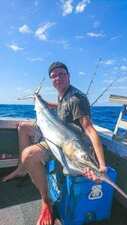
Vin Donovan knows where to catch fish like these ones.

‘The ocean and fishing are more or less like my second wife and I am on the water three or four times each week,’ said Vin. ‘As a matter of fact, the boat that I own at the moment not even five years old and it has done over 1,800 hours. I go to Moreton Island quite a lot and also spend a fair bit of time in Pumicestone Passage,’ he added. Vin explained that whenever he goes fishing, he places a lot of importance in understanding the science of the sport and he said that he always considers factors such as the phase of the moon, the direction of the wind and tide before deciding where to go and what species to target. ‘I have about fifteen hundred spots marked on the GPS,’ said Vin.

‘No matter when I go fishing, I can always fill the esky and I often give a fair few fish and crabs away to neighbours and friends,’ he said. Vin is a family man with two young children and he told me that they feel the same about being able to enjoy the outdoors as he does. He feels strongly about protecting the environment and says that his lifestyle is all about being able to get back to nature.

‘We live in a place with a great backyard so it is up to us to look after it,’ he pointed out. In keeping with this policy, Vin said about how nothing from his fishing excursions goes to waste. He described how he uses the fish frames as bait for when he goes crabbing and makes a healthy broth out of other parts of the fish such as the head. Prior to taking on his current role of a multiskilled handyman, Vin was employed for fifteen years in the fishing, camping and boating industry and for some time, was the manager of a large outdoors retailer. Along with his love of nature and the environment, Vin is a firm believer in living a healthy and rather old-school life.

He has never had a cigarette and does not own a computer or have an email address or Facebook account.

On the subject of protecting our fish stocks, Vin said that he is convinced that it is not the commercial or recreational fishing population who do the damage and feels that the problem is mainly caused by pollution from toxic runoff.

After spending time talking to this man who is so obviously passionate about all things Bribie, I came away convinced that this is one local who will never be guilty of damaging our island or letting technology spoil what in many ways seems to be the best lifestyle in the world.

For Vin’s tips on where they’re biting, go to our fishing report

Tide Times

Click here to see Bribie Island Tide Times

Life. Philosophy. Life Lessons

Tags: Life. Philosophy. Life Lessons

THE SHADE OF YOUR HAIR

Dearest Bribie Islanders, I hope you have all been faring well lately. I know, it’s been swelteringly hot! I hope you’ve found your means of staying cool whether that be swimming in the pool or ocean, wandering through the shopping centre or hiding out at home in the air con. Then there are the people you see running across the bridge in the middle of the day! My mind does not comprehend this.

Either way, enjoy the rest of Summer because, by the time you read this, Autumn will have strolled on in. Although, if it’s anything like the last few years, Summer will be dragging its feet on the way out and overstaying its welcome on the Sunshine Coast. So, do you ever get that restless feeling that arises every now and then that calls for something to change? Not anything drastic, but just little daily changes, like a new bedspread or a new wallpaper in the background of your phone.

Well, my version of this of late was something to do with my hair. I wanted a bit of colour. Not an all over colour change…just something with a bit of pop thread throughout the hair. In particular, the colour magenta. I knew this would be a little spur of the moment kind of thing and that if I waited around too long I would probably change my mind and not do it. And I think sometimes you just have to go and do something spontaneous every now and then for good health. Or at least I’ll use that as an excuse to be impetuous. Anywho, so I called a couple different hairdressers to find out when there next available booking would be and the first opening, I would take. I actually felt somewhat guilty doing this as I have a hairdresser that I always go to and am loyal to, but there were no availabilities until the next week, so I looked elsewhere.

Life Philosophy

As it turns out, someone I went to school with who runs a salon had a next day availability so I grabbed that one. I was so excited! The next day came and I got my hair done exactly the way I explained and they did a professional job. However, it took only a matter of hours before I realised something wasn’t right. I kept looking in the mirror and just didn’t feel good. I didn’t feel like me. About five days passed and I couldn’t stand it any longer I had to get it fixed.

So I contacted my original hairdresser and explained the whole thing and they knew exactly what to do. Thank goodness for people who understand your crazy ramblings huh. Basically, the colour, I liked. However, I didn’t realise how much it wouldn’t suit the hair framing my face. So my hairdresser put my original colour on the top part of my hair and blended it down to the magenta colour. Yay! All fixed. The world was right again. Thank you to my hairdresser if you’re reading this! You’re probably wondering why I just told your about all that.

There is a point, I promise. I felt like there was a lesson or two learned out of this hair drama. First of all, that while it’s good to be spontaneous, it’s always good to just check yourself before rushing ahead and know what you really want. Secondly, and more importantly, you suit YOU best.

What do you mean Nikita? What I am saying is, that we were born with certain features externally and internally that help to define who we are. Our eye colour, hair colour, skin colour and our personality and mannerisms. Of course these things change a bit as we mature, but generally speaking, we get what we are given and anything given is a gift. It is a gift to be given brown hair and brown eyes, it is a gift to be given blonde hair and blue eyes, it is a gift to be given red hair and green eyes and all the in-betweens are gifts too! They make us who we are and we should be proud of it.

Generally speaking, we suit what we are given best as well. So that’s why I felt uncomfortable seeing another colour framing my face, it just didn’t feel like me. It goes the same for all areas of our life too. Of course, when you are younger it can be difficult to fully know yourself and know what you like. Part of growing up is learning and trying new things to define who you are.

But when you do know what makes you tick, what makes you come alive and makes the world a better place, it is best to stick with that. There’s that old quote that goes: Just be yourself, everyone else is taken. And that couldn’t be truer. Everybody is too busy trying to fit in when it should be that we stand out for a reason. You’re totally unique, no one else can live your life.

Therefore, live it to the fullest and live it outside of the box of normality. No one remembers those who didn’t do anything to stand out. Legacy is born out of unusual. Legacy is born out of you being fully who you were made to be.

Other Articles

https://thebribieislander.com.au/love-for-bribie-tourist-destination/

https://thebribieislander.com.au/learning-the-plumbing-trade-plumbing-apprenticeship/

Mini train rides – Kids amusement rides

Tags: Tourist Destination Queensland.  Kids amusement rides. Trains. Model Engineers and Light Steamers Association. Mini train rides

THE TRAINS DON’T COME TO BRIBIE

Yes, that’s correct, the trains definitely don’t come to Bribie Island but, that doesn’t mean that you will never see a train making its way along a track right here on the island. As a matter of fact, on the third Sunday of each month, you will always see a train if you visit the park next to the Bongaree Sports Club on Toorbul Street around midmorning.

The initials M.E.L.S.A. stand for ‘Model Engineers and Light Steamers Association” and the members of the local club are keen enthusiasts who operate the mini-train rides for the enjoyment of both locals and visitors alike. The idea for MELSA club on Bribie resulted in Bob Loseby, Dick Steel, Eric Richards, Hugh Bull, Roy Milner and Merv Hall forming a steering committee in 1981 to coordinate the project.

Amusement rides Local tourist destination queensland

MELSA Club members having fun

Successful lobbying resulted in the fledgling club receiving a $100,000 grant with the conditions that the project had to be completed in one year and work had to be carried out by people who were at that stage unemployed.

I recently had the opportunity to meet up with current MELSA members Col Farrell, Phill Grant, Dave McIntyre and Les Young who kindly offered to tell me more about the club and these meticulously constructed trains. Club Secretary Col Farrell told me that the track is longer now than when it was first built. ‘The track is about one kilometre long now and goes almost down as far as the Vietnam Veterans Park,’ said Col. ‘The original track was only just a small loop but by the time it began operating, extras had been added,’ he said.

I was told that the mini-trains are normally built by members and are either steam or electrically driven. The little trains have been running around the Bribie Island track since April 1st in 1985 and the club members that I spoke to explained that they really love to see how happy the kids are as they go for a ride on the train. ‘They all have big smiles on their faces and they are always looking for someone to wave to,’ Phill Grant pointed out. Apparently, the trains pull two carriages and are able to accommodate about twelve passengers on each ride.

Mini trains train rides

The MELSA steering committee(left)

The club operates under a set of guidelines set down by the Australian Association of Light Steamers and these allow for anyone who is seven years or older to become a club member and operate a train under supervision on club days but, when passengers are carried, the driver must be at least fifteen. The MELSA Bribie Island Club currently has twenty-five members and new members are always welcome.

Not all members own a train and I was told that a train is being built at the moment for the club. These mini-train rides on the third Sunday of each month are always a popular attraction and operate from approximately 10 am until early afternoon at MELSA Park on Toorbul Street in Bongaree.

Anyone who would like to find out more about becoming a member of the club is welcome to call Colin Farrell on 0439 822059 or come along on running days.

Other Articles

https://thebribieislander.com.au/history-bribie-island-fascinating-history-historical-society/

https://thebribieislander.com.au/love-for-bribie-tourist-destination/

https://thebribieislander.com.au/elvis-is-on-the-island/


Learning the plumbing trade – Plumbing Apprenticeship

Tags: Plumbing Apprenticeship. Apprenticeship. Tradies. Trades.

TEACHING THE RIGHT VALUES

When local plumber Brad O’Carroll of PLUMBING Bribie Is. developed his current business plan he included a provision to give back to the Bribie Island community that supports his business by taking on an apprentice from within that community and this has resulted in the recent employment of year eleven student Jye Shearman under the school-based apprenticeship program.

Brad told me that he was impressed by Jye’s apparent keen attitude towards getting a job. ‘He was constantly sending out emails and putting himself out there on Facebook,’ Brad explained. ‘He was doing all the things that I consider to be the important signs that someone really does want to work.

Plumbing Apprenticeship

Jye will learn the importance of doing a quality job like this one

He is responsible for his own outcome,’ said Brad. Under the conditions of his apprenticeship, Jye works for Brad on one day each week and this allows him to still go on to complete year twelve next year.

He will also attend the Services Trades College of Australia at Salisbury where he will be able to learn the science of plumbing and this will be for a certain amount of time each year. Brad told me that this is able to be done during the school holidays. Having been in the plumbing industry for over thirty years, Brad believes in the importance of making sure that all work is carried out in the best possible way using quality products and equipment.

‘I want to be able to teach Jye the principles and the value of integrity that I believe is essential. As far as I’m concerned, if you do a job and you think that it’s not right, then it’s not right,’ said Brad. ‘Jye will earn that it is so important to produce a reliable product every time. We don’t just plumb buildings for a five-year guarantee, we do it for a twenty-year return,’ he added.

Brad said that during his time as an apprentice, Jye will be taught a full aspect of the trade and will be able to see just what the trade can deliver for him in the future. When a business takes on an apprentice under the school-based program, they receive an incentive payment from the government and Brad pointed out that this subsidy can often make the difference when it comes to the costs involved and he explained that the agency which is responsible also takes care of the necessary paperwork other than the wages.

“This is an excellent way for businesses to become involved in making sure that the youth of today receive the best training and learn the importance of doing the best possible job,’ said Brad. ‘I sincerely hope that hearing about what I am doing will at prompt other employers to at least inquire about the scheme,’ he said.

PLUMBING Bribie Is. can be contacted by calling 0478 021927 so, if there is anyone who is in need of their services, they should give Brad a call and the chances are that this job will be one that provides another learning experience for the island’s newest school-based apprentice, Jye Shearman.

Other Articles

https://thebribieislander.com.au/technology-and-how-it-affects-our-life/

https://thebribieislander.com.au/local-handyman-store-closing-down/

https://thebribieislander.com.au/love-for-bribie-tourist-destination/