
Issue 112 OUT NOW. Get all your community news and information. Bribie Islands only community gloss magazine NOW EVERY TWO WEEKS! – Articles on boating, camping, fishing, life, drama, travel destinations, sports and what to see and do on Bribie Island. Covering charities, organisations, places, children’s activities, arts and crafts, tourist destinations, heritage parks, technology, science, music, gardening, and much more.
The Bribie Islander Gloss Magazine April 11th 2020 Issue 111
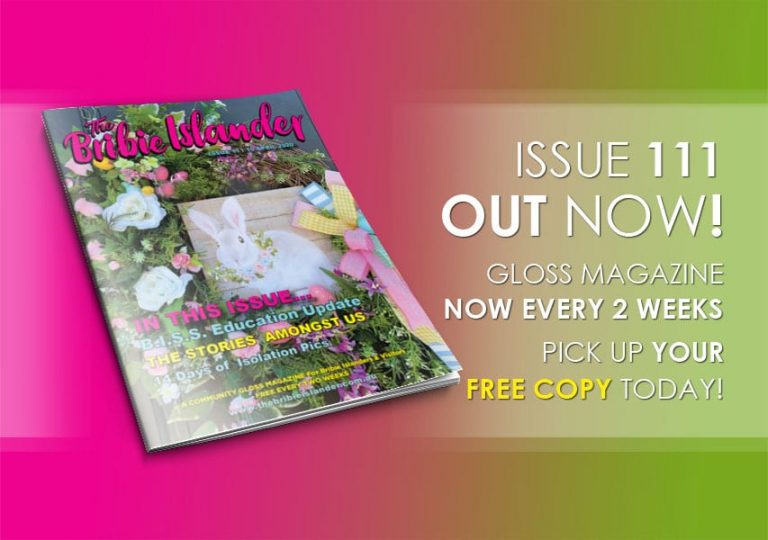
Issue 111 OUT NOW. Get all your community news and information. Bribie Islands only community gloss magazine NOW EVERY TWO WEEKS! – Articles on boating, camping, fishing, life, drama, travel destinations, sports and what to see and do on Bribie Island. Covering charities, organisations, places, children’s activities, arts and crafts, tourist destinations, heritage parks, technology, science, music, gardening, and much more.
The Commemorative Booklet celebrating the Bribie Island Lions Club’s 50th anniversary

BRIBIE ISLAND LIONS CLUB ANNIVERSARY
This booklet is a compilation of photos and information collected from different history books and members sharing the Bribie Lions Club’s hard work and service for our community and surrounds over the past 50 years. It was made possible by the businesses that are advertised within the book and a thank you page on the back full of businesses that also donated for this booklet to be printed.
Unfortunately, there are way too many incredible works and projects that have been achieved by the Bribie lions to possibly fit everything in. We hope we have done their amazing service justice.
WHERE IT ALL BEGAN
In the 1968 – 70 Lions Years, an investigation was commenced by the Redcliffe Peninsular Lions Club, into the possibility of chartering a Lions Club on Bribie Island. Active participants in the Redcliffe Peninsular Lions Club were Lion Reg Wright and Lion Noel Kropp. Bribie Island interested locals were Bluey Piva amongst other businessmen. Bluey had purchased the Blue Pacific Hotel on the island several years before and had previous experience in Lionism in Ayr and Home Hill.
A survey of Island businesspeople revealed a lack of enough interest at the time, so the plan was deferred for twelve months. In the 1969 – 70 Lions Year with the assistance of another local identity, Otto Fluck, enough interest was generated, and the Bribie Island Lions Club was chartered on the 19th of March 1970. Otto had been a Lions club member previously in Melbourne.
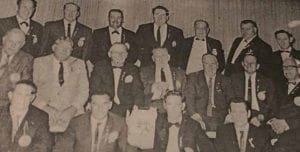
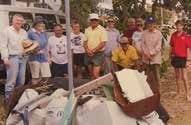
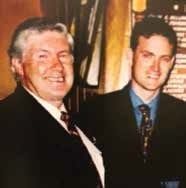
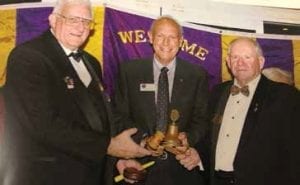
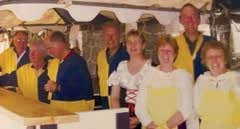
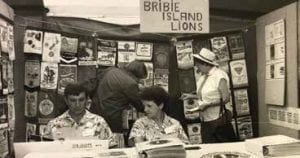
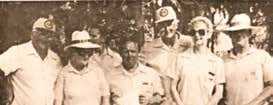
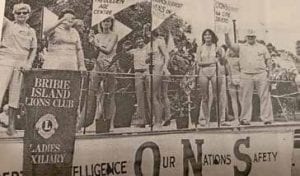
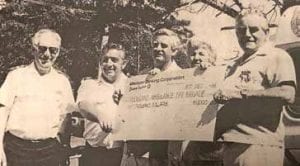

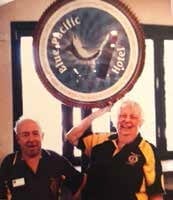
The Blue Pacific Hotel then became the home of the Bribie Island Lions Club and still is today. Where the Piva family for many decades played host for many a function run by the Lions Club.
Through the ’60s and ’70s, the hotel became the community hub of Bribie Island and over the years with a keen eye for new members, Bluey was able to introduce 15 members to the club. On Friday nights and Saturdays, you will still find the Lions Club members running their raffles at the hotel where they still hold all of their meetings to this day.
HEARING TEST FOR PREP SCHOOL STUDENTS
For nearly a decade the Bribie Island Lions have met the cost to get the prep school-aged children from the Bribie Island Primary School hearing tested. Audiologist Ms. Stephanie Morris from the UQ Health and Rehabilitation said “Hearing is very important for a child’s development in learning, language communication, etc. As a lot of the problems are through middle ear infection, hearing is tested when a child is born and again before they start school. In 2019, 90 children were tested, 17 were found to have issues. This is obviously a much-needed service.
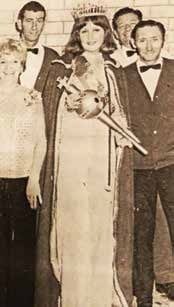
MISS PERSONALITY
Only 3 local identities have managed to be found that were at some stage Miss Personality entrants. The Miss Personality fundraising was a Lions Quest that went towards their fundraising efforts. These were Judy Piva, Jacky Wright, and Melissa Wing-Young.
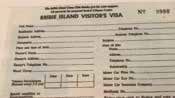
BRIBIE ISLAND VISITOR’S VISA
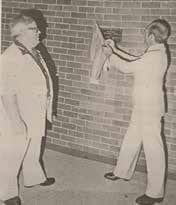
On the 12th of November 1976, the Bribie Island Lions Club decided to go ahead with plans for a Republic of Bribie Island as a fundraiser. By the 15th of March 1977, a total of $13,915.83 had been raised by selling visitors passes.

ANNUAL ART SHOW
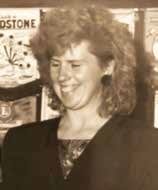
With the passing of Lion Veronica Cook in November 2001, Liz Heber, who was long-standing friend, offered to hold her annual Art Show preview in March 2002 in her honour, (prizes donated by the artists), with the proceeds of sales and raffles to assist Breast Cancer Research at the Wesley Hospital in memory of Lion Veronica. That year $4500 was raised. This event was held each year up until 2010 when the change of format to the Art Show by the organisers, 2010 was the last occasion the Lions Club participated.
CHILDREN OF COURAGE
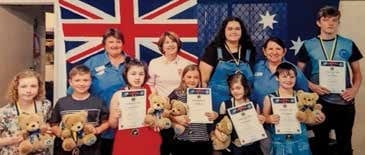
“Aiming for the stars”. The Lions Children of Courage Awards is not a competition but having said that, every child nominated receives an award. All children just want to be accepted by others regardless of any special needs they may have. The awards will portray the recipients as children who have successfully overcome additional barriers that face them in the world.
BUS SHELTERS
As early as 1976 the Lions Club began the project of installing bus shelters on Bribie Island with numbers increasing steadily over the next few decades due to the advertising revenue initially defraying the erection costs and subsequently providing valuable resources for the club and community projects. In December 1988 the Lions Club entered into a formal agreement with the Caboolture Shire Council where the construction, maintenance, and advertising rights were established.
During the following year, 17 new bus shelters were built adding a substantial revenue base to the club. With the amalgamation of the Pumicestone/Ningi & Bribie Island Lions Clubs in July 2007, all the bus shelters at Ningi and Sandstone point came under the control of the Lions Club of Bribie Island. Bringing the number of bus shelters up to 34.
In 2008, a 5-year option as per agreement was extended to the Lions Club which would expire in 2013, at which time the number of bus shelters would be reviewed. The Moreton Bay Regional Council then had a consultation with the Lions Club regarding the new compliance standards required for bus shelters and possible changes to advertising rights. At the time the bus shelters advertising was approximately generating $20,000 per annum for community projects.
Unfortunately, in 2018 TransLink began replacing the bus shelters with the new compliance standard shelters, which meant the Lions Club lost this valuable source of income which always went back into the Bribie Island community.
THE BRIBIE GOLDEN AGE CENTRE
was a massive undertaking for the Bribie Island Lions Club. The project which commenced in 1972 and with a cost of over $500,000 came to completion when opened by the HON BD Austin, MLA, Minister for Health on 19 March 1983. Bribie Island Lions through their involvement with local citizens became aware of the need for a community centre and for a meal on wheels kitchen to provide a service to those senior citizens requiring it.
Following an application to the Lands Dept on 8th April 1972 under Lion President Edwin Schrag, approximately 6 acres of land was made available by the State Government on the ocean side of the Island. This came to fruition on the 26th of October of that year with five Lions members being appointed as trustees of the area. There were copious amounts of red tape to get through, but this didn’t deter the lions club.
They dug in and with a lot of hours volunteered by the Lions Members raising funds, along with others the project was finally finished, and the Golden Age Community Centre became a reality. Throughout the years proving it is still just as valuable of an asset to the community as ever, housing Meals on Wheels and serving as a much needed centre for our senior citizens to have access too.
The facility is second to none, holding many concerts and functions over the years, and no doubt has many fond memories for a lot of us to look back on. Today the building is known as the Bribie Respite & Support Services Inc.(Golden Age Day Respite)
CAMP QUALITY
On Sunday the 16th of December 1990 members for the Bribie Island Lions Club Kerry Wright and Anther Hayes held a Christmas Party for 33 terminally ill children from the Royal Brisbane Hospital, at the Bribie Island Funland Waterpark. Each Lion adopted a child for the day and Santa visited with gifts for them all.
For the next two years, it was a zone project but in 1993 it was elevated to a district project with Lions Clubs in the area becoming involved. On the 28th of November 1993, seventeen Lions and Lioness Clubs put on the Lions Camp Quality Christmas Picnic day at Bribie Island. They provided all the fun, food and entertainment free, for 600 people which included 147 Camp Quality children, their families, and Lions club families.


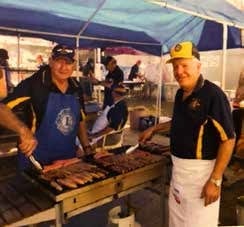
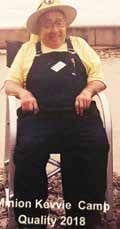


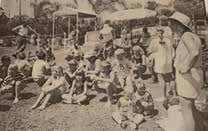
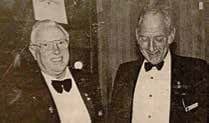
Every year since then, it has brought a moment of happiness for these children, their families, and carers, as well as older children upon their return. This special day, which is held on the last Sunday in November, at Brennan Park, Bribie Island Lions Club provides a full range of treats and activities, including the arrival of Father Christmas, with gifts for all the children.
Lion’s club member Kerry Wright remained District Co-Ordinator until 2003, with Lion Kevin Williams from the Bribie Island Lions Club becoming the District Co-Ordinator in 2004. Now known as the Liaison officer, Kevin Williams still holds this position, helping to provide a wonderful day out for those less fortunate.
In 2019 the event hosted 200 people from Camp Quality and the Lions Club and 200 General public, totaling 400 people approximately. This year they will proudly celebrate as it will be the 30th year of giving to the children through this great Lions initiative, the special day being Sunday the 29th of November.
BRIBIE MEMORIAL GARDENS
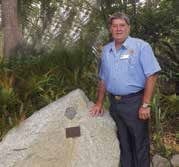
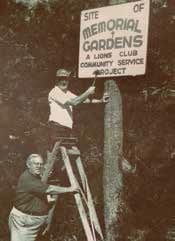
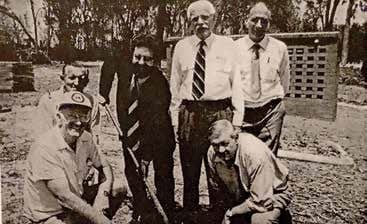
In November 1987, Harry de Gono, a member of the Bribie Island Lions Club proposed that the construction of a columbarium and memorial gardens should become a project of the club. This led to a request being made to the Caboolture Shire Council for a suitable site in early 1988.
By the 25th of November 1990, it was deemed ready for an official Consecration Day which was performed by Pastor John Nichols who represented the Ministers Fraternal of all churches on the Island. Early in 1991, the first ashes were inserted in the Tristania Wall and the Memorial Gardens became official.
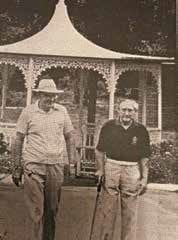
Under project Chairman Lion member Bryce King instruction, Lions members Alan Suffolk and Brian Deadman took over as curators and landscapers and the surrounding gardens began to take shape, limited only by the inefficient water supply. The Caboolture Shire Council who constructed the entrance road and the car parks also donated a gazebo which was erected by the Lions Committee. The Lions Club then also completed the connecting pathways. The Bribie Lions Club still maintain the Memorial Gardens today.
SENIOR CHRISTMAS LUNCH
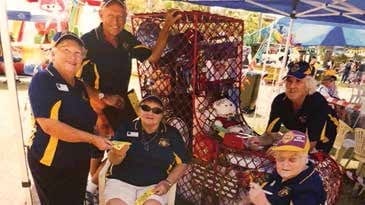
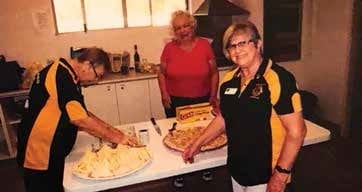
Another Great Lions Club initiative was to hold an annual seniors Christmas lunch. It was a dream of one of the presidents Phil Carne which became a reality on the first Saturday in December 2012. It is a very special day on the Lions Club calendar each year, also a much-anticipated date for many of their guests, as not everyone has family or friends to spend Christmas day with.
So, this is it for many of them and what a way to spend it, laughing and enjoying the day. Sadly, Phil passed away in 2016, so the Bribie Lions Club dedicated this great tradition in his honour and re-named it the Phil Carnes Memorial Senior Xmas Lunch.



LIONS YOUTH OF THE YEAR
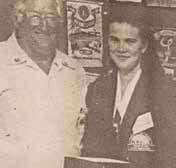
The Lions Youth of the Year Quest aims to select an outstanding young individual to be an Australian ambassador allowing them to travel overseas under the auspices of Lions Club International. Through all levels of participation, the Quest seeks to assist secondary school students in developing citizenship and leadership qualities as they prepare for entry to the workforce or higher education.
On perusal of the historical documents of this event in the early 1990s, it came to light that Janelle Williams was the only youth to win the award twice. Janelle won the award two consecutive years and happens to now be the General Manager of the Bribie Island RSL.
LIONS INTERNATIONAL PEACE POSTER & ESSAY CONTEST
For over 3 decades, Lions clubs around the globe have been sponsoring a very special art contest in schools and youth groups. Creating peace posters gives children everywhere the chance to express their visions of peace and inspire the world through art and creativity. The Peace Essay Contest was created to provide an opportunity for visually impaired young people to express their feelings of peace and is, along with the Peace Poster Contest, a staple of Lions clubs around the world.
Under the leadership of the Art Teacher at the Bribie Island State school, Cheryl Thornley takes part in this contest each year. The 2019 winner was Livina Curley. The theme was “Journey of Peace” Over the last 50 years, the Bribie Island Lions Club has held a proud record of serving the community by providing many much-needed amenities for the Island.
They have also been able to ensure assistance is available for many charities and worthwhile projects not only on Bribie Island but also District and Multi-District Lions projects serving the wider community with numerous fundraising efforts. The Local Lions Club has evolved over the years to meet the needs and expectations of our local community.
In the early years, the club was instrumental in many “hands-on” projects such as the Lions Park at Woorim, which provided picnic facilities for the visitors to the Island. The facility was recently upgraded by the regional council as part of the Beautification Project for Woorim, and whilst no longer maintained by the club, it still bears the name “Bribie Island Lions Park” in recognition of the Lions contribution over the many years. The Bellara Lions Park established in 1989 was also a project of the local Lions Club.
They have built and supplied our community with so many things, for example.
• Providing the House of Happiness with chairs, palm trees, electric BBQs and gas cylinders.
• The amenities block at the Bridge Lions Park and picnic tables in our parks.
• Blue nurses’ cars, new ambulance vehicles and equipment, helped purchase a new minibus for the Caboolture special needs school, bus shelters, Air-sea rescues boat, lifesavers rubber duckie and SLSC flagpole.
• Books for our Bribie Library, a line marker for the schools and sports grounds to use, book trolley for the children’s ward at the Caboolture Hospital and a World book set for Banksia Beach State School.
• BMX track, a kindergarten, St Vincent DePaul bikes and certainly not forgetting the original Golden Age Community Centre, our beautiful Bribie Island Memorial Gardens and Columbarium and so much more.
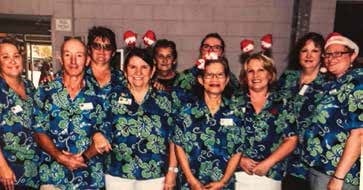
The Bribie Island Lions Club’s hard work and efforts have raised so much money for these projects and when you think that most of this money comes from running raffles and functions, it’s amazing just how many hours must have been donated by these hardworking Lions Club members.
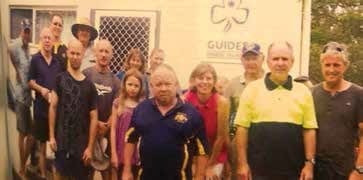
The residents of Bribie Island and Caboolture Shire have been very fortunate to have such an active and effective organization as the Bribie Island Lions Club. For over 50 years they have vigorously supported, through physical and financial means many individuals, families, and organisations, continuing to do so to this day.
Their record clearly shows their dedication to recreational land and the environment, and their commitment to build the columbarium and memorial gardens genuinely shows their concern for our community.
Other Articles
Bribie Island Wildlife – Black Kite Milvus migrans
Tags: Native wildlife. Birds. Black Kite Moreton Bay. Queensland. Australia.
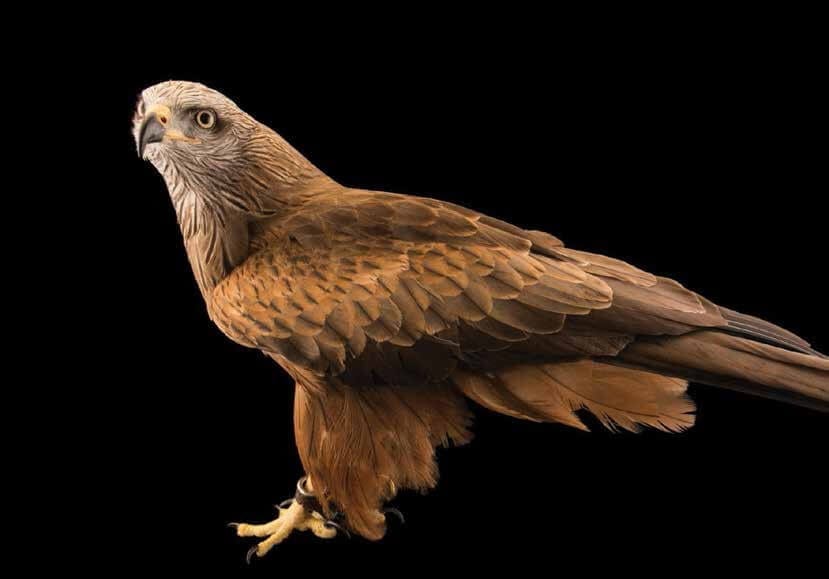
Black Kites are seen very rarely on Bribie Island but are more common on the mainland around Caboolture. I have sometimes seen one flying between the Bribie Bridge and Ningi. They are a little smaller and darker than the Whistling Kites which are common on Bribie Island. They are one of Australia’s most common raptors and the most numerous of all raptors in the world.
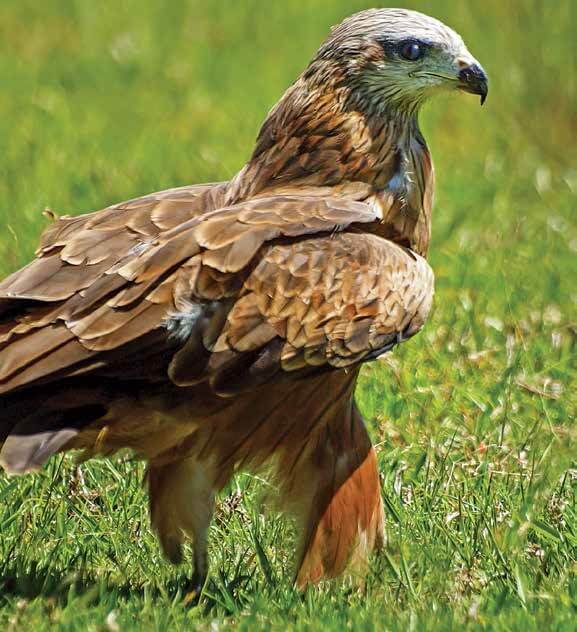
They are rather nondescript, medium-sized dark brown raptors that appear black from a distance. Eyes are brown and bills are black with a smudge of yellow near the nostrils. Males are around 50cm long while females are about 55 cm. Wingspans are 1.2-1.5 m and they weigh 560-671 g. In-flight the wings with distinctive fingers at the tips glide and soar with occasional slow flaps.
Forked tails are probably their most distinguishing feature which they twist from side to side while working the updrafts. This action makes them easy to identify in flight. When the air is calm wings are held flat while they glide at lower altitudes among the treetops. When perched they sit upright with folded wings reaching almost to the tips of their tails. They are often seen in groups of up to hundreds of birds but are sometimes solitary.
Square-tailed Kites are similar in appearance but do not have the forked tail. Preferred habitats are forested areas, mangroves, swamps, cattle yards, rubbish tips and around fires. They are more common in the north of Australia and inland areas and less common as you travel southwards.
On a trip on the Bruce Highway to Cairns, you will see hundreds of Black Kites flying overhead, many searching for roadkill. They are also found in Europe, Asia, and Africa. Much of their food is carrion and roadkill, insects especially grasshoppers, reptiles and small mammals. Fires are an attraction and as small creatures and insects try to escape the flames they are swooped upon by the hungry kites.
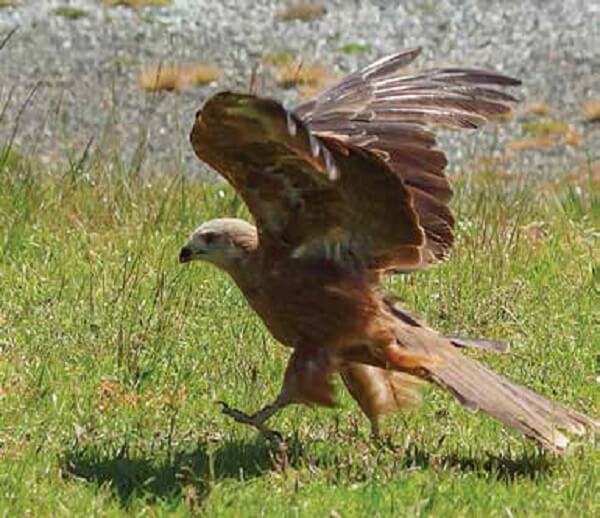
During the days when most cane farmers burnt off their crops before harvesting, there would be flocks of hundreds of kites swooping down with legs outstretched snatching at escaping prey and picking up the charred remains of animals unable to getaway. During grasshopper plagues, large flocks form and gorge on the prolific insects. No other raptor forms flocks such as these.
They are opportunistic hunters and take what is available. Breeding in the north is recorded to occur in all months while in the south it is mainly during the months from July to December. Nests are rough slightly rounded platforms of sticks high Black Kite Milvus migrans By in trees and lined with grasses and available soft materials. Both birds perform ritual courting dances in the air by loud calling, grabbing of talons, with falling and somersaulting before nesting.
Both parents build nests. Clutches of 2-3 speckled eggs are laid and the female incubates for about 35 days while the male provides her with food. When hatched the young are covered with grey down. Siblings are aggressive towards one another and the weaker ones are often killed. Parent birds are diligent in keeping their nests safe. After about 50 days the young will leave the nest to stand on nearby branches. After about 2 years they begin breeding themselves.
Sometimes the nests of other birds such as crows are used. Some nests are used for several years. Indigenous people of NT claim that raptors such as Black Kites, Whistling Kites, and Brown Falcons will start their own fires by picking up burning sticks and carrying them to a new location where they are dropped to start new fires. They then wait for a fresh crop of terrified creatures to run from the burning debris to be pounced upon by the waiting predators.
For this reason, they are sometimes called “Firebirds”. Another common name for obvious reasons is Fork-tailed Kite. Milvus is a Latin word meaning Red Kite while migrand means migrating. There are few natural predators, but unwanted deaths often occur as a result of human interference.
As kites are carrion feeders and swoop to feed on roadkill they often collide with oncoming vehicles. Sometimes when perching on electric wires they are electrocuted. Feeding on animals that have been poisoned can also cause death. Their conservation status is stated as secure. Populations appear to be decreasing but have not reached the status of vulnerable.
Other Articles
- Bribie Island Wildlife – Leaden Flycatcher – Myiagra rubecula
- Bribie Island Wildlife – Black-fronted Dotterel – Elseyornis melanops
- Bribie Island Wildlife – Little Egret
History of some sports on Bribie Island
[vc_row][vc_column][vc_column_text]History of Bribie Island sports. Moreton Bay. Brisbane. Queensland
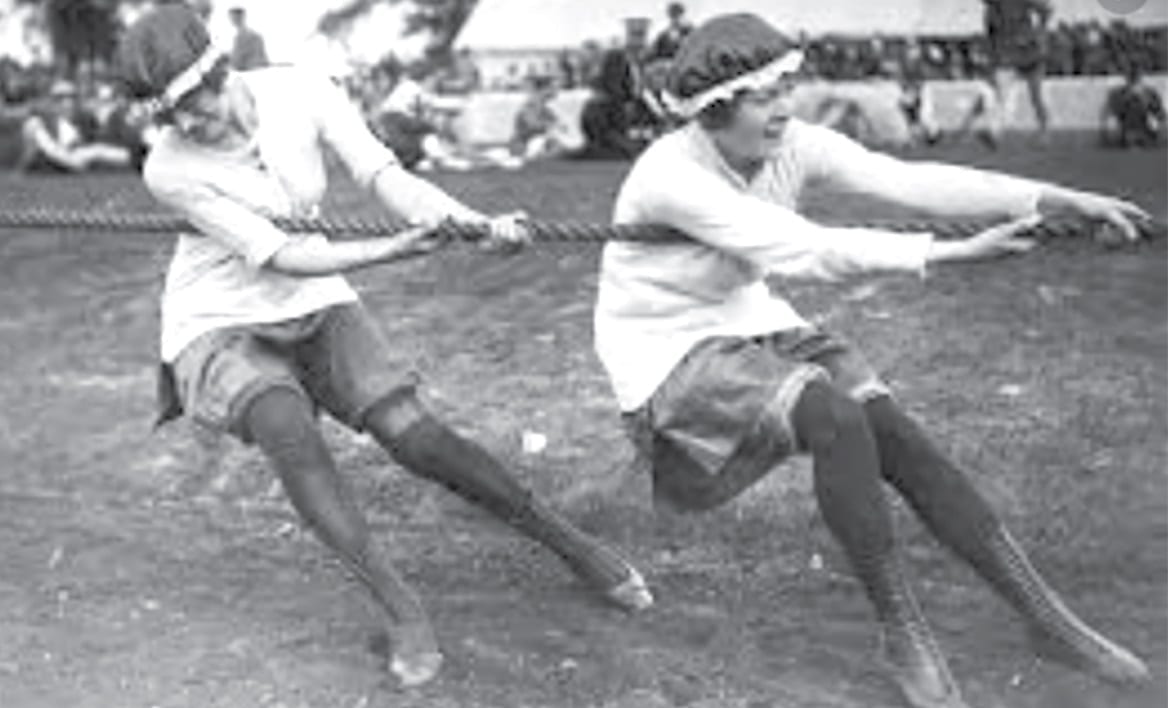
This article tells the start of some sporting clubs and activities on Bribie island. The Brisbane Tug & Steamship Co. opened up Bribie island to day-trippers and holidaymakers, when they leased land, built a jetty, and ran large steamships from Brisbane to Bribie from 1912. Before that the only people who came here for “sport” were catching dugong or shooting birds.
SURF LIFESAVING
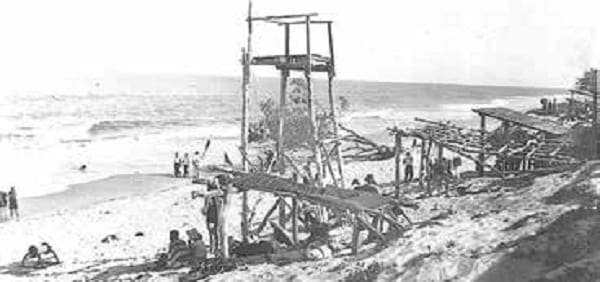
In 1923 Tug Company was instrumental in setting up the Bribie Island Surf Lifesaving Club providing staff and equipment to enable protection and safety for bathers and surfers. At that time Woorim was the closest surf beach to Brisbane, even with the long steamship trip, before easy access to what is now the Gold Coast and Surfers Paradise. There were many more high sand dunes and breaking waves on the beach in those days. It became a very busy and popular destination after the first basic road was cleared from Bongaree to the Ocean Beach in 1924, and trucks provided basic transport across the island.
BRIBIE BOWLS & TENNIS
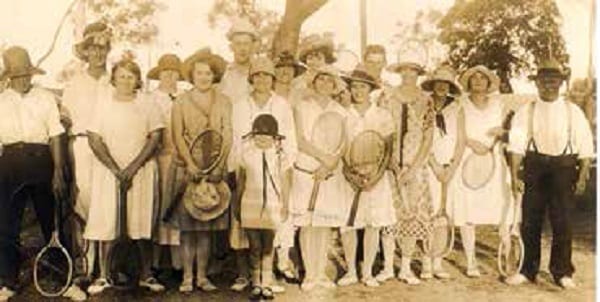
In 1929 the Bribie Island Bowling Club and Tennis Courts were established. The Tug Company brought a large old timber building from Moreton Island and placed it on “The Hill” where the Water Tower now stands at Bongaree. Initially used as a School, before the State School was built in 1924, it was also the Community Hall for Dances and all sorts of functions at weekends and evenings.
The building was later moved down the Hill to become the initial Clubhouse for the Bribie Island Bowls Club. The first President of the Bowls Club was Alf Johnson and the Bowling Greens were subsequently named for prominent members including Campbell, Bell, Cressy, Loi, and Pettitt. In the 1930s Tennis had become a very popular sport for all family members, and Tennis Courts were constructed at the south end of the Bowling greens.
Early Members of the Bribie Island Bowls Club were largely non-residents, who came by Steamship from Brisbane at weekends and holidays. In 1947 a Bowler’s Hostel was established, providing accommodation for up to 30 visiting Bowlers, in a building that had also been brought to the island, as the first School Headmasters house. That building still stands today and has had several different uses over the years, and is now the “Bribie Doctors”
BONGAREE BOWLS
By the early 1950s, Bribie residents had increased to more than 300 and they campaigned to create a Bowls Club specifically for residents. The Bongaree Bowls Club was formed in 1949 and using a horse to clear land and filling the swamp, it was opened by President Arthur Winston in 1952.
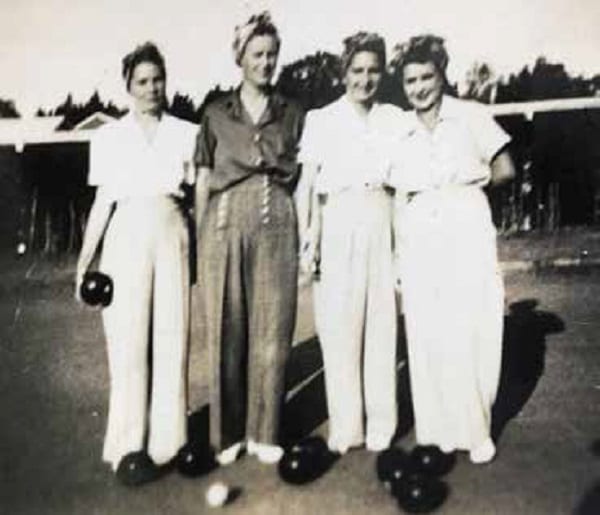
The Greens were later named to honour pioneer members including Winston, Richardson, and Kling. Six months after the opening of the Bongaree Bowls Club in June 1952, the ladies of Bribie formalised their involvement, at the inaugural meeting of the Bongaree Ladies Bowling Club, held at the Church of England Hall. The foundation President was Marion Winston with a committee of local ladies including Shields, Stanley, Rasmussen, Thornley, Tesch, Kling ad Whitney.
FISHING
From the earliest times, Bribie was known for its remarkable fishing. As early as 1908 a Fish Canning operation had been established at Bongaree, where the IGA Store stands today. Operated by Mrs. Sarah Balls, an outstanding businesswoman who also operated refreshment rooms at many of the new railway stations throughout Queensland. The oldest Fishing Club in Queensland, the Amateur Fishermen’s Association, established in 1904, built a Clubhouse at Bongaree in 1925 for its visiting members.
This building still stands on the waterfront along South Esplanade and still used by members. Thomas Welsby, a Brisbane businessman, Historian, and author of many fishing books, was an early President, serving for 17 years from 1906 to 1923. It was Thomas Welsby who later wrote the book “Bribie the Basket Maker” creating the legend of a runaway convict who lived with the aboriginal people of the island.
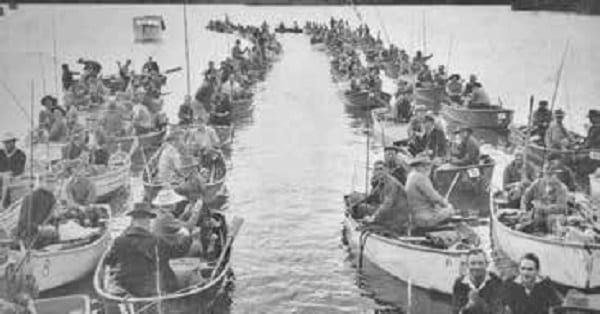
Over the years, the AFA conducted Fishing Competitions in the waters around Bribie, often involving hundreds of people being towed out in boats to a designated fishing area.
BRIBIE OLYMPIAN
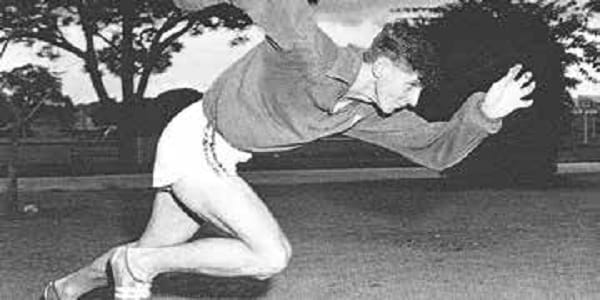
As far as I am aware, there has only been one current Bribie Island resident to compete in the Olympic Games, at the 1956 Olympic Games in Melbourne. This was Doug Winston, who represented Australia in the 200m and 4 X 100m relay. The Winston family were pioneers on early Bribie, establishing a Tobacco Farm at Bongaree in the 1930s, and running the General Store opposite the Jetty at Bongaree.
BRIBIE SPORTS CLUB
Back in 1961, before the Bribie Island bridge, was constructed, the island was a very different place with a permanent population of fewer than 500 people. A number of concerned residents were keen to provide some recreation facilities for the youth of the island and conducted Gymnastics and Boxing in various locations. In 1963 tentative approaches were made to the Lands Department for land as a recreation area.
This led to the promise of land near the old “Town Dump”, on the south side of Ocean Beach Rd, (now First Ave.) and where the Recreation Hall now stands The present building known as the Recreation Hall was constructed over a period of many years. Initially, funds would only allow the building of two sides and a rear wall, and it was finally completed and enclosed in 1979.
Over the years, the Hall has seen many different groups use the Recreation Hall, and numerous functions, events, and celebrations have been held there. Today it is used by Vietnam Vets and U3A where several more modern “Sports” such as Pickleball, Boule, and Burlesque on a Chair are played.
MORE BRIBIE HISTORY
If you have questions or information to provide, please contact us. The Historical Society has monthly public meetings at the RSL Club on the second Wednesday of each month commencing at 6;30pm. with guest speakers on a wide range of topics. Come along, visitors welcome. You can see many more photos and articles on our Blog Site at http://bribieislandhistory.blogspot.com or contact us on [email protected]
Other Articles
- History – BRIBIE’S OWN AUSTRALIA DAY
- Vintage, classic and historic car group – HISTORICAL CARS ON BRIBIE ISLAND
- History – BRIBIE deserves a VISION for the FUTURE
[/vc_column_text][/vc_column][/vc_row][vc_row][vc_column][/vc_column][/vc_row]
Helly’s celebrities of the 20th century – in the kingdom of James Clavell

It’s a bad start to our first meeting in Austria in 1969, interviewing novelist screen writer-director-producer of KING RAT, TAI-PAN, SHOGUN and NOBLE HOUSE fame, JAMES CLAVELL. Each novel is an instant bestseller and all, in the 70s and 80s, will be released globally as movies or TV series with a 120 million audience. But I find James arrogant, condescending, dismissive, and yes, in fact, quite rude. And interviewing him is as fruitful as trying to penetrate the skin of an armadillo.
Two years later, the LONDON OBSERVER also ask me to interview James in London, and this time I am prepared to retaliate. But instead, James’ welcome, friendliness, and courtesy leave me both speechless and angry. “Why are you so nice to me today, when you treated me abominably in Austria last time we met?” I blurt out indignantly. James pauses, shrugs his shoulders, and, with a guilty smile, his brash, but honest reply makes me laugh. “You’re the Observer now!”
And so a curious friendship develops with a most inspirational and superb writer, but a man I could never imagine wanting to be friends with. When my son is born in 1973, weighing just over two pounds and being 12 weeks premature, even a flowerpot of hydrangeas arrives from James on my London hospital bedside table. This flowering bush grows 2m high in my garden, when, in 1980, I leave London, returning to Australia after completing my pilot licence on the Isle of Guernsey.
But in 1971 we are sitting in a small London office, cluttered to the ceiling with files, books, parcels, papers, and posters. James has just finished his latest production with all offices, administrative staff, and paperwork completed, but is tidying up the last remnants himself, as he explains. “You pull in your tentacles from five offices and I’m now running my empire from behind this miserable curtain.
It drives me barmy. Instead of being able to go dream a bit, I’m doing the work of a 20-pounds-week clerk and am trying to be a businessman, which I’m not.” Although he now owns homes in L.A., Vancouver, and London, 50-year-old James insists there is no time to live in any of them, as he is always on location. And I am not the only person finding this Australian born, half-Irish HELLY’S CELEBRITIES OF THE 20TH CENTURY with Scottish overtones Englishman with American citizenship, difficult. James likes being the boss and he is not the most loved man in the film industry.
On film sets, you can feel the tension between James, his actors, and his crew. To the charges of being cold, hard, ruthless and ready to kill, he responds to me with glee. “I’d like to spread that around a bit. It’s a great reputation. I’m not really trying to be the favourite man in the business. What I am concerned about is getting the best out of people.” But does he??

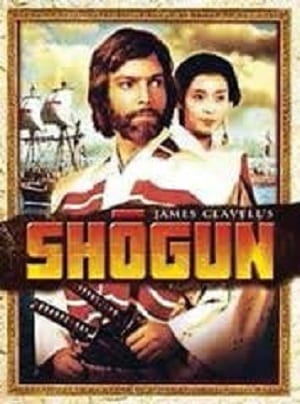


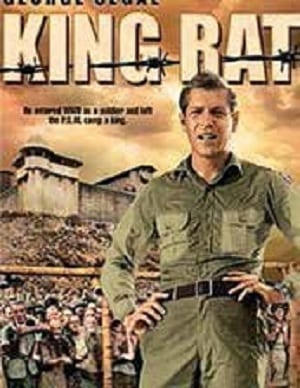
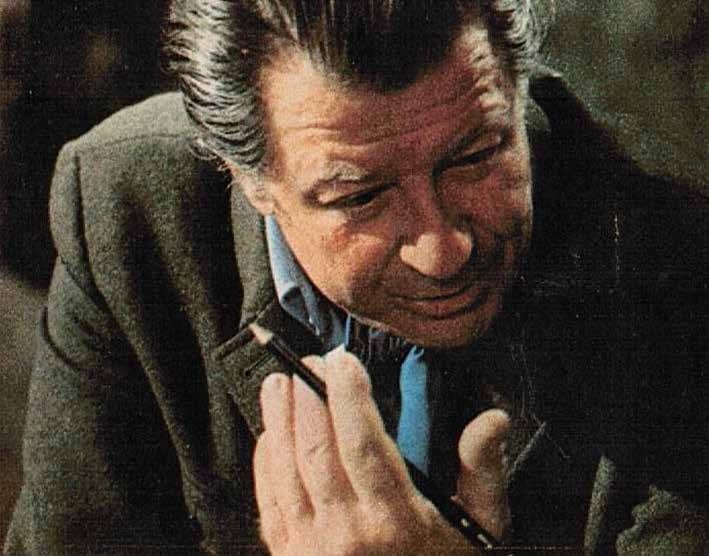
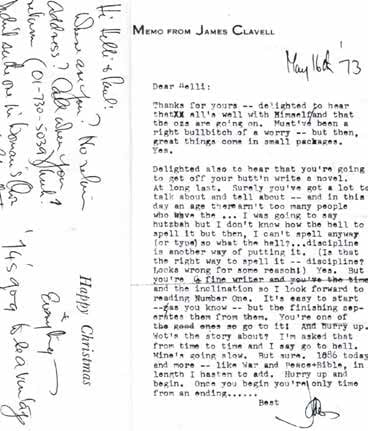
As screenwriter and director, he certainly achieves this in the 1967 TO SIR WITH LOVE, starring Sidney Poitier, Katharine Hepburn, and Spencer Tracey, as well as being co-writer for 1963 THE GREAT ESCAPE with Steve McQueen. As a director it is clearly the exercise of power which traps James. “It’s certainly not material success,” he agrees. “After a very small threshold, once you have your drop-dead money, wealth is just a point of view.” Longish, greyish hair falls over James’ ears, as the genius bends forward on his desk and having made his point with relish, he straightens up, his strange blue eyes narrowing, and he drops a clenched fist on the desk.
You are suddenly conscious of the former Captain in the Royal Artillery, as he was in World War II, captured in 1942 by the Japanese in Java and incarcerated in the infamous Changi Prison in Singapore, where only 1 prisoner in 15 survived – the setting of his first novel, KING RAT. But in 1971 the real challenge for James, who will succumb to cancer in 1994, is the actual writing not the directing. “I’m a soul stealer, a story-teller. I wanted to be a director because a director is a writer in the film form.
The director is the story-teller. But it’s time for another book now – some real work. It means cutting myself off completely from what I’m doing. I’ve told everybody. Eventually, they’ll believe me. “Writing is the hardest work I know and it stretches me the most. The greatest satisfaction has known has been in my novels. If you write the truth, you’re fulfilling your function. But my truth is not necessarily yours.”
Other Articles
The Illusion of Away

[vc_row][vc_column][vc_column_text]“Greetings one and all, dearest and fair, mighty and little, Island-folk”.
Honesty compels me to come clean and confess my – unpatriotic to the last article – behaviour. Help, help! For I have succumbed to the pressure of summer heat and have not only been sitting in the lap of luxury but indulging in its whole being; many hours per day have I been immovable from the A/C. All this talk last time of being planet-conscious and here I am daily enjoying the pleasure of man-made cool air.
Maybe I’ll make up for it by not using the heater in winter…Anyway, I’ve forgotten what I was going to talk with you about. Hmm, Oh yes, The Illusion of Away. One thing I will carry on from our last chat is the concept of being resourceful. There’s a long way ahead of me until I become an expert on the topic, but I have my ideas and that’s why we are here. So thank you, kind local-news reader, for giving me a second shot.
Think about this: We seem to be inundated by media and general talk that persuades us to chase fulfillment in far-away places. People goggle at success, travel, and status, with the pinnacles of such mountains always in the distance and never on our doorstep.
Why are these things dangled in front of us like they’re so desirable? I can just hear some of our little subconsciousness in annoying mosquito-like voices, “Because power, popularity and overseas holidays are desirable”. Aha-ha, yes, maybe, or maybe it is the illusion that’s desirable. Are our lives that stressful and/or unfulfilling in the present that happiness is always in the future or on another continent? Something about the push, strive, the unsatisfied culture we live is disturbing and – as I hinted toward in the last letter to you all – is controlled by the ‘powers that be’.
That is, controlled via two effective methods: slavery and seduction. These methods hustle people into the need for lavish escapes through stress-driven work as well as seduce us into trying to make incarnate a marketed fantasy-life. The problem with this control is that it is forever dangling the bait in front of us and just as we seem to reach the prize, it is moved along, yet again being out of our grasp. What diligent, little creatures we are. If only we all worked for a good boss.
Well my dear co-working community members, I’m here to say that living free from control is possible! We are at an interesting time in earth’s history where, once we break-away from the platforms of mind-control, we can choose joy in a free, unstructured way unique to our personalities. Satisfaction, then, will no longer be dictated by destructive external- powers but peaceful internal-transformation. Life is not a box. It doesn’t come from a box and it doesn’t put you in a box.
True life is complete freedom and freedom is recognizing that life has not been running from you, but perusing you! Life was surrounding you all along, yet it was you that hadn’t taken hold of it yet. Never too late is it, my dears, to stop and become resourceful. Look around at what life has already placed inside your hands and in your heart. The very word resourceful is wonderful. The prefix‘re’ means to go back to, ‘source’ is where someone or something originated and ‘-ful’ is something being filled. Couldn’t that mean: go back to where something originated from and be filled with it.
And because the resource has positive life-giving connotations, you could even say: go back to the simple, original, good things of life and be filled with them. From there, you will have an abundance to keep going, keep giving, all the while, being satisfied. Moreover, if you’re rich in those simple things, then you’re as rich as you could ever be. You’d be surprised what treasures already lay in your room, your home, your street, your neighbourhood, and your community.
These treasures can give you what you need to go and be your ultimate self in the world! Best of all, you’d be surprised what treasures already lay up in your heart. I do like these topic Islanders, what do you say we keep going in the same direction next chat?
Much Love, Nikita
Other Articles
[/vc_column_text][/vc_column][/vc_row][vc_row][vc_column][/vc_column][/vc_row]
Arrival – Home Swapping Part 1
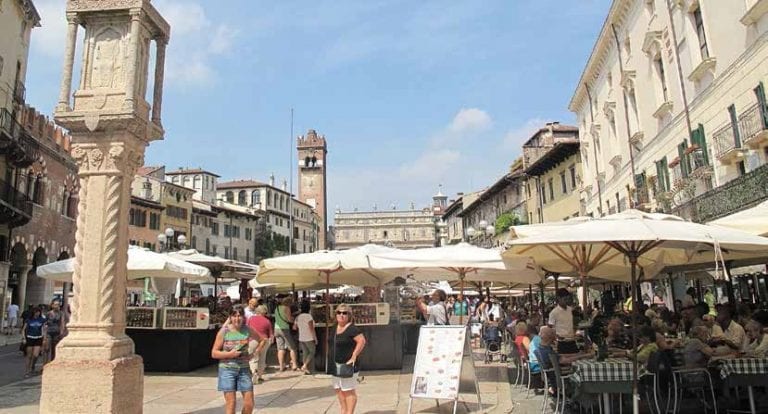
REGULAR FEATURES “HAVE YOU BEEN OVERSEAS AGAIN?” ASK OUR FRIENDS ENVIOUSLY. “WHERE HAVE YOU BEEN THIS TIME?” “HOW CAN YOU AFFORD THREE MONTHS AWAY?”
No, we are not millionaires, but like many retirees we have gone some way to solve the dilemma of being time rich, money not exactly poor, but vastly insufficient to put us in the jet-setting class. We have discovered the joys of Home-swapping! The theory is simple: You live in Brisbane and want to go to the UK during September/November. You need to find someone in the UK who wishes to visit Brisbane around the same time.
You then swap homes. You live in their home and they live in yours, often using each other’s cars. As well as overseas swaps you can arrange to exchange within your own country, useful for visiting adult children and grandchildren. In order to find your perfect match, you enlist the help of a kind of Introductory Agency, one of the many Home Swap Organisations. To find them simply put Home Swap into your Google Search Engine and you will find several organisations.
Having paid your money and signed up you then vet the possible exchanges yourself. It pays to be flexible. Remember Spring can be just as lovely as Autumn, perhaps Cornwall is unavailable at the right time but consider Yorkshire. Don’t shillyshally; most people want to feel that plans are secure and most important of all, having made an agreement, don’t renege unless there are compelling reasons such as serious health problems.
The first home swap you do you can be excused for being nervous, but once in you will find the water is lovely! Most common worries are centred on security. Will your new friends wear masks or balaclavas and make off with all your prized possessions? If really concerned, you can get friends to call around and count teaspoons but I assure you it is not really necessary….in fact, if you are into teaspoon counting perhaps home swap is not for you. Accidents can sometimes happen, so if Grandma’s vase is irreplaceable, maybe give it to a friend for safekeeping for the duration of your holiday.
It is also permissible to request that the contents of the display cabinet are not to be used during their stay. Another common worry is that somehow or other your home is not grand enough for the folk offering you their castle. Ask yourself, which you would rather stay in? A clean and tidy modest home or one requiring the up-keep of acres of dove-grey carpet. You are on holiday for Heaven’s sake! The one mansion we exchanged with, we lived in the kitchen anyway, being far too nervous to enter any other rooms besides those of a strictly utilitarian nature. It is usual to leave your new friends a potted guide to your home. This is well worth some time and thought.

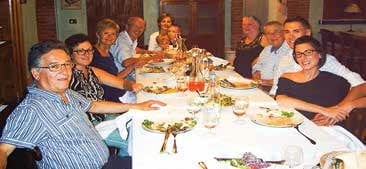
We have had so many problems with English showers that we always ask for instructions as to how to turn them on. I believe they are devised as a fiendish form of I.Q. test which Don and I were doomed to fail. Explain in detail how your air-conditioning works and hope they have revealed the mysteries of English heating. Each home has its own idiosyncrasies so if your dryer needs an encouraging “pat” to whirl into action write it down in the troubleshooting part of your vade-mecum.
Leave an emergency number of a good friend who knows your home well; preferably one who knows which of the seven remote controls operates the T.V. Maybe even enlist their help to welcome your guests if you cannot do this yourself. It is also a good idea to leave maps, bus and railway time-tables and brochures about the local tourist attractions to get your visitors started. Do not forget that the emergency number for your country could be different to theirs!
A crisis is no time to be looking! It usually takes a couple of days to feel at home in your new surroundings. With no expenses for accommodation and in many cases car hire, you can afford to splurge on meals out, the local fish and chip shop, or just the Pub. Alternatively, after an exhausting day spent sightseeing, you can paddle round in your pyjamas and eat sardines on toast, falling asleep in front of the Television…..not behaviour you can indulge in whilst staying in hotels or even with friends or relations.
No washing one’s smalls in vanity basins, you have a washing machine at your disposal which vastly cuts down the problem of how much to pack, although the friends of ours who have done thirty or more trouble-free swaps may have taken this to an extreme. They pack his sailor kit bag; he left the Navy many years ago but he is still seeing the world, and that’s it for both of them! To be continued…..
Other Articles
Types of Low or No Alcohol Wines
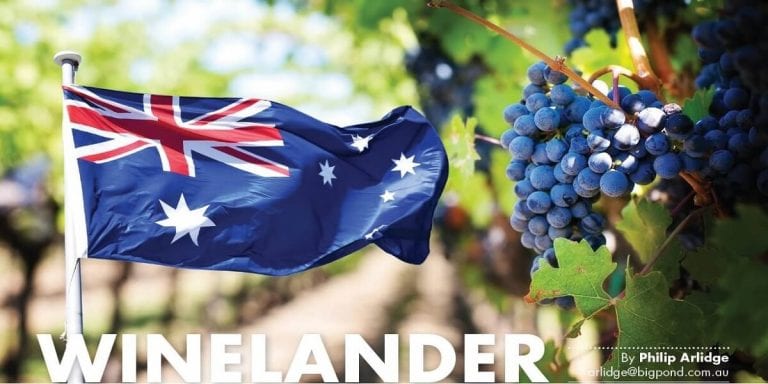
In recent editions of The Bribie Islander Magazine, we have covered the growth of organic wines which although looks impressive only comes from a very small base. There is another segment that is also continuing to grow but has been around since the making of wine began and that is low alcohol wines and no-alcohol wines.
Because of our warmer climate here in Australia and all the Southern Continents, the grapes always ripen with a higher sugar content which ferments to a higher alcohol content as each gram of sugar converts to 1% of alcohol depending on how sweet or dry the winemaker wants the wine to be. This has led to red wines having an alcohol content of between 13% and 15% and white wines around 12% to 13%. If the vines produce high-quality grapes the resulting wines usually have strong aromas, big flavours and tend to cellar for a long time, the downside is that each bottle represents 8 standard glasses which is also not good for your health.
When I say since time began in Europe most of the wines have always been made with lower alcohol of around 10%-12% due to cooler climates and when The New World wines became popular this encouraged many of them to get around the lower alcohol content by adding an amount of grape sugar before adding yeast which then increased the alcohol in the wine, this is called Chaptalizing something which is illegal here in Australia, although over the years several winemakers have been caught cheating. With the trend to lighter alcohol wines, all they have to do is go back to how they made wines for thousands of years.
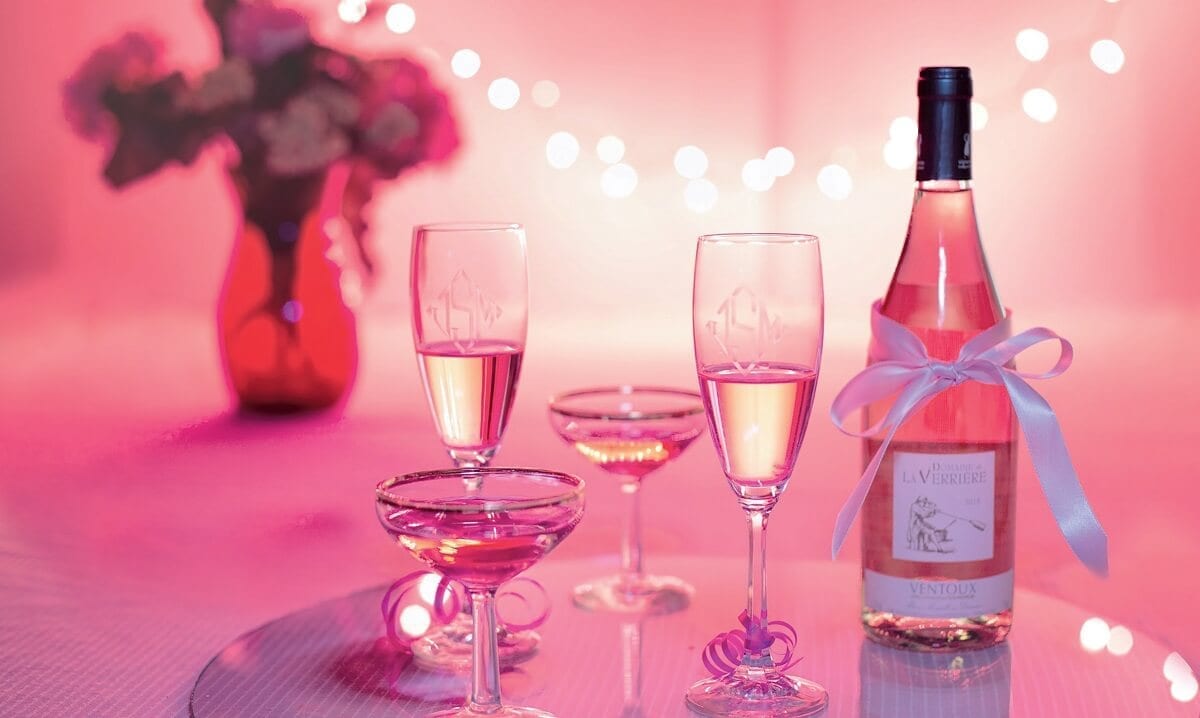 There have been several attempts to produce alcohol-free wines especially in the supermarkets, Ariel and Eden Vale are a couple, but I must be honest I have found them very sweet almost like drinking grape juice and the problem is that alcohol not only preserves wine it also enhances the aromas and flavours so when you reduce the alcohol a lot of the good things also disappear. However, because of health concerns, globally many winemakers are introducing lighter wines and also many of the new grape varieties from the cooler climates seem to cope better with this trend than our traditional varieties. Wines made from Vermentino, Viognier, Pinot Grigio and the Rose style all cope with lower alcohol better than the Cabernet Sauvignon grapes and Shiraz grapes.
Several New Zealand producers Giesen, Villa Maria, and Wither Hills produce lighter Sauvignon Blancs and are being backed by a 15million dollar government grant, the group have developed winemaking techniques that allow them to produce wines that are still full of flavour but naturally lower in alcohol, around 9%.
Here in Australia Casella who makes the Yellow Tail label, has released a Pinot Grigio, Sauvignon Blanc, Chardonnay and Rose to the U.K. market all at 8.5% alcohol, perhaps if successful we shall see them here one day.
Australian winemaking giant McGuigan Wines have just released through the Liquorland, First Choice outlets and Independent retailers an alcohol-free range called simply ZERO, in the varieties Sauvignon Blanc, Chardonnay, Rose, a Sparkling wine and a Shiraz using spinning cone technology, a method they claim to be the only winery with this in Australia and has been two years in the making. The Zero Sauvignon Blanc claims to have rich gooseberry and citrus aromas with a subtle grassy aroma. It is medium-bodied with notes of passionfruit and lime which one would expect to find on many Australian Sauvignon Blanc labels of this variety and it should be drunk very cold even with a couple of ice blocks, I found this wine worth a second visit.
The Rose doesn’t tell what grape varieties are in this wine but the label informs us that there are bright lifted aromas of delicate red fruits complimented with hints of rose petals. The palate is generous with flavours of strawberries and pink grapefruit leading to a crisp and refreshing finish. I thought for a non-alcoholic wine this was actually pretty good and certainly, on a warm evening, it was very refreshing and lived up to the back label description, again serve icy cold.
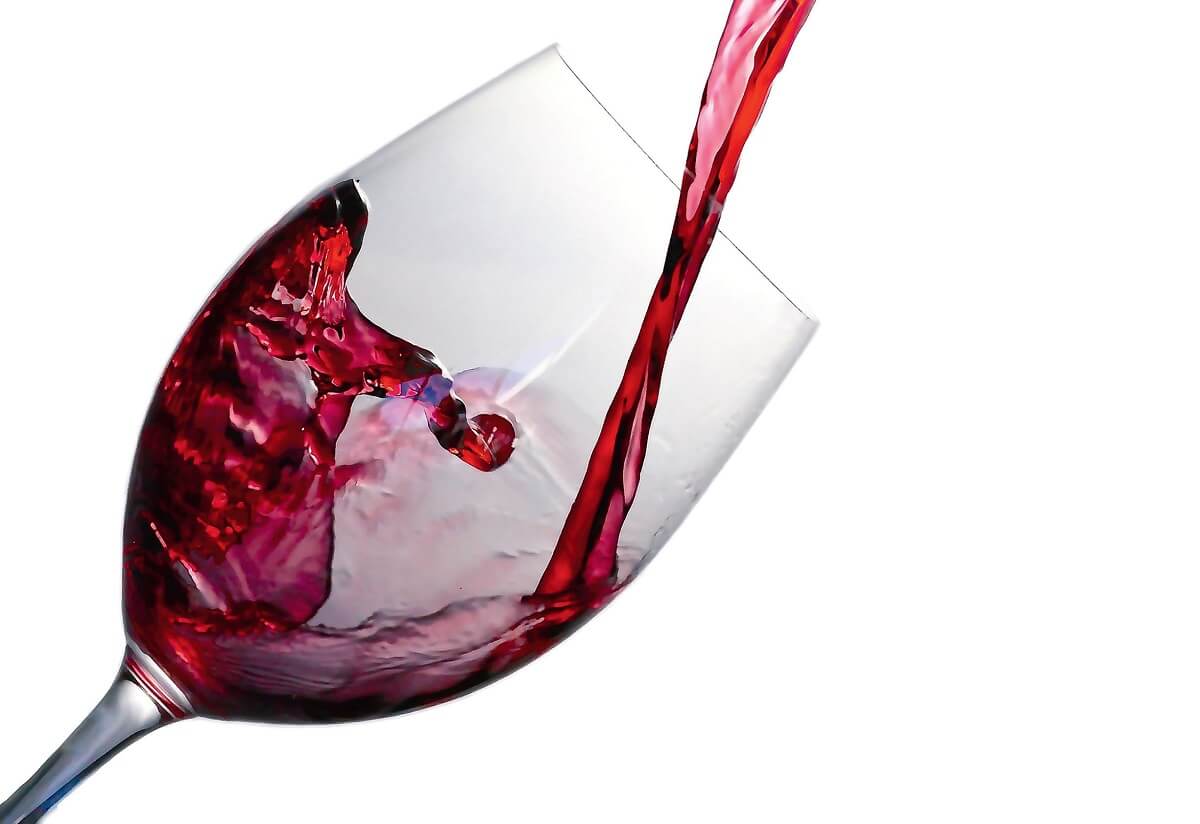 Again the sparkling wine didn’t mention the grape varieties but described the wine being refreshing featuring crisp pear and green apples, lively bubbles and an attractive crisp finish. Again serve icy cold and you will certainly enjoy this wine.
Unfortunately at this stage, the Liquorland outlets on the Island don’t seem to have found room for the Shiraz but perhaps by the time this article is out they may be stocking it. I found a bottle of the Shiraz at First Choice Morayfield and after being quite impressed with the plummy aromas felt let down with the flavour which seemed to me very disappointing however it may be worth trying if you are looking for a healthy alternative.
I was also impressed that the wine is bottled in premium wine bottles which lead me to think McGuigan is going to pursue this market and at this moment are at the forefront of an exciting new development in wine production.
Whilst these wines certainly don’t have the punch of the alcoholic varieties they are certainly a massive step up from the supermarket wines, if you enjoy a wine or two with dinner it is certainly worth checking out and you can drive home without any problems, they are specialled at around $10 and normally retail at $12.
I mentioned several issues ago that the bushfires could have an impact on the grapes with smoke taint and if you enjoy wines from The Adelaide Hills where more than 60 wineries have been affected, Victoria and The Hunter Valley in N.S.W. where Tyrell’s have up to 80% of their vines affected you should buy up now. Higher prices are forecast but this may open the doors for imported wines, we shall see, The U.S.A. has forecast a massive oversupply of grapes this vintage, leading to cheaper wines which will affect our exports over there and as I mentioned last issue several Australian companies especially Treasury Estate are certainly having a tough time over there.
Cheers Philip Arlidge [email protected]
Other Articles
What is the Coronavirus, where did it come from and why its so dangerous

“Feeling confused as to why Coronavirus is a bigger deal than Seasonal flu? Here it is in a nutshell. I hope this helps. Feel free to share this to others who don’t understand…
It has to do with RNA sequencing… I.e. genetics.
Seasonal flu is an “all human virus”. The DNA/RNA chains that make up the virus are recognized by the human immune system. This means that your body has some immunity to it before it comes around each year… you get immunity two ways…through exposure to a virus, or by getting a flu shot.
Novel viruses come from animals.
The World Health Organization: WHO tracks novel viruses in animals, (sometimes for years watching for mutations). Usually, these viruses only transfer from animal to animal (pigs in the case of H1N1) (birds in the case of the Spanish flu). But once, one of these animal viruses mutates, and starts to transfer from animals to humans… then it’s a problem, Why? Because we have no natural or acquired immunity.. the RNA sequencing of the genes inside the virus isn’t human, and the human immune system doesn’t recognize it so, we can’t fight it off.
Now…. sometimes, the mutation only allows transfer from animal to human, for years it’s only transmission is from an infected animal to a human before it finally mutates so that it can now transfer human to human… once that happens..we have a new contagion phase. And depending on the fashion of this new mutation, that’s what decides how contagious, or how deadly it’s gonna be…
H1N1 was deadly….but it did not mutate in a way that was as deadly as the Spanish flu. Its RNA was slower to mutate and it attacked its host differently, too.
 Fast forward to today’s Coronavirus pandemic.
Now, here comes this Coronavirus… it existed in animals only, for nobody knows how long…but one day, at an animal market, in Wuhan China, in December 2019, it mutated and made the jump from animal to people. At first, only animals could give it to a person… But here is the scary part…. in just TWO WEEKS it mutated again and gained the ability to jump from human to human. Scientists call this quick ability, “slippery”
This Coronavirus, not being in any form a “human” virus (whereas we would all have some natural or acquired immunity). Took off like a rocket. And this was because Humans have no known immunity…doctors have no known medicines for it.
And it just so happens that this particular mutated animal virus, changed itself in such a way the way that it causes great damage to human lungs.
That’s why Coronavirus is different from seasonal flu, or H1N1 or any other type of influenza…. this one is slippery AF. And it’s a lung eater…And, it’s already mutated AGAIN, so that we now have two strains to deal with, strain s, and strain L….which makes it twice as hard to develop a vaccine.
We really have no tools in our shed, with this. History has shown that fast and immediate closings of public places have helped in the past pandemics. Philadelphia and Baltimore were reluctant to close events in 1918 and they were the hardest hit in the US during the Spanish Flu.
Factoid: Henry VIII stayed in his room and allowed no one near him, till the Black Plague passed…(honestly…I understand him so much better now). Just like us, he had no tools in his shed, except social isolation…
And let me end by saying….right now it’s hitting older folks harder… but this genome is so slippery…if it mutates again (and it will). Who is to say, what it will do next.
Be smart folks… acting like you’re unafraid is so not sexy right now.
#flattenthecurve. Stay home folks… and share this to those that just are not catching
Read more from the source of this article here.
Other Articles
History – Bribie News 60 years ago

[vc_row][vc_column][vc_column_text]My regular articles about Bribie History are generally bases on research and information from up 100 years ago, but 60 years ago is much more recent. The last article about a “Future Vision for Bribie” was a bit different and got some interesting reactions. It is easy to forget about things as recently as just 60 years ago.
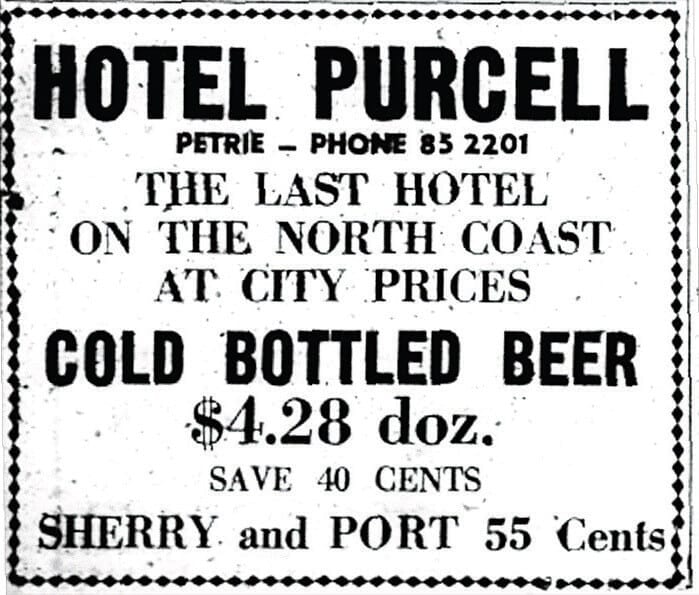
For some “senior” readers the 1960s will be vivid memories, while for younger people it is like ancient history. This article is a reminder of some fascinating events back then, with articles and advertisements from local newspapers at that time. Back then, a dozen bottles of Beer were just $4.28, and a very smart new Automatic Washing Machine was only $129.
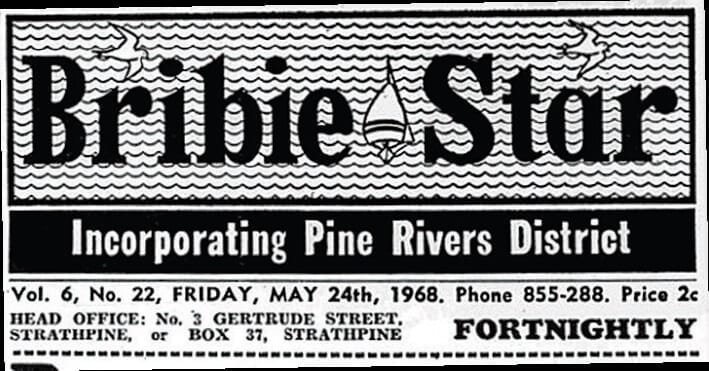
In 1962 Bribie, a year before the Bribie Bridge opened, Bribie ran its own newspaper, the “Bribie Star”, for 10 years until the early 1970s. Newspaper headlines from that time provide an insight into the topical and political issues and news from that era. Here are some news items that were taken from the Bribie Star that you might find interesting.
NEW BUILDINGS ON BRIBIE
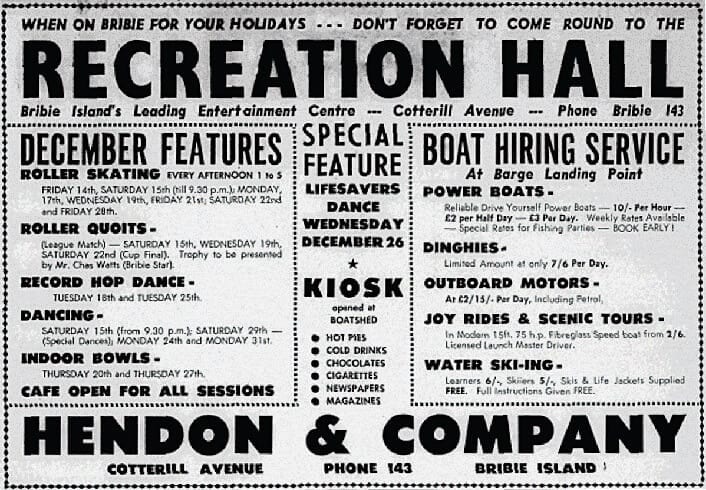
With the building of the bridge to Bribie, new business opportunities opened up, including a Recreation & Sports Centre in Cotterill Avenue built by Hendon & Sons. It offered Roller Skating, Quoits, Dancing, and indoor Bowls, together with various Boating Services. The building later became a Cinema for a few years, after that was “Busy Fingers” Op shop for 22 years and is now the Baptist Church.
When the Bribie Bridge opened, you could build a new two-bedroom home on Bribie for $2176, with just $100 deposit.
INDUSTRIAL DEVELOPMENT
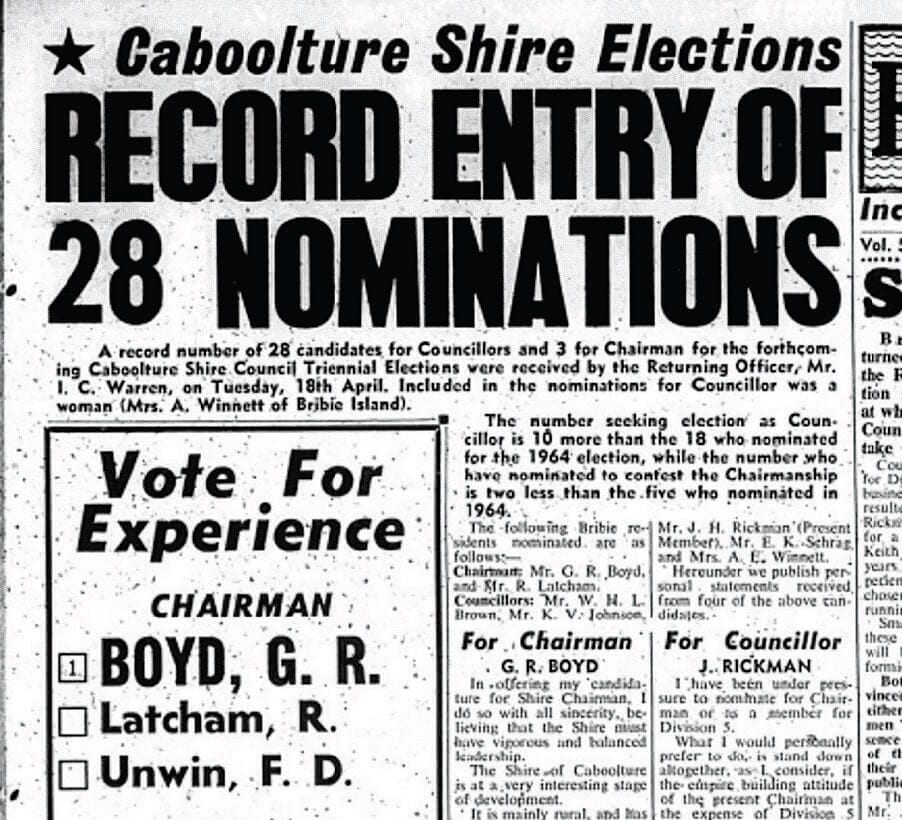
In 1967, it was proposed to approach the Government about the construction a major Oil Terminal in the Pumicestone Passage area, to unload Oil cargoes from large new Oil Tankers being built. There was also a Caboolture Shire Council election in 1967 in which a record number of 28 candidates nominated for election.
There were 3 Bribie people who nominated for election as Chairman of the Council. The article mentions the names of Boyd, Schrag, Latcham. Unwin and Rickman, who are all well-remembered people from Bribie’s past, who have streets or Parks named for them.
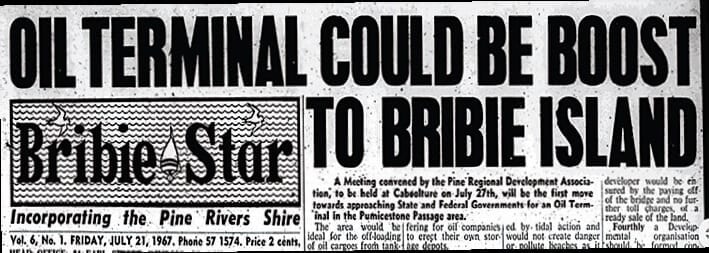
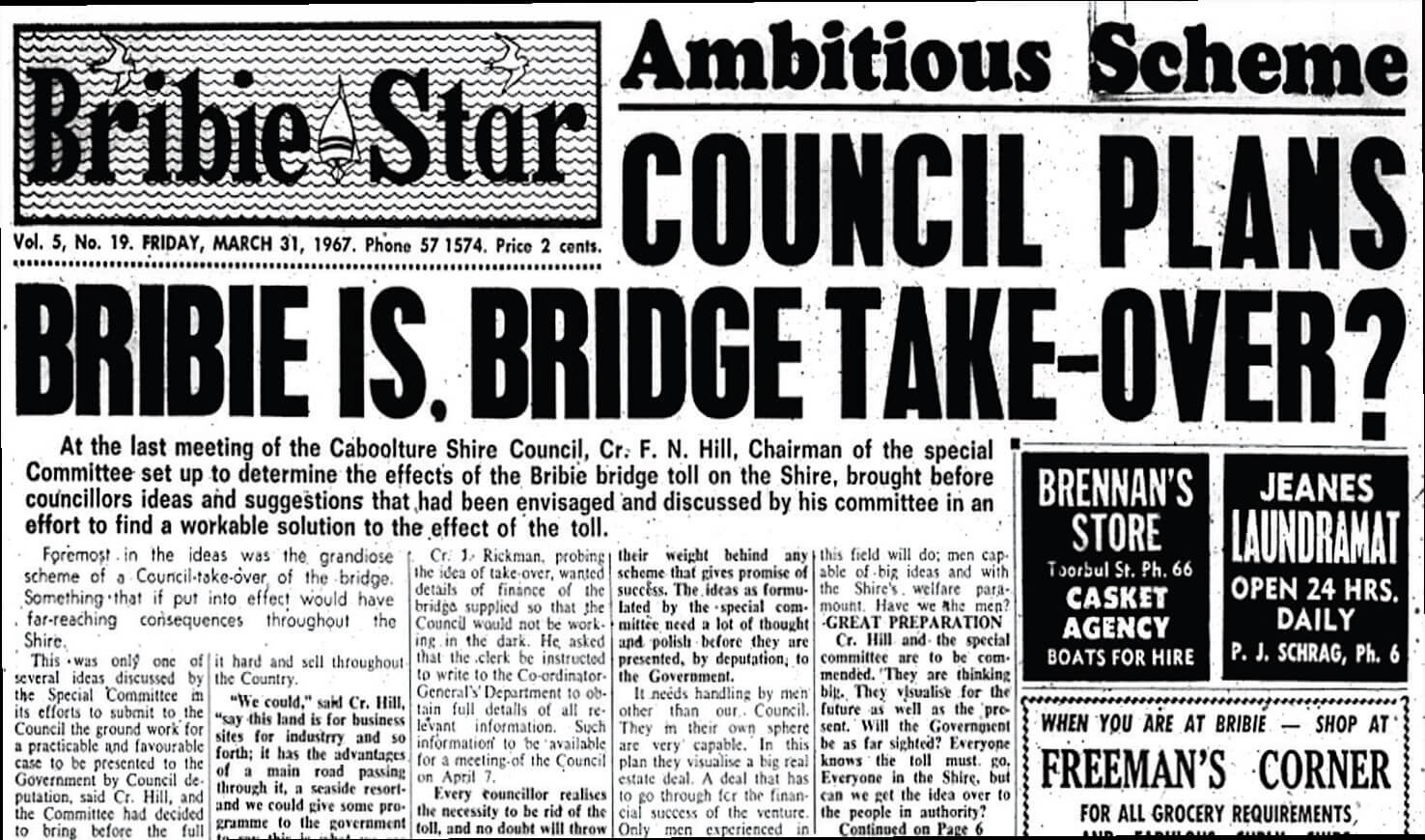
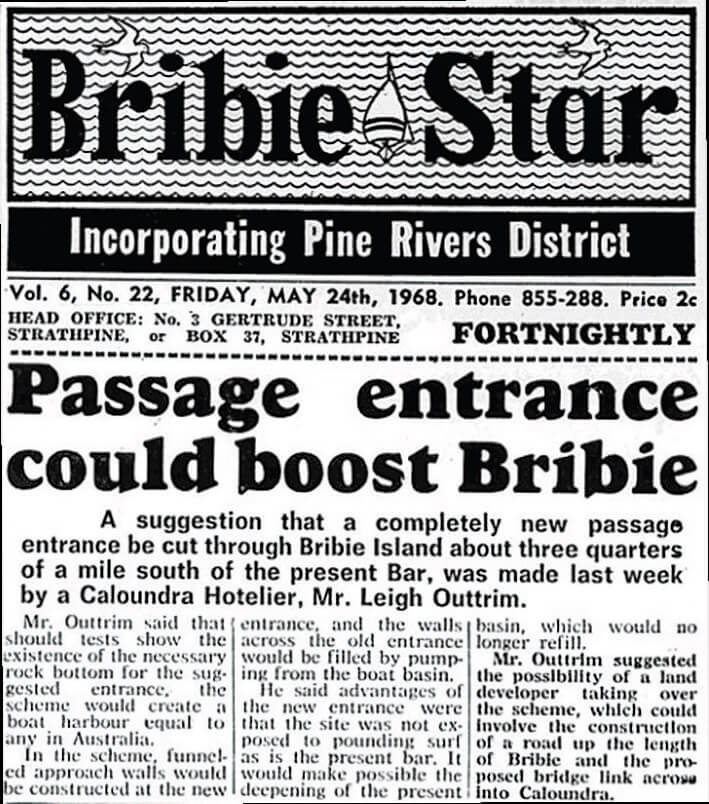
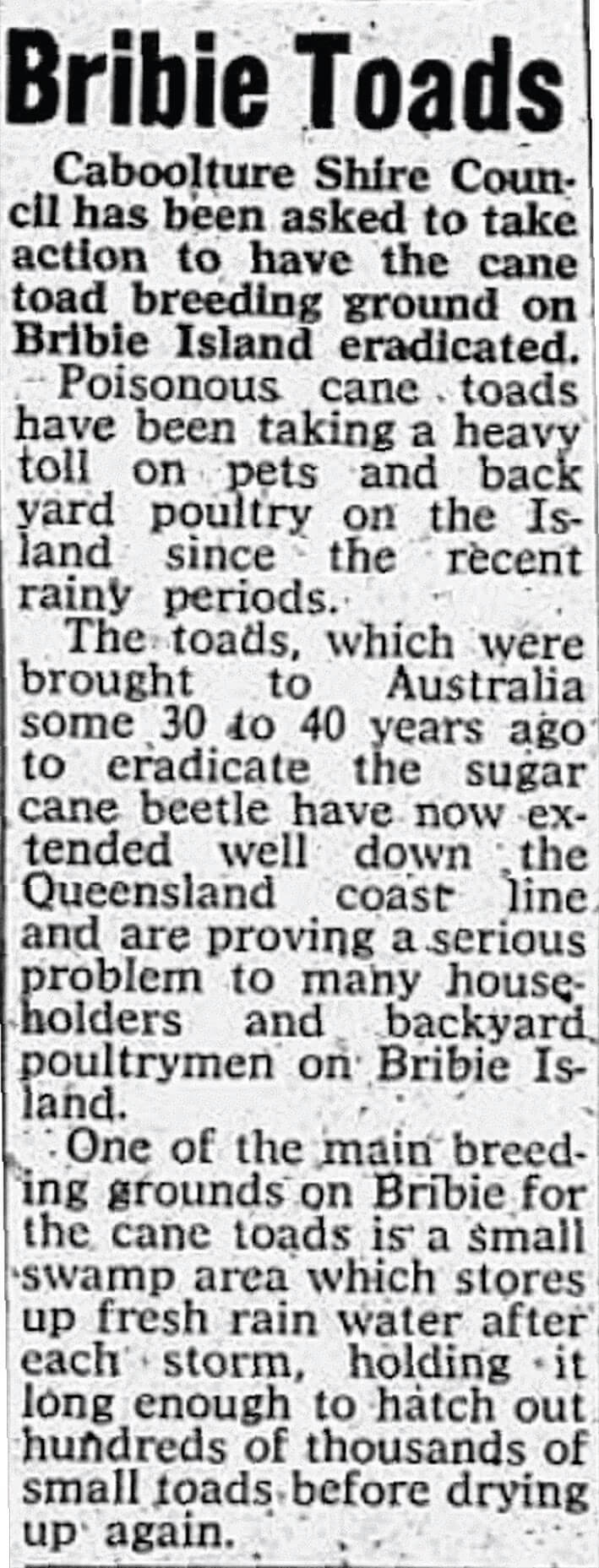


BRIBIE BRIDGE TAKE-OVER
When the Bridge opened in 1963 a surprise announcement of an expensive Toll to be paid to cross the Bridge, created much concern in the community. This led to further agitation for Bribie Island to succeed from Caboolture Shire Council and become its own self-Governing Council. There was even talk of a Council takes over the Bribie Bridge from the State Government, who had built it, to have direct control of the Bridge Toll revenue.
CUT THROUGH THE ISLAND
In 1968 an even more amazing proposal was put forward, to cut a channel through the north of Bribie Island, into Pumicestone Passage, and build a new access road up the middle of the island, and new Bridge to the mainland.
LOOKING BACK AT LIFE
These news clips from the Bribie Star newspapers are just a few of the fascinating stories published throughout the 1960s. You can imagine what the resident’s and visitors’ reactions might be. Some were delighted….and others very sad. None of these things actually eventuated………but Beer was just $4.28 a dozen!
I hope they give you an appreciation of the sorts of political issues at that time. There were only about 700 residents on Bribie in 1963 when the bridge opened. There was still a lot of wildlife, excellent fishing and a variety of birds and wildflowers that were enjoyed by residents and visitors. It seems that Cane Toads were becoming a major problem at that time as this newspaper article testifies.
Other articles
- Vintage, classic and historic car group – HISTORICAL CARS ON BRIBIE ISLAND
- History – REMEMBER AUSTRALIA?
[/vc_column_text][/vc_column][/vc_row][vc_row][vc_column][/vc_column][/vc_row]
Little Red Flying Foxes Visit the Sanctuary of Bribie Island
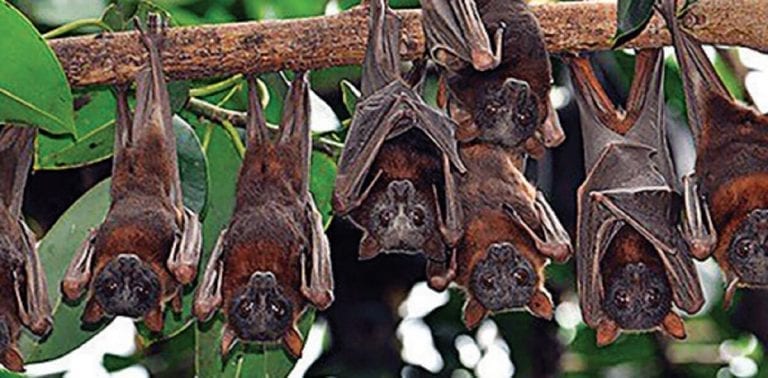
[vc_row][vc_column][vc_column_text]A most remarkable phenomenon is happening right now here on Bribie Island. Thousands of the Little Red Flying Foxes have come to enjoy the flowering trees. They are the only flying fox in the world that almost exclusively eats nectar. As many Australian eucalypts and related trees only make pollen at night, the bats are their pollinators as the bees only work in the daytime.
So, without these remarkable creatures and their cousins, the Black, Grey Headed and Spectacled flying foxes pollinating, there would be no koalas and no Australian trees for us to enjoy. With so much devastation at present, please be conscious of the need for these Little Red Bats.
They are migratory so will not stay long. They will be noisy and maybe a little on the nose, but this is a small disturbance for us for a short time for the valuable work they do for us humans and all creatures that need trees. Living in strong family groups they hang together and fly together en masse making highways in the sky at dusk. Something more than remarkable – a gift for us to observe in wonder!
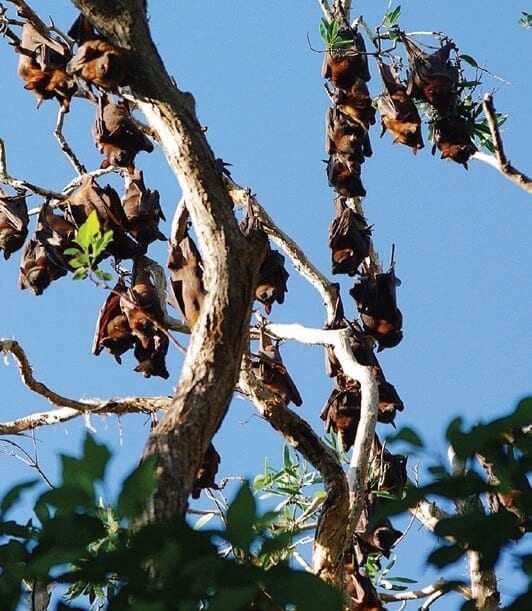 Although thought of as a threat to humans, they do not attack. If a bat is sick or injured and on the ground no member of the public should touch it but should call Wildlife Rescue Queensland on 0478 901 801 to assist the bat.
While Little Reds are not regarded as endangered yet, the Australian government lists Grey-headed Flying Foxes as vulnerable. The recent clearing of trees near where the Little Reds are now camping disturbed the Greys and the Blacks, many of which had youngsters depending on them.
They need all the help they can get to raise their families. Look upwards in awe as they fly on the highways of the sky. Look closely at their translucent wings and remember without these bats, no trees, no tree dwellers, negatively impacting on our wellbeing.
Other Articles
- AUSTRALIAN PELICAN – PELECANUS CONSPICILLATUS
- Bribie Wildlife – LITTLE CORELLA (CACATUA SANGUINE)
- AUSTRALASIAN FIGBIRD (SPHECOTHERES VIEILLOTI)
[/vc_column_text][/vc_column][/vc_row][vc_row][vc_column][/vc_column][/vc_row]
Gloss Magazine Bribie Islander March 27th 2020 Issue 110

[vc_row][vc_column][vc_column_text]Get all your community news and information. Bribie Islands only community gloss magazine NOW EVERY TWO WEEKS! – Articles on boating, camping, fishing, life, drama, travel destinations, sports and what to see and do on Bribie Island. Covering charities, organisations, places, children’s activities, arts and crafts, tourist destinations, heritage parks, technology, science, music, gardening, and much more.
Download latest digital edition here. Or use the ebook below to view.[/vc_column_text][/vc_column][/vc_row][vc_row][vc_column][vc_column_text][/vc_column_text][/vc_column][/vc_row][vc_row][vc_column][/vc_column][/vc_row]