Tags: Music Festival. Events. Live Music. Bribie Island. Sandstone Point
As most Bribie Islanders (and visitors) know, there are many talented and popular entertainers who reside within the local area and can often be seen performing to patrons at one of the hotels, restaurants or clubs.
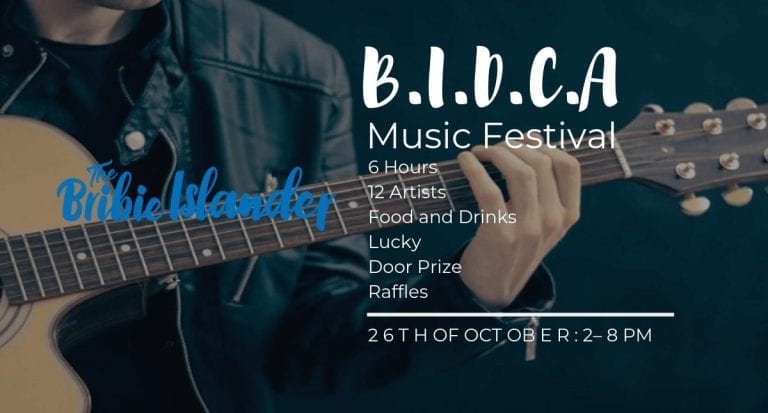
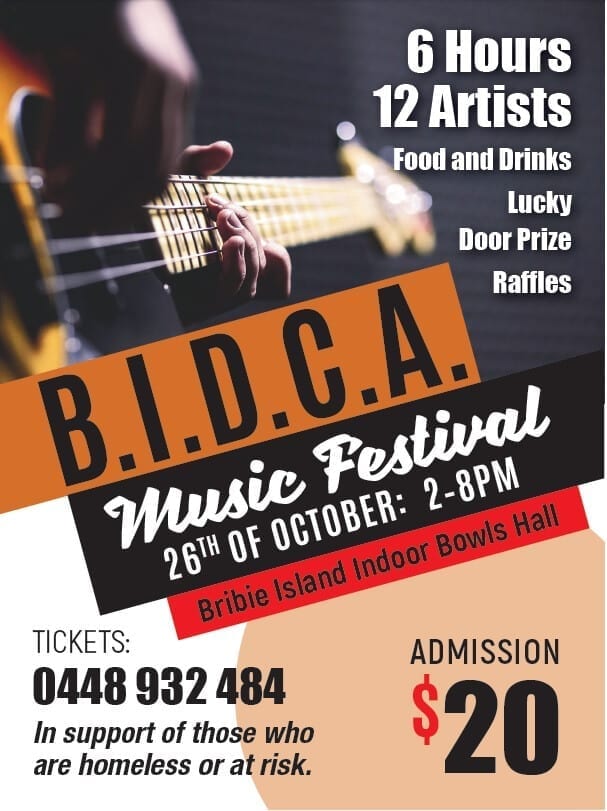
Whilst this ensures that there is almost always somewhere to go for music lovers to enjoy whatever genre that is their favourite, at most these events usually only feature two or three artists over a few hours so, for anyone who would like to be entertained by a different artist every thirty minutes over a six-hour period, the BIDCA Music Festival on October 26th is an event not to be missed.
Commencing at 2 pm in the Bribie Island Indoor Bowls Hall on First Avenue (next to the Orchid House), this concert is being held as a fundraiser in support of those who are homeless or at risk and a BIDCA (Bribie Island District Community Appeal) spokesperson has advised that, as there are only a total of two hundred tickets available, those who wish to attend should get in early to avoid disappointment.
‘The artists who are appearing at the Music Festival all have their own style and this will ensure a great range of genres, providing entertainment for all tastes and making it a must-attend for many,’ he pointed out. Over the six hours, music lovers will be treated to performances by Michael Early, The Wildflowers, Jack James, Rick Dalton and Erin May as well as Emma Dyson, Peta Schubel, the Plumb Dogs and more.
To ensure that patrons do not go hungry, there will be tasty hamburgers and cold drinks available throughout the duration and as well as the chance to take home the lucky door prize, festival-goers will have the opportunity to purchase tickets in the raffle which offers major prizes of a BBQ Boat Hire Voucher and a New Acoustic Guitar with carrying bag and other minor prizes.
As is the case with all fundraising events, the support of the local community and businesses is essential and the BIDCA team have said that they would like to thank major sponsors Victory Press, Simone Wilson MP, The Bribie Islander Community Magazine and Bribie Island Boat Charters along with other businesses for their wonderful support. Anyone who wishes to purchase tickets or find out more about the BIDCA Music Festival should call Neil on 0448 932 484.
RAISE YOUR MUG FOR THE BREW THAT KICK-STARTS THE DAILY GRIND
Millions of coffee lovers across the world will be raising their mugs tomorrow morning as they pay homage to one of humanity’s all-time favourite drinks.
Tomorrow (October 1) is the fourth annual International Coffee Day, a calendar milestone that enables caffeine-lovers to celebrate the dark, rich brew that kick-starts their daily grind each morning.
Australians consume nearly 2kg of coffee every year with more than one in four fans (27 per cent) admitting they couldn’t survive the day without a cup.
Brisbane coffee company owner Dean Merlo said Queensland coffee drinkers had developed refined palates when it comes to nature’s nectar.
“When I opened my first espresso bar in Brisbane in 1992, a cappuccino was considered exotic,” said Mr. Merlo, owner of Merlo Coffee.
“People now like to choose beans from particular countries and they drink different styles of coffee at different times of the day. We’ve come a long way.”
But how much do we really know about our favourite brew?
Here’s a way to test your coffee connoisseur knowledge:
Which country produces the most coffee in the world each year?
In which Australian state was the first recorded growth of coffee in Australia?
What is the most popular style of coffee in Australia?
How many cups of coffee are consumed every day around the world?
a) More than 1 million
b) More than 1 billion
c) More than 2 billion
d) More than 5 billion
If you drink a coffee that has fruity and floral flavours, which continent are the beans most likely to come from?
Answers:
Brazil produces the most coffee at 2,592,000 tonnes per year, followed by Vietnam with 1,650,000 tonnes.
The first recorded growth of coffee in Australia was at Kangaroo Point in Brisbane, Qld in 1832.
Australia’s favourite style of coffee is a latte (33% of coffees bought in Australia are lattes, 24% flat white).
Approximately 2.25 billion cups of coffee are enjoyed every day around the world.
African coffees are often described as complex, fruity and floral. These are stronger, fragrant-rich and full-bodied flavours.
Get all your community news and information. Bribie Islands only community gloss magazine NOW EVERY TWO WEEKS! – Articles on boating, camping, fishing, life, drama, travel destinations, sports and what to see and do on Bribie Island. Covering charities, organisations, places, children’s activities, arts and crafts, tourist destinations, heritage parks, technology, science, music, gardening, and much more.
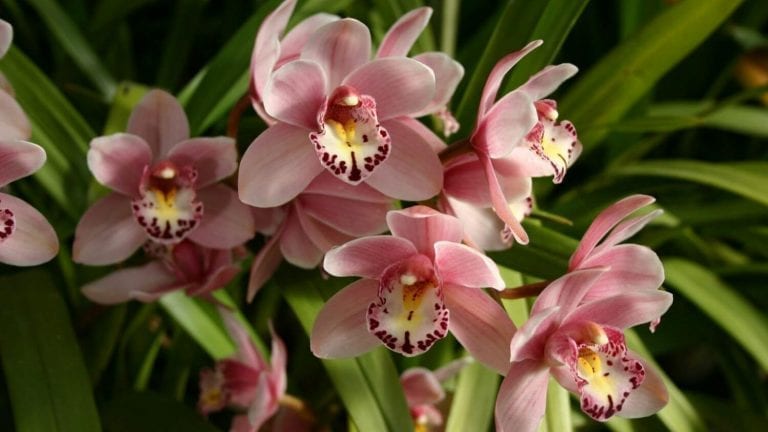
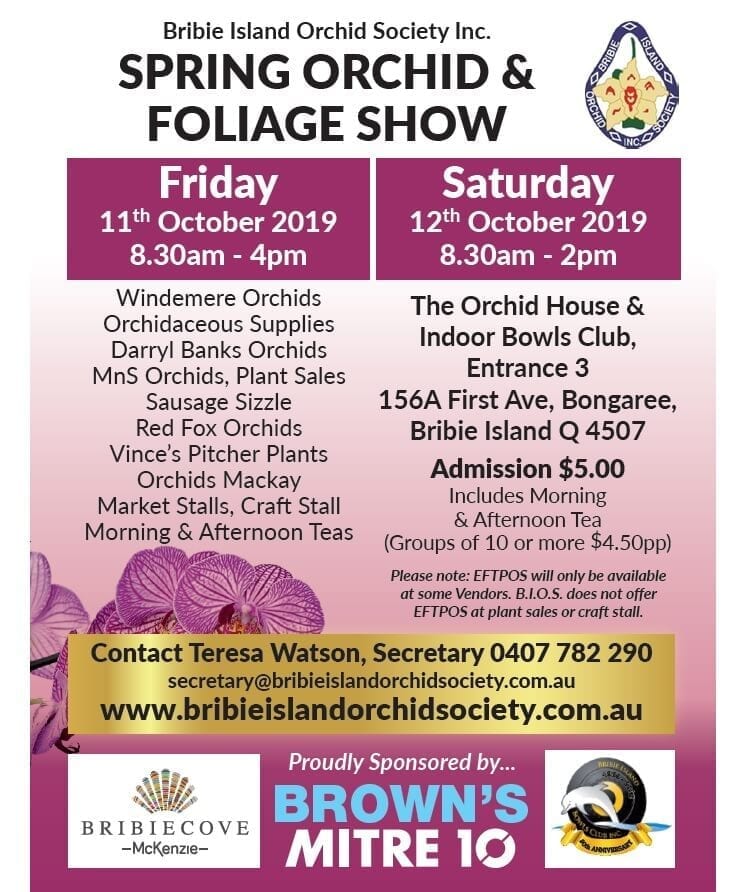
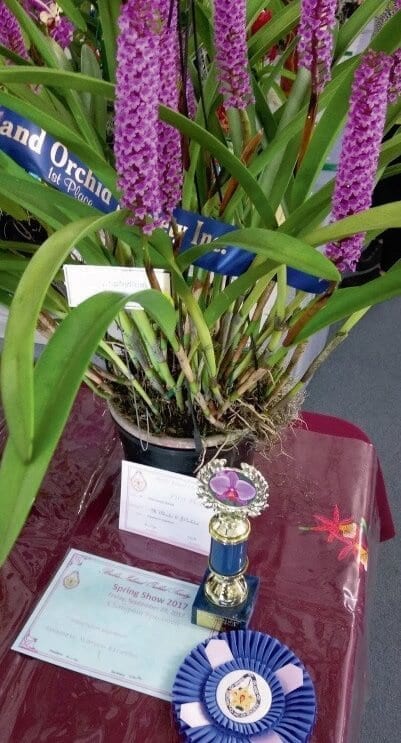
October brings lots of orchid lovers from far and wide to see the beautiful blooms on display at the Bribie Island Spring Orchid and Foliage Show, proudly sponsored by the Bribie Island Bowl Club, McKenzie Aged Care and Mitre 10. Bribie Island Orchid Society Inc. was founded thirty-two years ago and currently has approximately 90 enthusiastic members from all walks of life, some of whom are beginners with just a few plants, through to those who have been bitten by the ‘orchid bug’ (be warned, they are very addictive) and have collections of several hundred covering numerous genera.
Flowers range from some of the very tiny Species group through to the large showy hybrids. There is always something to catch the eye of just about anyone who visits the Show, including the huge range of Foliage plants which are displayed in the Indoor Bowls Hall. The annual Spring Show has been held at the Orchid House at Bongaree for the previous nine years and in other locations before then and has always attracted orchid enthusiasts from near and far, not only for the display, but to also have the opportunity to purchase plants from the number of vendors who set up at the Show, some from as far away as Sarina and Mackay.
There will also be a cake and craft stall, potting demonstrations and one of our favourites, the sausage sizzle run by the Vietnam Veterans Association. Speaking with President Paul Thomas, Paul is confident that this year’s event will be bigger and better and those who attend will not be disappointed. Secretary, Teresa Watson indicated that Mitre 10 have generously donated a wheelbarrow filled with gardening goodies to be raffled during the twoday show.
“The only way people can get a ticket in that raffle is for them to come along to the Show. We will also be selling tickets in another raffle which has prizes of $150, $100 and $50 Woolworths gift cards, each with an orchid. These tickets will be sold at a number of locations around the island prior to the event, including a sausage sizzle at Mitre 10. A portion of the profit from these raffles will be donated to the Vietnam Vets Association”. The Show will be held at The Orchid House and the Indoor Bowls Hall, Entrance 3, 156A First Avenue, Bongaree on Friday 11th October from 8.30am until 4pm and Saturday 12th October from 8.30am until 2.00pm.
Entrance is $5 per person which includes either morning or afternoon tea. The premises are wheelchair friendly and groups of ten or more will receive a discount on the admission price. The society welcomes new members or anyone who just wants to come along to a meeting or two to see what goes on. For more information about the society itself, those interested should log onto the website www.bribieislandorchidsociety.com.au, our Facebook page which has updates, or give Teresa a call on 0407 782 290.
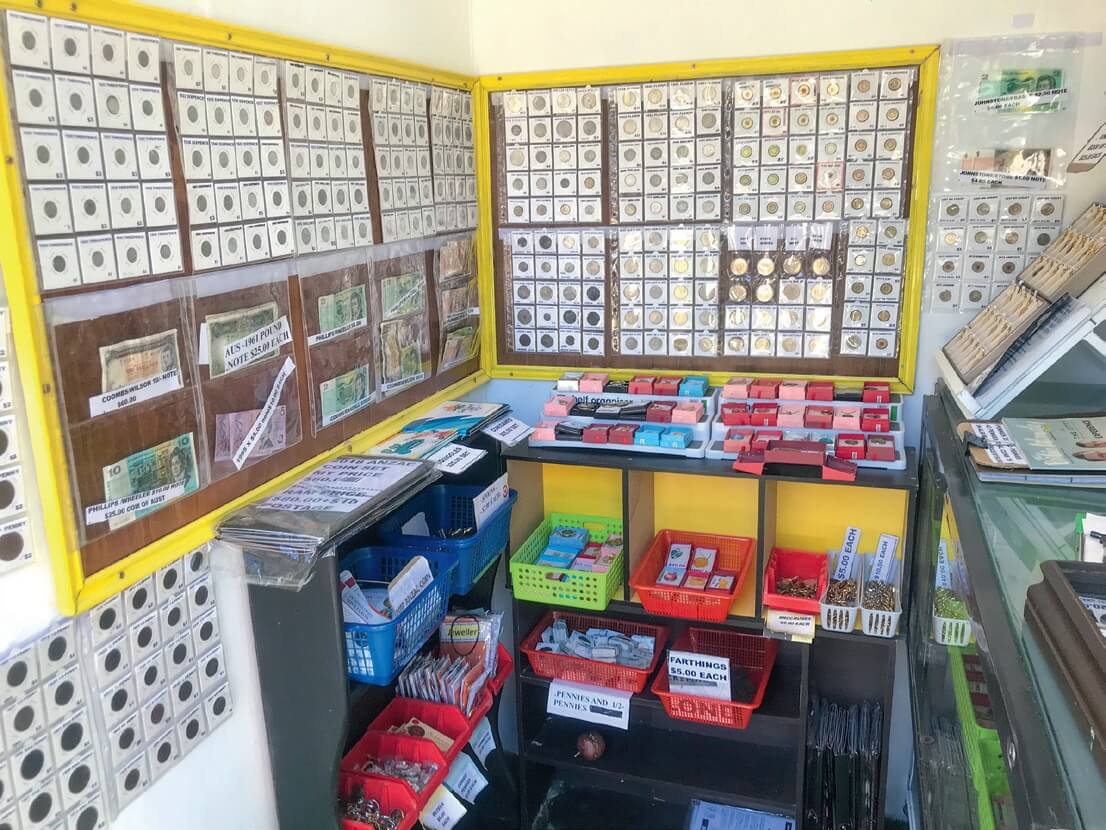
When a new business opens on the island it’s always interesting to see what they have to offer and will they be a success? But what if this business had never been tried on Bribie? Surely every type of retail shop has had a go over the past few decades or so? Wrong… Welcome to The Teenie Weenie Coin Shop where local owner Ray Wharton has a mind, full of information on all manner of coins and banknotes whether buying or selling. Ray has over 30 years’ experience and knowledge in this industry.
Featured Image(above): Ray in The Teenie Weenie Coin Shop
Now His tiny shop in between Allen and Louise at Serenity Cafe (and by the way a bacon/egg muffin & small coffee is only $7! My breakfast hot spot!) and the barbershop run by local Ian Davies situated on the corner of Welsby Parade and Kangaroo Avenue at Bongaree. I would reckon the coin shop is the smallest shop on Bribie Island, I don’t recall seeing anything smaller but I could be wrong. I had a good old yarn to Ray and he said. “Being in the industry for 30 years, I had coin shops in Brisbane, I’ve attended the Bribie markets for 10 years building up a clientele base and I still have them, customers, today. The markets were too much work, packing, and unpacking.
I’ve been in this shop now for 2 months, it’s going alright, between this and eBay I’m selling a fair bit, I use the shop as an office too. I’m buying a lot locally and selling well on the island with hundreds of local collectors, new ones walk in every day.” I asked what value do the coins and notes increase with age? “Coins and notes go up around 8% per year, people buy these for investment too, it’s silver and gold, the 1966 ‘Rounda’ (50c silver round coin) are a good investment, I have a bloke who comes to the shop every morning looking for silver, interesting.
I get a lot of old crap too, there’s a lot of 1800 stuff here as well” When Ray was 18, he found a job on the railway and then worked his way up to station master out at Cloncurry in North-West Queensland, he came back and joined the company Rambles in Townsville as the branch manager, working there for many years. Ray left Townsville and headed back to Brisbane and opened a coin shop where his local journey began. I wondered what made him open up a coin shop and asked the question?
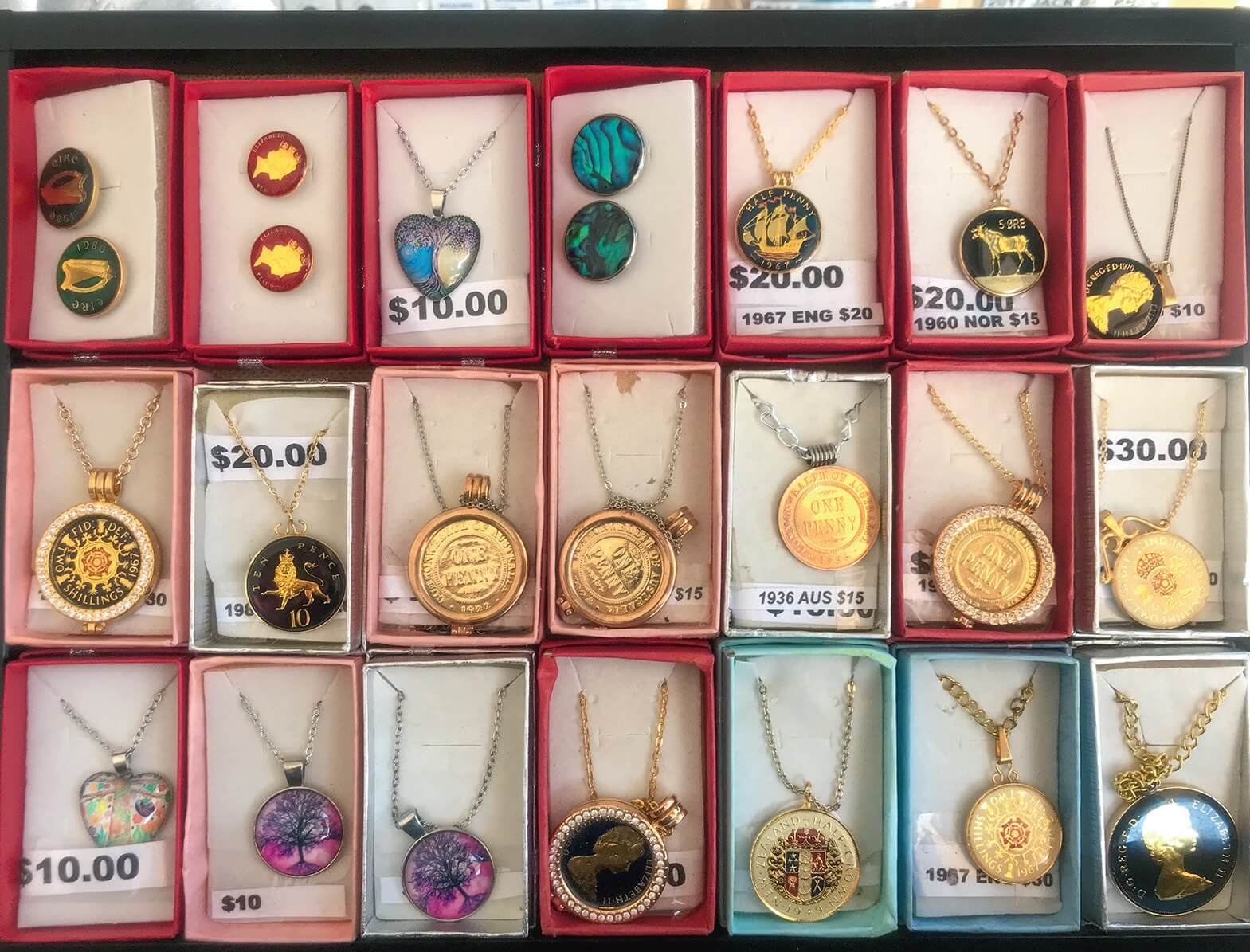
Coin jewellery
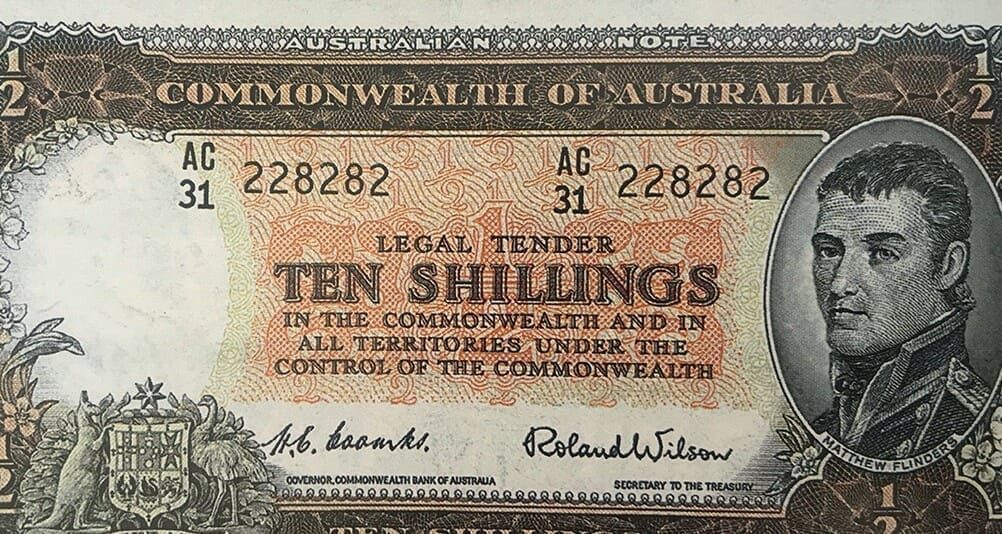
A Ten Bob note
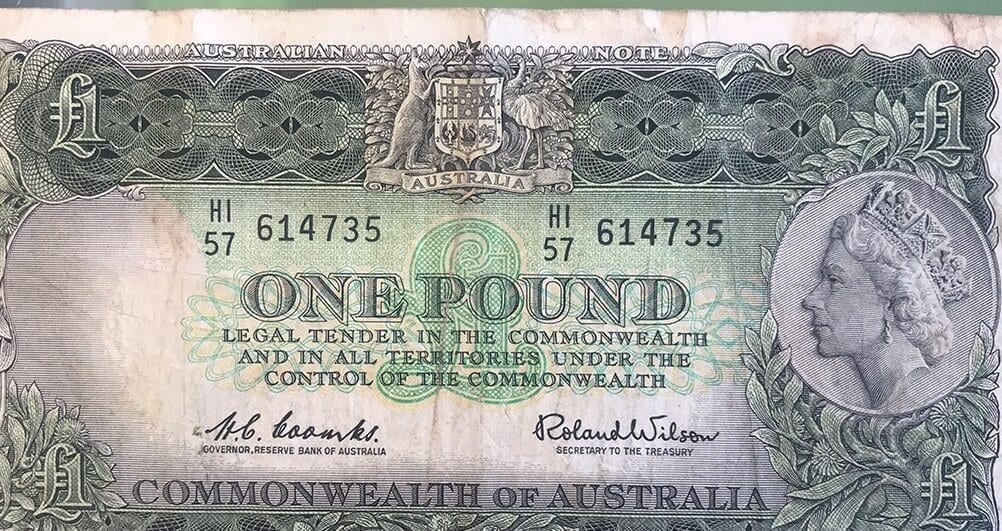
Bringing back memories to the writer a one pound note
Quite an impressive collection for such a small place
“Because I was a collector, 30 years ago, and I know it all off the top of my head with the Australian stuff, I research anything else. There are the 25 and 46 penny, the 33 shilling, the 23 ha’penny, the 30 penny. I had a one-pound star note I paid $500 for its now worth about $3000.” Ray said. “Really? What is a star note?” I asked and Ray explained. “In the old days they used to send them out in bundles of 100 and if they stuffed one up the last digit on the numbers was a star”.
“So that made it a rare one then?” I asked. “Yes, they start at $800 but uncirculated notes are worth up to $32,000 for a Dollar note, 10 shillings” “what’s the most expensive item here in the shop?” I asked. “$600, it’s a gold sovereign from 1893, I had 2 of them, sold one the other day, there’s $666 worth of gold in that, 3 of them to the ounce, golds over $2000 an ounce at the moment” “That’s amazing, isn’t it? Do you take the big value items home?” “Yep…all the expensive items are taken home each night. With these banknotes, they go on signatures, crumpled or ‘scrubbers.”
Which Ray described “That are rough as guts, a cheap one $8, one there for $60 or a couple of hundred dollars” “Can you iron them out?” “No, you can’t iron them if that one wasn’t creased it’ll be worth a couple of hundred dollars.” Coin Jewellery given to Ray from a colleague who is no longer able to make coin Jewellery rang him up about 6 months ago and said. “Ray you’ve been dealing with me for 30 years, you’re the only one I want to have them, the Jewellery I’ve got leftover” Ray explained he was quite generous and what was included.
“He gave me 24 boxes of jewellery. First, he gold plates them, then under a big magnifying glass he handpaints them then finishes with a clear gloss resin” “The 1927 Canberra comes up a million dollars, this is a 2 bob, I haven’t got a 27, this one here with Parliament house on it 1934, 1935 is worth big dollars” Ray shows me his paperback book of notes and coins with dollar values depending on rarity and condition.
Ray has been a Queenslander all his life and was born in Rockhampton, he has been a resident of Bribie Island for 12 years now. He told me that everybody he has dealt with he has always given them a fair deal and tells me his price is the lowest. “If you were to buy off me it will be cheaper than anywhere else.” And Ray guarantees that. If you never knew Ray was there at The Teenie Weenie Coin Shop, pop in and say G’Day, he’s a really nice bloke and it’s well worth a look.
I thought what a great present these notes and coins would make, sorry to say this, but Christmas is coming! (Way too quickly) I might add. Buy Local. Shop Local. Support Local Business.
Tags: History. Bribie Island Historical Society. Brisbane. Queensland. Australia
When I retired to the peace and quiet of Bribie Island, after a worldwide career as a Project Management Consultant, I had no idea how my life would be changed. I had lived and worked for over 40 years on projects in Libya, Denmark, China, Indonesia, Japan, Malaysia, New Zealand and more recently on the Sydney Olympic Games and the Sydney Harbour Tunnel. As a member of Rotary International, I had organised a huge fundraising walk through the new Sydney Harbour Tunnel.
On moving to Bribie in 2003 I noted that it was the 40th Anniversary of the Bribie Bridge, so I organised a Bridge walk as my first fundraiser for Bribie Rotary. With absolutely no knowledge or interest in Bribie Island history this simple event launched me into an amazing retirement hobby. I happened to meet a delightful old lady who had been involved in the opening celebrations for the Bribie Bridge on 19th October 1963. I had travelled around the world more than 50 times and lived in 20 different countries.
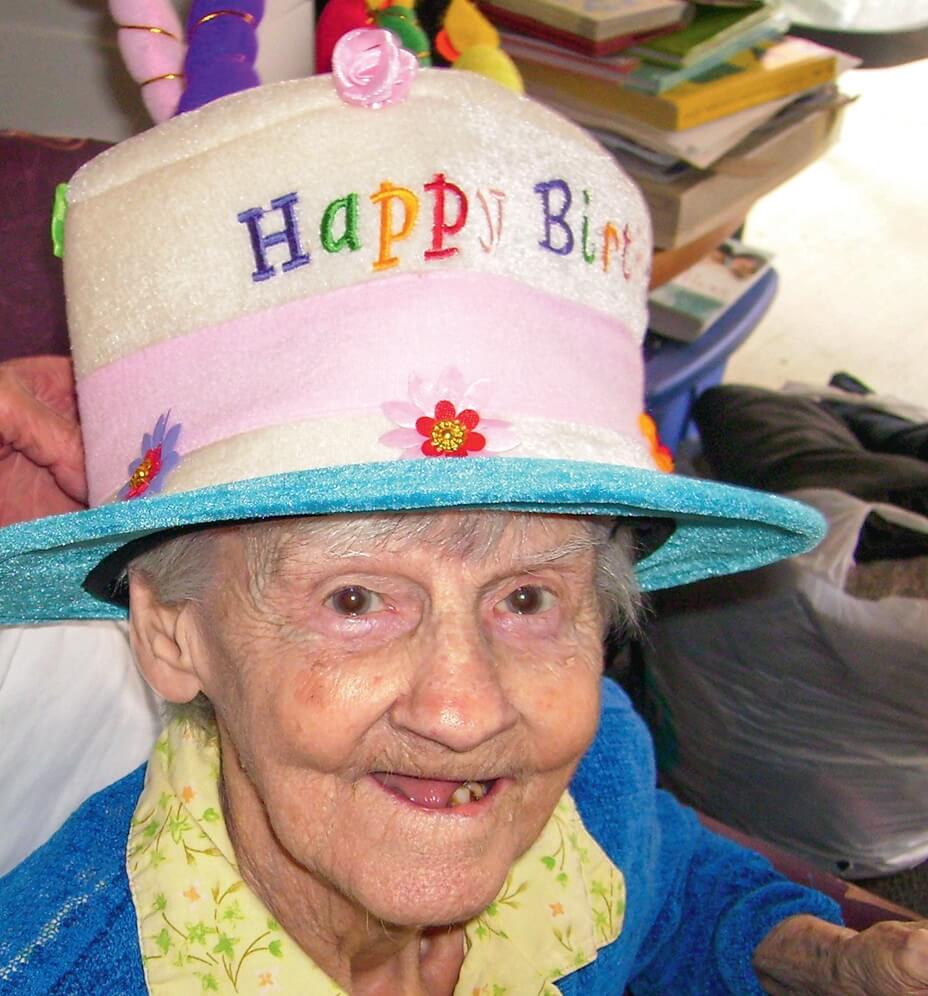
She had lived on Bribie Island for almost 60 years, and the furthest she had been in her entire life was to Bundaberg to a wedding for a day. We were two totally different people, but we made a great connection with each other. This remarkable old lady, Stella Ray, sparked my interest in the fascinating history of this unique island, and helped me to interview many old-timers, and appreciate how remarkable life on Bribie was long ago. Stella had lived a challenging life of hard work with little reward.
She worked in many of the cafes, fish shops and take always on Bribie from 1950 to 1980, serving residents and visitors, listening to their stories and gossip, and had some remarkable stories to tell. She died at the age of 95 in 2014 having lived on the same small block of land in Bongaree for 70 years. My subsequent 14 years fascination with Bribie History is all due to meeting her.
Stella Ray 90th birthday, 10 October 2009
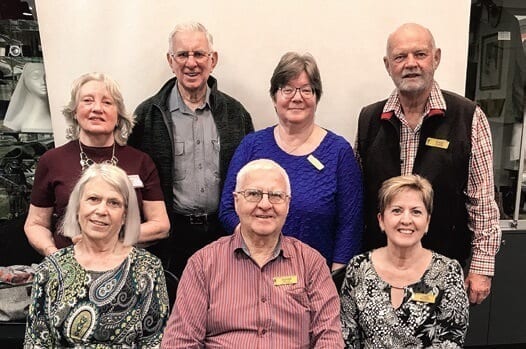
2018-2019 Committee
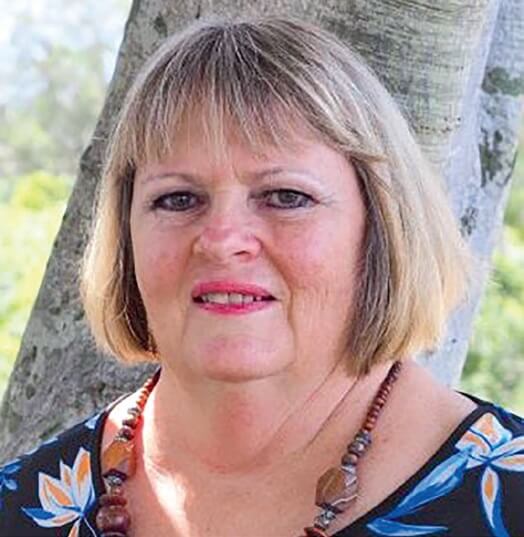
Shauna Hicks- President 2019-20
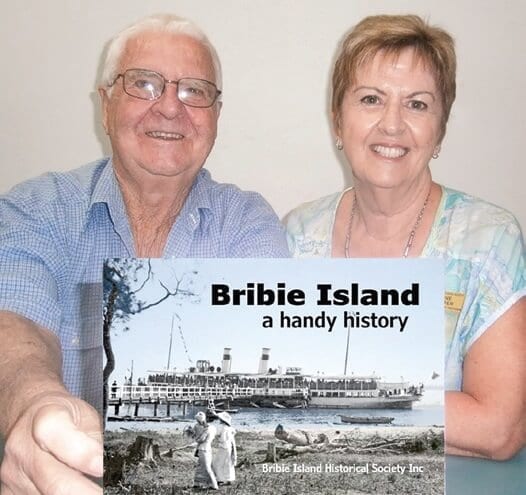
Graham Mills & Lynne Hooper
Showcase Bribie History
When I became interested there were few books or information telling any historical stories of this small island, so I set about gaining knowledge, raising awareness and interest. Over the next few years, I had plaques and signage installed around Bongaree to provide interesting historical insights for residents and visitors. I had informative brochures printed and made available free, commemorative plaques installed at Ian Fairweather Park and Coungeau House, and worked with the late Warwick Outram as he produced numerous books and started me teaching local history at U3A.
I did record interviews with over 140 long term residents, many of whom showed me old photos and documents going back more than 100 years I was surprised and delighted to learn some of the fascinating histories of this small island. Not simply in terms of the History of Queensland, but the overall history of Australia and the role Bribie had played in Commerce, Tourism, Defence and Science.
With the pending merger of three local Council areas in 2008, I felt it appropriate to form a Bribie Island Historical Society to provide a voice and repository for Bribie’s rich history. The Bribie Island Historical Society recently celebrated its 10-year anniversary and reflected on its extensive achievements, which include;
• Developing a searchable Database of more than 350,000 items of local history, including photos, maps, letters, films, newspapers, and documents.
• Installing bronze plaques along Bongaree waterfront recording significant people, events, buildings, anniversaries and aspects of Bribie Heritage.
• Ten years teaching local history to Seniors at U3A, and various grades of children at Banksia Beach and Bribie State School.
• Giving presentations on various aspects of Bribie History to numerous Clubs, Groups, and Organisations throughout the Region.
• Presenting Historic Photos for display in Sandstone Point Hotel, Bribie Doctors, Bongaree Bakers, Baptist Church, and Solana.
• Conducting regular guided Heritage Walks at Bongaree and Woorim in conjunction with Council “Healthy & Active” program.
• Publishing regular “History Page” articles in local newspapers and magazines, plus numerous radio and TV interviews.
• Research and publish three books about specific aspects of Bribie Island history (Describing Bribie Island, They Answered the Call, A Handy History)
• Attracting exceptional Authors, Historians, Pioneers and local identities as guest speakers to the Societies monthly meeting.
President & Committee
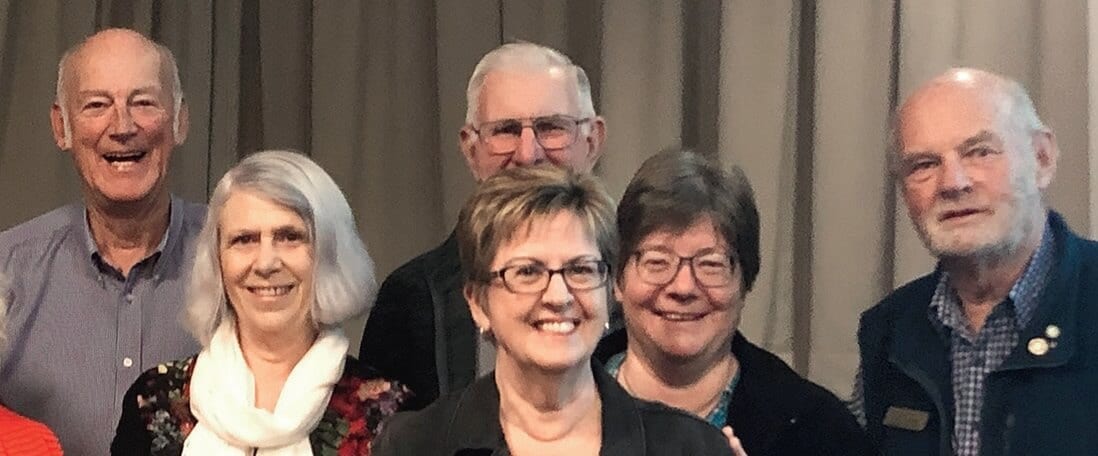
In the 10 years, the Society has been operating there have been four Presidents, two men, and two women. Barry Clark, Graham Mills, Donna Holmes and Lynne Hooper, all of whom have made significant contributions to the growth and achievements of the Society. All continued to serve on Committees in various roles over many years, and a tribute was paid to the outgoing 2018/19 Committee at the AGM.
At the recent Annual General Meeting, Shauna Hicks was nominated and elected as the new President for 2019/20. Shauna had been on the Committee previously, but her many other interests in History and Genealogy had kept her busy in recent years. Shauna Hicks has a long association with the area’s history and moved to live here in 2012. Her great great great grandparents settled at Toorbul 150 years ago in the 1870s. Shauna has a 40-year interest in local and family history and worked in government libraries and archives in Brisbane, Canberra, and Melbourne.
Since retiring, she has written 11 family history guides and is a regular speaker at genealogy cruises, conferences, and seminars. She now operates her part-time research and consultancy business. Shauna currently tutors two Bribie Island U3A courses – Advanced Family History and Writing Family History, and is co-convenor of the Bribie Island Library DNA for Genealogists Group which meets monthly.
Shauna has tertiary qualifications from Queensland universities including a Master of Arts in Australian Studies, a Graduate Diploma in Library Science and a Diploma in Family Historical Studies from the Society of Australian Genealogists. She is a Fellow of the Queensland Family History Society; a recipient of the Australian Society of Archivists Distinguished Achievement Award and the Australasian Federation of Family History, Services to Family History Award.
Also joining the Committee is Trevor Sutton who has recently moved to live on Bribie, but has a long family connection with the Island. He is related to the Moyle family who ran the Guest House and Restaurant by the Jetty at Bribie back in the 1920s. Former President Lynne Hooper will continue as Secretary and Ellen Beechey as Treasurer. Remaining on the Committee are former Presidents Graham Mills, Barry Clark, and Donna Holmes, together with Viv Tucker from Deception Bay who has extended the range and connections to local History.
Over the last 10 years, Bribie Island Historical Society has visited and hosted many other Historical Groups in the area including Peachester, Redcliffe, Woodford, Buderim, Windsor, Caboolture, Deception Bay, Dayboro, Landsborough and Pine Rivers, together with history exhibits at Miegunyah, Bankfoot House and Maritime Museum.
3 Bribie Girls Renunion
BIHS Committee 2019-20
May Newton with Barry Clark
Warwick Outram – Patron Bribie Island Historical Society
Joyce Voysey book launch
Some special History moments
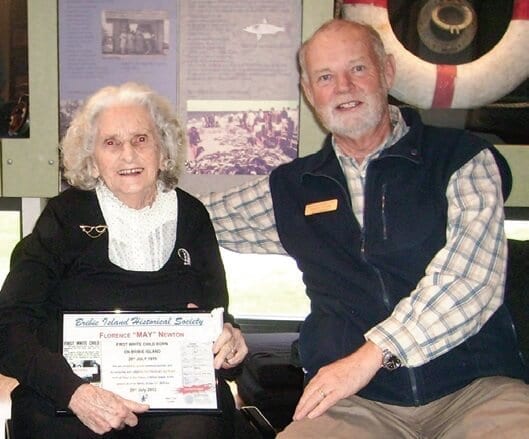
The Historical Society has organized and hosted many special functions over the last 10 years to commemorate key events in Bribie’s past. A couple is worth remembering in this article. Florence “May” Newton was the first white girl born on Bribie Island in July 1919. We brought her back to Bribie in 2014 to celebrate her 95th Birthday. It was a very special occasion as her niece is a teacher on Bribie, and several of her School children sang her “Happy Birthday”.
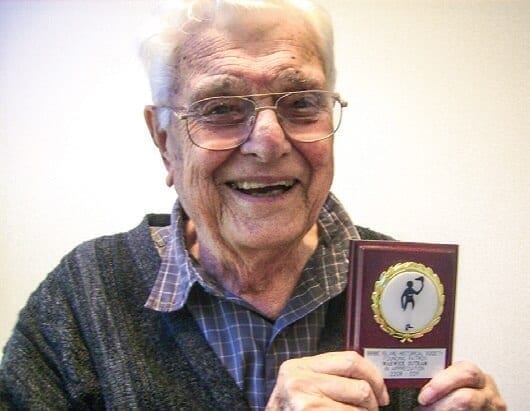
In July 2019 May Newton celebrated her 100th Birthday at her home in Tewantin but was unfortunately too frail to consider another trip to Bribie. Another special moment for me was to recognize the huge contribution that Warwick Outram had made to Bribie Island over more than 30 years of writing and self-publishing more than 30 books about the island’s history and its people.
It was a great pleasure to invite Warwick to be the inaugural Patron of the Society. In 2010 I was pleased to provide some old photos to Joyce Voysey (nee Batterham) who had lived on Bribie as a young girl in the 1930’s. Joyce had wonderful and vivid memories of her time Bribie Island and it was a pleasure to be able to bring her and her family back to Bribie to launch her book “A Girl from Bribie Island”. Joyce was one of three ladies that I brought together in 2008 for a reunion after more than 71 years.
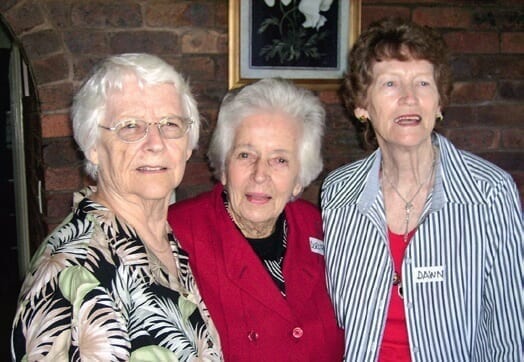
They had not seen each other since the 1930s when these much three younger ladies had all played very different roles in the early years of the island’s development. Dorothy Schulte (nee Shirley) then age 93, the daughter of Bill and Grace Shirley had seen her father supervise construction of the first road on Bribie Island in 1924, and her family went on to run the large Ocean Beach Guest at Woorim that was occupied by the military during the war years. Dawn Carey (nee Robertson) was the daughter of Caroline and Ted Robertson who had driven the first buses that ran on Bribies first road.
Joyce Voysey (nee Batterham) was the daughter of Elsie and Ike Batterham, and I had seen her brother Geoff’s name in the Corporal Punishment Register of Bribie Island State School back in 1928. It was a special moment to track down these three ladies and invite them back to Bribie. I invited these three ladies back to Bribie, with many members of all their families, to celebrate their long association, look at many old photos and record interviews and memories with them.
These are examples of simple events and celebrations that contribute significantly to the documented history of this place where we now live. As Founder of the Bribie Island Historical Society, I would like to think that many generations of future Historical Society Presidents and Committees will still be doing such things in 50 years……when Bribie will certainly be a very different place.
HISTORY CONTINUED
More BRIBIE History
The Historical Society has monthly public meetings at the RSL Club on the second Wednesday of each month commencing at 6:30 pm with interesting guest speakers on a wide range of topics, and you can see many more photos and articles on our Blog Site at http://bribieislandhistory.blogspot.com or contact us on [email protected]
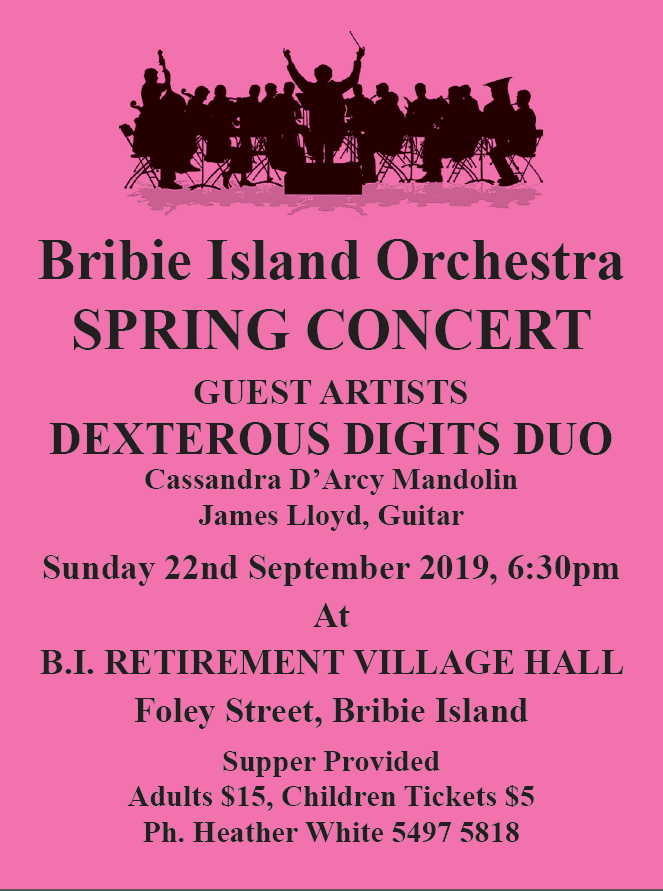
On Sunday 22nd September the Bribie Island Orchestra is giving a concert of popular music from Verdi to Joplin – from Dvorak to Offenbach with guest artists the Dexterous Digits Duo.
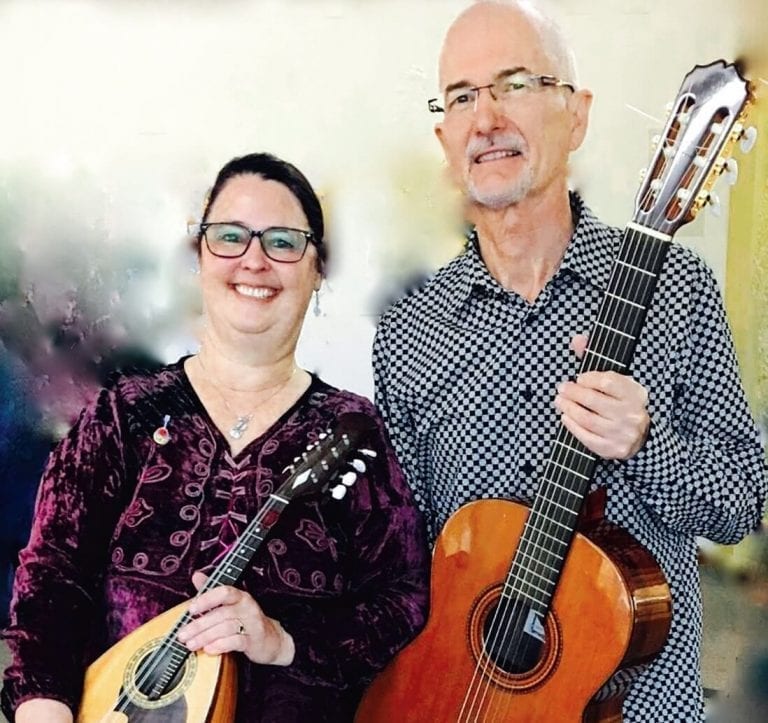
Featured Image(above): Cassandra D’Arcy and James Lloyd
The Spring Concert will be held at the Bribie Island Retirement Village Hall, Foley Street and will commence at 6:30 pm. Special guest artists Dexterous Digits Duo comprises the talents of Cassandra D’Arcy on mandolin and violin and James Lloyd on classical guitar. The pair met while playing in the Brisbane City Pops Orchestra where Cassandra plays the cello and James plays guitar and percussion instruments.
Both artists are teachers – Cassandra at her Dexterous Digits Music School, teaching all the stringed instruments, whereas James has directed the Brisbane Spanish Guitar Centre since 1976. Casandra also plays in the Indooroopilly Chamber Orchestra and with the Bribie Island Orchestra, founded and conducted by her father, Martin White.
James has an interest in arranging music for guitar groups and ensembles and this has led to the formation of the Dexterous Digits Duo as a vehicle for exploring music of all styles and periods. We will be welcoming back our two expert trumpeters Ruth and Jennifer Grant for this concert and they will ensure that you toe-tap along and if you don’t feel like getting up to do the Can-Can it will be because you can’t.
Convenor of the concert Heather White said supper will be provided and tickets are modestly priced at $15 for adults and $5 for children. For more information contact Heather on 5497 5818.
Get all your community news and information. Bribie Islands only community gloss magazine NOW EVERY TWO WEEKS! – Articles on boating, camping, fishing, life, drama, travel destinations, sports and what to see and do on Bribie Island. Covering charities, organisations, places, children’s activities, arts and crafts, tourist destinations, heritage parks, technology, science, music, gardening, and much more.
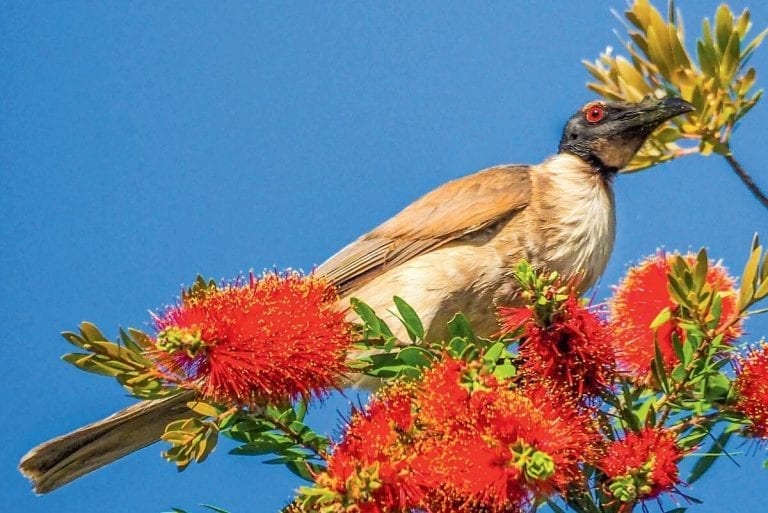
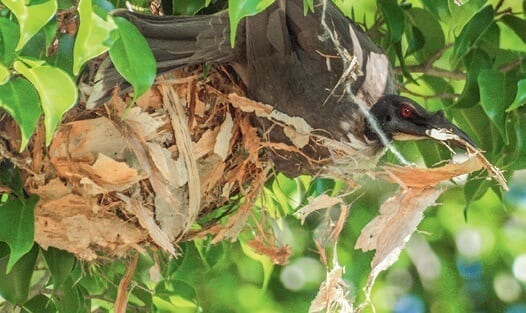
Noisy Friarbirds are one of the two very common honeyeaters found on Bribie Island and surrounds. Little Friarbirds are also found here but are in smaller numbers. Noisy Friarbirds are large passerines 30-35 cm in length and weigh about 85-130g. Their heads and part of their necks are completely naked of feathers and covered with black skin. Because of this, they are often referred to as “Leatherheads”.
Featured Image(above): Noisy Friarbird on Calistemon bush
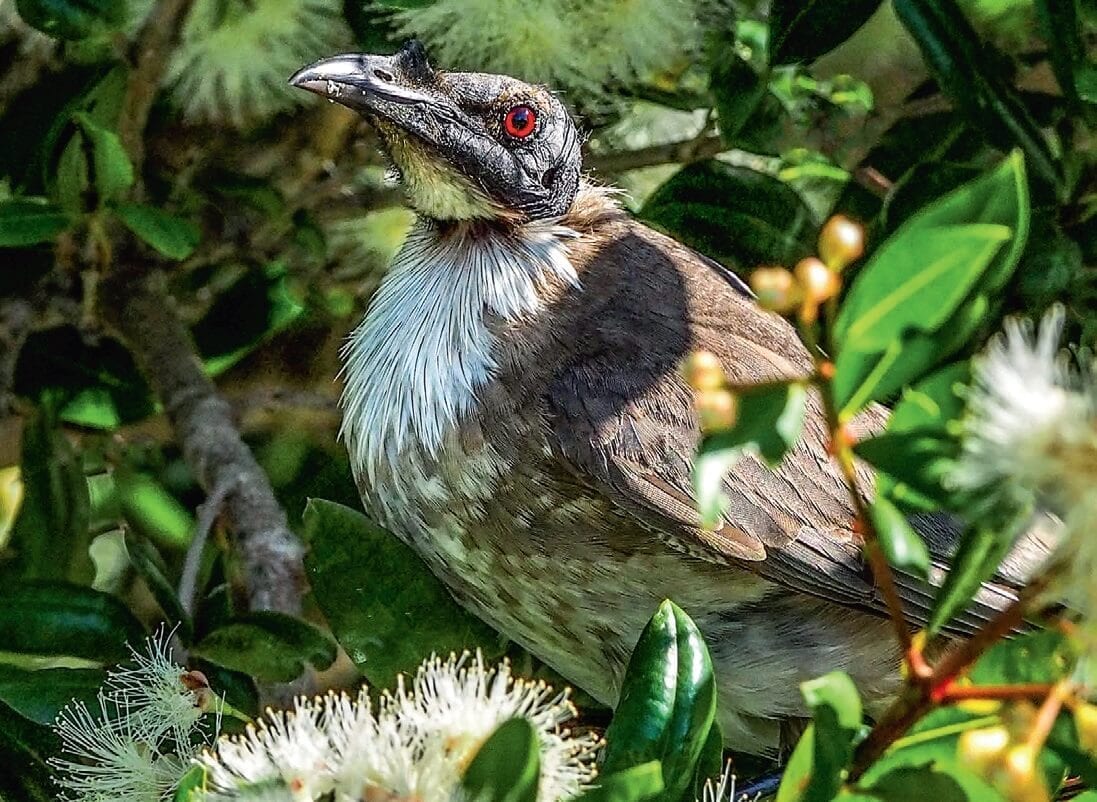
They have the barest head of any of the four Australian species of Friarbirds. Another of their prominent features is a knob on the top of their beak. Upper feathers are a dark brownish colour while the underparts are light grey with a tuft of whitish feathers under the chin. Eyes are red.
Their calls are harsh and loud with “Tobacco” and “Four O’clock” being two of their many sounds. Their name implies their noisiness. Most of Queensland, NSW, Victoria and the Murray River region in SA are where they are most likely to be seen in woodlands, swampy forests, heathlands and parks and gardens in suburban areas. They are also found in PNG. Nectar, pollen, insects, and fruit such as berries are their favoured foods.
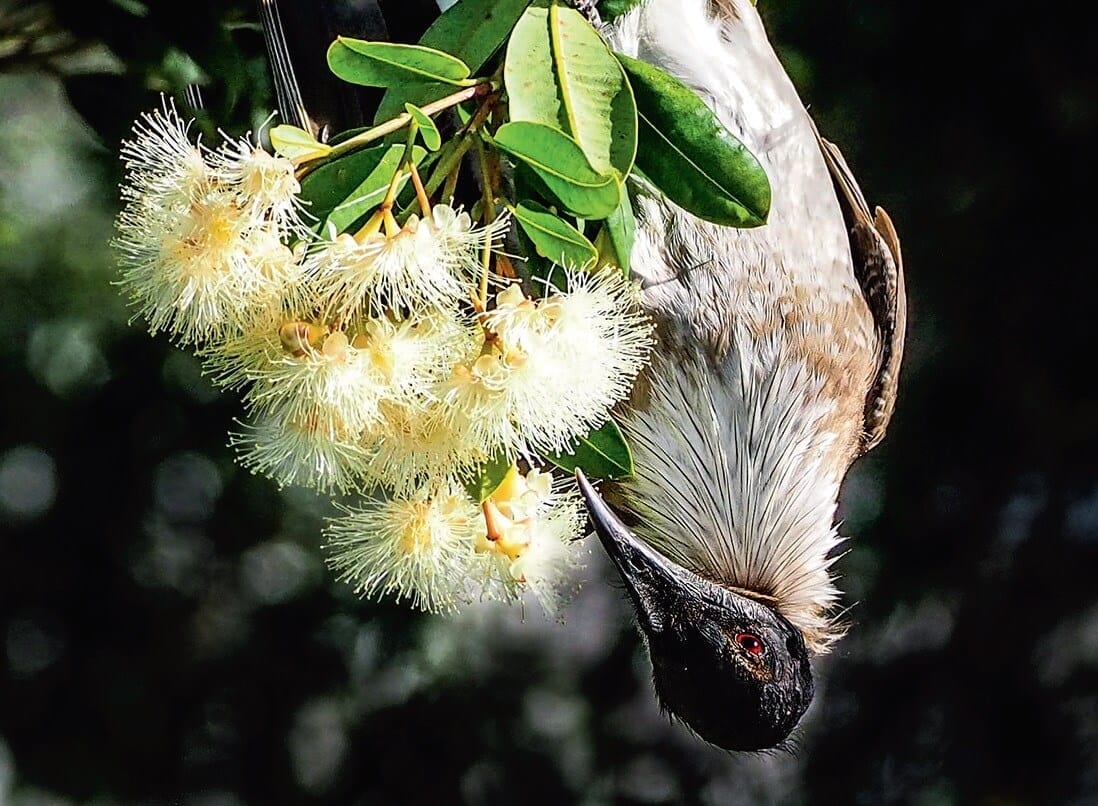
Not the most comfortable way to take a meal.
Noisy Friarbird – Note tuft of white feathers on breast and naked head.
Friarbird dismantling its nest.
Their behaviour becomes quite aggressive and noisy when feeding, often fighting among themselves and harassing other bird species and chasing them away. In our area, the Friarbirds are locally nomadic following the flowering trees for their nectar. In southern areas, they are mostly migratory flying north in the winter months. In some areas where farmers grow grapes and berries, they are considered a pest as they can be very destructive to crops.
July to February is their favoured time for breeding. Females build open cup-like nests of bark and woven with cobwebs between thin branches and up to 17 m above ground. Nests are lined with soft grass and wool if available. Clutches of 2-4 pinkish, mottled eggs are laid and incubated by females. Both parents defend the nests and feed the chicks for up to 21 days after fledging. Noisy Friarbirds were first recorded in 1790 by John Latham. They were called Friarbirds because their heads resembled the shaven heads Friars. Common Koels are parasitic cuckoos which favour Friarbird nests.
They push the existing eggs from the nest and lay their own which when hatched are parented by the Friarbirds causing the loss of a seasons breeding for them. Their conservation status is secure for now. Feral cats are always a worry. Land clearing decreases habitat but they have adapted well to suburbia and do well on the planted native trees in towns and cities.
I always start off the weekend having a look at Des Houghton’s Quaff column in the Courier Mail and his recommendations which often would require something of a bank loan to try, however this week he showcased a couple of reasonably priced award winners from the recent Royal Queensland Wine Show. If you missed the article it mentioned the Jacobs Creek Le Petit Rose 2018 vintage made from Pinot Noir, Grenache and Mataro grapes and sells for around $15, A Wolf Blass Yellow Label 2017 Chardonnay selling for around $14 and A Windance Estate 2018 Margaret River Shiraz at $26
With a couple of friends arriving on Bribie for a few days from Perth via Cairns, we knew it was going to be a fairly damp weekend eating hearty homemade food and drinking plenty of outstanding wines. On Thursday we started the evening with pea and ham soup with which we served a Rapaura Springs 2018 Sauvignon Blanc, this was followed by spaghetti bolognese and served with a Joel Gott 2017 Californian Zinfandel and a Sister’s Run 2017 McLaren Vale Shiraz.
The Rapaura Springs Sauvignon Blanc and The Sister’s Run both were bought at Liquorland and both wines were very good, as I have commented on before I believe when the Rapaura Springs, which has heaps of grassy overtones and finishes fresh and crisp, is on special it is one of the best buys around, I paid $10 for the wine. I have bought The Sister’s Run before and again when on special for $12 which is around $8 off the normal price it represents very good value, being from McLaren Vale the wine has plenty of spicy aromas, it is a full-bodied style and fully recommended when the price is right again.
When you take friends around you realise what jewels we have around us within a very short drive and Friday involved a trip up to Mooloolaba with a visit for lunch to the surf club and fish and chips with which we enjoyed a very acceptable Angove Long Row Riesling. Friday night began with some more pea and ham soup followed by a butter curry and this time one of the big guns I have been saving for a rainy day came out of the wine fridge. To begin with, we started with an Angove Alternatus Small Batch Rose 2018 McLaren Vale Grenache, Tempranillo, Vermentino and Carignan which was crisp, pale pink, with dry light berry fruit and made a refreshing change from Sauvignon Blanc.
This was a very well made wine with interesting grape components but McLaren Vale Grenache makes for some outstanding wines. This was followed by the wine of the week-end a Penfold’s 2012 Bin 28 Kalimna Shiraz which I bought from Dan Murphy’s vintage wine section several years ago, the wine had spicy peppery aromas and was probably wasted alongside the curry but sometimes you just have to indulge! On Saturday after a mornings visit to The Eumundi market we had lunch at The Noosa Surf Club where garlic prawns was washed down with a Jim Barrie ‘W’ Riesling which is a fantastic bone dry white with lovely citrus aromas and is available from BWS for $20 then back home to try a couple of interesting fruit wines from our far north.
Our visitors had brought with them a bottle of Golden Drop Sparkling Mango from Mareeba North Queensland and a bottle of Jaboticaba Tropical Dry Red from the Shannonvale tropical fruit winery which was a Brazilian Tree Grape which was said to be medium-bodied with plum-like aromas. The sparkling Mango lived up to its title and was served with a cheese platter including a very pleasant Stilton and the wine went surprisingly well with this selection.
However the second wine had aromas more in keeping with cough medicine and was quite disappointing, but the overall experience was very interesting as a change from everyday grape wines. Sunday evening was relatively light as the weekend came to a close and platters of assorted meat, cheese and olives were enjoyed with Taylor’s 2017 Clare Valley Cabernet Sauvignon which had aromas of black currents and an Angove Long Row 2018 Pinot Grigio which has aromas of apples and pears with a crisp and a fresh clean finish, a great weekend enjoyed by all.
If you are interested in matching food with wine take a close look at the back label and consider what the winemaker explains about the wine and what the characteristics of the wine are. For instance, if the wine has aromas of apples it almost certainly suits pork, look for a Pinot Grigio or Pinot Gris, an unwooded Chardonnay or even a Viognier from Yalumba. Wines such as Riesling or Sauvignon Blanc with citrus characters will suit prawns, lobster and light seafood especially with a squeeze of lemon.
Steak with a pepper sauce would suit a full-bodied Shiraz and if winter has brought out the lamb shanks or Osso Bucco enjoy with a cabernet sauvignon but use the wine as part of the gravy as well and never skimp on the quality used in the cooking serve the same wine with the finished course. The friends have continued on their journey and everything is back to normal, Liquorland has Vin Vale Shiraz from Shingleback on special this week, everything that comes from this winery is always top draw including the Red Knot range from BWS or Dan Murphy’s.
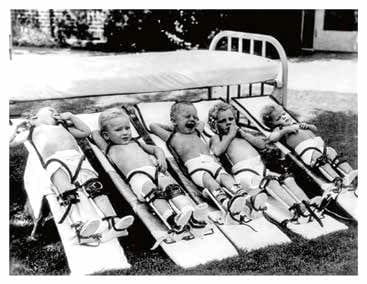
In a marathon race, many competitors say the last part of the run is always the most difficult and many a runner has ‘Hit the Wall’ in the final stages. So it is with Polio eradication. Michael Zaffran, Head of Polio eradication at the World Health Organisation, expressed it well when he said ‘The last mile has proven to be the toughest phase of the polio eradication.’ On Saturday 13 July 2019, the Courier-Mail ran a front-page article titled ‘Polio Peril.’
The article talked about the plunging vaccination rates across southeast Queensland. It also gave statistics showing areas where vaccination rates had fallen and informed readers of the fact that Polio is just a plane ride away from Australia. It is hard to believe that, in Australia today, we still have people who decry vaccination and claim it is harmful. However, the reality is that vaccinations save many millions of lives – and lifestyles – every year. We, therefore, must educate people to realise the benefits of vaccination – especially against polio.
It was Nelson Mandela who said ‘education is the most powerful weapon which you can use to change the world.’ Polio is a highly infectious disease caused by a virus. It mainly affects children under 5. The World Health Organisation says that the ‘virus invades the nervous system, and can cause total paralysis in a matter of hours. The virus is transmitted by person to person spread mainly through the fecal-oral route or, less frequently, by a common vehicle (for example, contaminated water or food) and multiplies in the intestine.
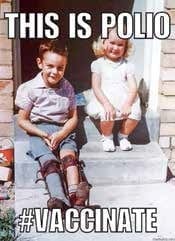
A young boy wearing callipers on his legs
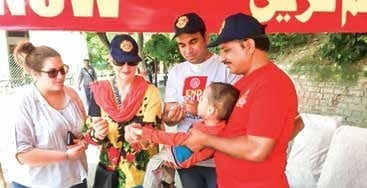
Rotarians giving Polio vaccinations in Lahore Pakistan
Polio victims in the 1950’s
Initial symptoms are fever, fatigue, headache, vomiting, stiffness of the neck and pain in the limbs. One in 200 infections leads to irreversible paralysis (usually in the legs). Among those paralysed, 5% to 10% die when their breathing muscles become immobilised.’ There is no cure for polio! However, it can be prevented by vaccination. Polio vaccine, given multiple times, can protect a child for life. Over the last 30 years, Rotary has made the eradication of Polio it’s Number One Priority.
By the end of 2018 over 99.9% of cases had been eradicated with only 33 cases reported that year. We were on a count down to complete eradication and a Polio free world. Unfortunately, the latest figures show that the wild poliovirus remains entrenched in Afghanistan and Pakistan, and in Africa, the vaccine itself is generating virulent strains (see ‘vaccine derived Polio’ below).
In Pakistan, polio health workers are often met with hostility and violence. In April 2019, fuelled by rumours on social media that children were being poisoned by the polio vaccinations, people rioted killing one polio worker and the two police officers guarding her. Likewise, the eradication program in Afghanistan is complicated due to the violence across much of the country and by the refusal of some communities to accept the vaccination programs. Last year’s vaccine-derived polio outbreak in Papua New Guinea is now under control following a massive vaccination program.
Vaccine-derived poliovirus (VDPV) is a mutated version of the weaker polio virus used in vaccinations. VDPVs are rare and happen in populations with very low vaccination rates. They develop when children who have not been vaccinated come into contact with the feces of vaccinated children. A massive vaccination program is the only way to stop VDPVs. Africa can bring this outbreak under control and thus finally realise Nelson Mandala’s edict of ‘kicking Polio out of Africa.’
So reports that polio is just a plane flight away from Australia, and indeed, Bribie, are not scaremongering. The reality is that low immunisation rates are a recipe for an outbreak and no place on earth is safe from polio until the disease is eradicated everywhere. Bill Gates (who contributes US$2 for every $1 Rotary raises to End Polio) puts it this way – ‘As long as polio threatens even one child anywhere in the world, all children — wherever they live — remain at risk. The stakes are that high.’
What can you do to help?
1. If you know an anti-vaxxer, show them photos of children with polio and urge them to have their children vaccinated immediately. Just because you live in Australia does not mean you are immune or that Polio won’t affect your loved ones.
One crucial step in this quest is the need to Stop Complacency! Even some Rotarians are saying they have grown tired of the Polio campaign and are considering sending their funds elsewhere. Many have become desensitised to the campaign. We are so close to a Polio free world now is not the time to be complacent. So I encourage everyone to increase their efforts to End Polio.
Smallpox is the only disease that has been eradicated from the world. Let’s help Rotary and our partners to go down in history and make poliomyelitis the second. In June 2019 Rotary announced that it is giving US$100 million in grants to support the global effort to end polio. Of this Afghanistan will receive $16.3 million, Nigeria $10.2 million and Pakistan $25.2million. Additional funding will support efforts to keep vulnerable countries polio-free.
Michael McGovern, chair of Rotary’s International PolioPlus Committee, said that he was ‘optimistic that the end of polio is within our grasp, but we must remain vigilant in rallying global political and financial support as we push towards a poliofree world.’ We clearly have it in our hands to finish this marathon – and not “hit the wall”.
We can ensure that no child will ever be paralysed by any form of poliovirus – be it wild or vaccine-derived. If readers like me remember children from their childhood who had this horrid disease, or who have friends suffering post-polio syndrome, they will understand why we must ensure it never returns. Robert de Castella – the great marathon runner – perhaps said it best, ‘There are no shortcuts!’ We must vaccinate every child.
 Other Articles:




 This was a very well made wine with interesting grape components but McLaren Vale Grenache makes for some outstanding wines. This was followed by the wine of the week-end a Penfold’s 2012 Bin 28 Kalimna Shiraz which I bought from Dan Murphy’s vintage wine section several years ago, the wine had spicy peppery aromas and was probably wasted alongside the curry but sometimes you just have to indulge! On Saturday after a mornings visit to The Eumundi market we had lunch at The Noosa Surf Club where garlic prawns was washed down with a Jim Barrie ‘W’ Riesling which is a fantastic bone dry white with lovely citrus aromas and is available from BWS for $20 then back home to try a couple of interesting fruit wines from our far north.