avoid late fees and grab a discount Paying your bills on time is a great way to keep your credit record clean. If you struggle with your bills, consider setting up a regular repayment amount to even out the cash flow. Some energy providers will also offer a discount to customers who pay on time.
2. Monitor your bank balance
To avoid paying overdrawn fees, ensure that the interest rate is correct and that you have not been charged for purchases you didn’t make.
3. Check how much interest you are paying on your credit card
If you owe money on your credit card, check what interest rate you are paying. Credit card interest rates can vary from less than 10% to more than
4. Customer rewards
Think about stores where you commonly do your shopping and find out if they have a rewards program and if it is worth signing up. Some may provide discounts, gift cards or other rewards. Be aware of the data they will collect and ensure you are comfortable with the payoff.
5. Bonus interest rate on savings account
Some providers offer additional ‘bonus’ interest on your savings account if you meet certain criteria, such as making a minimum monthly deposit or making no withdrawals. Sometimes the bonus rate expires after an introductory period. Check to see if your institution has a bonus rate, or consider switching to a savings account with a higher interest rate to save money.
6. Phone your bank and ask for a discount on your mortgage interest rate
Even a small discount could save thousands over the life of your loan – and there is currently more than a 2.5% difference between highest and lowest variable home loan rates on Canstar’s database.
7. Audit your bank accounts to see if you are not paying fees
If you are, there are plenty of fee-free options available.
8. Review your health insurance
Health insurance can be another great place to make savings. Canstar researched and rated 21 health insurance providers
9. Review your personal insurance
Review your personal insurance including your life, total and permanent disability, trauma and income protection insurance. Some of them can be paid via your superannuation fund (or maybe you have a double-up?) – is it a practical option for your needs?
10. Review your superannuation fund
A small difference in fees and/or return can make a big difference to your retirement nest egg.
Tags: History. Bribie Island. Moreton Bay. Queensland. Australian
This is a delightful story about the building of a holiday cottage on Bribie Island in 1946, and the coming of the first mains Electricity to Bribie Island in 1954. That was 66 years ago…. so just think about all the “things” that people did not have before electricity came.
The residents of Bribie Island had been requesting the Government to provide a mains electricity supply to the island for several years. In 1945 the Southern Electric Authority of Queensland sent three Engineers to meet the Bribie Island Progress Association and report its findings on the question as to whether a supply of electricity to Bribie Island was warranted. Keith Price was one of the Engineers who travelled from Brisbane to Bribie Island on the Steamship Doomba to attend the meeting at Bongaree.
Their wives went with them and had a picnic whilst the meeting was in progress. This was my introduction to Bribie Island. After the meeting, the woodman of the Island took all of us for a ride around on his truck. There were no made roads along the front of the passage, just dirt tracks, and we could only go North as far as where the I.G.A. store now stands.
Postcard Bongaree 1950’s
It was just bumpity bump, bumpity bump and we were certainly glad to get off. However, the Committee’s report was against mains supply being extended to the Island as the estimated revenue would be insufficient to cover the cost of the cross-passage cables, etc… So nothing was done about it at that time.
BUYING LAND ON BRIBIE
During a conversation with Arthur Winston, the local Storekeeper at Bongaree, we heard that he would be selling some of his property North of Bongaree where he and his family had a tobacco farm which had not come up to expectations. During 1946 my husband Keith saw an advertisement offering the land for sale.
He rang Arthur Winston who invited him to go down and have a look at it, offering a house that he owned to us for the weekend. We went down, and Keith arose early in the morning and took a walk along the beach, leaving me in bed asleep. When I awoke and heard the scampering of the opossums in the ceiling.
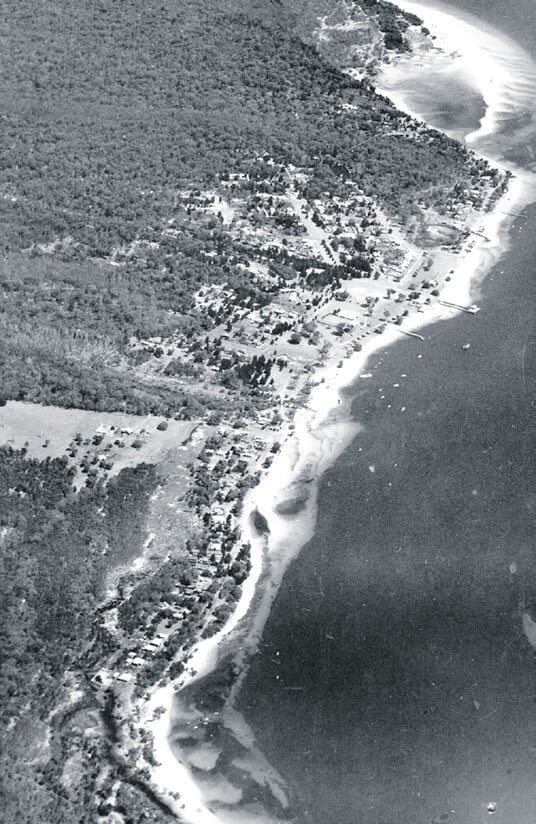
Aerial view Bongaree 1948
And imagined all sorts of wild animals being up there. Keith came back and reported that he had seen hundreds of yabbies, and being a very keen fisherman he was very interested. Of course, at that time yabby pumps had not come on to the market – you had to dig holes, then get down on your knees and scrape the yabbies out of the holes which was pretty hard work.
Later in the day, we set off to look for the land being sold, but all we could see was a dense forest. However, we saw a big black woman on the veranda of a house and recognised her as Lottie, Tom Welsby’s cook. She recognised us, and after we told her the reason for our being there, she called out to Charlie next door, who was cultivating beautiful carnations and asked him to take us down to the land.
When we were on the beach in front of the allotment all we could see was dense forest studded with beautiful trees. We scrambled through the bush and found the allotment which Arthur Winston had mentioned, and found a swamp in front of it, which we filled in by hard labour after we bought it.
BUILDING “KIAMA” COTTAGE
We bought the allotment on which “Kiama” now stands for 50 Pounds. The sale prices were controlled by the Treasury Dept. and Arthur Winston had to sell the front allotments at not more than 50 Pounds, and back allotments at 30 and 25 Pounds. Our first Council rates were 3 Pounds a year.
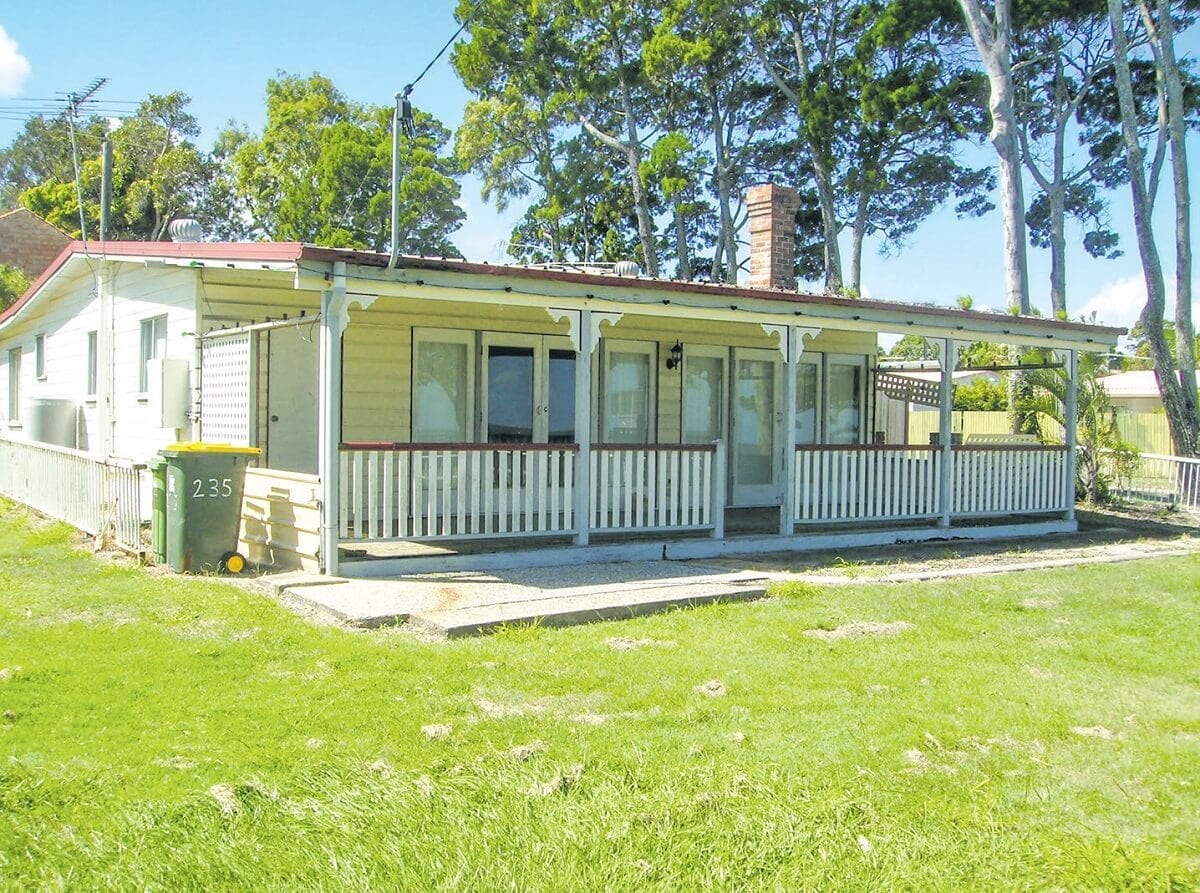
We decided when Keith had built our cottage we would call it “Kiama”, after a coastal town on the way to Melbourne, where we always swam in the pool cut out if the natural rocks near a big blow-hole. It is an aboriginal name meaning ‘Good fishing grounds’ which was very apt at that time. The first stage was clearing of the land, and then Keith calculated the amount of timber required, and purchased it from Redcliffe.
It was delivered by boat and left on beach and Keith had to carry it up to the site. He erected a tent in the back yard and the two us went to Bribie on the Steamship most week-ends whilst he was building the cottage.
REMINISCENCES
Whilst Keith was building, he dug a hole in the back for water, which we pulled up by bucket on a long rope, complete with many huge green frogs. Afterwards, when we got the electricity, he put in the spear pump and water tank. Then we got the town water and the pump proved very useful for the garden and lawn.
Once the building was finished Keith built a dinghy for himself, and each weekend we would drive over a very bad road from Caboolture to Toorbul Point on a Friday night and hire a boat, and Keith would row across. Some nights were very rough and I was always thankful when we reached the Island.
I was then left at ‘Kiama”, with only a kerosene lamp, whilst Keith towed the hired boat back to the owner. All I could hear were the kangaroos hopping around the cottage the whole time until Keith got back.
Kiama Cottage
CAR FERRY TO BRIBIE
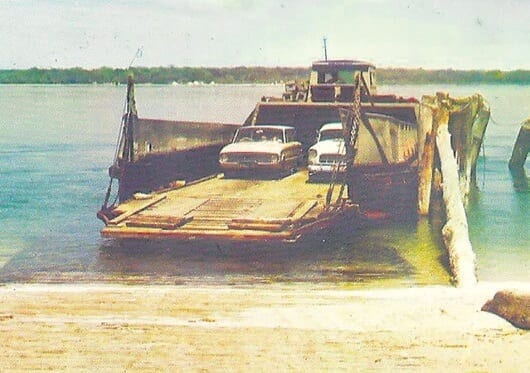
When the car ferry barge started operating after the War we would sometimes ring Mr.Tesch from Caboolture if we were running late on Friday night, and he would have the barge at the Point when we got there. We very often had to wait in a queue for hours on the return trip, Easter Monday being the worst day, there always being a queue of cars waiting five hours or more before getting on to the barge.
Car Ferry
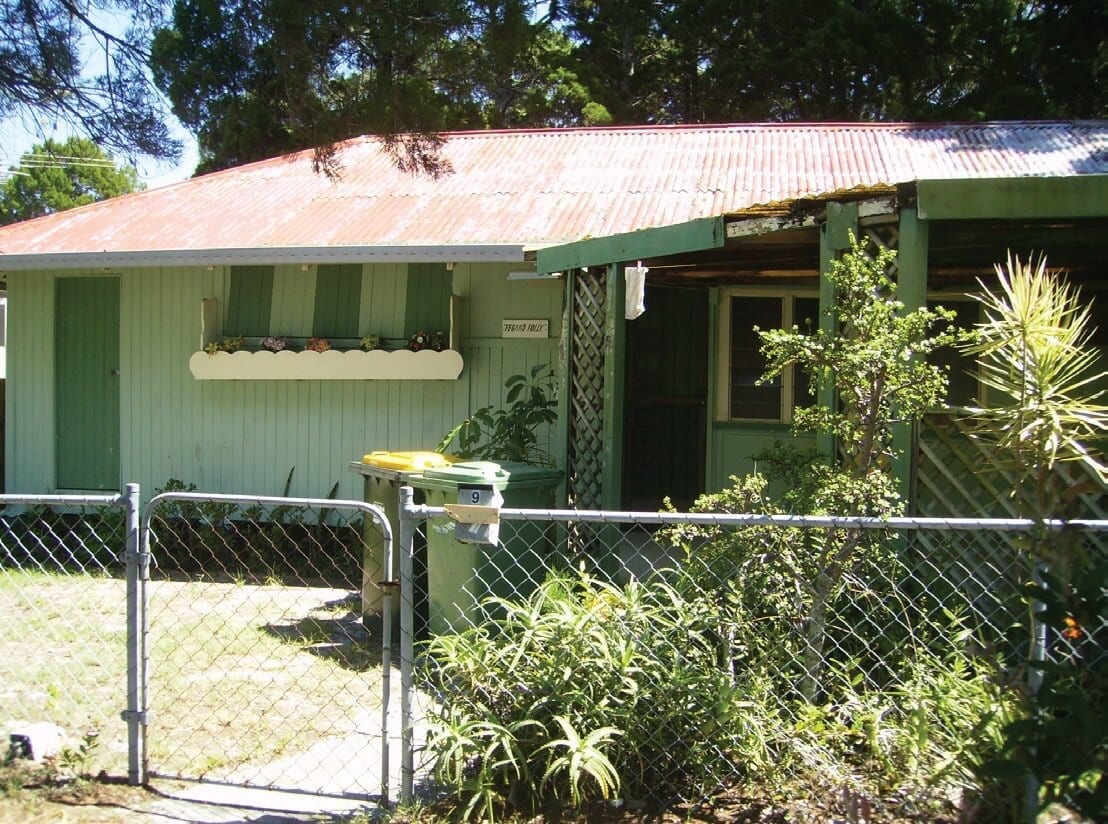
We solved it by taking the car over at daybreak and carrying remaining luggage over later. During the first years, our near neighbours were Fegan, Blacklegs, Butterworth, Stanley, Robert, Marr and Hermes, who built cottages they named Faux Pas, Fegans’ Folly, and Blacklegs’ Blunder.
Fegans Folly
NEW YEARS EVE
On New Year’s Eve, we always had a big bonfire on the beach and every child had to give an item, which they did willingly. What parties they were! Good clean fun. One year the theme song was “Goodnight Irene”, another “I’ve got a beautiful bunch of coconuts” and so on. In that era, most of the fishing was done in front just off the beach and we could see the snapper and sweetlips being pulled out of the water into the boats.
It was not out of the ordinary to catch three or four big fish weighing from 12 lbs. to 24 lbs. during a weekend. The reason for the big fish being so close to the shore was that the Americans, when camping during the war years had a swimming pool in front of “Kiama” which they enclosed with arc mesh and the big fish were feeding on the weed which had accumulated on the mesh. Keith and others built fences from some of the mesh, and fishermen lost quite a few anchors by snagging on it.
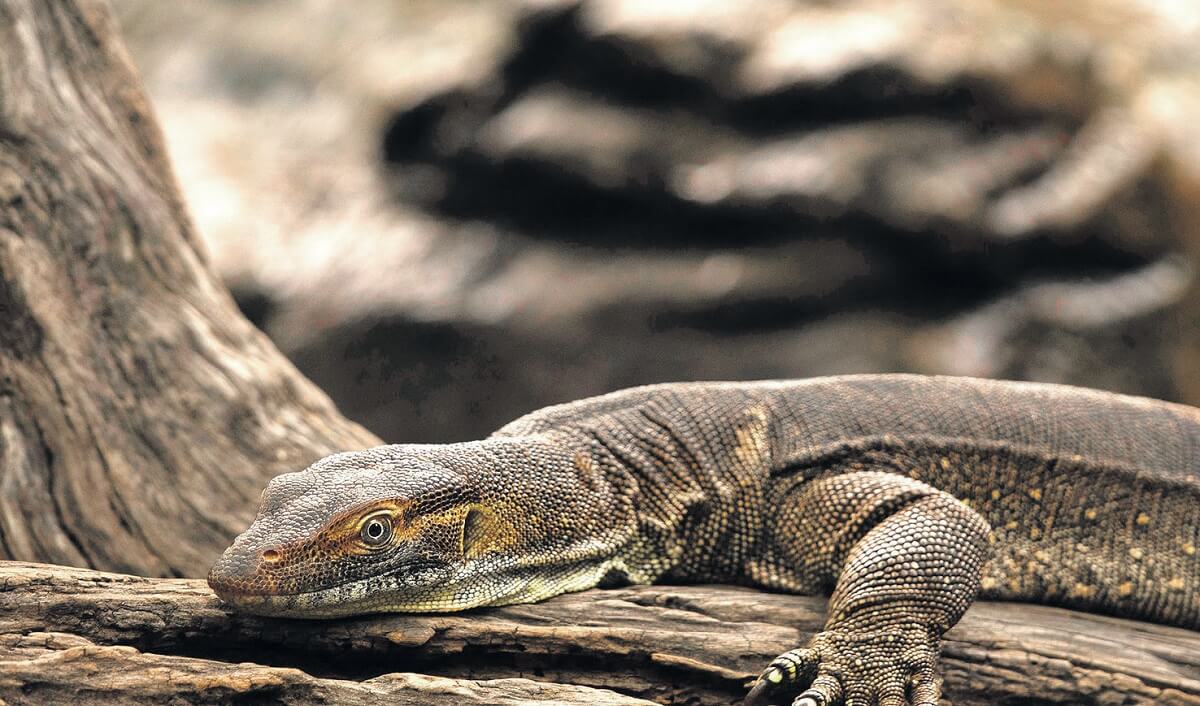
Goanna
THE GOANNA INCIDENT:
One weekend friends and I were sitting at kitchen table cleaning crabs for lunch and boning fish for fish cakes, the men being away fishing, when we heard a loud scraping noise presumably coming from behind kitchen dresser. I went outside to see if anything was scratching the sidewall but found nothing.
The scratching continued louder and louder so we all moved to the other side of the dresser with all eyes on the dresser. We all screamed and scrambled out of the window until a neighbour arrived and wanted to know what we were doing. He got on a chair and peered down the back of the dresser, then jumped off quick and said “It’s a goanna trying to get away from there, and it’s the biggest b….. I’ve ever seen. Get me a gaff”.
The goanna was apparently living under the pile of trees left on the front footpath, crept into the house during the night, took a fancy to a basket of eggs on top of the dresser and fell down at the back of the dresser.
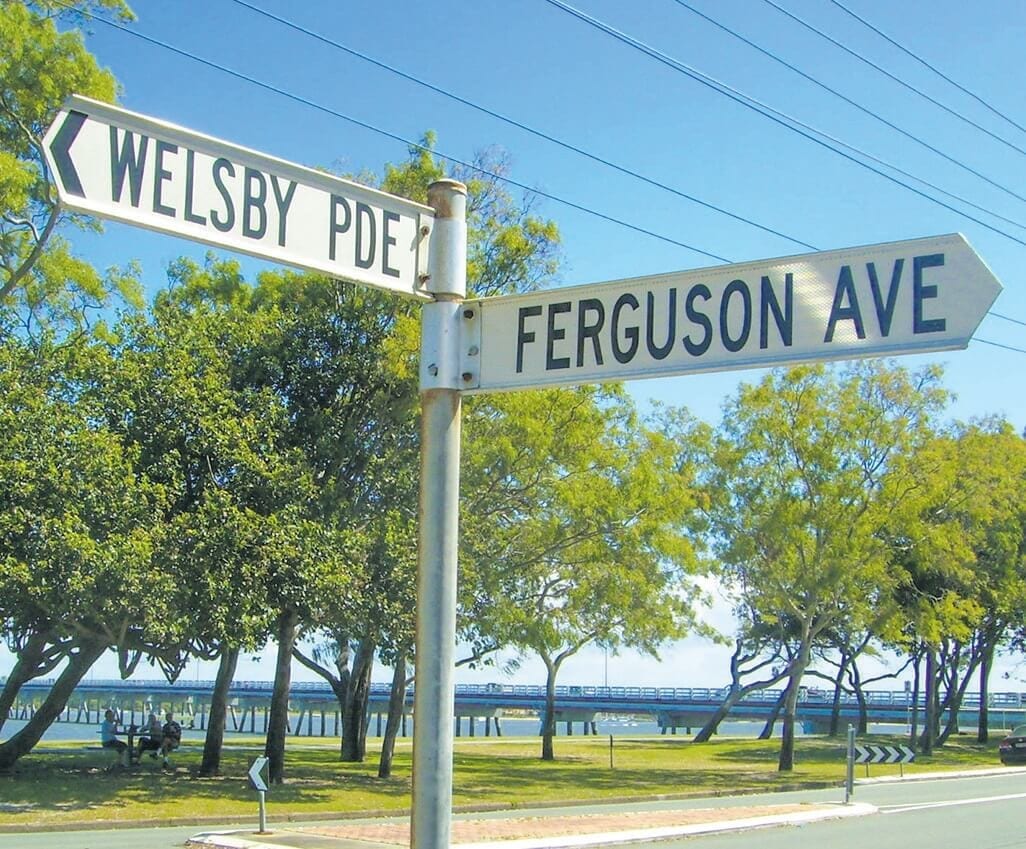
FERGUSON AVENUE:
The street beside the cottage in those days was only a winding sand track with a swamp gully running through it. Years later we were invited to give a name to the Street beside our “Kiama”, and I decided it should be named “Ferguson Ave.”, that being Keith’s middle name. Much later the Council officially gave it that name and erected a sign.
Cable to Bribie 1953
CABLE CROSSING
From 1947, we came to stay in “Kiama” on most weekends and holidays. Keith kept telling his Manager at Southern Electricity Authority how great it was and how the resident and holiday population was increasing on the Island. In the early 1950’s the S.E. Authority asked Keith to prepare another report on mains Electricity for Bribie, and draw up a specification for a cross-passage electricity supply cable and call tenders, which Keith joyfully did.
Eventually, Keith recommended the best tender to the Manager and Board of Directors, and huge drums of cable were purchased and delivered. Keith was then asked to set the date for laying of the cables, which turned out to be a perfect day for the job. I have photographs of the men doing the work. We got the electricity supply in 1954, our area being the first to be switched on.
We all had a great night square dancing on the lawn, singing etc. The official opening was held at Bongaree sometime later. Thanks to Evelyn Price for writing down the above story in the 1960s, and to Bev Grimmer for saving it and giving me a copy.
MORE PEOPLE MORE POWER
These first submarine mains electricity cables laid in 1954 were two 11Kv cables. When the Bribie Bridge was being built in 1961 they were replaced with 33Kv cables to cater to the demands of increased population. The 1000 yards of 33Kv cable weighed 21 Tons and was the longest cable laid, jointed and commissioned by the company at that time.
MORE BRIBIE HISTORY
The first submarine electricity cables laid in 1954 were two 11Kv cables. When the Bribie Bridge was being constructed in 1961, with anticipated increases in population to follow, The Historical Society has monthly public meetings at the RSL Club on the second Wednesday of each month (except January) commencing at 6;30pm. with interesting guest speakers on a wide range of topics. You can see many more photos and articles on our Blog Site at http://bribieislandhistory.blogspot.com or contact us on [email protected]
The love of field and coppice,
Of green and shaded lanes.
Of ordered woods and gardens
Is running in your veins,
Strong love of grey-blue distance
Brown streams and soft dim skies
I know but cannot share it,
My love is otherwise.
I love a sunburnt country,
A land of sweeping plains,
Of ragged mountain ranges,
Of droughts and flooding rains.
I love her far horizons,
I love her jewel-sea,
Her beauty and her terror –
The wide brown land for me!
A stark white ring-barked forest
All tragic to the moon,
The sapphire-misted mountains,
The hot gold hush of noon.
Green tangle of the brushes,
Where lithe lianas coil,
And orchids deck the tree-tops
And ferns the warm dark soil.
Core of my heart, my country!
Her pitiless blue sky,
When sick at heart, around us,
We see the cattle die –
But then the grey clouds gather,
And we can bless again
The drumming of an army,
The steady, soaking rain.
Core of my heart, my country!
Land of the Rainbow Gold,
For flood and fire and famine,
She pays us back threefold –
Over the thirsty paddocks,
Watch, after many days,
The filmy veil of greenness
That thickens as we gaze.
An opal-hearted country,
A wilful, lavish land –
All you who have not loved her,
You will not understand –
Though earth holds many splendours,
Wherever I may die,
I know to what brown country
My homing thoughts will fly.
——————————— Famous Australia Poem by Dorothea Mackellar
10 Iconic Foods To Celebrate This AUSTRALIA DAY
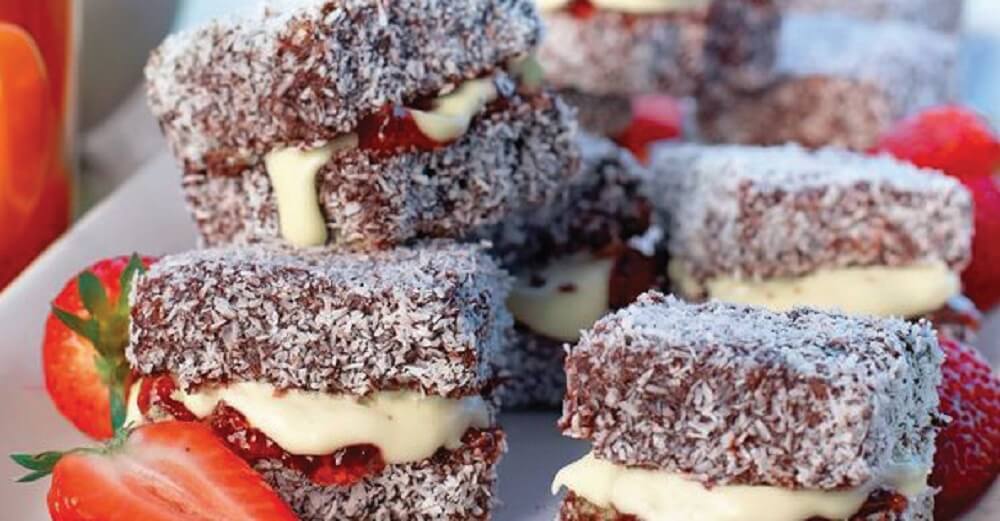
1. Lamington.
The lamington is certainly one of Australia’s edible national symbols; there’s even a National Lamington Day on July 21. Sometimes it even comes in two halves with a layer of jam and cream in the middle, making it the perfect accompaniment to an afternoon tea or coffee. The lamington was invented more than a century ago and named after Queensland’s governor at the time, Lord Lamington. Exactly who whipped together the first recipe is still up for debate, with both Toowoomba and Ipswich claiming to be the lamington’s birthplace.
2. Meat pie.
They’re a staple at sporting events and parties and the cause of many a burnt tongue — the humble meat pie is Australia. The meat pie hit our shores at the same time as the First Fleet, and by 1891 George Sargent was commercially producing them in Sydney. And while there’s plenty of gourmet varieties now on the market, it is hard to go past the old-school flaky pastry containing diced or minced meat with gravy.
3. Vegemite.
Love it or hate it, after 90 years Vegemite is still an Australian breakfast favourite. Spread on toast, bread or crackers, or even added to casseroles or layered in cheesy scrolls, the black, salty paste sure is versatile. Chemist Cyril Callister created the vitamin B spread from brewer’s yeast in 1922 for the Fred Walker Company and called it Pure Vegetable Extract. A national competition saw it labelled Vegemite and it hit the shelves in October 1923. The Happy Little Vegemites jingle hit radio airwaves in 1954 and resonates with many Australians to this day, so much so we buy more than 22 million jars of the spread every year.
4. Pavlova.
Both Australia and New Zealand claim to have invented Pavlova in honour of Russian ballerina Anna Pavlova, who visited both countries in the 1920s. Either way, the meringuebased dessert is one of Australia’s premier sweet treats. With its crisp crust and soft, light centre, decorated with whipped cream and fresh fruit, it is hard to go past fresh Pavlova at any gathering.
5. Tim Tam.
Two chocolate biscuits filled with a chocolate cream centre and covered in more chocolate — these biscuits aren’t good for anyone watching their waistline. Invented by Arnott’s Ian Norris and named by Ross Arnott after the horse that won the 1958 Kentucky Derby, Tim Tams first hit our shelves in 1964. Since then there have been many varieties of Tim Tams and our love of this choc bikkie has only grown, with more than 45 million packets sold in Australia each year.
6. Anzac biscuit.
They’re a big part of the Anzac tradition and commemorations, but the 10 Iconic Foods To Celebrate This AUSTRALIA DAY FOOD, WINE & GOOD TIMES ISSUE 105 | 17th January 2020 21 sweet chewy (or crispy) biscuits we know and love weren’t actually eaten by troops at Gallipoli. The legend goes that they were sent to troops on the Western Front because they had a long shelf life. But according to the Australian War Memorial, the biscuit is often confused with a soldier’s ration staple called the hardtack biscuit, sometimes known as Anzac tiles or Anzac wafer biscuits. The much sweeter and softer Anzac biscuits we enjoy today came along later in the war and were sold at fetes and public events to raise money for the military effort.
7. Chiko roll.
The true home of the Chiko roll has long been debated. Is it Wagga Wagga, Bathurst or Bendigo? The savoury snack was developed by Bendigo boilermaker Frank McEncroe in competition to the Chinese spring roll that was being sold at football matches. It made its first appearance at the Wagga Wagga Agriculture Show in 1951 as the Chicken Roll, despite not actually containing chicken. Food Company Simplot now manufactures Chiko rolls in Bathurst, and the deep-fried snack remains commonplace on menus in fish-and-chip and takeaway shops across Australia.
8. Sausage sandwich
There’s nothing more Australian than getting together for a barbecue with family and friends. And every good barbie offers a sausage sanga — a sausage on bread with a squirt of tomato sauce. Of course, you could upgrade and add onion, different sauces, crusty bread rolls or even break away from a traditional beef or pork snag and try a fancy gourmet sausage. Sausage sizzles have become a staple of work functions, birthday parties and fundraisers — we just can’t walk past the appetising smell of a barbecuing snag.
9. Weet-Bix
“Aussie kids are Weet-Bix kids.” As the song suggests, many of us grew up eating this flaked cereal biscuit with milk for breakfast. Whether it’s with warm or cold milk, covered in honey or sugar, or even eaten dry with jam or Vegemite, there’s certainly plenty of ways to enjoy Weet-Bix. It was developed by Bennison Osborne for Grain Products in the early 1920s as competition to the popular Granose, a wheat biscuit marketed by Sanitarium at the time. Osborne added small amounts of sugar and malt to his cereal biscuits to make them more palatable and they soon became a best-selling breakfast cereal.
10. Burger with the lot
The traditional hamburger may be an American thing, but the Aussies have made the “burger with the lot” their own by adding some true blue flavours. Layering sliced pineapple, beetroot, egg and bacon on top of a meat pattie, cheese and salad on a bun creates a true “works burger”. And the best ones leave burger juice running down your arms as you get your mouth around the enormous taste sensation.
Get all your community news and information. Bribie Islands only community gloss magazine NOW EVERY TWO WEEKS! – Articles on boating, camping, fishing, life, drama, travel destinations, sports and what to see and do on Bribie Island. Covering charities, organisations, places, children’s activities, arts and crafts, tourist destinations, heritage parks, technology, science, music, gardening, and much more.
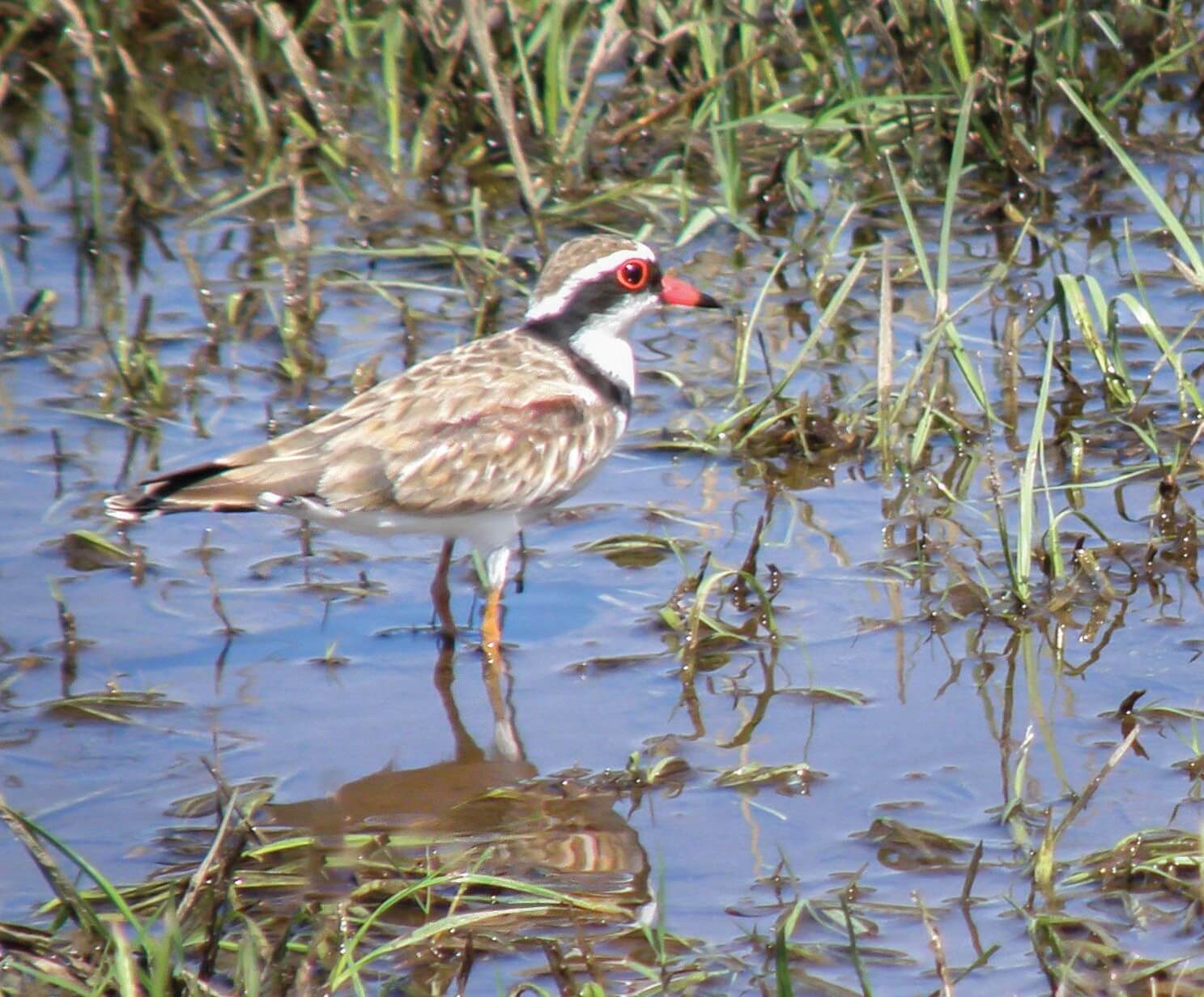
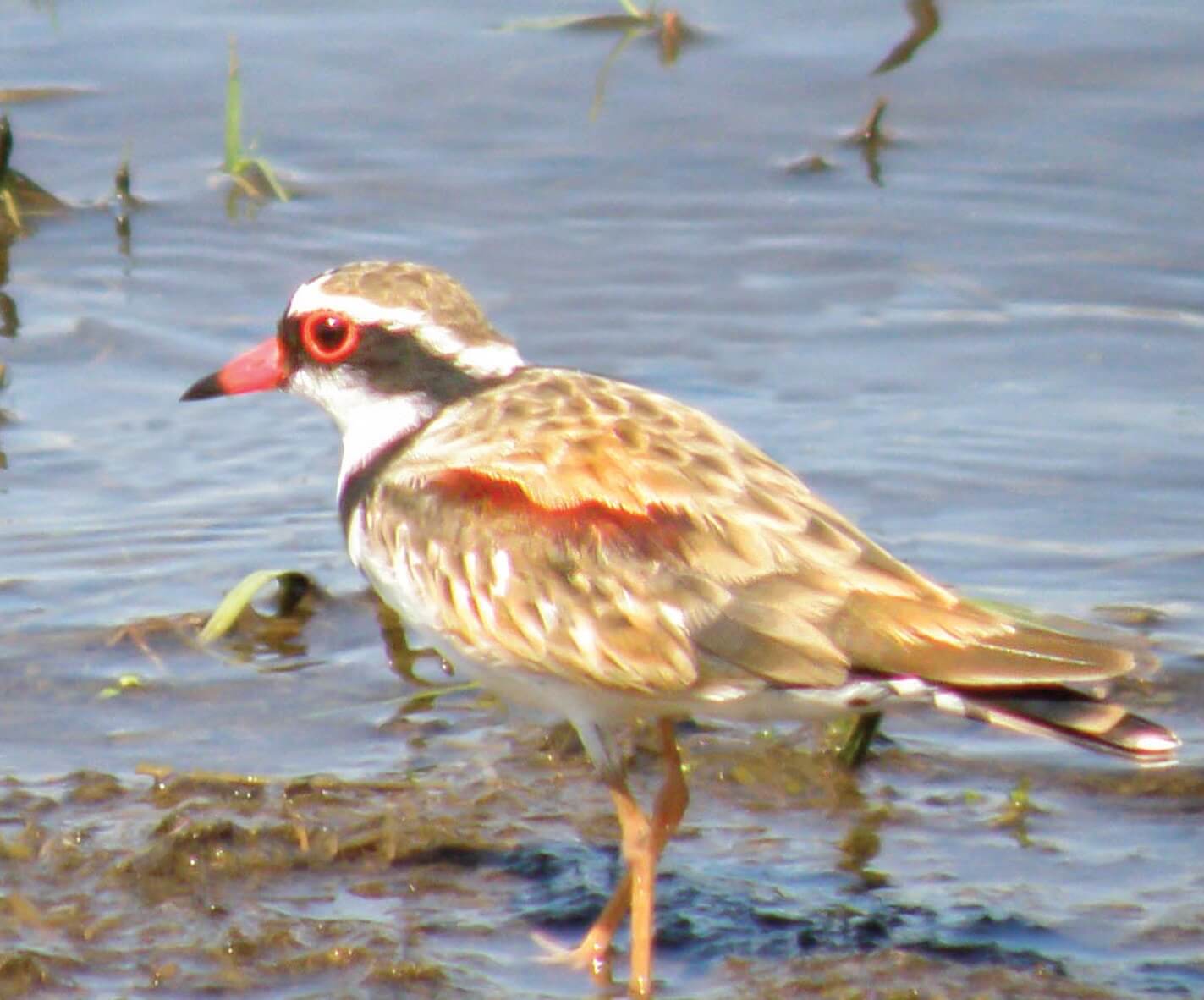
I have seen Black-fronted Dotterels a few times on Bribie Island. When the water is low at Buckley’s Hole, I have seen them at the edge on the mud on the ocean side of the hole and once at the very north of Sylvan Beach walking on the sand.
They have been known to breed here but have not been recorded very often. When water levels drop, they are likely to turn up at the edge of any of our waterholes to feed along the edge. Black-fronted Dotterels belong to the plover family and are sometimes called Black-fronted Plovers.
They are usually in pairs or alone but sometimes when there is abundant food, they form into groups to feed along the edges of waterholes. Being just 16-18 cm long and weighing only 26-39 g they are indeed small birds.
Dotteral sometimes feeds in very shallow water.
With red-ringed eyes in a black face mask, red bills with a black tip, deep black Y shaped breast band, chestnut on the shoulder, brown wings, pinkish legs and white below they are not hard to identify. They maintain their colouring throughout the year and do not change into breeding plumage.
Males and females are of similar appearance. Flight distances are mainly short and rather slow. When in flight wings appear broad and tails look short. Black-fronted Dotterels are nearly always found along the edges of freshwater wetlands and swamps and manmade dams.
They are only sometimes seen near saltwater shorelines. Usually sedentary, Dotterels are dependent on water and become nomadic if their waterholes dry up and food becomes scarce. They are scattered throughout mainland Australia and Tasmania where conditions are suitable.
During the 1950s they self introduced into NZ where their population is still quite small. Food such as molluscs, crustaceans, aquatic insects and small creatures is mostly foraged for along the edges of muddy waterholes and in water no deeper than a few mm. While feeding in the mud they perform and interesting procedure with bodies held straight running quickly with bobbing heads, stopping, picking up their prey and running on again.
Dotterel feeding in the mud.
August to February in the right conditions is the favoured time to breed. Nests are just a small scrape on the ground usually in the open and very near water. Mostly they nest in solitary pairs with the female laying 2-3 speckled brownish eggs. Both parents incubate the eggs for 25-26 days and the babies when hatched spend less than a day in the nest before they leave to find shelter from predators in nearby vegetation.
During one good breeding season, the parents may produce two broods. The development of breeding sites may be affecting their numbers. Predators such as cats, dogs, raptors and reptiles are the main threats during the breeding season to chicks and parent birds. There are some losses due to flooding during heavy rains.
Throughout Australia Black-fronted Dotterels are common and widespread. At this time, they are considered secure in Australia.
Nearly two and a half thousand years ago, the Greek philosopher Aristotle wrote ‘What is the essence of life? To serve others and to do good.’ This is the oldest quote I know regarding volunteering and to me, it proves that giving back to the community is a long-held tradition. Rotary’s motto of ‘Service above Self’ and mission of ‘Doing Good in the World’ are befitting adaptations of Aristotle’s long-ago words.
In the modern world we live such busy lives it is hard to find the time to volunteer; however, research has shown that the benefits of volunteering are enormous. It not only helps others, but it also builds better communities and provides numerous benefits to the mental and physical health of the volunteer.
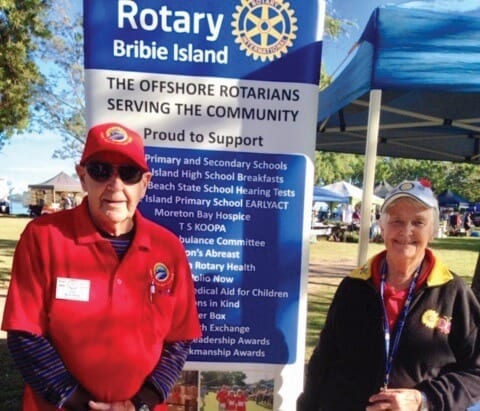
Ian Beaumont and Gillian Parry volunteer at the Rotary markets every month.
What we might call it a win/win situation! Volunteering helps counteract the effects of depression, stress, anxiety, and anger. The social contact of helping and working with others has a very positive effect on your overall psychological wellbeing. Nothing relieves stress better than a connection with a likeminded person or someone in need. Also, using pets for therapy has demonstrated what a positive impact an animal has on people’s moods.
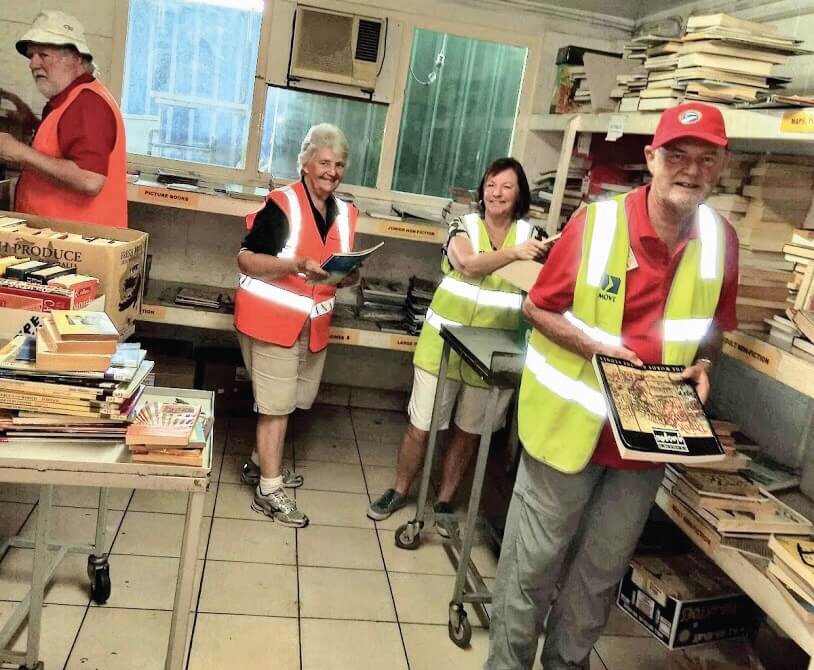
John Oxenford, Gillian Parry, Robyn Harper & Barry Clark packing containers to go to PNG for Donations in Kind
One of my friends takes her beautiful dog to hospitals and nursing homes. She talks so positively not only about the benefits provided to the receivers of the dog’s attention but of the happiness, it brings to her. Volunteering does make you happy. By measuring hormones and brain activity, researchers have discovered that being helpful to others brings great pleasure. Human beings are hard-wired to give to others.
The more we give, the happier we feel. A good example can be found in our current Christmas season where many get more satisfaction out of giving a gift than in receiving one. To see the pleasure on another’s face is all the gratitude we need. It has also been proven that volunteering improves self-confidence, provides a sense of purpose and helps volunteers stay physically healthy – thus, volunteering themselves to health!
A recent worldwide study on the ‘The Scope and Scale of Rotary Volunteering’, conducted by the ‘John Hopkins Centre for Civil Society Studies’ found that:
Rotary’s 1.2 million members volunteered a total of nearly 5.8 million hours in the four-week reference period. Taking out the hours of volunteering associated with World Polio Day, which fell in the survey reference period, Rotary members accounted for close to 5.1 million hours of volunteering;
3. Rotary volunteers save communities an estimated US$850 million in service costs per year;
4. Our members are responsible for 47 million hours of volunteer effort per year; and
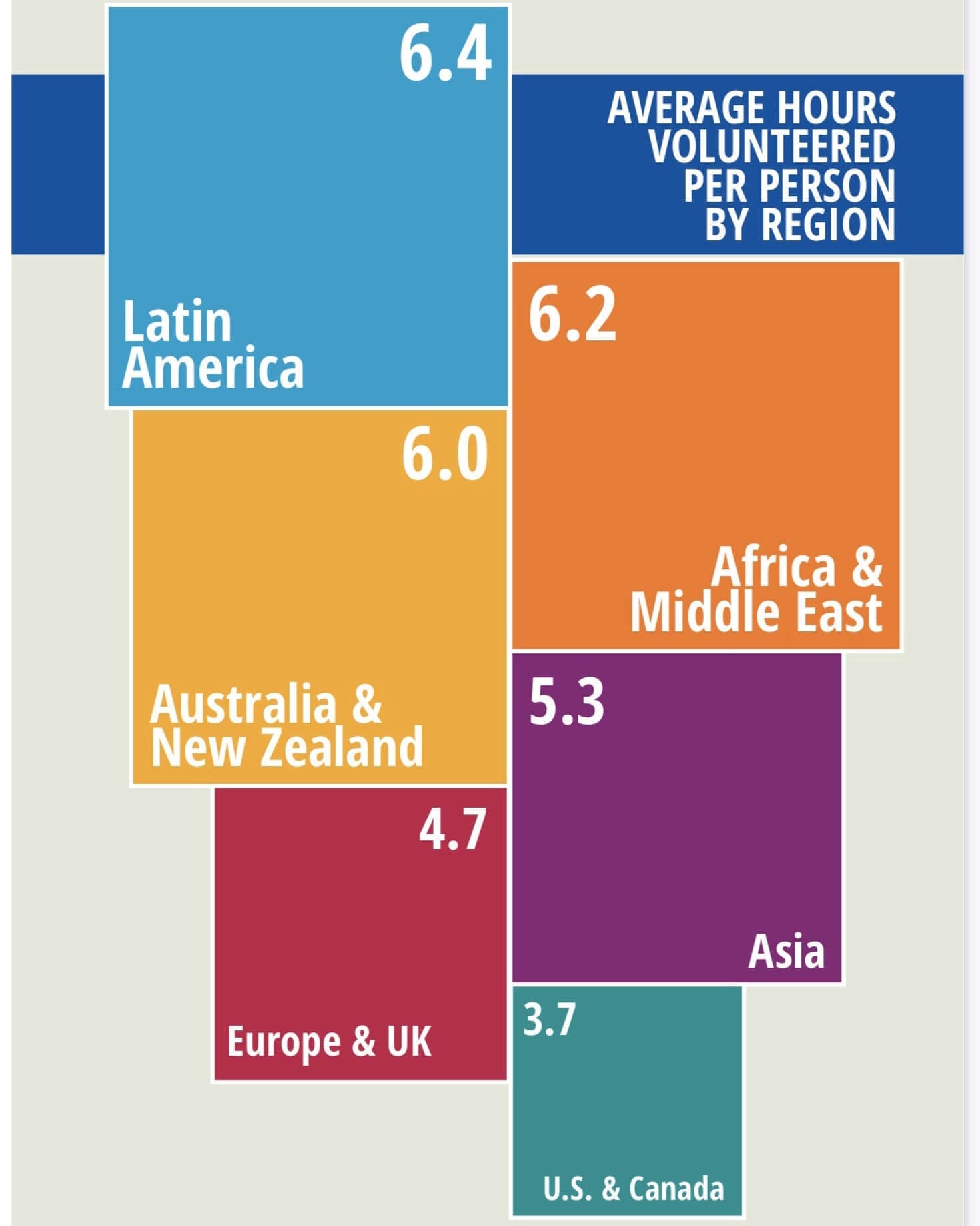
5. Average volunteer hours per month varied by region with the average hours in Australia and New Zealand being 6 (see graph).
These statistics do not even include the more than 1 million friends and relatives of members who frequently help out at Rotaryorganised volunteering events. Nor do they include the volunteering contributed by the more than 700,000 members of Rotary’s Rotaract, Interact, or Community Corp affiliates.
The study concludes that ‘Rotary is annually generating a scale of social and economic problem-solving effort that is worth nearly nine times more than it costs the organisation to produce. Here is a powerful demonstration of the enormous leveraging possibilities available from mobilising the unique renewable resource represented by volunteer work.
For a world challenged to meet a demanding set of Sustainable Development Goals (SDGs) in the face of withering environmental catastrophes and limited governmental and philanthropic resources, the lesson is clear: volunteer service is not only a feel-good calling—it may provide one of the more promising, and one of the more fulfilling, avenues through which to achieve the ambitious goals that the international community has set for itself.
By putting itself through the demanding inquiry described here, Rotary may thus have done a special service by opening this avenue for all to see. If so, this work will have more than met its objectives’. As someone who majored in Sociology and Psychology at ANU and received Distinctions in units such as Methods of Social Research, I found the methodology used in the John Hopkins study ground-breaking.
Previously it was not possible to gain a meaningful grasp on the actual scale or economic value of volunteer efforts. But now, thanks to a recent internationally recognised methodology for measuring volunteer work, it has become possible to answer this question.
Oscar Wilde sums up volunteering in this quote ‘The smallest act of kindness is worth more than the grandest intention.’ Bribie Rotary has 27 members with only a few still working. They all bring a wealth of skills and knowledge to our Club. Giving to, and helping others, not only connects you to people, but it can also advance your career and it brings fun and fulfillment to your life.
Whatever your age or life situation, volunteering can help take your mind off your worries, keep you mentally stimulated, and add more spark to your life. For me, volunteering with Rotary has brought new meaning and direction to my life and I find it very rewarding to help others. Mahatma Gandhi observed ‘The best way to find yourself is to lose yourself in the service of others.’
Therefore, my fellow Bribarians, remember that volunteering is good for your mind and body and it also gives you a sense of accomplishment. Always remember, the better you feel about yourself, the more likely you are to be happy and have a positive view of your life. So, make your new year’s resolutions as you normally do, but perhaps include one whereby you vow to try to help others and do good in the world.
Also, feel free to come and join us and help build better communities. If you would like to volunteer yourself to health and happiness, or just get more information on Rotary, give me a call on 0409 244 005. I hope all readers had a wonderful Christmas, and I wish you all a very Happy New Year!
Tags: SE Queensland weather forecast. Severe storms Brisbane. Moreton Bay. Bribie Island
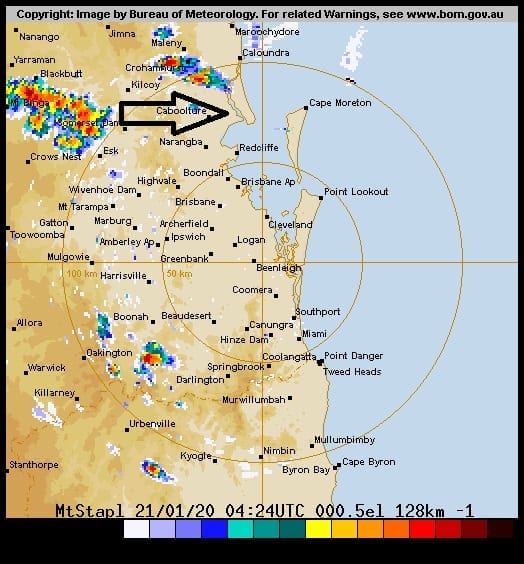
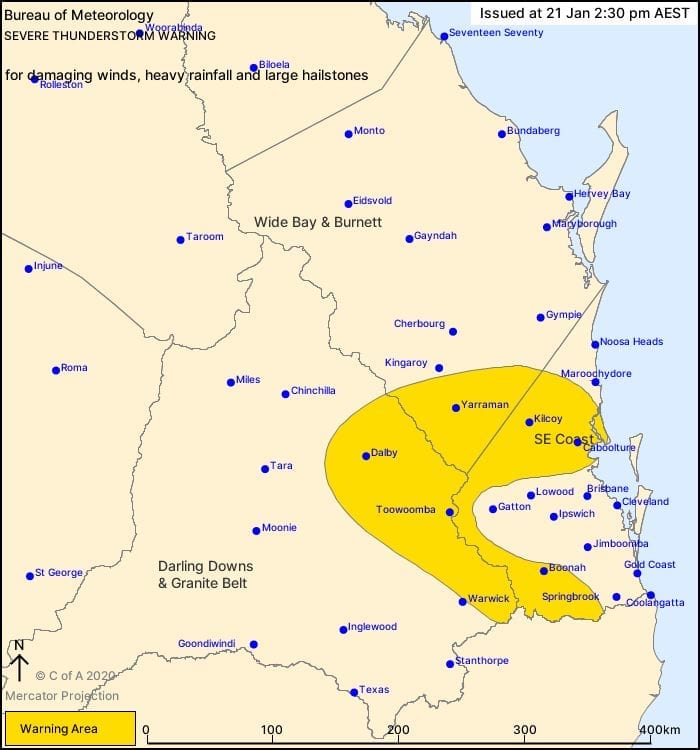
Severe thunderstorms are developing over the ranges to the west of Bribie Island and are moving in an easterly direction. They contain damaging winds, heavy rainfall, and large hailstones.
Image is taken from http://www.bom.gov.au/
These thunderstorms will continue to strengthen as they approach the coast. Please be prepared for impact in the next few hours as these thunderstorms could be very dangerous.
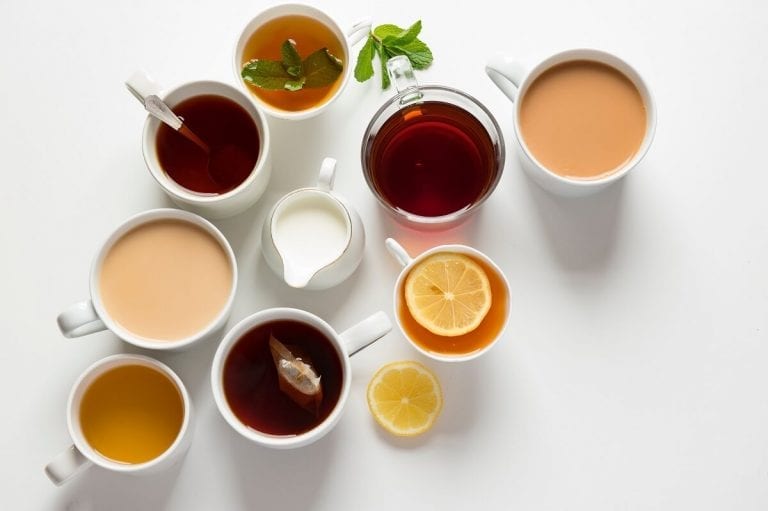
“What tea would you like, English Breakfast?” asks your friend, who clearly doesn’t know you.
You gasp, horrified at the thought of a watery English breakfast tea this early in the day, “What do you take me for, a savage? Assam for goodness sake please!”
“Er, what’s that? Is that like English Breakfast?” queries your soon to be ex-friend.
No, no it is not. Let me learn you a couple of things about black tea.
Note – I’m only talking about good loose-leaf teas here. Teabags have no place in this article, or anywhere for that matter including the entire surface of planet earth.
Let me start off by clarifying that all tea comes from the same plant: Camellia Sinensis. That’s right, your green, white, black, yellow, oolong, and pu’erh tea is all from the same magical bush. It’s simply the different growing conditions, localities, and processing of the leaves that gives us our different types of tea. I know – blew my mind when I first found out too – green tea is the same as black tea WHAT?
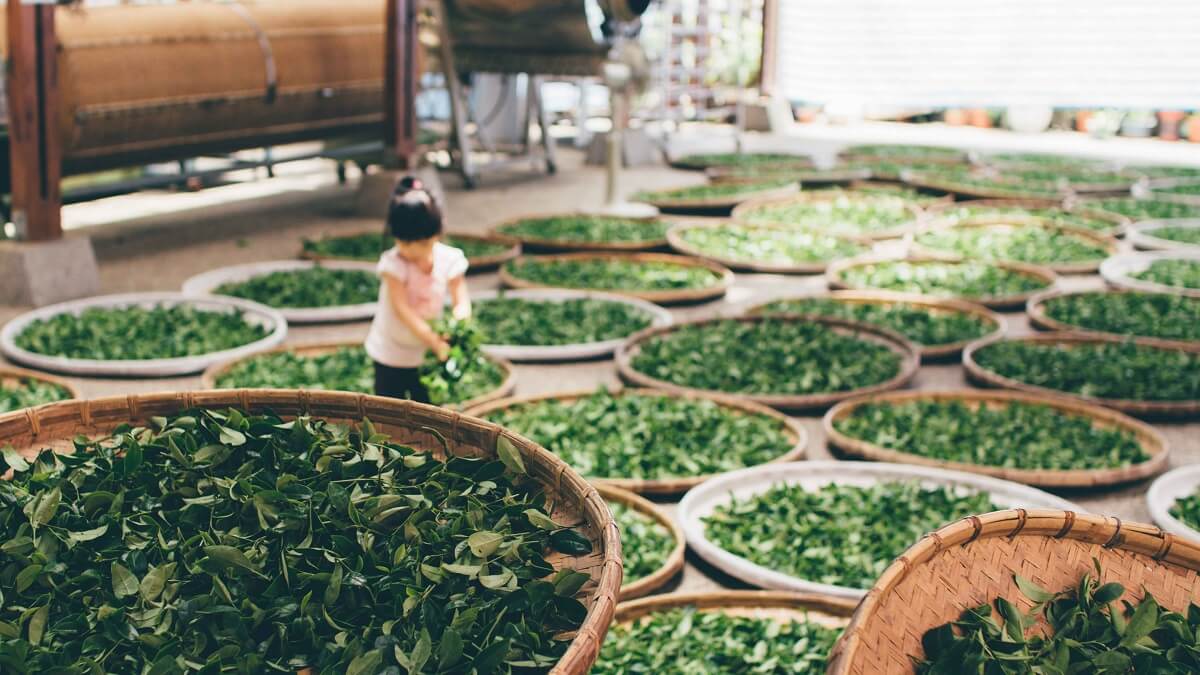
Black teas are fully oxidised during their processing. Very simply, this means the leaves are damaged (i.e. lightly crushed, tumbled around in a basket, flung over a rainbow, etc) and exposed to the air which sets off a chemical reaction – i.e. the leaves go brown.
There is a lot more to it of course and a lot of science-y terms involved such as polyphenols, catechins, and chlorophylls, but that’s the gist of it. Oxidisation = black tea. Green tea, on the other hand, isn’t oxidised at all – that’s why the leaves are still green. Science!
I’m asked all the time about what the difference is between the handful of black teas that people are familiar with. They want to know why I turn my nose up at some and not others. We don’t need to touch on all of them, but there are some major players that are useful to know about (that make up the majority of blends) so you aren’t totally lost next time you walk into a tea shop.
Oh, you’ll still be lost, for sure, but not totally.
The Single Malts of the Black Teas
These fellas are your single-origin teas, akin to a single malt whiskey.
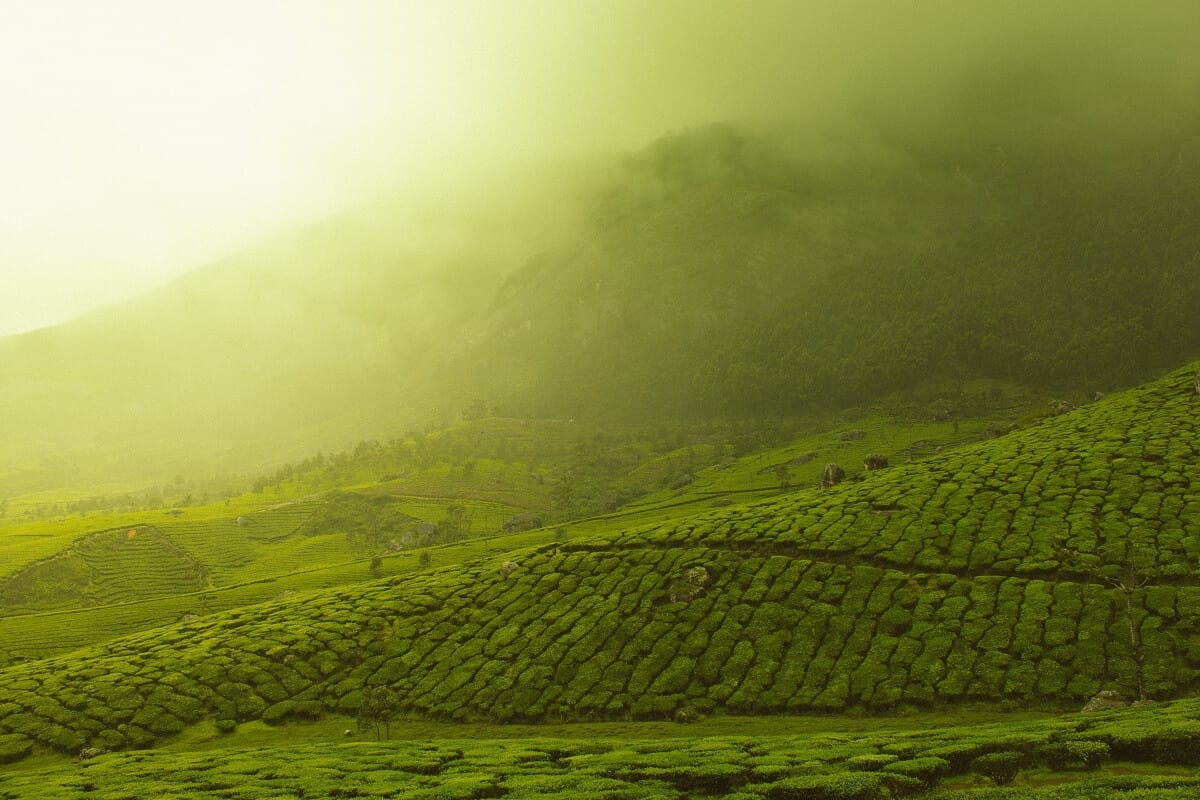
Assam: Assam is a state in north-eastern India. Tea from here is called Assam tea. Shocking, I know. The tea grown in Assam is full-bodied, rich, malty, dark, great with milk, and better than sex. If you ask a tea shop for their strongest tea, Assam is what you’ll be given. You’ll want this guy first up in the morning, and whenever you need your tired mind stroked by strong malty fingers.
Ceylon: Sri Lanka used to be called Ceylon before it became a republic many moons ago. So naturally, tea from this region is still called Ceylon tea. There are loads of different varieties of Ceylon tea due to the different altitudes the plants are grown at, however your usual Ceylon tea is darker and bolder than most black teas, but lighter & less malty than Assam. An all-day-round easy drinking brew not for sissies.
Darjeeling: Grown in Darjeeling (gee really?) and also the Kalimpong District which split off from Darjeeling, in northern India, Darjeeling tea is considered by connoisseurs as the ‘champagne of tea’. Darjeeling tea is light, thin-bodied, a little floral, and is often described as having ‘muscatel’ notes (like wine). This is your late afternoon drinking tea to lead you seamlessly into a nice glass (or several bottles) of wine as you watch the sunset.
Keemun: A popular Chinese tea (it’s a black tea but it’s red – you’ll see what I mean when you brew it) used in a lot of blends. It’s a gentle, aromatic hug for your face, with just a whiff of fruity sweetness. Easy on hangovers.
Lapsang Souchong: A wholly unique smoky Chinese tea; the leaves are smoke-dried over a pinewood fire. There’s nothing else like it; pairs well with camping, starry nights, and Tom Waits.
The Cousins
These aren’t technically ‘black teas’ but they still make a blackish brew, so I’ll mention them anyway for interest’s sake.
Oolong: This fella straddles the wall between green and black tea as it is only partially oxidised (remember that black teas are fully oxidised). Oolongs vary widely based on their preparation and degree of fermentation and oxidisation. Not for beginners, this a tea for the snobs who know what they’re playing at.
Pu’er: A special Chinese fermented tea, this guy is dark, robust, strangely a little sweet, and usually comes in the form of a solid brick. I can only describe it’s flavour as ‘essence of damp earth’. Like Oolong, best not to approach if you’re only just entering the loose tea leaf world. Get your mouth around single malts first before venturing towards these dark stallions.
The Blends
These teas are all differing blends of the single malts & cousins. They are the Chivas Regal to your Lagavulin.
Breakfast Teas, including English, Irish, and Scottish: These bad boys are various blends of the above plus some others, including mass-produced lower quality teas (not necessarily bad) from Kenya. If you inspect these loose leaves closely, you’ll notice the different leaf types and colours. The difference between these breakfast teas is the pretty much the strength of flavour, achieved basically via more or less Assam. You’ll find a huge range of these sorts of teas with each producer making their own unique blend, but generally speaking, English Breakfast has the lighter colour & flavour of the three, Irish is in the middle, and Scottish is the strongest with the most Assam. No surprises there – who doesn’t love a good strong Scot (Jamie Fraser anyone?).
Russian Caravan: Not actually Russian but Chinese, this is a blend of Oolong, Keemun, and often Lapsang Souchong. You know how your clothes smell like the campfire the day after camping? Well, this is the tea equivalent of your smoky clothes.
Earl Grey: Grandma’s favourite am I right? Named after Lord Grey (hopefully no relation to Christian) it’s a black tea blend, like the breakfast teas, but flavoured with oil of bergamot. It basically tastes like an orange rubbed itself all over your tea leaves. I’m not a fan but I know it’s a favourite of many, including my grandma. Pairs nicely with cakes and doilies.
And what the heck is Orange Pekoe, is it some sort of Earl Grey? That’s what I thought when I first heard the term, but no, nothing of the sort. Despite having the word ‘orange’ in it, Orange Pekoe is a term used when talking about the different grades of tea: Orange Pekoe (OP) = whole leaves, Broken Orange Pekoe (BOP) = broken leaves, etc. There are lots of them. The point is, Orange Pekoe isn’t a type of tea, it’s a grade.
So next time someone asks if you’d like a tea, you can confidently respond with, “Look it’s a little late in the day for Assam but I could go a nice Irish Breakfast, or perhaps a Darjeeling if you’ve got one? Broken Orange Pekoe is suitable, thanks.”
Kerrie Goodwin
Have a story?
Submit your article and if approved we’ll publish it on The Bribie Islander.
No self or business promotions, pornographic or abusive material, only helpful, informative and local news articles allowed.
LABOR CANDIDATE CALLS FOR COMMUNITY INPUT ON BRIBIE ISLAND ROAD
Labor’s Candidate for Pumicestone Ali King has called on our community to have their say and help shape a Bribie Island Road Action Plan. “I received positive feedback from locals on the news that works will start later this year on the intersection of Old Toorbul Point Road and Bribie Island Road. But there’s still so much more to do.
That’s why I’m calling on the Minister for Transport & Main Roads to work with me on a Bribie Island Road Action Plan.” Ms. King, who uses Bribie Island Road every day to commute to work, says she understands the frustration of our community that time spent sitting in traffic means less time spent with loved ones.
In her letter to the Minister, Ms. King states that she is also concerned traffic congestion will discourage visitors to the Island, with flow-on impacts for local businesses. “Our community needs a long term plan for Bribie Island Road that prioritises upgrades for the most congested and dangerous sections.”
“I am also seeking an urgent briefing from the Minister’s office or department representatives on what work TMR has done or is doing to plan for long term upgrades for Bribie Island Road.”
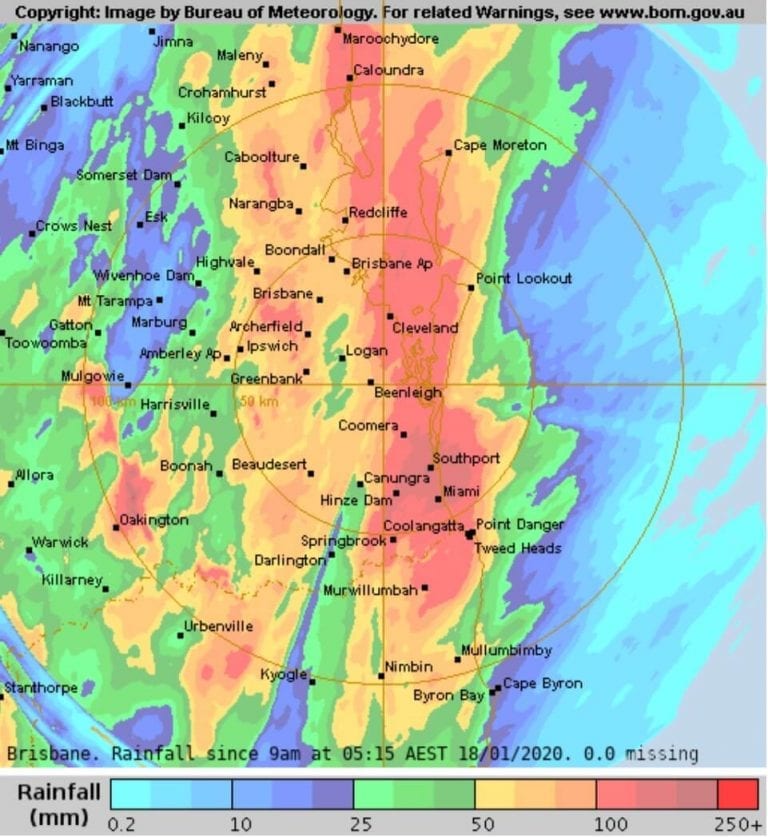
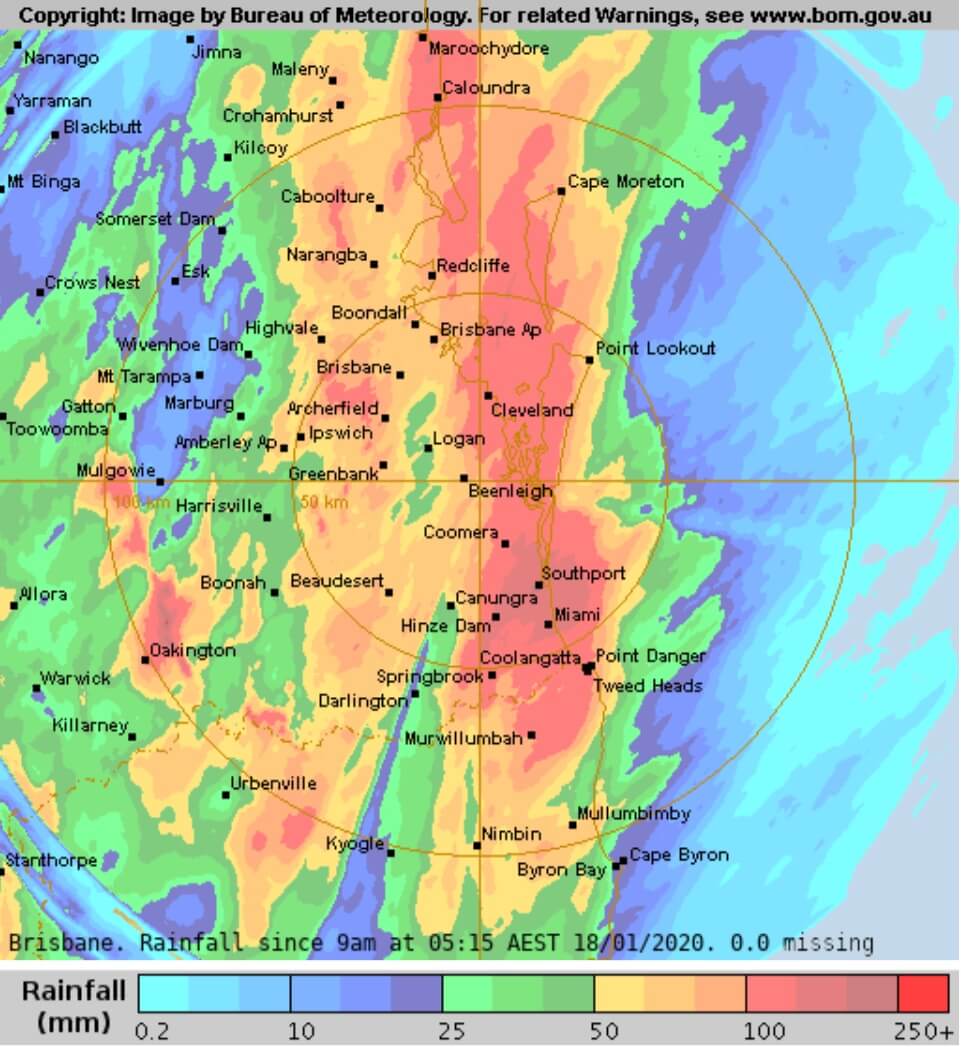
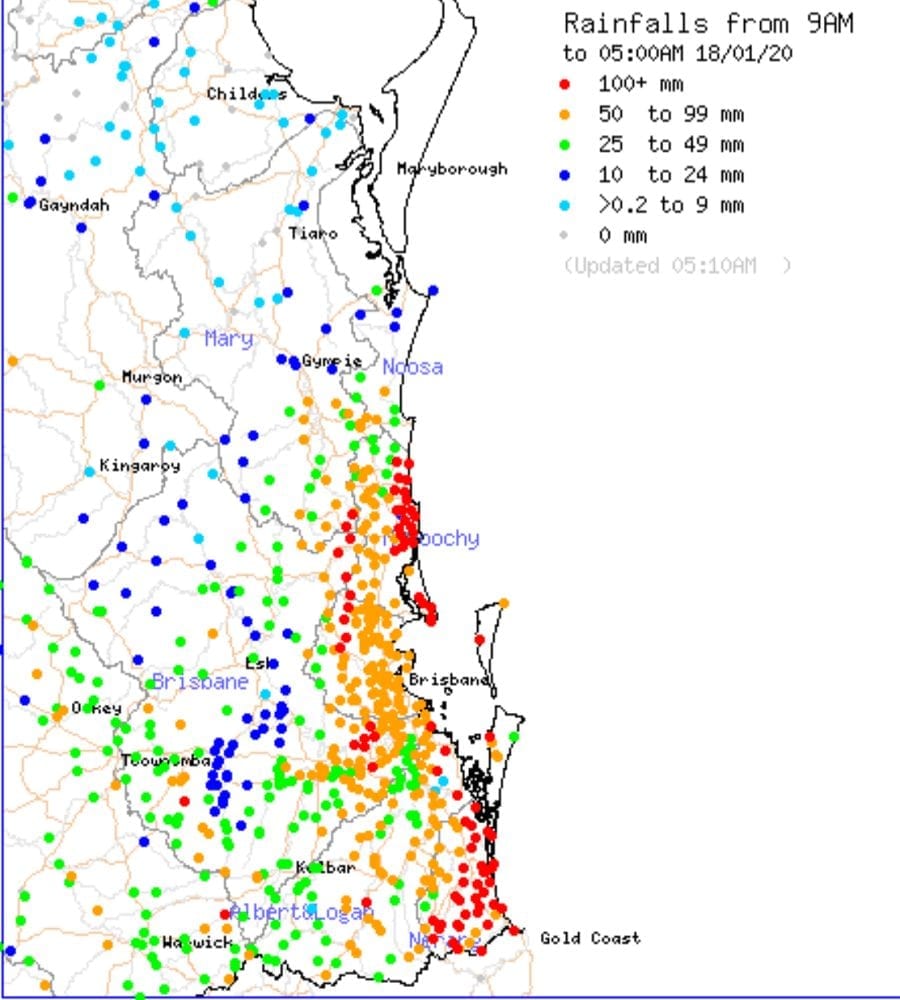
SE Queensland, the Sunshine Coast, and Gold Coast have been hit by extreme rainfall overnight. (18/01/2020) There is widespread flash flooding over most of the region.
The sunshine coast has reports of over 150mm total and further south the Bribie Island and Moreton Bay areas have been hit by over 200mm in some areas falling in less than 3 hours.
Featured Video(above): Brisbane Radar taken overnight.
The Gold Coast and surrounding areas have been hit as well with reports of over 250mm + in some areas.
Flash flooding leading to dangerous waterways and roads have been cut off over most of the SE Queensland Coast.
Sunshine Coast, Brisbane, Moreton Bay, and Gold Coast weather forecast for the rest of the weekend.
SIGNIFICANT WEATHER VIDEO UPDATE & FORECAST: Current situation and forecast for SEQD & NENSW. ~ Jeff ~ * Click on HD * Image from Weatherzone and BSCH Detailed HSC forecasts available on our website here > https://higginsstormchasing.com/higgins-storm-chasing-membership/
We should continue to get some lighter patchy rain with some scattered thunderstorms for the rest of the day and Sunday, but there is the possibility of heavy rainfall later on this afternoon and evening around the ranges and coastal areas.
Taken from BOM – http://www.bom.gov.au/products/IDR66C.loop.shtml
Remember, if it’s flooded, forget it!
Taken from BOM – http://www.bom.gov.au/qld/flood/seast.shtml
When my children were teenagers, many years ago, this was Bribie. Perhaps Bribie has not changed that much. Suddenly the Island is sinking! Or you well might imagine that it would, considering the increase in the number of people here. Yes, it is the Christmas holidays, and at this time of the year the population of Bribie doubles or even trebles. Day-trippers come from Brisbane, the motels are fully booked, and there is not a vacant unit to be found.
The caravan and camping parks are packed, the flapping beach towels proclaiming the enthusiasm of our temporary residents. Whilst this alters the atmosphere of our usually sleepy Island, I am not averse to sharing; it would be churlish to frown in the face of the obvious enjoyment of our holidaymakers. For many families, this is the week or fortnight that they have looked forward to all year, two weeks of sun, sand, and sea, and what better place than Bribie for that laidback family holiday.
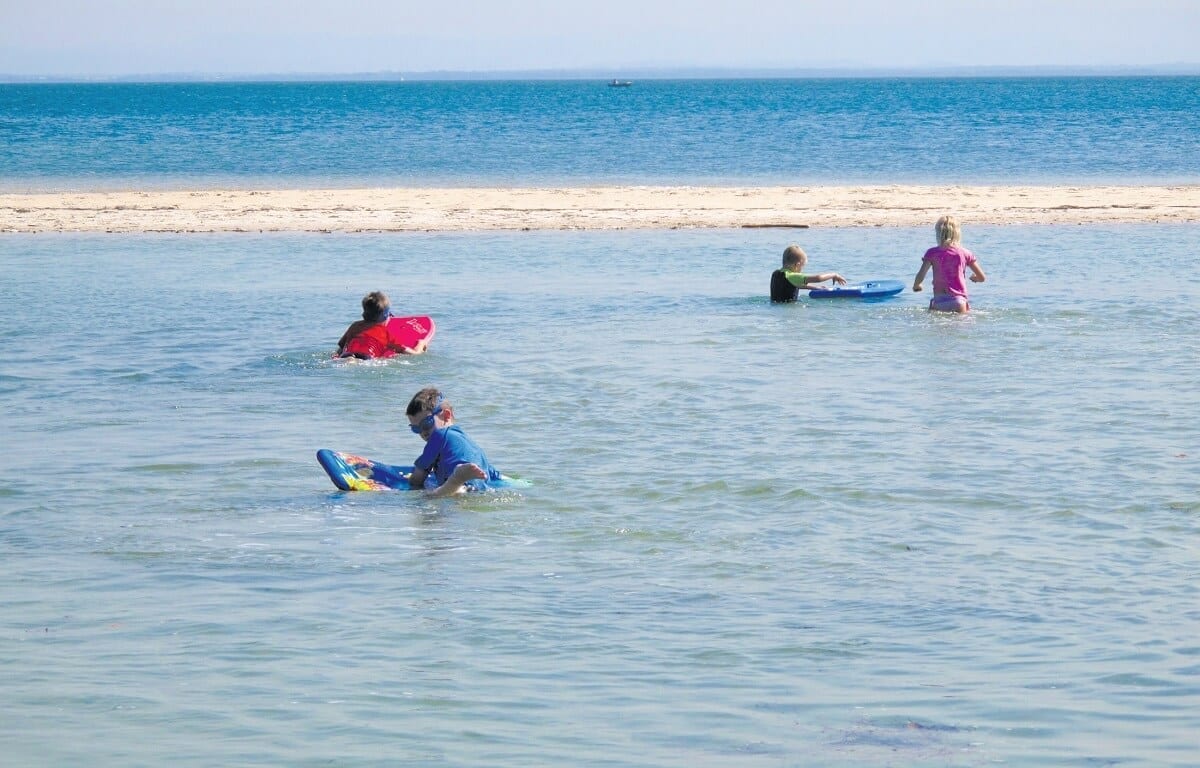
From early in the morning small children are busy digging in the sand or paddling in the usually calm waters of the Passage side, the fluorescent colours of their protective sunsuits making them appear to be a cross between little lorikeets and miniature Edwardian bathers.
At high tide, their parents and grandparents venture into the sea for a little gentle swimming, nothing too vigorous, more bobbing than anything else. Small boys and old men try out their Christmas rods from the beach or the jetty with enough fish caught to keep everyone happy. Perhaps fresh whiting for tea; at least sometimes.
If that fails, one of the numerous fish and chip shops can fill the gap, giving Mum a well-earned rest. The bikeways ring to the sound of bicycle bells from new bikes and the thunder of roller-blades from their proud new owners. It would seem that Santa has not failed to deliver. Around dusk, happy laughing families, in their best smart-casual clothes, pass us on their way to the Pubs, RSL or Bowling Clubs for an inexpensive meal, a beer for Mum and Dad, perhaps Coke or pink lemonade for the kids.
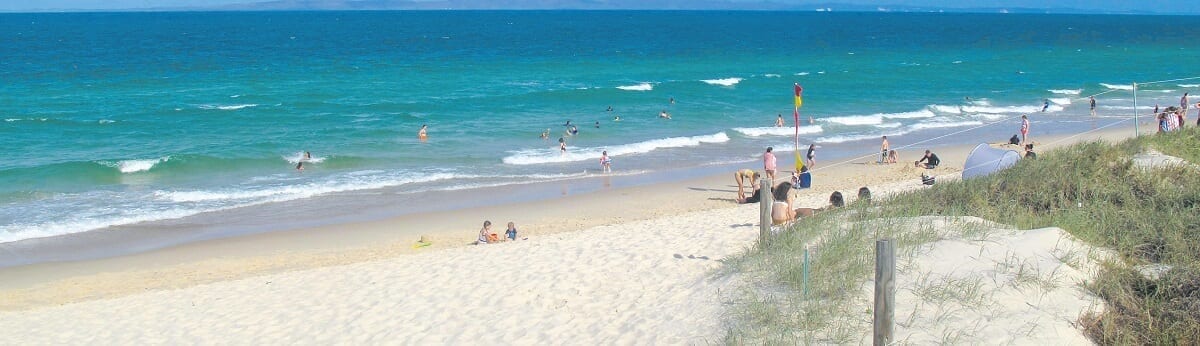
Maybe tonight is the night to win the raffle in the meat or fish tray or the big win on the Pokies. If all this seems a little too quiet, dare I suggest boring, then one can leave the Passage or Bongaree side of Bribie and head for the surf at Woorim. This side of the Island is where the testosterone loaded young men with their boogieboards and surfboards hang out, attracting their young nubile maiden camp followers.
Or is it the other way round? Whatever, this is where the action is. Throwdown your beach towel, claim your patch, anoint yourself with whatever turns you, and hopefully them, on, and there is no need to move for the rest of the day except to alternatively head for the ocean, bake in the sun, or maybe catch a quick burger at the café near the Surf Life Savers Club. Not what the dermatologists of Wickham Terrace might recommend, but when you are sixteen or so, skin damage at sixty is eons of time away.
Later in the evening the “catch of the day” may be entertained in the small cinema in the centre of the Island, or further “fishing” take place whilst dancing to one of the live bands performing at the Surf Club or Pub. Of course, all good things must come to an end, and holidays are no exception. Around the end of January, the locals find they can once again find parking at the supermarket and opposite the Post Office. This was summed up nicely by a sign that appeared in a shop window that read, “You can come out now. They’ve all gone home!”
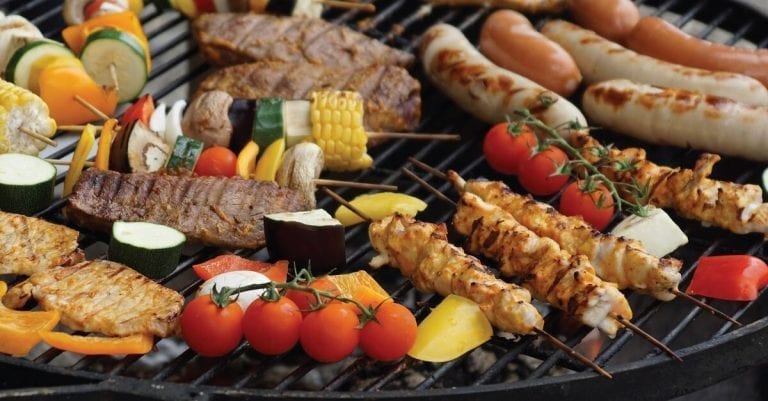
The Australia Day Barbeque is an Aussie classic, and while it might be a tradition to indulge, the food you pop on the grill doesn’t have to put you at risk. Here are five fast tips to a healthier Australia Day barbeque.
1. Swap processed meats for lean cuts Opt for leaner meat options by grilling up a few kebabs, skinless chicken, or a few lean mince patties.
2. Swap salts and sauces for herbs and spices Try swapping tomato and barbeque sauce bottles from the table so your guests can taste the extra flavour from healthier herbs and spices. You can lower your kilojoule intake by swapping out these sugar-laden sauces for chopped up chives or spring onions or spreading on some avocado or hummus to wholemeal bread.
3. Swap your side of fries for a serve of veggies Increase the amount of colour on your barbeque by grilling some vegetables or serve your meat with a fresh summer salad. Grilled veggies make for a great flavour addition to your meal and are easy to pop in between your meat for a balanced kebab.
4. Swap red meat for fresh fish Cancer Council recommends Queenslanders limit their red meat consumption to a weekly intake of 455g (cooked weight), and with a few days of feasting on the calendar, this could easily be overtaken. Swap some of the red meat options out for a fresh serving of fish to balance it out. Stocked full of protein, zinc, and iodine, vitamins, and omega 3, fish is a nutritious option for your Australia Day barbeque.
5. Swap your deli spread for a veggie and dip platter Instead of chewing on a sliver of salami, switch to a platter of sliced veggies and dips such as hummus or guacamole. More information about Cancer Council Queensland and healthy living is available at cancerqld.org.au


 The residents of Bribie Island had been requesting the Government to provide a mains electricity supply to the island for several years. In 1945 the Southern Electric Authority of Queensland sent three Engineers to meet the Bribie Island Progress Association and report its findings on the question as to whether a supply of electricity to Bribie Island was warranted. Keith Price was one of the Engineers who travelled from Brisbane to Bribie Island on the Steamship Doomba to attend the meeting at Bongaree.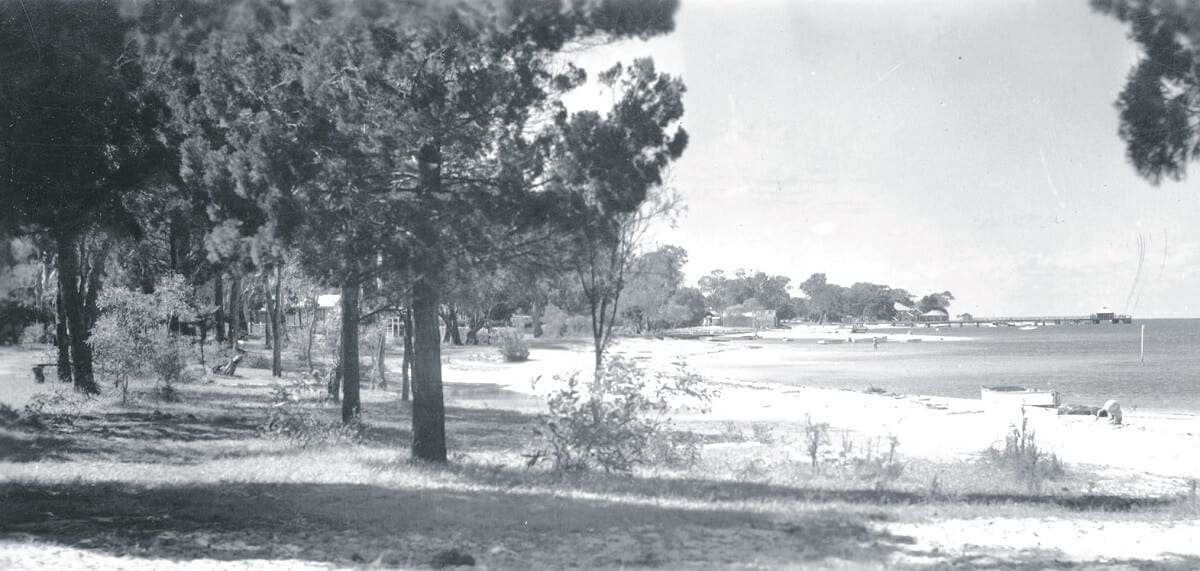
 FERGUSON AVENUE: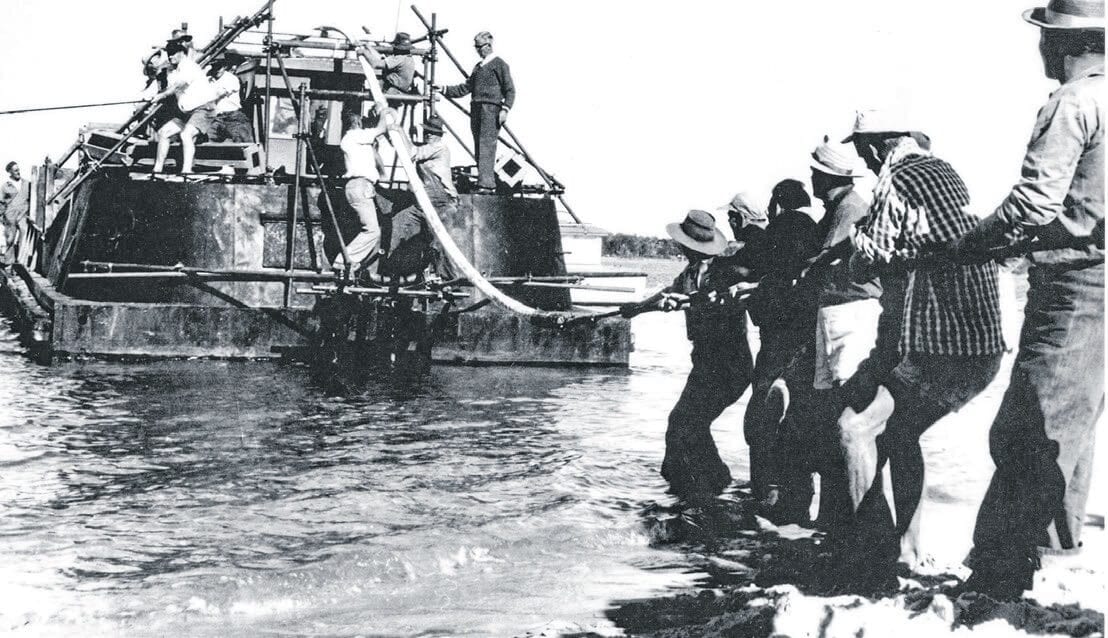




 These statistics do not even include the more than 1 million friends and relatives of members who frequently help out at Rotaryorganised volunteering events. Nor do they include the volunteering contributed by the more than 700,000 members of Rotary’s Rotaract, Interact, or Community Corp affiliates.




 Let me start off by clarifying that all tea comes from the same plant:
  The Single Malts of the Black Teas
 The Cousins
  The Blends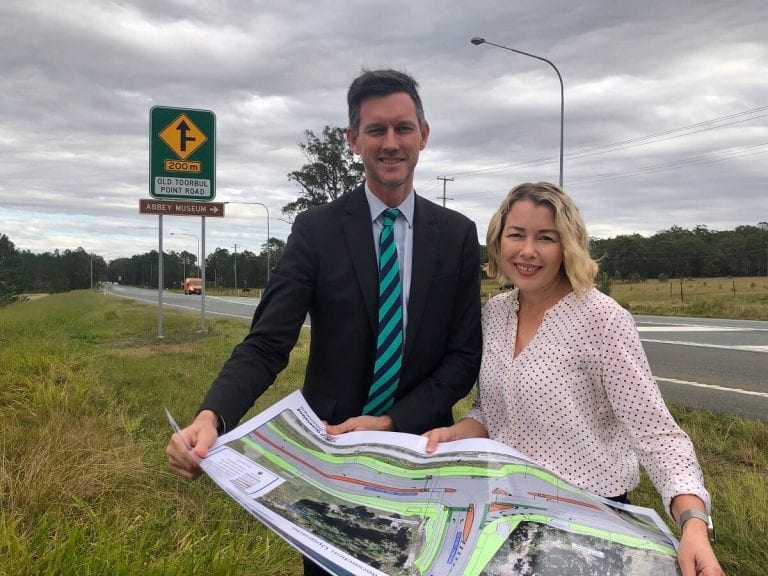
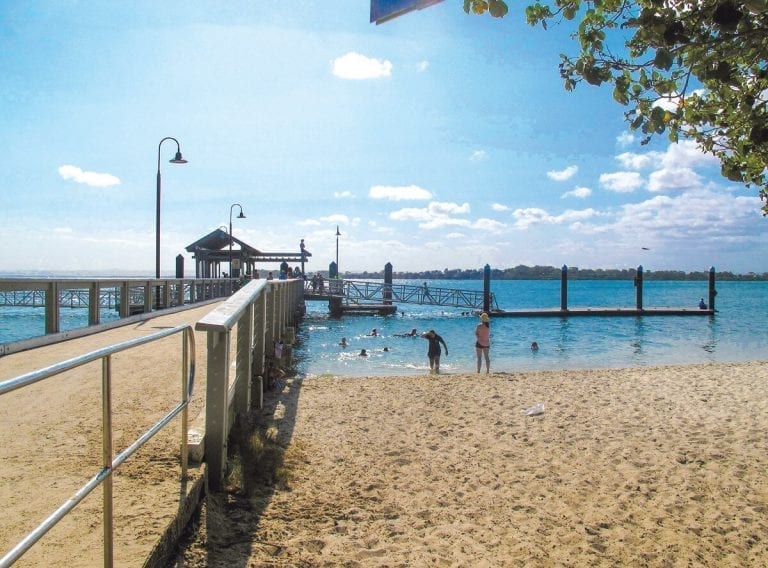
 From early in the morning small children are busy digging in the sand or paddling in the usually calm waters of the Passage side, the fluorescent colours of their protective sunsuits making them appear to be a cross between little lorikeets and miniature Edwardian bathers.
 Or is it the other way round? Whatever, this is where the action is. Throwdown your beach towel, claim your patch, anoint yourself with whatever turns you, and hopefully them, on, and there is no need to move for the rest of the day except to alternatively head for the ocean, bake in the sun, or maybe catch a quick burger at the café near the Surf Life Savers Club. Not what the dermatologists of Wickham Terrace might recommend, but when you are sixteen or so, skin damage at sixty is eons of time away.